What if the walk you trust every morning is helping your heart? But quietly missing the strength, balance, and control that protect your independence after 60. That sounds surprising.
Because walking has been treated like the gold standard for healthy aging for decades. And to be clear, walking is still one of the best habits you can keep. It supports your circulation, your mood, your stamina, and your heart.
But here's what most people over 60 are never told clearly enough. Walking is not a complete independence plan. And here's the pattern that shows up again and again in senior mobility research.
Many adults who walk every day still struggle to rise from a low chair, steady themselves after a small stumble, keep their shoulders from rounding forward, or get off the toilet without pushing on the wall. That is not because walking failed. It is because walking trains one pattern very well, but leaves three critical systems under challenged.
A JAMA summary of the physical activity guidelines for Americans reported that older adults should include balance training, aerobic movement, and muscle strengthening activity in their weekly routine. In other words, after 60, walking alone is not the full plan. That's not a small detail.
That is the missing piece. So today, I'm going to show you three simple exercises that fill the gaps walking leaves behind. One protects your ankles.
One helps reset your posture. And the final one may be the most important. Because it trains the exact movement that decides whether you can rise from a chair, toilet, car seat, or bed with confidence.
Before we begin, tell us in the comments now your age and where you're watching from. Now without any further ado, let's get started. Number three, heel raises.
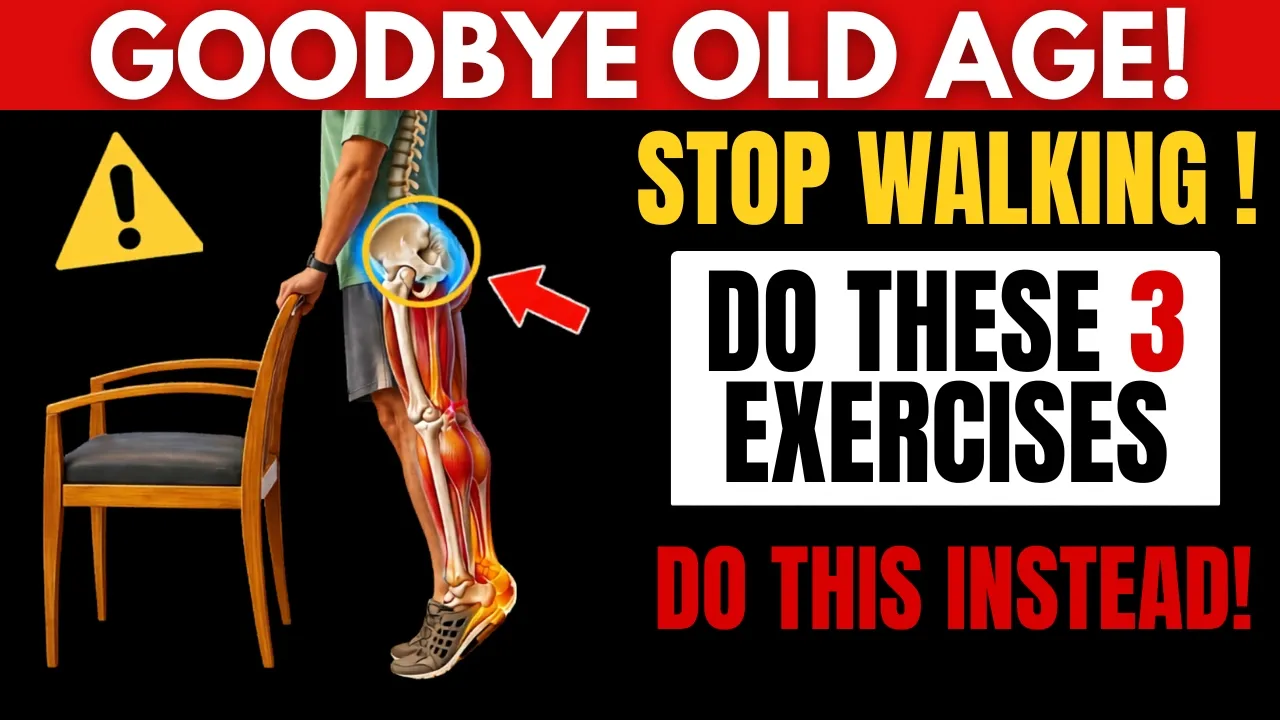
At first glance, this barely looks like exercise. You stand behind a chair, rise up on your toes, and come back down. But after 60, this movement trains a system most people do not think about until it starts to fail.
Your calves, ankles, and the quick balance response that helps you recover when the ground surprises you. Think about when balance is really tested. It is not usually during a calm walk on a flat sidewalk.
It is when you step off a curb, turn too quickly in the kitchen, walk across grass, or catch your toe on a rug. In those moments, your ankles and calves have to react fast. Walking uses them, yes, but it does not always strengthen them enough to handle sudden changes.
A 2021 systematic review and meta-analysis published in physical therapy looked at ankle plantar flexor strength, balance, and walking speed. In older adults, stronger ankle plantar flexors were moderately associated with dynamic reactive balance with a correlation of 0. 42 and proactive balance with a correlation of 0.
55. That means calf and ankle strength is not just about standing taller on your toes. It is closely connected to the kind of balance you need when your body has to respond before a small stumble becomes a serious fall.
Here's how to do it. Stand behind a sturdy chair with your feet about hip width apart. Rest your fingertips on the chair, but do not lean your weight into it.
Slowly rise onto the balls of your feet for 2 seconds. Hold at the top for 1 second. Then lower for 3 full seconds.
That slow lowering is where the real strength is built. Start with 10 repetitions, two sets. If that feels easy after a week or two, move to 12 repetitions, then three sets.
Keep your knees soft, your body tall, and your eyes looking forward. Do not bounce. Do not rush.
And do not grip the chair like it is doing the work for you. This is your ankle armor. But ankles are only one part of the independence equation.
The next movement targets the posture problem walking almost never fixes. Number two, floor seated resistance band pull aparts. Now we move to a posture exercise that is a little more challenging than it looks.
Because this version takes away the comfort of a chair. When you sit on the floor, your body has to organize itself differently. Your hips, spine, core, shoulders, and upper back all have to work together just to keep you tall.
And after 60, that is exactly why this movement matters. You see the problem every day. The head starts drifting forward.
The shoulders round. The upper back curves. Breathing feels a little shallower.
And many people think that is just age. But very often, it is also years of sitting, looking down, reaching forward, and never training the muscles that pull the body back open. >> [clears throat] >> A 2021 systematic review on thoracic hyperkyphosis found 28 studies with 17 included in meta-analyses and reported that structured exercise programs can reduce excessive upper back rounding, including in older adults.
For someone over 60, that is not just about standing straighter in the mirror. It can affect how open your chest feels, how your neck carries your head, and how steady your body feels when you turn or reach. Here's how to do it.
Sit on the floor or on a firm exercise mat with your legs extended in front of you. If that feels too tight on your hamstrings, bend your knees slightly. Sit tall.
Lift your chest. And imagine a string gently pulling the top of your head upward. Hold a light resistance band in both hands at chest height.
Arms straight in front of you. Pull the band apart slowly until your arms open wide. Squeeze your shoulder blades together for 1 second.
Then return with control. The key here is posture first, resistance second. Do not lean back.
Do not shrug your shoulders. Do not let your chin poke forward. If sitting on the floor feels difficult, sit on a folded towel to slightly raise your hips.
Start with eight to 10 repetitions, two sets. As you improve, slow the movement down. 3 seconds out, hold for two, 3 seconds back.
Before we continue, if you have been enjoying this so far, hit that like button so more seniors can see it. And subscribe. We've got more powerful senior health tips coming every week.
And you do not want to miss the next one. Now we are moving to the final exercise. And this one may be the most important for daily independence.
Number one, chair supported squats. And now we've reached the movement I saved for last. Because this one trains the strength pattern that protects independence better than almost anything else.
The ability to bend, lower, and stand back up with control. Chair supported squats may look simple, but they train the exact muscles you use when you get off the toilet, stand from a low chair, climb stairs, step into a car, or stop yourself from collapsing into a seat. Here's where this version is different.
Instead of sitting down onto a chair behind you, you place a sturdy chair in front of you and hold the back of the chair with both hands. That support lets you practice the squat pattern safely, while still making your legs, hips, glutes, and core do the real work. A 2016 study published in PLOS ONE stated that rising from sitting to standing is a prerequisite for functional independence.
And the CDC's Steady program uses the 30-second chair stand test to assess lower body strength and endurance in older adults. In plain English, clinicians pay close attention to this pattern because it shows whether your legs still have the power and control needed for daily life. Here's how to do it.
Stand behind a sturdy chair facing the back of it. Place both hands lightly on the top of the chair back. Keep your feet about hip width apart.
Toes slightly turned out. Now push your hips back like you are reaching your bottom toward a chair behind you. Bend your knees slowly.
Lower only as far as comfortable. Then press through your heels and stand tall again. The key is the hips.
Do not drop straight down. Send your bottom back first like a squat. Keep your chest lifted.
Your knees tracking over your toes, and your hands light on the chair. The chair is there for balance, not to pull yourself up. Start with six to eight repetitions, two sets.
As you improve, lower a little slower, pause for 1 second at the bottom, and work toward 10 to 12 controlled repetitions. This is not about doing deep squats. It is about rebuilding the movement that helps you bend, rise, sit, stand, and move through your day with more confidence.
So, here's the big takeaway. Walking still matters. It is good for your heart, your mood, your circulation, and your stamina.
But, after 60, walking alone does not fully train the systems that protect your independence. It does not challenge your ankles enough for sudden balance corrections. It does not pull your posture back open after years of sitting and looking down.
And it does not rebuild the squat pattern you need every time you sit, stand, bend, or rise from the toilet, bed, car, or chair. That is why these three exercises work so well together. Heel raises train your ankle armor.
Floor seated band pull aparts wake up your posture muscles. Chair supported squats rebuild the lower body power that daily life depends on. And remember, the goal is not perfection.
The goal is progression. Start where you are. Use support when you need it.
Move slowly, breathe steadily, and let your body adapt 1 week at a time. Your body after 60 can still respond when you give it the right signal. Now, tell us in the comments, which of these three movements do you want to try first?
Thanks for watching.