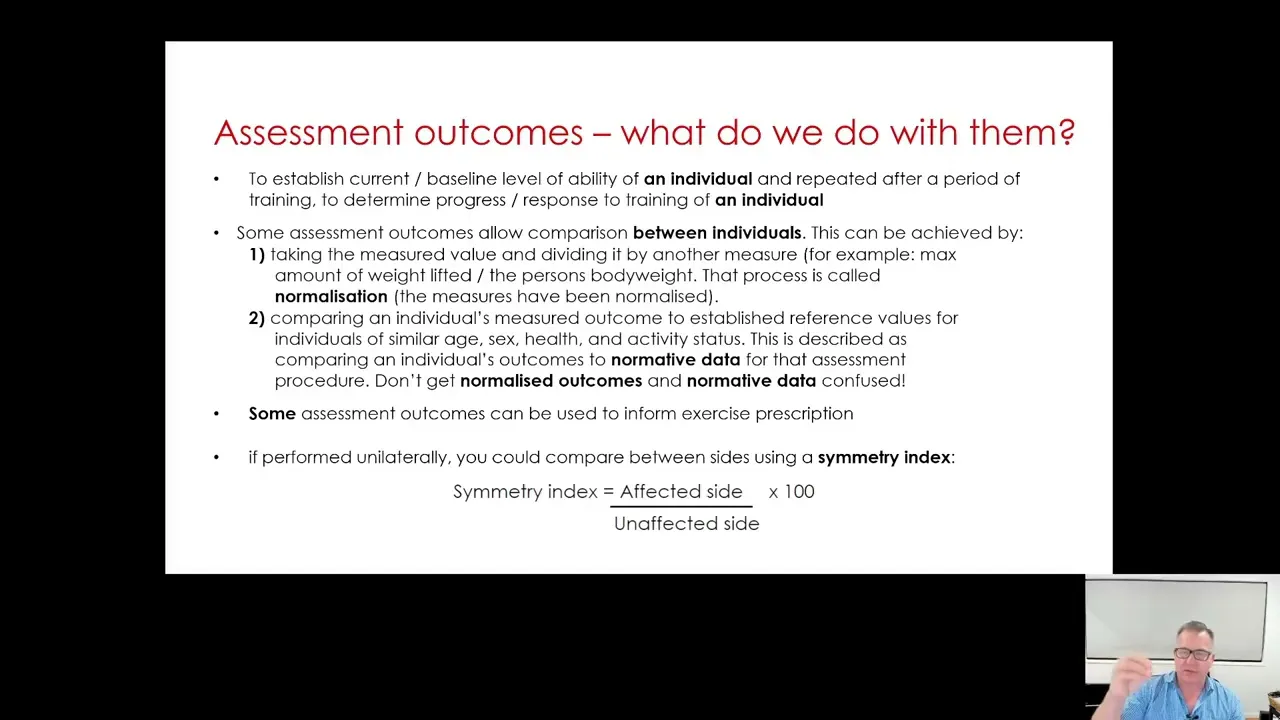
So with an assessment outcome, we so we get one, do some assessment. What do we do with it? Well, the first thing that an assessment outcome allows us to do, it allows us to establish the the the person's current level of ability or in other words, their baseline level of performance at the moment.
Um and we could repeat that assessment after a period of training and then to determine if any progress has been made or in other words what response um what is the response to training for that individual. So again, we can use to establish a baseline of current levels of ability or performance. And then after a period of training, we could repeat that same assessment with that same individual, compare the responses um to see how much progress they've made as a result of their uh training program.
Now, some assessments will allow you to compare between individuals, and there's a couple of different ways that this can be achieved. So the first one is that you can take the measured value. So the the the value or sorry the the thing that was measured during the assessment and then we could take that value and divide it by another measure.
Um so to give an example there we could take the maximum amount of weight a person could lift and we divide that by the person's body weight. And so what that does is it would allow the us to compare some how strong somebody was. is if you like um how strong somebody was um to other individuals because we've taken into account the person's body weight.
So for example, someone who's 150 kilos is probably going to lift a fair bit more than somebody who weighs 50 kilos. But if we take into account the person's body weight, so we take the amount they lifted and divided it by the person's body weight, then we could say, "All right, well, in fact, the this person who didn't lift as much but weighs less is actually stronger overall. " Um, another example there, and this relates to one of the tests we'll be talking about, assessment procedures we'll be talking about in a few minutes, um, is that there's, um, it's it's called the Y balance test.
And so the person stands on one foot and they reach as far forward as they can with their other foot. And so we record the distance like how far they can reach while maintaining their balance. But you can imagine if somebody has longer legs and shorter legs, the people with longer legs will reach further.
But it may not necessarily mean that their balance is better. So we could take into account the so we could do there is take the into account how far they reached but also their leg length. Yeah.
So that process of um taking the measured value and dividing it by another measure is called normalization. In other words, the measures have been normalized so that we could allow comparison between individuals. Another way to do this is that we can compare an individual's measured outcome to establish reference values for individuals who are of similar age, sex, health, and activity status.
And so that is described as comparing an individual's outcome to normative data for that assessment procedure. So an example there could be um we looked at an individ individual's V2 max and then um we could look at there's a bunch of reference tables so similar age, sex, uh health and activity status and we could compare um the the the one individual score to other individuals who are are similar to them. Right?
So there's two ways that we can um compare outcomes between individuals through through a process of normalization or looking at normative data. So but it is important that you don't get normalized outcomes and normative data confused. Um and some assessment outcomes can be used to inform exercise prescription where others can't.
So for example, we'll look at some assessments here where we um where we can get um a certain uh measure of how strong somebody is and we could take a certain percentage of that and that could be used to design the training program. But not every assessment item or every assessment procedure, I'm sorry, can be used to design a training program. In fact, the majority of them are used to establish baseline levels of ability and then they can be retested later so that we can determine the person's response to training or how much progress they've made.
And the last thing we'd say here too, if an assessment procedure is performed unilaterally, whether it's one arm or one leg at a time, what you can do is you can use a symmetry index to compare the outcomes between sides within an individual. So what you would do there is take the affected side outcome over the unaffected side outcome multiply it by 100 and you get a percentage difference. Um if the person doesn't have an affected or unaffected side.
Um so for example if they're otherwise healthy person what you could do is you would take the lower number and divide it by the the larger number. Yep. And then multiply it by 100.
But it it it just gives you a an approximation of percentage differences between sides. And in terms of assessment outcomes, this information I've just provided applies to every assessment. Um so it's going to be some element of what's on this slide will apply to every assessment.
Certainly the top point will apply to all of them. Yeah. Um things that can influence reliability is like we have here look it's it talks about familiarization warm-up what that means is practice.
So before we do our assessment procedures, have we familiarized the patient enough? Have we g have we give them given them sufficient practice so that they really understand what they're meant to be doing so that the outcome that we get is actually reflective of their ability, not just them trying to figure out that the the assessment procedure, how to perform it. Um sometimes a warm-up is relevant depending on the intensity of the assessment procedure.
Um and sometimes there are standardized warm-ups with some of the tests. Um, and if it is, that then we do want to make sure that it those warm-up procedures are consistent each time we do the test. So, a lot of, as I say, a lot of times they have standardized warm-ups.
Um, the instructions, are we are we making the instructions um clear? Is it action positive oriented language? Um, so they know what to focus on.
Motivation and encouragement is a tricky one as well. Oh, and again, I think I may have said client, but this is clinician related, just so we're clear. Sorry about that.
Um, the um motivation and encouragement. So, let's say some days I come in, I'm still feeling a little flat that day. Yeah, go ahead.
Give your best effort. Then the other day I come in like, "Yeah, let's go. " You know, that kind of thing.
So, we do want to make sure that our level of encouragement is is certainly standardized and consistent. And sometimes the best thing to do is to provide no encouragement at all really, you know, um it's just to let them go. And then at other times it really does if you're really trying to get the best out of somebody then it really does to you strong verbal encouragement you know um so you have to um understand the value of that and make sure you're consistent with it.
Where it says m machine calibration if we are using some equipment or device we have to make sure that equipment device is calibrated so that the information we get from it is real it is accurate. Um, if we perform an assessment at a different time of day, that can influence the outcomes. Um, um, for example, with strength assessments, most folks will perform a bit better later on the day than they will earlier in the morning.
Um, so whenever possible, we try to keep that the same. Yep. And time of day, too.
Yep. um with the client, you know, how fatigued are they? How well rested are they?
Are they under a particular period of stress at one time versus, you know, not think about things like food and caffeine intake? Um how well hydrated are they? Um how much do they actually want to do well in the assessment?
You know, are they really motivated to do their best? Um and the other things can that can change too is if somebody you know was in a pain-free state or injury-free state at one point and then has a change in their injury status um later on that can certainly affect the reliability of the outcomes. So you can see there's a lot of things here that we have to really keep in mind if we want to get reliable outcomes from our assessment procedures.