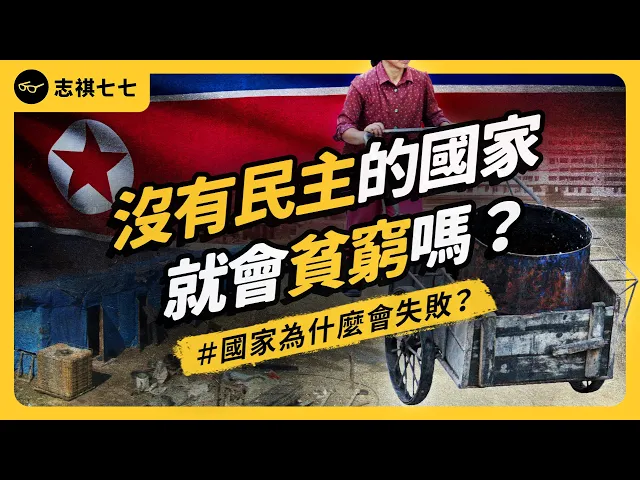
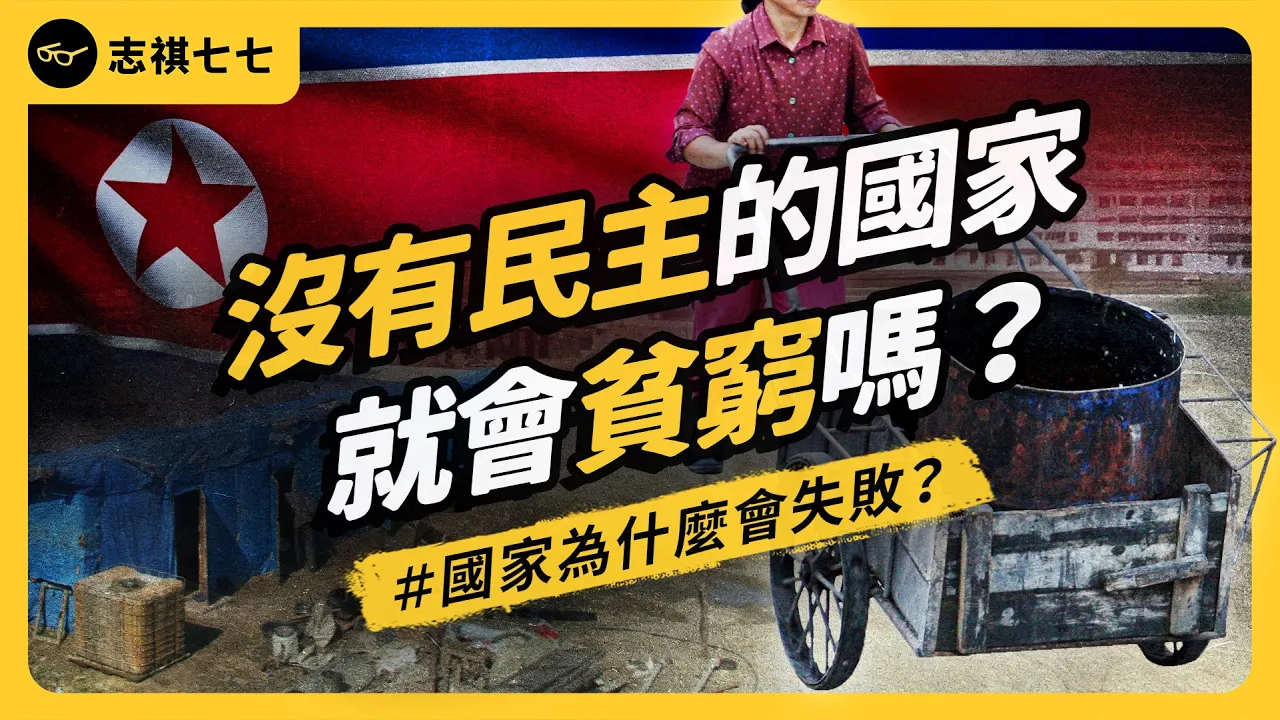
Have you ever wondered what is the key to a country’s prosperity or poverty? Today let us talk about "Why countries fail" Hiho ~ Hello everyone, I am Zhiqi. Usually on YouTube we will see many Vlogs taken by people traveling abroad to share the lives of people around the world, but I didn't know you would Don’t you wonder why some countries in the world are rich and others are poor ?
What is the origin of the wealth gap between countries? The mainstream view of the answer to this question for a long time has been that the main factor affecting a country's success or failure is geographical environment and cultural differences. However , the American scholar "Daron Acemoglu" who won this year's 2024 Nobel Prize in Economics James A.
Robinson has a different view. In 2012, the two of them published a book called "Why Countries Fail. " In this book, they believe that the key to a country becoming rich or poor is actually Is this really the case in a human-implemented system ?
How did this conclusion come about? So what is the system that can make a country rich ? But before we start today’s discussion, let’s go into some business service time!
[Is the difference between rich and poor affected by geography and culture? 】 Speaking of the causes of a country's wealth or poverty, the author first gives examples of the "geographic hypothesis" and "cultural hypothesis" that were very popular in the academic circles in the past. First of all, the geographical hypothesis claims that the inequality of wealth between countries is caused by differences in geographical conditions.
It is located in Africa and China. Tropical countries in the Americas and South Asia will have poor soil and are not suitable for farming. In addition, the tropical areas are prone to diseases , which will affect labor productivity and lead to poverty.
On the other hand, most of the countries in the temperate zone with pleasant climate and abundant resources are concentrated in this region. Next, the cultural hypothesis This theory attributes the wealth of a country to the lifestyles of different cultures. This theory claims that people in Western Europe have developed a good work ethic due to the influence of Christianity and thus have achieved rich economic results.
However, Africans, for example, will be affected by their nature. Laziness, rejection of new technologies, superstition of witchcraft and magic lead to poverty. The author believes that the above theory may sound quite reasonable at first.
However, when we think about it more carefully, we will find that some countries are very close in geographical location, have equivalent resources, and have the same culture. They are also highly similar, but their economic development is very different . Why?
[Close but very different] In order to point out the limitations of the geographical hypothesis and the cultural hypothesis, the author uses the border between South and North Korea and the US-Mexico as examples. The book points out that there was basically no difference between North and South Korea before the division. Their geographical locations are connected and the people are all the same.
Koreans are even blood relatives who speak the same language and have shared a common culture for a long time. However, as time passes, South Korea has become one of the richest countries in the world. North Korea is completely opposite .
The average annual income of the two peoples differs by 24%. The average life expectancy of South Koreans is 11 years longer than that of North Korea. Another example is the city of Nogades (Mexico) and Nogades (United States) located on the U.
S. -Mexico border . The two cities are separated geographically by only a wall.
There is no difference in climate. The cultural background of the residents is almost the same. Most of them are of Spanish descent.
However, the income and education of Nogales citizens living in the United States are much better than those of Nogales citizens in Mexico. Both cases confirm the geography. Culture is not the key to determining whether a place is rich or not .
. . but then again , what is the key?
The answer given in the book is: System The author believes that South Korea and the United States have become rich because they have adopted an "inclusive system" in politics and economy, while North Korea and Mexico have become relatively poor because they have adopted an "extractive system. " Here comes the question: What are these two systems? [Inclusive system that promotes prosperity] The two systems mentioned in the book are actually more like "spectrum" concepts.
When discussing the system, we can subdivide it into "politics" and "economics" " It may be a bit abstract to talk about two different dimensions . You can refer to the picture on our screen. In the two different dimensions, each has a spectrum that is more "accommodating" or "extractive".
Then the "accommodating type " For example, the focus of this economic system is to provide incentives that make people willing to work and be innovative . This includes the state's need to protect people's private property, establish a fair legal system, provide public facilities, education, and a free workplace environment, etc. In this Under the premise, people can expect that they can enjoy the fruits of their labor after hard work , thereby generating motivation to work.
To achieve such a state, it usually requires an inclusive political system. In short, it is democratization. The author gives an example of the Glorious Revolution in Britain in the 17th century.
It limited the king's power and established a constitutional monarchy to create the world's first inclusive political system. After that, the British government promoted a series of economic reforms, including enforcing private property rights, protecting patents to encourage business activities, promoting infrastructure, etc. These incentives The inventors at that time were willing to devote their efforts to researching new technologies , which indirectly contributed to the subsequent industrial revolution and made Britain one of the first wealthy countries in modern times.
In addition, the author also pointed out that under an open, transparent, pluralistic and democratic political system, if the government introduces For policies that are not in line with the inclusive spirit, the public can still put pressure on the government to correct its policy direction through supervision and voting . However, on the other hand, the political and economic rights of the people under an extractive system will be greatly reduced. Restrictive [Extractive System Leading to Poverty] Compared with the inclusive political and economic system, it brings about the common prosperity of the country.
The focus of the extractive system is that a small number of elites maximize their own interests by squeezing the interests of the majority of the people . Politics This group of people will adopt a totalitarian rule , and the power in the hands of players and referees is usually rarely supervised and restricted. For example, the author gives an example of colonialism in Europe in the past, which was an extractive system.
Typical colonists would use high-pressure policies. The purpose of plundering the resources and manpower of the colonies is to drain the surplus value of the colonies. While the colonists make a lot of money, the colonized areas fall into poverty as a result.
Even if these colonies become independent in the future, the new leaders are likely to retain this system. The existing system of extraction ensures that one can become a new vested interest. Under such exploitation, there will be a very large income gap between the elite and the public.
In a situation where private property is not protected, the people's rights can be taken away at any time. Not only are they unable to freely display their skills and have no incentives to invest in innovation and promote social progress, the country will fall into a vicious cycle of poverty. In addition, with the huge gap between rich and poor, many people will want to overthrow the existing regime and gain power to become a small elite, leading to domestic political instability.
Stability often leads to coups , but when it comes to this, some people may be curious. There are obviously many extractive regimes, such as the former Soviet Union and now China. They also all had times when their economies were booming.
Could it be that extractive systems were completely unable to bring about growth? [The growth brought about by extractive systems is limited] The author believes that in fact, extractive systems can also bring considerable economic growth, but the bigger problem is that this growth cannot be sustained for a long time. The book points out that the economic growth brought about by extractive systems It may be that those in power directly allocate resources to the high-productivity activities they control.
For example, the Soviet Union used government power to transfer a large amount of resources from agriculture to industry, resulting in rapid economic growth . Or it may be the case in South Korea under Park Chung-hee . Politically it is an authoritarian system , but economically it adopts an inclusive system that has successfully allowed South Korea to develop from a poor agricultural country to a moderately developed country.
But when it comes to why the extractive system cannot make the country "sustainably" wealthy, the author believes that when politics When the economic system and economic system are all extractive, domestic new technologies and industries cannot always make breakthrough progress. The Soviet Union may be able to create rapid economic growth by taking the lead from the central government and allocating resources, but once it reaches the limit, economic growth will stagnate or even stagnate. It began to decline .
On the other hand, the reason why South Korea's economy can continue to progress is because South Korean society finally experienced a democratic transformation, allowing politics and economy to shift to an inclusive system that can support each other to form a positive cycle. As for China, although this book was published in 2012 When it was published in 2010, China's economic performance was outstanding and was visible to all the world. However, the author also specifically pointed out that they believed that the rule of the Chinese Communist Party was basically an extractive system and could not develop sustainably.
The book mentioned that although China had reached the extreme level of Deng Xiaoping's reform of Mao Zedong, The extractive economic system has led the country towards an inclusive economic system, but to be honest, the core value of private property rights is not completely reliable in China. Although Chinese entrepreneurs can start businesses and fight for the economy , they can take the hard work of the people at any time as long as the Communist Party wants. The author believes that economic development under such a system cannot be sustained.
Well , I would like to emphasize again that this is his research and prediction in 2012. Then you can see whether China's economic development has met this expectation. Make your own judgment , but then again, if the problem of whether a country is rich or not is all because of the system , does that mean that those countries that are currently very poor can be saved by simply changing the system?
The author believes that it is not that simple [Can a country be saved from poverty? 】 The author emphasizes that from a historical perspective, a country or region can indeed rely on political and economic reforms to escape poverty and move towards prosperity. But the problem is that the system does not mean that it can be changed if it wants to .
According to the author's point of view , there are so many reasons The country chooses to adopt an extractive system that will make the country poor not because those in power are too stupid to know how to make the country rich . On the contrary, these people in power do so because they know that this extractive system can continue to benefit themselves . It will do its best to maintain it and is unwilling to let go of the power it holds .
Therefore, it is not that simple to change the extractive system and end the poverty problem. From past experience, the author compiled three possible paths. The first one is from Those in power will start on their own.
When those in power find that the extractive system actually does more harm than good and makes them unable to profit, they may take the initiative to change it. The case here is Australia. This was a place where the British government exiled criminals in the past , but they found that high-pressure management will make criminals So bad that they can't squeeze anything out even if they want to, so they are willing to change.
The second is like the South Korea just mentioned, changing the political system through popular revolution. This process is very risky and there are probably only a few successful cases. The third is It is a very accidental comprehensive situation.
The example presented in this part of the book is the extractive economy in the American South. In the past, the elite class in the South would exploit black people and ask them to pick cotton by hand. However, with the advancement of agricultural science and technology, the elite gradually did not need so much manpower .
In the United States, both the North and the South had the same constitution. Later, the civil rights movement also surged, and other accidental factors combined. The South successfully ended the extractive system.
[Our point of view] The reason why we introduce this book today is mainly because many people in the past When talking about the gap between the rich and the poor in a country, the classic work "Guns, Disease, and Steel" is most often quoted. We have heard that "Why Nations Fail" very boldly challenges the classic discussion "Guns, Disease, and Steel". The author of "Disease and Steel" believes that inequality in human society is due to different geographical conditions , but the author of "Why Nations Fail" believes that institutions are the key.
Looking at the data of countries around the world, we can find that the geographical resources and culture of national economies are similar. Performance can indeed vary widely, but if we look at it from another perspective, countries with the same system must also have particularly strong economies or particularly poor ones. So who is right?
Or which factor is more important? Our current view is that the natural conditions of geographical resources can be regarded as a difference in starting point , but the subsequent business results are largely determined by man-made factors. In other words, rather than saying that these two theories are competing, we think the latter may be more like This is a classic "supplement" to the previous work.
The two authors have very carefully included how many regimes developed and changed in different periods around the world , as well as the analysis of the application of inclusive and extractive systems in various countries . What we are most impressed with is the author's mention of The status of a country's wealth or poverty is not permanent. In addition to differences in systems, differences in implementation may also cause a country to move forward or continue to regress.
The content shared today is very superficial or simple. If you are interested in If you are interested in this topic, we highly recommend that you read this book in person and support good books and publishers. At the end of today, I would also like to ask everyone, do you agree with the author's statement that "system" determines the economy?
Finally, if you like today's video, please share it to let more people know "why countries fail. " In addition, you can also click here to see related discussions on "class replication" and "why poor people cannot stand up. " So today's Zhiqi Seven Seven ends here.
See you tomorrow night.