With every passing moment, a chance to buy something is at your fingertips. That new pair of pants you just saw on Instagram, the latest gaming PC that your favorite streamer uses, or the newest line of Teslas to make you feel like you're saving the planet all bombard you with visions of what could be. In the imperial core, buying things has become the stuff of life.
To feel good, you shop. If you’re bored you browse things to buy. If you want to be ethical, you don't stop buying, you just need to find the "right" brand to buy from.
Seemingly our whole lives are wrapped up in the vicious cycle of working all day and then spending to fill the void in our lives. Consumerism is a problem that runs rampant in imperialist countries like the United States. It’s right up in our faces at every moment.
It’s easy to see this conspicuous spending and claim that overconsumption is the source of many of our environmental problems. Consumers are, after all, the ones making the choices at the checkout counter. They’re the ones voting with their dollars.
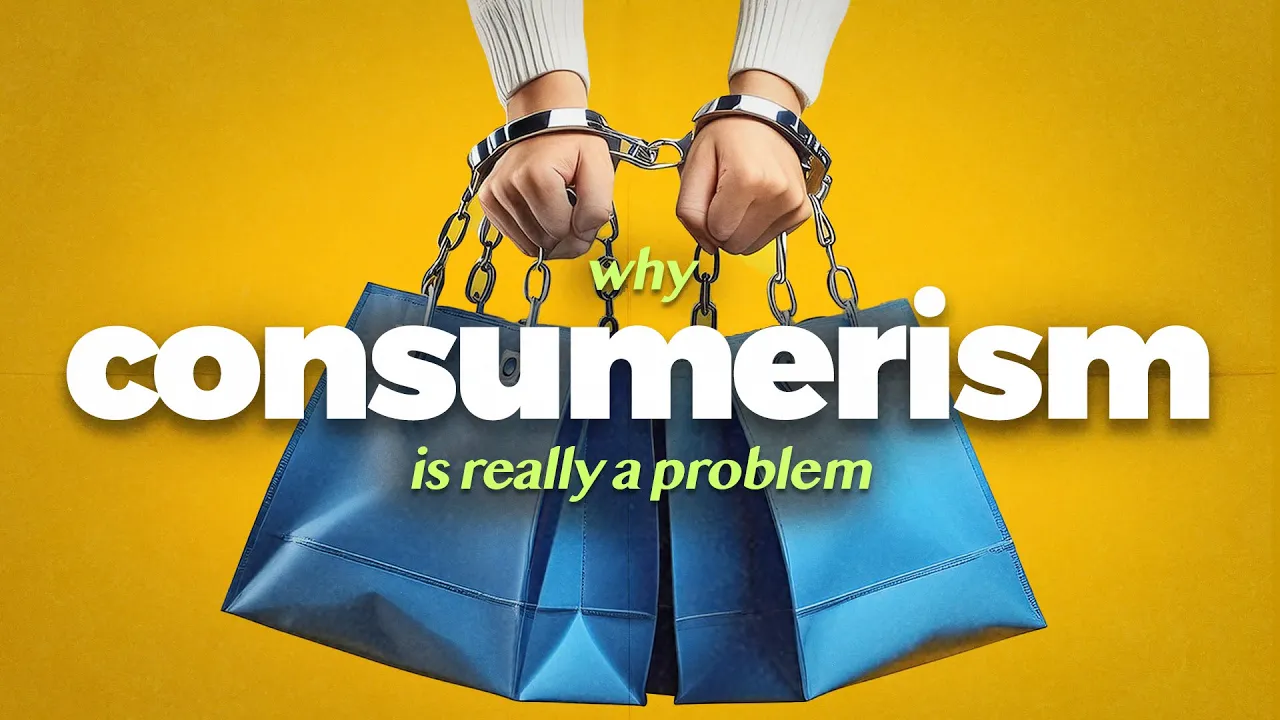
But today, we’re going to dive into this mistaken worldview. Consumerism is not the problem, it’s a trap. It’s a symptom of a much larger and more insidious problem of capitalism that lurks in the shadows.
Today we look at the real problem with consumerism, and how we really combat the out-of-control waste and accumulation of stuff. This video is made possible by my amazing viewers who support me on Patreon. Over the last two years, my revenue from ads and sponsorship have dropped substantially.
So much so, that if this trend continues, making videos like these will become less and less financially viable. Which is why I need you. Our Changing Climate will always be free for everyone regardless of how much I make, but OCC is a one-person operation and it would be nice to earn enough to pay for rent and my health insurance, both of which seem to grow yearly.
So, if you’ve been a long-time viewer, or just stumbled across the channel, thank you for watching, and please consider supporting Our Changing Climate on Patreon with the link in the description. Just one dollar a month from a small portion of my audience would be huge for the channel and to be honest, me. Overconsumption is everywhere?
Spend enough time on the internet and you’re bound to buy something. How could you not when Amazon offers free shipping and an option to click just one button to speed you through the checkout process? Or when the new online marketplace, Temu, offers rock-bottom prices for basically any good you could want.
Consumerism in the US has risen precipitously, with total retail sales in the US more than doubling since 2013. Indeed, the percentage of households with two or more cars has increased dramatically from 22% in 1960 to 59% in 2020, while the average home size expanded by 149% from 1,595 square feet in 1980 to 2,383 in 2022 according to the Census Bureau. And when families run out of space to put all of their stuff, they’ve turned to storage units.
In the United States, an estimated 14. 6 million households rent additional storage to keep all of their stuff generating the self-storage industry $29 billion in revenue every year. All of this growth hasn’t been to accommodate larger families, because the average family size has actually decreased by 16% from 1980.
This expansion of consumption has had disastrous effects on the environment. Despite being home to just 5% of the world’s population, the United States consumes 15. 7% of the world’s total fossil fuel energy.
In the United States, between 30-40% of food gets wasted through a combination of on-farm loss, transportation, store overstocking, and lack of at-home planning. The average American emits 14. 9 metric tons of carbon dioxide equivalent, which is more than triple that of the global average of 4.
7. Yet, despite unprecedented consumption rates and a glut of almost every gadget and appliance imaginable flooding the market, people in the United States aren’t that happy. According to the General Social Survey, only 25% of Americans are satisfied with their life.
A percentage that’s slowly declined since the 1970s and plummeted during the pandemic. In part, this is due to the vast inequalities that cleave the United States. As some fill up their oversized homes and shipping containers with stuff, many struggle to survive.
Over 42 million rely on food stamps to put food on the table, while more than 650,000 people experience homelessness across the country. As the economist William Gibson observes: “The future is already here – it's just not evenly distributed. ” Even for those who do enjoy excessive and conspicuous consumption of the newest Tesla or Apple’s $3,500 Vision Pro, more consumption and more income don’t necessarily lead to more happiness.
A phenomenon that has been deemed the Easterlin paradox. A concept that claims that after basic needs are met, economic growth and higher incomes don’t necessarily lead to greater happiness. With all this in mind, it’s clear that the capitalist hub of the world is on a dangerous path.
A path that is not only leaving us overworked, in debt, and unhappy but is also driving us headlong toward a ruinous collision point. Paraphrasing scholar Timothy Jackson, Diana Stuart and fellow researchers write in a paper that considering the biophysical limitations of the Earth, extreme resource and material consumption on a finite planet means “ ” In short, the imperial core is consuming far more than is sustainable for human well-being and the planet. But is consumerism really the problem?
Are the consumption habits of the masses really the driving force between our environmental and social ails? These are the crucial questions, ones that hand us the keys to what Karl Marx calls “the hidden abode of production. ” What’s really causing these problems?
Behind every dollar spent on that butter melter you saw on TikTok, or that automatic pot stirrer, lies a corporation. A company eager to offload its product into your hands to generate profit. The core engine of capitalism is its constant demand for capital accumulation.
Capitalists must constantly expand their productive capacities through new technologies and decreasing labor costs to create the most commodities for the lowest prices. If it fails to do so, it gets eaten alive by other, more capable owners who’ve managed to create more products at cheaper prices. This process of constant accumulation and expansion creates increased overproduction.
Production that generates piles of commodities must be sold to the masses to continue the cycle of capital accumulation. Exchanging products for even more money is essential to complete the last leg of the money invested into commodities and sold for even more money also known as M-C-M’. In a sense, consumption is a release valve of production, it expands and contracts, but never creates the flow of goods.
As scholar Allan Schnaiberg notes, “Consumption cannot be the leading factor in the expansion of production. Increased consumption may permit expanded production, but it does not generally cause it. ” Unrestrained capitalist production, then, is the root cause of what we see as the ails of consumerism.
According to the average person living in the capitalist stronghold of the United States and indeed, most economists, however, corporations are merely responding to consumer demand. This is a skewed view of reality. The true culprit of all the stuff in our houses, in our landfills, and in our atmosphere is overproduction.
Companies like Best Buy, for example, supply a false freedom when you walk through their stores. The range of brands and products on the shelves might make you feel like you have freedom of choice but in reality, you are only served cameras, laptops, or phones that generate profit or allow corporations to stay competitive. Factors that are often determined by labor costs, raw materials, and transportation logistics much more than consumer demand.
In the housing market, for example, most people want affordable, comfortable living spaces. Yet, the buildings developers construct are often luxury condos or turnkey mansions– dwellings that are unaffordable for the majority, but rake in extensive profit for real estate companies. So, capitalists produce goods based on factors outside of the realm of consumerism.
That being said, they still need people to buy their stuff. To complete the cycle of Money-Commodity-More Money, capitalists must sell their products on the market to the masses, regardless of whether their products have any use. So, instead of focusing on producing only things that are useful and necessary, capitalism has built a massive apparatus that manufactures false needs and desires.
Here lies the true trap of consumerism. To assure the continued success of their businesses, capitalists manufacture desires and needs. We believe that it is wholly inherent wants, needs, and desires that are driving our consumption, that it is human nature, when, in fact, the forces of corporations are constantly whispering in our ear: consume, consume, consume.
The Trap of Consumerism: In 1919, Henry Ford and his fellow capitalists were scared. A rising insurgence of anarchist and socialist movements seized the hearts and minds of Americans across the country. Labor strikes, walkouts, and protests seeking a better workplace threatened to disrupt the profit-making machines of Ford’s car-making factories.
Then Ford had an idea. A double-edged sword wielded against the worker to maintain the status quo. Ford and his fellow industry leaders, as one paper describers, “decided to reduce the chances of a worker rebellion by giving workers increased wages, bank credit, and more leisure time—all for the purpose of encouraging increased rates of consumption.
” As we’ve already seen, producers require the endless consumption of their commodities to stay competitive and profitable within a capitalist market system. Capitalists must keep consumers on an endless treadmill of consumption to reap maximum profit and continue accumulating capital. This leads to the real trap of consumerism.
The manufacturing of what Marxist scholar Herbert Marcuse deemed “false needs. ” To offload all of the useless gadgets, new iterations of the same tech, and just general junk onto the masses, capitalists need to make us believe that we actually need the latest iPhone or the Slapchop, or that latest TikTok trend, rather than just want it. This is where the vast apparatus of advertising comes into play.
With ads like this: [XX] and this [XX], companies assign emotional value and meaning to objects whose actual value stems from the labor and costs needed to make that product. This process not only obscures exploitative practices employed during production but also allows companies to set higher prices because the commodity is now imbued with certain politics and values. Tesla has been extremely effective at this task.
Its brand imbues its cars with ideals of luxury, clean, and sustainable futurism. These values, in turn, mask the exploitative practices throughout Tesla’s supply chain. Fellow YouTuber, Yougopnik, cheekily describes this process of value formation through a chocolate bar: [“Advertisers consciously understand that purchasing patterns directly correlate to personal values, therefore, the chocolate bar becomes a locally grown eco-friendly saw infused chocolate bar with a hipster biodegradable wrapper and from whose every purchase two cents go to starving Sri Lankan children.
Now what's the actual difference between this world-saving chocolate bar and just a chocolate bar? Almost none. They’re made in the same Factory with the same ingredients and for the same profit motive.
”] In short, the advertising industry works tirelessly to wrap products in values like happiness, power, connection, or sustainability, because they know that it’s much easier to sell a product to someone based on appeals to their principles rather than describing the utility of the commodity. This value generation apparatus, otherwise known as the advertising industry, has become an essential lever in the capitalist machine. Indeed, advertising revenue has nearly doubled since 2012.
With spending on digital display advertising in just the US alone reaching $63. 5 billion in 2022 But in the age of social media, it’s not just advertisements directly from companies that are pushing us to buy to boost our happiness or save the planet. Your favorite streamer or Instagram star is constantly influencing you to buy stuff, regardless of whether they’re paid to or not.
Even I support myself through the ad revenue, which I’ll get into later on in the video. This has disastrous consequences on our mental health as we constantly strive to fulfill those false needs generated for us. Especially as corporations wield algorithms and data collection to hone in on what product will best seduce you into buying.
In essence, every day, a social media advertisement is placed in front of you with a product that you never even thought about buying, but because of data tracking and algorithmic decisions, that product now wiggles its way into your head like an earworm, and you can’t stop thinking about how your life would be better with those slippers or that new watch. As a result, the “good life” becomes synonymous with consuming things. Happiness is equated with shopping.
Even streaming services keep you hooked and numb with features like the autoplay button. It allows us to constantly consume content and search for that next dopamine hit. But in the process, we stay up way too late, leaving us tired, and burnt out.
In 2017, Netflix’s CEO, very bluntly claimed that their biggest competitor was sleep. Yet, all of this advertising leads us to believe that the current system we live in actually benefits us. That keeping up with the Joneses, going deep into debt to buy a new car, or going on a shopping spree is the answer to our loneliness, alienation, and disconnection from the people and places around us.
As Diana Stuart and her co-authors write, “The ruling class, benefiting from the labor of others, perpetuates ideas that mystify, elude, and deceive workers into falsely believing that they benefit from the current system, can move up in the system, and have freedom in the system, as well as that no other system is possible. ” And many of us have become so distant from the cogs of capitalist production that often political activism has been boiled down to “voting with your dollars. ” This narrative is exactly what the fossil fuel industry has been hard at work creating for over 40 years through its popularization of carbon footprints, recycling, and individualizing action.
When we as worker-consumers are placated into believing that the most effective means of change is to transfer our money from one capitalist to another, the owners of production have won. They’ve distracted us from what’s actually a threat to them: collective organizing, labor agitation, union power, walkouts, and strikes. Activities that directly disrupt that cycle of capital accumulation.
As scholar Douglas Kellner writes, capitalists wield “image and spectacle to manipulate people into social conformity and into behaving in ways functional for the reproduction of capitalism. ” In essence, consuming not only perpetuates the endless cycle of production and capital accumulation, but it also pacifies the masses by narrowing the possibilities of a “good life” to the purchasing, having, and watching of more stuff. So, if we know the root causes of consumerism, how then do we escape it?
How we combat consumerism: We already have the means and capacity to fulfill everyone's basic needs worldwide. Let that sink in. We already produce enough food to feed everyone globally, but we’re wasting nearly a third of it.
We have the technology to create renewable energy for everyone on the planet, but we’re nowhere near that level. We can build a world where everyone lives a good, meaningful, and environmentally ethical life, but that world will mean an end to only shopping at Temu or Shein. It means no Amazon one-click purchases.
It means an end to incessant advertising. And here is where I struggle. I am complicit in that manufacturing of consumer desire.
My channel is run on manufacturing false needs for people. My livelihood is based on getting you to become a Nebula member or sign up for Ground News. Does it make it better if I actually like those services and use them?
Or that Nebula is ad-free and based on membership revenue? I tell myself “yes” because I still live under this massive apparatus that is capitalism. Perhaps I could end YouTube ads if there was more Patreon support, but at the moment it’s not feasible.
At the end of the day, I have no good answer to how to live under capitalism while also struggling against it. In a sense, this is capitalism at work. It insidiously corrupts the very messages of those working to dismantle it.
Blaming those who must live within it for living within it. But even if I did cancel all ads, it would only be like spooning a small drop of water out of a vast ocean. This is why we need more than just an individual, vote-with-your-money approach.
Ideally, a mass revolution would upend our current capitalist system, and the adoption of full worker control of all companies and production would take root. Democratic planning through worker, consumer, and community councils would mean an emphasis on producing for actual planetary and personal needs rather than manufacturing false needs for profit. Of course, this kind of worker-led socialist economy could be a ways off in the future.
We’ll need to build mass power globally if we are to see it come to fruition. This is why we need to employ non-reformist reforms like restricting and regulating advertising on the road to building that power. To beat back the manufacturing of false needs we need to restrict the reach of corporations in our everyday lives.
This could start as simply as reinstating child advertising laws that were stripped away under the Reagan administration or tamping down social media and influencer marketing. We cannot simply hope that encouraging everyone to buy ethical, green, or just less stuff will somehow work to solve the multiple crises in front of us. Especially as mass marketing and overproduction peck at individual consumers incessantly to “buy buy buy.
” To truly escape the trap of consumerism we must approach the problem from the root. We must dismantle and reimagine the factories and offices of production that manufacture our desires. And on their rubble build a world based on useful goods.
A world where the stuff we make facilitates, rather than alienates, our connection to people and the planet. In an effort to depend less and less on YouTube ads and in-video sponsorships, I need your help. Recently, my revenue has been slipping because of a combination of demonetization and fewer sponsorships conversions.
My wonderful Patreon supporters, however, have been keeping this channel and myself afloat. My Patreon supporters have given me financial consistency over the last seven years so I can pay my rent and ever-increasing healthcare premiums. So, I’m turning to you, the wonderful people who watch my videos month in and month out.
If you have the means, please consider supporting the channel on Patreon using the link in the description. Just pledging a dollar a month is huge for the channel, and when you become a Patreon supporter you’ll get early access to my videos ad-free, bonus content like a guided meditation to calm your climate anxiety, or even the occasional full-length interview with authors or scholars. But if you aren’t able to become a channel patron, please don’t worry, just by watching this video to the end, you’ve done your part.
Thank you, and thank you so much to those who already support me on Patreon, you’re the reason I’m able to make videos like this. Thanks again, and I’ll see you next month.