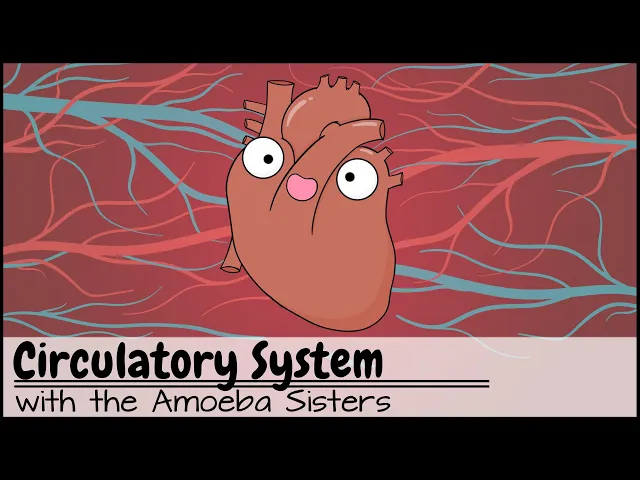
Captions are on! Click CC at bottom right to turn off. Did you have breakfast this morning?
Did you ever wonder after you eat breakfast and your food is digested, how is that glucose getting transported around your body? Or as you take a breath in, how does that oxygen get transported around? Or when you exhale, how does that carbon dioxide get transferred out?
Are these only questions I ponder? Maybe. But your circulatory system is absolutely fascinating and highly involved in this.
In this short intro video of the circulatory system, we will mention some basics about its functions and trace the pathway of how blood travels through your heart, but please know before we get started, there are gigantic textbooks on the circulatory system itself. So, obviously, this video is just an intro. We’re going to first talk about blood: the medium of how we transport glucose and gases.
As we mention in our body systems intro video from many years ago- there are some misconceptions. Human blood is red and always red although the shade of red can vary based on how much oxygen is in the blood. Veins and arteries are often drawn in diagrams as blue or red to show whether they have lower or higher concentrations of oxygen, but that’s just how it is used in most diagrams.
It doesn’t mean the blood, or the veins, or arteries are actually that color. Veins that you see under your skin may look blue or green by the way, but that involves the way they appear under the skin and the reason for this would make a great physics topic ----but I digress. Human blood has a lot of functions.
It maintains a certain pH, temperature, osmotic pressure – all of this is very important for homeostasis. It transports things like hormones, nutrients, and gases. And it’s made up of different components.
One component includes plasma, the liquid portion. Water, proteins, salts, lipids- you’ll find them in this liquid portion of blood known as plasma. Another component includes cellular components.
This means red blood cells, which do the transporting of gases. White blood cells which can fight infections. And platelets, which are actually cellular fragments, and they’re involved with helping your blood clot.
Very important when there is damage to the body. Red blood cells have an iron-containing protein called hemoglobin, and that is where that red coloring of blood comes from. So, when we’re talking about blood, and we’re just introing the circulatory system, we’re going to focus on how this blood moves around in the human body.
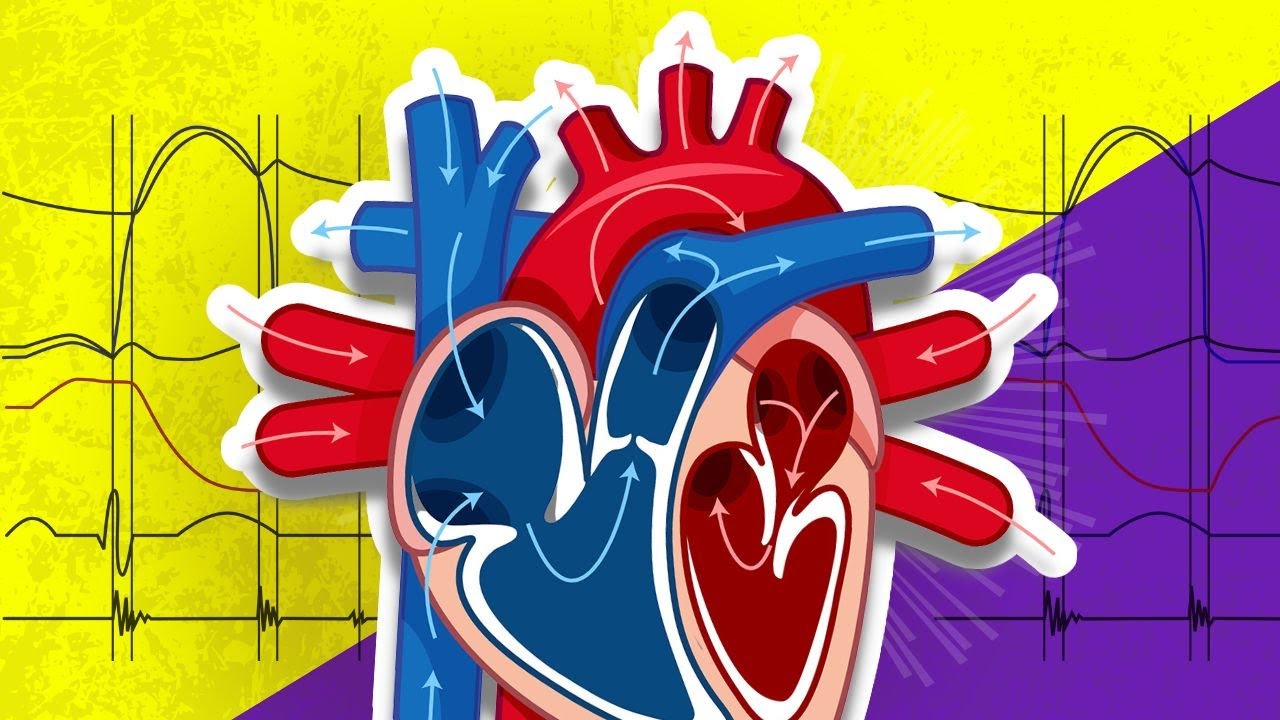
Human heart anatomy observes the heart divided into two distinct and separated partitions; a deoxygenated, or low-oxygen partition, and an oxygenated partition. There are some human congenital heart conditions that can result in this oxygenated and deoxygenated blood mixing, however. More on that at the end.
Arteries generally carry blood “away” from the heart. Think “A” for away. Arteries are typically oxygen-rich but there are exceptions.
Veins generally carry blood “to” the heart. Veins typically are oxygen-poor but there are exceptions. Capillaries are small blood vessels and it is at the capillary level where oxygen is delivered to organs and tissues and where carbon dioxide will also be picked up to travel back to the lungs.
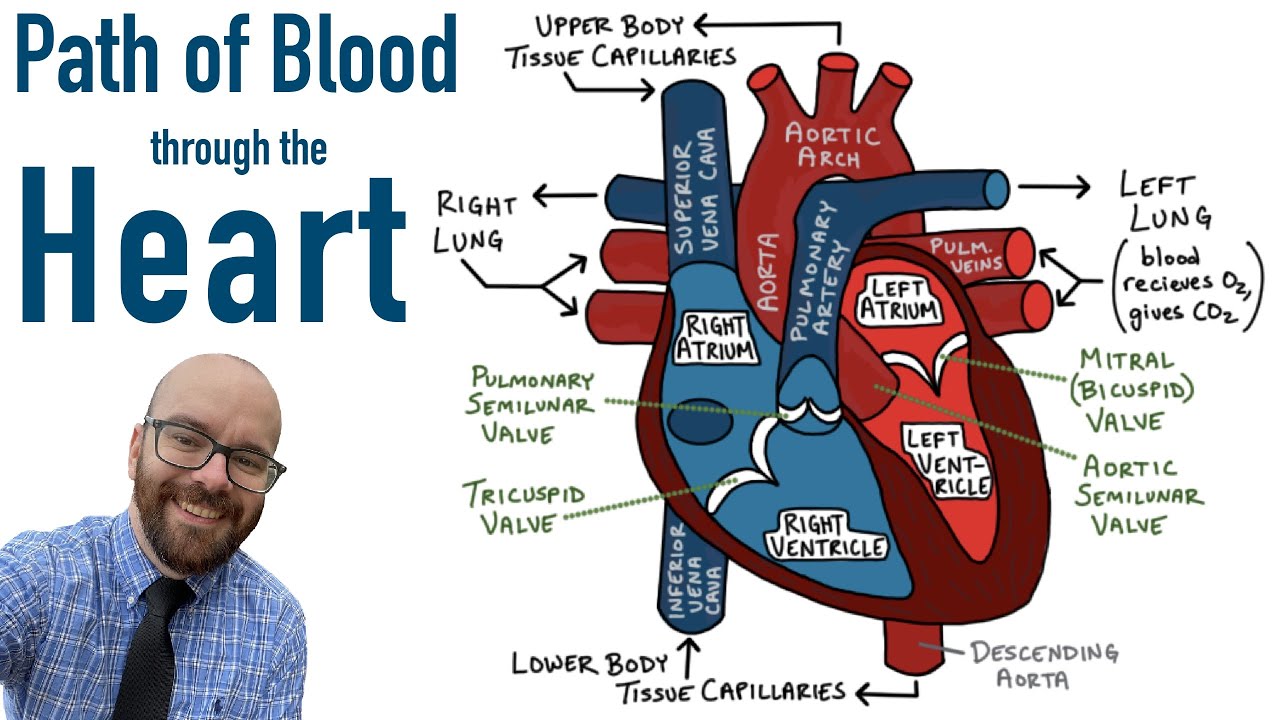
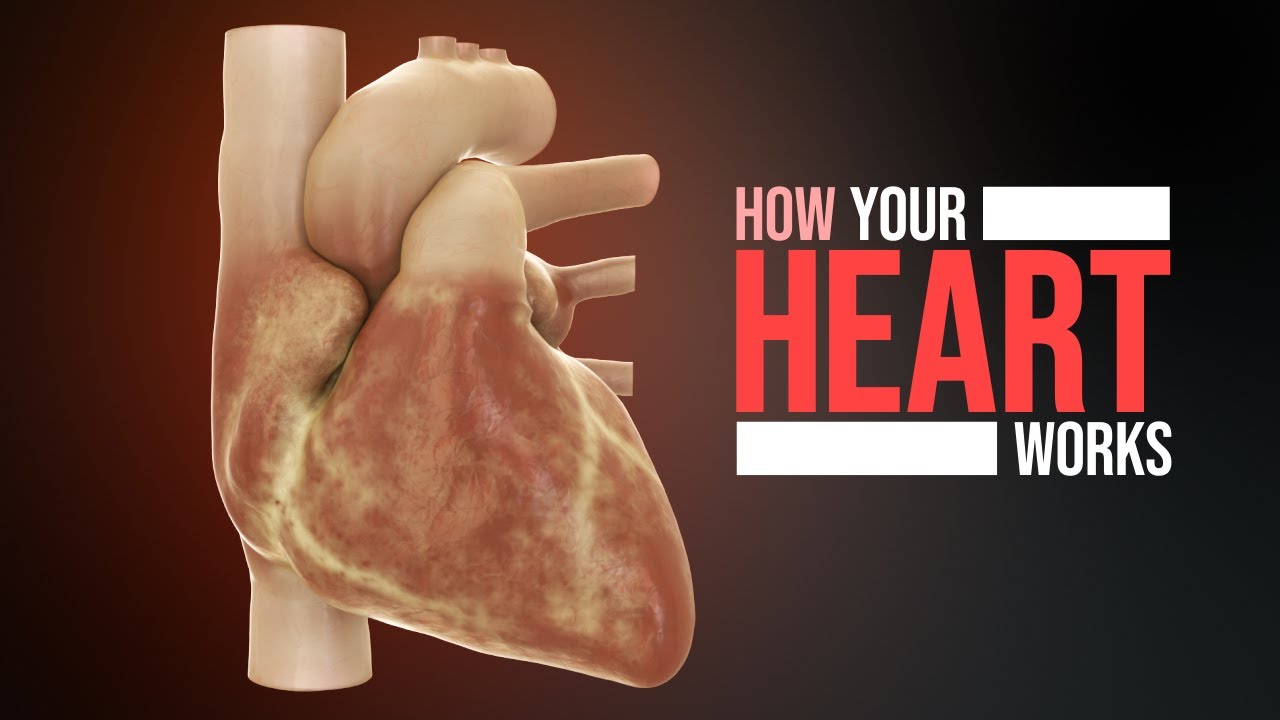
So, looking at this heart, the right side (and that’s the person’s right, so for you it will look opposite) pumps deoxygenated blood and the left side pumps oxygenated blood. We can also see 4 chambers: the right atrium and right ventricle and the left atrium and left ventricle. I like to remember that A comes before V in the alphabet so that helps me remember the A’s – for atria- are at the top of the heart.
V for ventricles- are at the bottom of the heart. Atria also have thinner walls than the thicker walled ventricles. The heart also contains valves which we’ll see when we get to tracing the pathway of blood.
The valves are one-way structures that help separate the chambers and also prevent backflow of blood. Ready to take the adventure of a lifetime? An adventure tracing the pathway of blood through the heart?
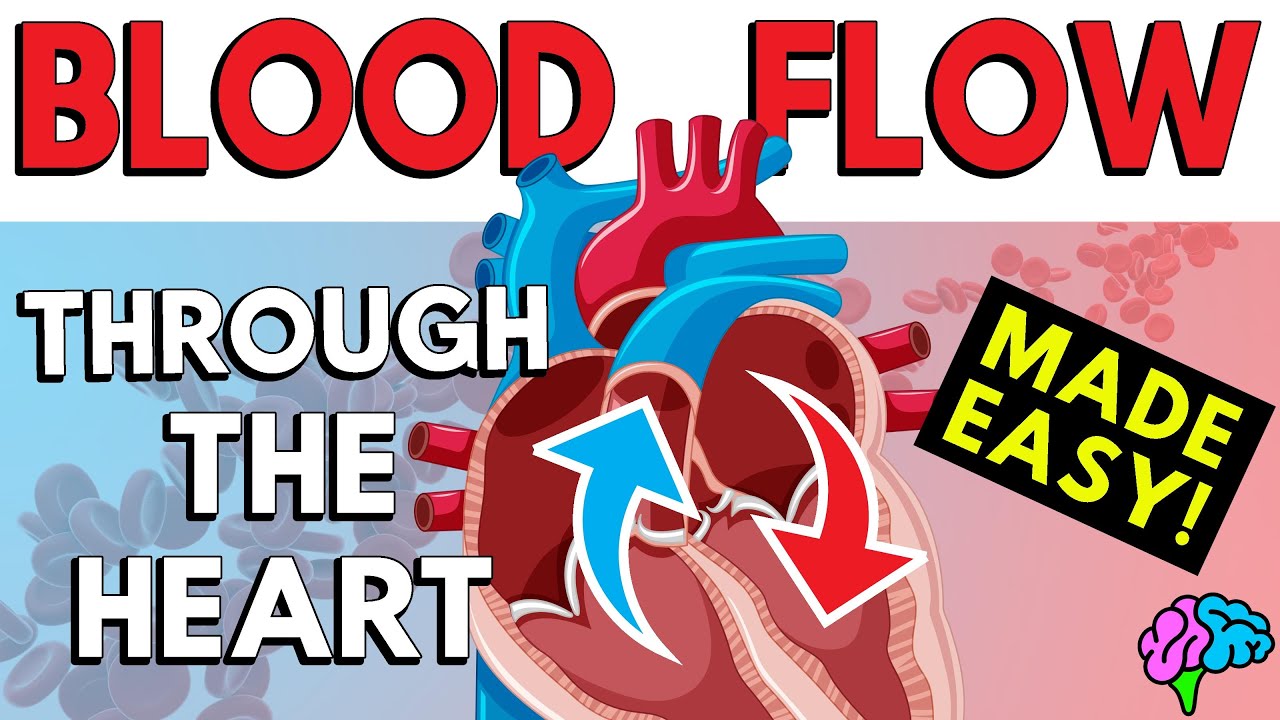
We’re going to start with blood that is in a human toe. This blood is deoxygenated. It needs to get to the heart so that it can be pumped to the lungs to pick up oxygen and then be spread throughout the body.
It’s going to get there through the vena cava. Inferior vena cava to be specific as superior vena cava is above the heart. The blood enters the right atrium.
The right atrium contracts, pushing the blood through the tricuspid valve into the right ventricle. The right ventricle contracts, pumping the blood through the pulmonary valve to the pulmonary artery. By the way, when you see the word “pulmonary,” it likely involves the lungs.
The pulmonary artery takes blood to the lungs where the red blood cells in the blood will take on oxygen and release carbon dioxide. Now this blood is oxygenated! It needs to return to the heart so that the heart can pump it throughout the body.
The oxygenated blood travels through a pulmonary vein to the left atrium. The left atrium contracts and the blood travels through the mitral valve, also known as the bicuspid valve, into the left ventricle. The left ventricle contracts and pumps the blood through the aortic valve and out a major artery known as the aorta.
The aorta is a major artery that carries oxygenated blood throughout the body. Now I don’t want to neglect the fact that the heart needs its own blood supply to deliver oxygen and glucose. The heart can receive this blood supply through coronary arteries.
Coronary arteries branch off the aorta and eventually deliver blood into capillaries. These capillaries deliver oxygen and glucose to the heart. Coronary veins will take the deoxygenated blood to the right atrium where the blood will eventually travel the pathway to become oxygenated.
In fact to quiz yourself, can you pause the video and trace the pathway of blood again? Ok, all together. Right atrium, tricuspid valve, right ventricle, pulmonary valve, pulmonary artery, lungs, back through the pulmonary vein, left atrium, mitral valve (bicuspid valve), left ventricle, aortic valve, aorta…takes it to the body and then it will eventually return through the vena cava back to the right atrium again.
*phew* It almost makes you want to turn it into a song! But we won’t. The significance of the pathways, how they interact, the coordination of contraction, and many more elements are part of every beat of your heart.
A human heart beats over 100,000 times per day so it’s significant that every beat is coordinated and blood is directed where it should go. The complexity of the cardiac cycle – which is the coordinated sequence of the heart’s contractions and relaxations – isn’t something this short video can go into; hopefully a separate video on that soon. One last thing: there are many conditions in which the heart doesn’t function correctly.
Anatomically, some heart conditions change the pathway flow of blood. One example that we had mentioned before is an atrial septal defect. The septum is the muscular wall that separates the right and left side of the heart.
So, a septal defect could mean an opening and oxygen-rich blood could mix with oxygen-poor blood. Depending on the size, this can cause future problems such as an abnormal heartbeat, stroke, or potentially heart failure in severe cases. Some medications may help the symptoms or surgery can be an option.
There continues to be more advancements for treating cardiovascular conditions. If you have interest in the amazing field of cardiology, take a look at the suggested further reading links in the video details! Well, that’s it for the Amoeba Sisters, and we remind you to stay curious.