This is the third and last segment of a lecture on the rights of distribution, public performance, and display. In this segment, I'll examine statutory exceptions to and limitations upon copyright owners' rights of public performance and display. For this purpose, we'll be returning once again to the map of copyright law.
The first thing to notice is that the exceptions are embodied in a long, itemized list. The general strategy underlying this list contrasts very sharply with the strategy underlying the more famous fair use doctrine, which we'll be considering next week. The basic idea underlying fair use, as you'll see, is that we use general, open-ended standards to confer upon courts a great deal of discretion to decide on an ad hoc basis whether a particular, unauthorized activity by a defendant should be excused as fair.
By contrast, the list of exceptions to the public performance right are, or at least appear to be, quite precise. As we'll see, this approach resembles more closely the European style of exceptions and limitations than it does the US fair use approach. So let's run down the list.
One of the more straightforward exceptions is section 110(1). That provision permits in a classroom a public performance or display that would otherwise violates Section 106(4) or 106(5) as long as it's done live. And as long as the copy of the work in question was prepared lawfully.
This means that when I present audiovisual works in the course of outlining case studies in my classroom, I'm on safe ground. So as long as the material I show was prepared lawfully. A closely related provision is 110(2), also known as the Teach Act, which deals with distance learning.
It's a very good idea to how a statutory provision that creates a safe harbor for distance learning. Unfortunately, in practice this particular provision is almost completely ineffective. The first thing you notice about 110(2) is that it's extremely complicated, contrasting sharply with the simplicity of 110(1).
The portions that I have marked with italics impose upon a defendant who seeks to invoke this provision many quite detailed obligations. Most importantly, 110(2) is only applicable to formal instruction of enrolled students. That's it's inapplicable to the copies of these recorded lectures that I make available to the public.
It's also limited to streaming of materials. If a teacher wishes to invoke this provision, he cannot make copies of any of those materials available for downloading, nor can he stream copyrighted materials in a way that enables students to copy them. Again, this restriction renders the provision useless for the kind of instruction I'm trying to do in this course.
Next, the provision is limited to materials that are not designed for distance education. In other words, the copyrighted works at issue have to have been designed for some other purpose and then adapted to distance education. A teacher must accompany those materials with instructions about copyright law.
This may not be a problem in this course, which happens to be about copyright law. But it's a burden with respect to most other courses. Finally, the teacher must adopt technologies to prevent the recipients from saving the materials to which they are given access.
These restrictions, when you add them all up, are sufficiently burdensome that very few distance learning enterprises rely on 110(2). To the extent that its purpose was to facilitate distance education, it's widely considered to have been a failure. Now, it likely occurs to you to ask how then does Fisher get away with including some copyrighted materials in his recorded lectures?
The answer is that some are licensed. But for the most part, I rely on the fair use doctrine. Next week, you'll be in a position to judge whether my invocation of fair use is persuasive.
Section 110(3) is much simpler than 110(2). It deals with public performances of religious works in the course of services. It's not obvious that this exception advances social welfare.
Putting aside the constraints imposed by the clauses in the US Constitution pertaining to the establishment and free exercise of religion, and just doing the provisioning from a policy angle, the result of 110(3) is to make it a lot easier for churches and other religious establishments to operate. But it also means that the creators of religious materials, specifically non-dramatic, literary musical works, don't get paid as much insofar as often the principal value of their creations is through performances. Perhaps the premise is that religious composers are motivated by non-monetary incentives.
And thus we don't need to compensate them in order to stimulate their work? Not clear. Section 110(4) is the so-called nonprofit exception.
This one is often neglected. But it's actually very important. As you can see from the map, it privileges live performances of a non-dramatic literary or musical work without any purpose of direct or indirect commercial advantage.
Restaurant waiters, for example, sometimes sing Happy Birthday to patrons. That's not copyright infringement as long as there's no direct or indirect commercial advantage. If the restaurant or the waiters charge the friends of the birthday boy or girl, they would not be shielded by this provision.
But as long as there's no independent charge for the performance, they're probably on safe ground. Some years ago there was a big controversy that implicated this particular provision. ASCAP, as you now know, is one of the organizations in the United States that issues blanket licenses, blanket performance licenses, to many organizations allowing them to publicly perform musical works.
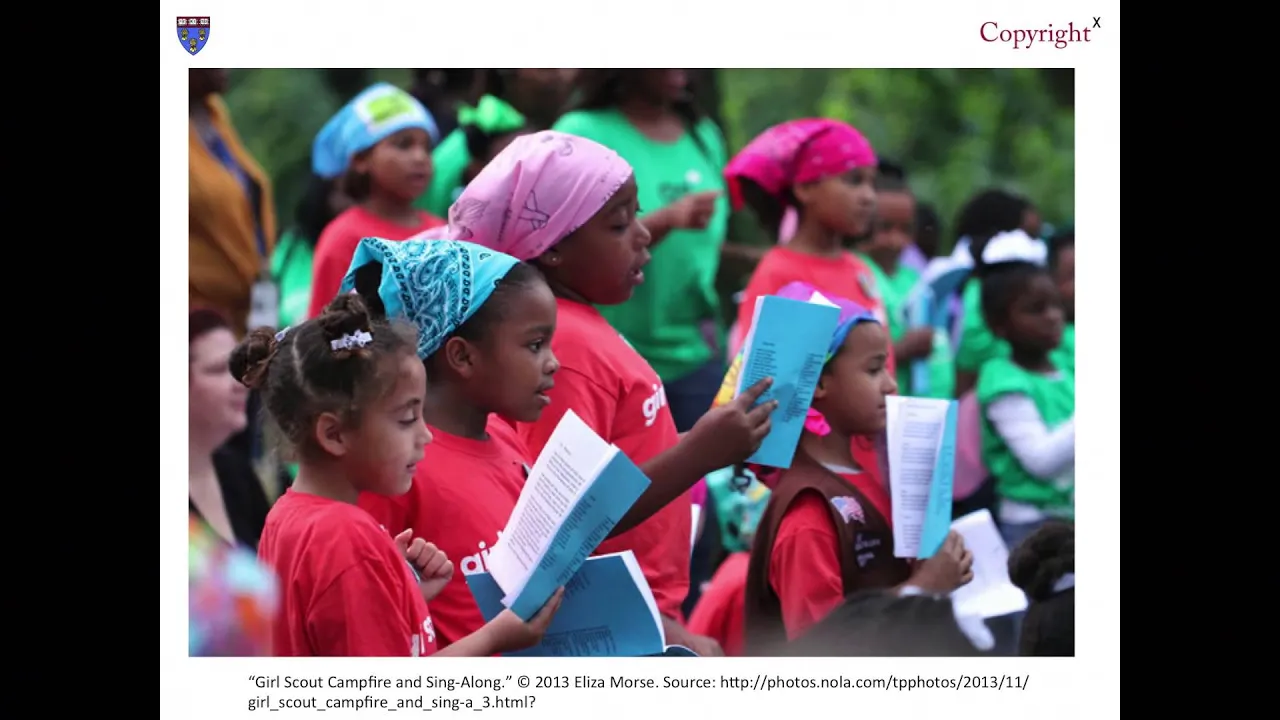
Foolishly, ASCAP apparently decided to seek license fees from the Girl Scouts in return for permitting the Scouts to sing songs around their campfires. This was a public relations disaster for ASCAP. The Wall Street Journal wrote a scathing article about it.
And in the end, ASCAP backed down and now grants the Girl Scouts public performance rights for a nominal fee. How did ASCAP get itself in this position in the first place? In particular, doesn't 110(4) permit the Scouts to perform the songs without getting a license?
It's not entirely clear. But the answer seems to be the Girl Scout camps that the ASCAP threatened with liability were charging for access to them. That made 110(4) inapplicable.
Now, we get to two related exceptions-- the so-called home-style exception and the FMLA, which is an abbreviation for Fairness in Music Licensing Act. The home-style exception embodied in Section 110(5)(B) is, as its informal name suggests, a privilege for publicly performing copyrighted works using the kind of apparatus that you would ordinarily find in a home. That's a little vague.
And it's changing as technology evolves. But the rough idea is that if the gizmo you used perform a work is the kind of tuner plus speakers that you would ordinarily have in your living room, then it's OK. The standard is vague and not often litigated.
But there it is. As I trust you see, this exception operates to shield some of the performances we were worried about in the previous segment of this lecture. Unfortunately, it's not broad enough to shield stores and restaurants who want to play music to entertain their customers, but need to deploy apparatuses bigger than you would find in an ordinary home.
So organizations representing restaurants and stores sought and obtained 110(5)(B) commonly known as the Fairness in Music Licensing Act. This one is extremely complex. You can read the details at your leisure.
The operators of bars, restaurants, and retailers when deciding how big an operation to set up and how to outfit it, pay lot of attention to the details here. If they're able to stay under these statutory ceilings, they can escape altogether an obligation to pay copyright owners, particularly ASCAP, any licensing fees. An alarm bell should be going off now.
You'll recall, I hope, that the Berne Convention requires member countries to grant certain substantive rights and limits their ability to carve exceptions out those rights. The TRIPS Agreement, discussed in lecture number one, incorporates and extends those requirements and creates a mechanism for punishing WTO countries that fail to abide by them. May the US without running afoul of those agreements carve out of the performance right an exception this broad?
The European Union thought no and brought a dispute resolution proceeding against the US concerning the FMLA and won. In other words, the US, in this respect, was deemed to be in violation of TRIPS. So did the US Congress amended the statute?
Surprisingly no. Instead, the US responded by submitting this dispute to binding arbitration which resulted in a monetary judgment the result was that the United States has to pay the EU a fee and continues to do so, over a million a year, to compensate for the injuries that EU copyright owners incur because of this exemption. The last of the exceptions we're going to deal with in this lecture concerns not public performances, but public displays.
This exemption is contained not in section 110, which is occupied us until this point, but in section 109. As we can see here, 109(C) provides notwithstanding the provisions of section 106(5). That's the public display right.
The owner of a particular copy lawfully made under this title to display that work publicly is not violated if he shows the two viewers present at the place where the copy is located. The upshot is that you can hang a painting on the wall of your living room. And you can host a wedding reception or a garden tour in your house, enabling lots of strangers to see the painting without infringing the painter's copyright.
As you can see, this is a major exception and helps to relieve the otherwise quite surprising reach of 106(5). For the past several minutes, we have been examining types of performances that the law excuses outright. In other words, we've been studying statutory provisions that give people an unqualified privilege to engage in particular sorts of performances and displays without permission and without paying the copyright owners anything.
We turn finally to a set of provisions that permit people to engage in particular sorts of performances without permission, but require them to pay the copyright owner's fees that are set in some way by the government. As you know now, such provisions are known as compulsory licenses. From the standpoint of the copyright owners, these provisions are not great because they deprive the owners of the capacity to control uses of their works and, typically, though not invariably, force them to accept license fees that are lower than the copyright owners given their druthers would demand.
But from the standpoint of the owners, such provisions are much better than the exceptions we've just finished surveying because the owners are at least paid something. There are five main compulsory licenses listed on your chart. These provisions give qualified privileges to public broadcasting organizations, some types of webcasts engaged in digital audio transmissions, re-transmissions by cable systems and satellites, and jukeboxes.
The ways in which the compulsory fees are set are complex and vary considerably across these provisions. Businesses that depend on these compulsory licenses for revenue or freedom to operate, of course, pay a great deal of attention to the details of the regimes. But I will not do so here.
Instead, I will concentrate, during my remaining minutes, on the general, normative question posed by all such compulsory licenses. What might justify using this technique? The question is difficult and important because you can readily see reasons why governments should not use this technique.
As I mentioned, it deprives owners of control. They must acquiesce in uses of their works that they might hate. You will recall from lecture number two that scholars like Rob Merges sharply criticize compulsory licenses on this basis.
In addition, the processes by which most of the compulsory rates are set and collected are expensive and cumbersome. The advocates of compulsory licenses bear the burden of establishing that despite these drawbacks, compulsory licenses make sense. How might they do so?
Defenders of compulsory licenses commonly make four arguments. I'll describe them, note the principal rebuttals to these arguments, and let you weigh the competing claims. The first argument is the compulsory licenses facilitate socially beneficial uses of copyrighted materials that otherwise would be frustrated by high transaction costs.
It would be prohibitively costly, so the argument goes, for jukebox operators, say, to negotiate licenses with the owners of the copyrights in all the songs and sound recordings they want to perform. The result is that were it not for compulsory licenses, we would have no jukeboxes. The retort is that transaction costs are not as high as the story suggests.
And information technology is causing them to decline. So, it is said, compulsory licenses are outmoded. The second argument is that inequality in the bargaining power of the copyright owners, on one hand, and these particular types of users on the other, would enable the owners in an uncontrolled market to extract excessive license fees from the users.
Excessive either in the sense of being exploitative and unfair, or in the sense of being much higher than is necessary to motivate the owners' creativity and, thus, socially wasteful. Skeptics suggest that the beneficiaries of most of these compulsory licenses are far from being powerless. The third argument is that the ratio of socially beneficial incentives to corresponding social losses is higher with respect to compulsory licenses than with respect to freely-negotiated licenses.
We touched on this argument briefly in lecture number four. Here's a brief review. Copyright law, seen through the eyes of an economist, is a device that shields an innovator from competition in sales of copies of his creation.
At least if there are no close substitutes for his innovation, this shield enables the innovator to set the price for access to those copies well above the marginal cost of producing them. The resultant monopoly profits, represented by the blue zone in this now familiar simplified graph, provide an incentive for innovators to produce their creations in the first instance. An unfortunate side effect of the strategy is that some potential consumers are priced out of the market for copies of the creation, giving rise to a welfare loss represented by the red zone.
That's regrettable. But we accept those social costs in order to offer creators sufficiently large carrots to induce them to make things we need or enjoy. If administered sensibly, compulsory licenses, it is argued, enable us to improve on the system.
Compulsory licenses force copyright owners to accept fees lower than they would otherwise demand. That, of course, reduces their profits. But the loss is partially offset by an increase in output.
The result is that the blue zone in this picture is smaller than the blue zone in the preceding picture but not by an enormous amount. Conversely, as you can readily see when the images are juxtaposed, the imposition of a compulsory license sharply reduces the concomitant dead-weight loss. The ratio between incentives and losses associated with uncontrolled licensing markets on the left is lower than the ratio between incentives and losses associated with controlled markets on the right.
Opponents contend that the administrative costs associated with the system on the right will exceed the cost savings it enables. The last of the four arguments is the simplest. Compulsory licenses are sometimes necessary, it is said, to enable socially-beneficial activities to flourish.
This is a hard argument to make with respect cable re-transmissions, but perhaps easier with respect to public broadcasting systems. The argument can be expressed in the language of economics. Public broadcasting has strong positive externalities that the stations are unable to capture.
So we need to reduce its costs if it is to survive. Or the same argument can be expressed in more moral terms. Public broadcasting helps educate the citizenry, generating a more informed, responsible, and tolerant electorate.
For that reason, we should and do place a thumb on its side of the scale. You decide who's right. Next week, we'll take up fair use.
![Upbeat Lofi - Deep Focus & Energy for Work [R&B, Neo Soul, Lofi Hiphop]](https://img.youtube.com/vi/THh4fT0O7IY/maxresdefault.jpg)
![Upbeat Lofi - Power and Energize Your Workday - [R&B, Neo Soul, Lofi Hiphop]](https://img.youtube.com/vi/ONcY0BM5EAg/maxresdefault.jpg)