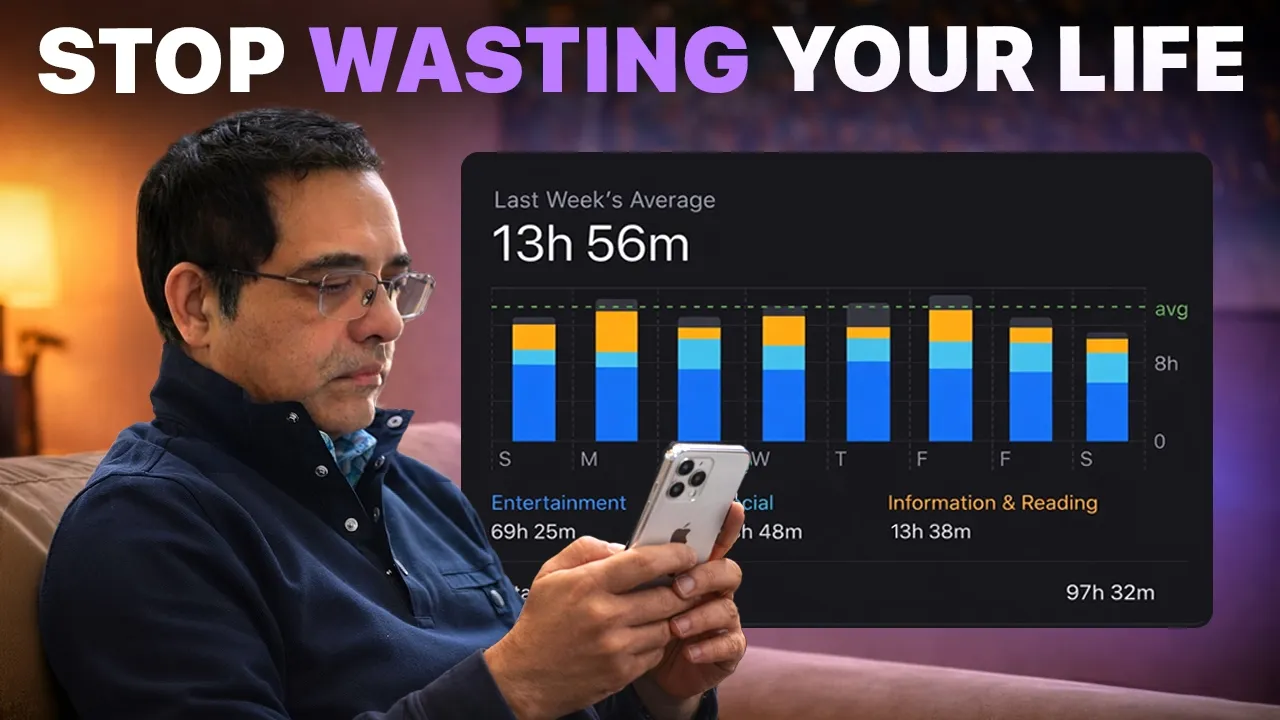
20 years ago, people had hobbies. Now they have a screen. The average person now spends 70 hours a week staring at a screen.
That's not just wasting time. It's slowly destroying our brain. I went from a homeless teen to an MIT grad to building and advising companies worth billions.
Somewhere in that journey, I almost lost every hobby I ever loved. But I also saw a pattern. The most successful people fiercely protect their seemingly useless hobbies because that's their best defense against brain rot.
In this video, I'll show you why hobbies matter more than ever, how they retrain your brain for success and fulfillment, and share a four-part framework for choosing hobbies that can help you change your life and your career. The first thing we need to understand is that brain rod isn't what you think it is. Our brains are under a two-stage attack.
Research from Neielson reported that Americans spend 70 hours a week consuming media across different screens. That's about 10 hours a day. Our screens have become our full-time employers and they pay us in brain rot.
We're all facing the same dangerous challenge. And that's because the social media we consume is programmed to give you rapid dopamine hits. Now, there are three side effects of social media.
First, our brain starts craving more of those hits. So, we start needing more hits for the same mental rewards. Second side effect, we start focusing more on sharing versus carrying.
You go to any concert nowadays or watch the sunset on a beach and you'll see people around you watching it through their phones. We're not enjoying our experiences. We're just camera operators for our followers.
And this leads to the most depressing third side effect. and hidonia. It's a clinical term about our inability to feel pleasure from normal things.
But that is only the first stage attack. There is an equally alarming second stage attack happening. AI.
Social media changes our attention. AI changes our agency. Microsoft just studied over 300 professionals and found something kind of terrifying.
When people are overconfident in AI, they basically turn off their own brains. They stop double-checking their work and their critical thinking just shuts down. It's like you're sending someone else to the gym and then wondering why your own health isn't improving.
AI doesn't outsource your tasks. It outsources your mind, your agency. And in this world of hyper stimulated junk food, hobbies are the nutritional meal.
So, why are your hobbies so important to your brain? I recently recorded a meeting with my team and I was listening to the playback and I was just horrified. My thoughts were jumping around mid-sentence, rambling.
I had no coherence. I realized that my brain had become a mirror of my Tik Tok feed, totally fragmented. Sitting there with my headphone on, I literally yelled at myself and said, "Come on, stop babbling.
Get to the actual question. " That was a wakeup call. If you don't keep training for focus, you're going to lose it.
Your brain doesn't adapt or grow when you're comfortable. It adapts when reality surprises you. No surprise, no change.
So, when you're scrolling your feed like a zombie or let AI write your essay or your strategy document, there is no struggle. There is no surprise. There is no discovery, no upgrade.
I call it deep fake mastery. It looks great, but it's not real. You know, in medicine, if you put an arm in a cast for 6 months, the muscle will atrophy.
It'll literally degenerate. It'll eat itself. And then when the cast comes off, you're going to need rehab.
To even open your wrists. Hobbies are your rehab. When you're cooking, you'll make a mess.
You'll play an instrument. You'll miss a note. A hobby allows you to struggle, to be surprised.
It forces your brain to upgrade. Now, if you're ambitious and you're successful or you're trying to be successful, you're probably going to feel guilty about your time spent on hobbies. Our 247 culture tells us that hobbies are selfish, that they're extra, that time you spend working on yourself is time stolen from work or from the people who need you.
Nothing could be further than the truth. And the proof comes from an unlikely place. Researchers at Michigan State spent 20 years studying 773 Nobel Prize winners.
What they found was well surprising. Nobel Prize winners had three times more serious hobbies than their peers. And they were nine times more likely to have formal training in crafts or fine arts or music.
For the world's most capable minds, hobbies weren't a guilty break from their work. It fueled their work. But then the question is, how do you pick the right hobbies?
For that, you need a framework. And we're going to use the vibe framework. Every thriving, high-erforming individual needs these four pillars.
Vitality. Are you running on empty? Then pick a hobby that gets your heart rate up.
Dance class, Pilates, tracking, martial arts, climbing, pickle ball, all fit here. Inquiry. Are you easily bored?
Then pick a hobby that forces you to be a beginner again. Learn a new language, play chess, take a course, belonging. Do you have a real community or just a list of contacts?
Try a hobby that weaves you into a tribe, a running club or a band, a nonprofit, a local book club, coaching little kids, and finally the fourth pillar, expression. Do you consume more than create? Then try a hobby that pulls something from inside of you and puts it out into the world.
Photography, painting, playing an instrument, pottery, writing, cooking, this one can be a long list. So whether your guilt is I should be working all the time or I should be taking care of someone else, this is your answer. Work on yourself first.
And one tiny observation about this, your hobbies don't have to fit neatly into one of those four quadrants. Painting, for example, can be an inquiry and an expression. For me, when I used to play in the band, it used to hit all four quadrants for me simultaneously.
So, what's the action item? You don't have to overthink it. Pick one or two hobbies that you love.
Apply the framework to see where they fit, if they fit, and then follow the rule of three. Do it three times and see if you want to commit to it. If it's not a good fit, pick something else.
Make sure you pick a hobby. You'll actually do with full attention. Because you don't pick a hobby just to escape.
You choose it to come back to yourself. Now, what's the best way to keep a hobby going? Focus on play, not on performance.
This is the fastest way to kill a hobby. Hobbies are your rehab. Don't turn rehab into a performance review.
The moment your hobby becomes a scoreboard, it becomes a grind that won't restore you. The fastest way to kill a hobby is to post about it. The second you bring an audience into the room, you stop playing for yourself and you start performing for them.
You're literally outsourcing your joy to the algorithm. You know, it's like going to Paris and spending the whole time taking a selfie with the portrait of Mona Lisa so you can show the world you were there and you're still trapped behind the same screen. So, the key question, I think, is who this hobby is for.
If it is for you, you'll build. If it is for them, you'll judge. If your hobby feels like a performance review, then you've lost the plot.
So, how do you actually protect the play? Not by fighting the urge to go back to doom scrolling. Social media is like an endless river.
You don't stop a river by standing in front of it. You cut a new channel and let the water find its way. Here's how you build that channel for yourself.
When you're enjoying your hobby, don't shoot it and don't post it. Focus on minutes, not on metrics. Start with cheap gear.
Don't overspend. And finally, after each session, just ask one question. Did I feel more alive or more judged?
Your hobby is where you go to be a messy, imperfect human in a world that demands you to be polished and optimized machine. So yes, hobbies is how you come back to yourself. And it's supposed to restore you, not rank you.
There's no win or lose, only the play. And here's what we learned from the happiest people in the world. In the world happiness report in 2025, Finland ranked number one for the eighth time in a row and US fell to number 23, its lowest ever.
Now Finland is no utopia. It endures some of the longest, toughest, bleakest winters anywhere in the world. But their environment is quietly built to reduce stress and increase real world experiences.
First, they're surrounded by nature and is a culture of walking and biking and hiking. Vitality check. Second, university education is publicly supported and affordable.
Inquiry check. And in that society, there's higher trust, stronger sense of community, lower inequality. So, belonging check.
And culturally they care less about constant competition or signaling higher status and success. They create because they want to. Expression check.
So you see Finland has actually built their culture around the vibe framework and the people there are the happiest on earth. The lesson is that the life you build outside of work should not be seen as a distraction. It's the most irreplaceable gift you can give yourself.
and to everyone around you. You know, machines and AI can replicate your output, but they can never replicate the life that produced it. I've been thinking about this that the more machines become like humans, the less we'll have to be like machines.
And hobbies connect you to your inner human being. There is a parable that I love. A traveler sees three stonemasons working very hard in the sweltering heat and they're cutting blocks of stones.
So he's wondering. He asks them what they're doing. The first one says, "Sir, can't you see?
I'm cutting stones. " The traveler turns to the second one. The second one says, "Well, I am earning a wage to provide for my family.
" But the third one stands up tall, looks up and says, "I am building a cathedral. " Same work, different meaning. Your hobbies don't owe you productivity or followers or wages.
They owe you joy. They bring meaning to your moments. Because your life is not just a pile of rocks stacked higher and higher.
It is a cathedral. If you like this video, watch this one next. It's about how to stay calm no matter what's happening around you.
Thank you and I love you.