A good argument is not an emotional experience in which people allow their anger to get out of control, leaving them ready to start throwing things. Instead, it is a rational discussion in which each person advances and supports a point of view about some matter. We might argue with a friend, for example, about where to eat or what movie to see.
We might argue about whether certain performers or sports stars deserve to get paid as much as they do. In an argument, the two parties each present their supporting evidence. The goal is to determine who has the more solid evidence to support his or her point of view.
In this playful cartoon, the wife’s supporting evidence is simply that the husband has no say about where they will go for Thanksgiving! Argumentation is an important part of much of what we read. Very often the three most important things we must do as critical readers are Recognize the point the author is making.
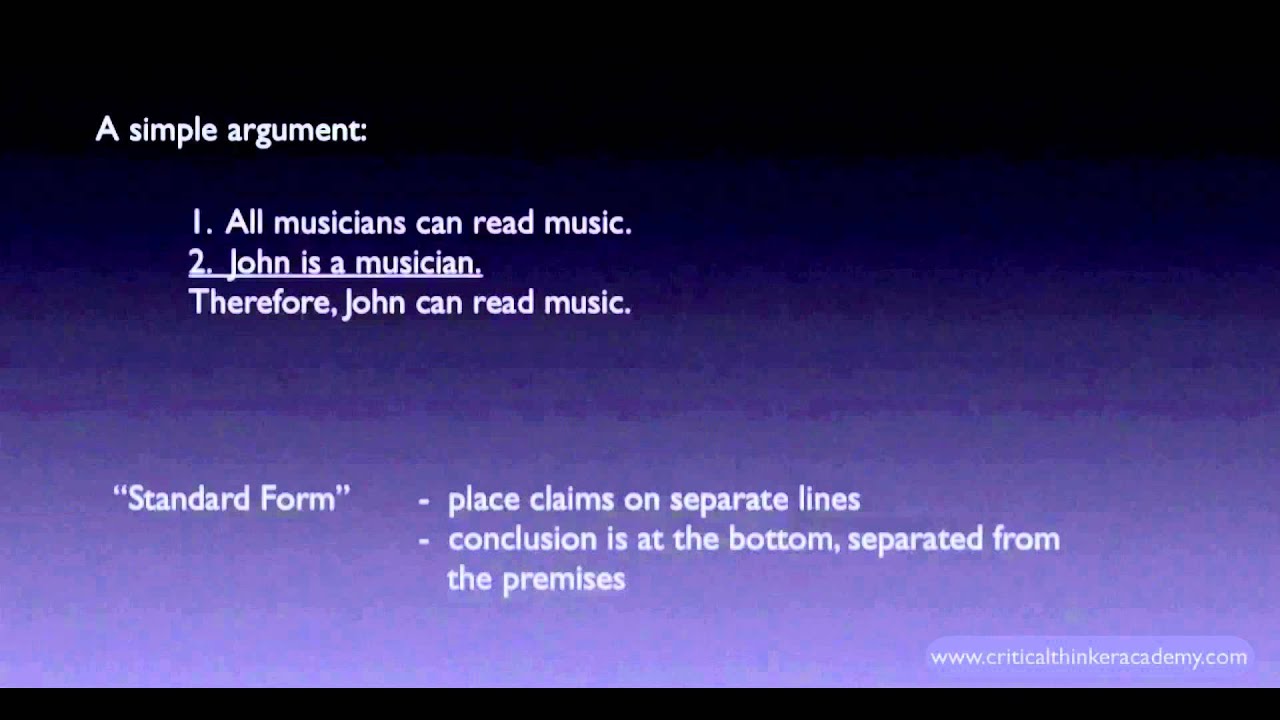
Decide if the author’s support is relevant. Decide if the author’s support is adequate. A good argument is one in which a point is stated and then persuasively and logically supported.
Here is a point. “Evidence suggests that men are more romantic than women. ” You may well disagree with this, especially if you are a woman.
“Why do you say that? ” you might legitimately ask. “Give your reasons.
” Support is needed so you can decide for yourself whether a valid argument has been made. Suppose the point is followed by these three reasons: “Studies indicate that men fall in love more easily than women, whereas women fall out of love more easily than men. ” “In interviews, women are more likely than men to say they would marry someone they didn’t love.
” “Research shows that men hold more romantic beliefs—such as “Love lasts forever”—than women do. ” Clearly, the details provide solid support for the point. Of course, you still might question the point and provide evidence of your own that supports your point of view.
Given the complexity of important issues, we must try our best to think as clearly as we can about them. We must decide what we individually think after close consideration of all the evidence available. Once you identify the point and support of an argument, you need to decide if each piece of evidence is relevant—in other words, if it really applies to the point.
Here is a point and two pieces of evidence. Which of the two statements is relevant support for the point? Statement B is relevant.
The fact that hundreds of thousands of sharks have been slaughtered for their fins is relevant support for the idea that sharks should fear humans. Statement A is an interesting fact about sharks, but it does not support that idea that humans are a threat to them. It is not relevant to the point.
A valid argument must include not only relevant support but also adequate support— support substantial enough to prove the point. For example, it would not be valid to argue “Abortion is wrong” if one’s only support was “My sister had an abortion and has regretted it ever since. ” Such an important issue would require more support than the attitude and experience of a single relative.
Textbook arguments generally have solid support, but recognizing the author’s point and watching for relevant and adequate support will help you become a more involved and critical reader. To summarize, in this lesson you learned that a good argument is made up of a point, or a conclusion, and logical evidence to back it up. To critically read an argument, you must recognize the point the author is making.
To think through an argument, you need to decide if each piece of evidence is relevant. To think through an argument, you also need to decide if the author’s support is adequate.