hello students in this lesson let us discuss about the geometric standards of the taxi [Music] way so there are basically eight elements of geometric standards of Taxi way which we have to discuss in detail so let's get started so these are the eight Elements which we have to discuss the first one is the length of taxiway second one is the longitudinal gradient third one is the rate of change of long itudinal gradient fourth one is a sight distance fifth one is the transverse gradient sixth one is a turning radius seventh one is the width of the safety area and the last one is the width of the taxi way now let us individually study each one of it so coming to the length of the taxi way it depends upon the distance between the apron and entry Aid or the entry end you can say or the exit end of the runway how much distance is there between your apron and the entry and the exit end based on this purely your length of the tax will be limited normally the limiting length of this taxiway is not recommended by any of the organization but in order to save fuel what we should do is we have to keep it as short as possible practically possible okay so theoretically we can do any calculation but practically it should be applicable so this this is about the taxi way moving on to the next one the next one is your longitudinal gradient normally if your longitudinal gradient is too steep steep means what two slope more angle you can say right or more slope you can say in this case your fuel consumption will be very high so we have to make sure that we keep a nominal longitudinal gradient not too heavy or huge or not too low or l yes so the standards according to the icao for your longitudinal gradient are as follows so if you are going for a and b types of airport the longitudinal gradient should be 1. 5% and if you're going for c d and e types of a air port then your longitudinal gradient should be around 3% okay moving on to the next one it is the rate of change of longitudinal gradient so for a particular length how much it is changing that is what is the rate of change normally the available sight distance on the pavement is affected by the rate of change of longitudinal gradient so let let's call the longitudinal gradient as so let's call the longitudinal gradient as log G okay so basically how much of sight distance or visible distance is available on the payment that normally depends on your rate of change of longitudinal gradient so there is a maximum which is fixed more than this you are not allowed to give okay so the maximum rate of change of your slope for 30 m length of vertical curve which is recommended by IC AO is as follows so for your airport type A B and C it is 1% and for airport type D and E it is 1. 2% so the next one is the site distance normally what will happen is the speed of your aircraft on the taxi way will be less or lower when compared to the speed of aircraft on Runway because Runway is used for landing and takeoff so during Landing also there will be certain speed and during takeoff also there will be certain speed but when it comes to taxi where this is majorly used for taxiing it or like parking it so normally here the speed will be lesser or lower so what will happen is we will need a smaller values of sight distance in case of your taxiway because basically we are fixing the geometric standards of the taxiway right now with respect to this standards the recommendation given by aao are as follows so if you're going for airport type A and B the surface of the taxi way should be seen for a distance of about 195 M from say Point 2.
10 m above the taxi way so basically if you are 2. 1 m above the taxiway and you are seeing the surface of the taxi W for about a distance of 195 M this should be okay for your airport type A and B now the same thing for your airport type c d and e e so same thing but the numbers will change here so instead of 195 M it will become 300 M and instead of 2. 1 m above the taxi way it will become 3 m above the taxi way when it comes to your CD and E type of airports so I guess the taxi way design in terms of side distance is clear to you now now moving on to the next one is your transverse gradient normally this transverse gradient is given for quick disposal of your surface water okay quick disposal of surface water compulsory we have to provide the transverse gradient now according to IC AO standards the maximum what we can give more than that it is not allowed for you to give the transverse gradient so the maximum given in the airport P type A B and C is around 1.
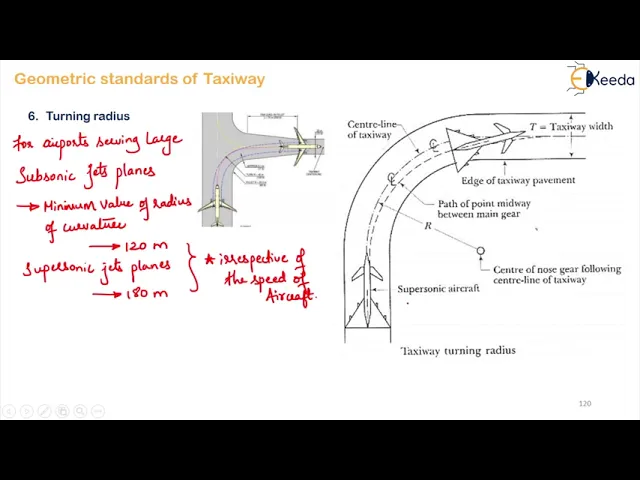
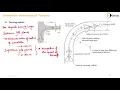
5% and in airport d and e the maximum we can give transverse gradient is about 2% now along with maximum there is also a minimum recommendation so the minimum compulsory we have to give I told now so the minimum what we can give is generally not specified by IO but according to standards it should be at least 0. 0% transverse gradient so this is just based on some standards not based on icao iO doesn't give any standards for your minimum transverse gradient but according to FAA the minimum transverse gradient you have to provide is about 5% for the first 3 m of the taxi way and then thereafter you can choose 2% depending upon whatever is the type of the airport the next one is your turning radius a very important feature out of all the eight elements so normally a horizontal curve is provided wherever there is a change in direction of the taxi way say now this taxi way is going like this but we need to change its direction so what are we basically providing we are providing a horizontal curve because this curve is is in horizontal plane we are calling it as horizontal curve it is provided for change in direction of the taxi way now it is very necessary to design the curve in such a way that your aircraft can negotiate it without significantly reducing the speed so whenever the horizontal curve is being used by the aircraft we have to make sure that there is the no significant reduction in the speed so in order to get this above feature without reducing the speed what we can do is we have to give circular curves with large radius and if you want to get the radius you can use the formula R is equal to v² by 125 F so where R is the radius of curve in meters and V is nothing but your speed of aircraft in kmph that is kilometer per hour compulsory this should be in kmph and then f is the coefficient of friction and this coefficient of friction is between your tire and pavement surface which is usually assumed to be 0. 13 if it is not given in case your airport serves large subsonic jet planes normally for airports serving large subsonic jet planes the minimum value of radius of curvature is taken as 120 M irrespective of whatever is the speed of the aircraft same way if we are going for supersonic jet planes then the minimum recommended is 180 M again both of this are irrespective of of the speed of aircraft now if You observe this figure it shows us the path which is followed by a supersonic aircraft having a wheel base of about so this wheel base is the distance between the wheels of about 1 2 m on the taxi way and this radius of curvature is say about 60 M radius now according to a scientist called Heron the radius of curvature should be such that a minimum of 6 m is maintained between the nearby main gear and the edge of the pavement right so between this point that is the path of Point midway between mid gear and the edge of the taxi way so according to that the formula will become what 0.
388 w² by 0. 5 T minus s so where R is what R is the radius of Center Line of Taxi way in meters then your W is the wheel base of aircraft again in meters and T is what width of Taxi way pavement again in meters and five finally s is distance between midpoint or you can say Point Midway of the main gear and the edge of taxiway payment again this value also is in Meers now what happens is if the pilot maintains the nose gear on the center line of the taxi way what is nose gear the gear or the wheels which are in the front portion of the aircraft if he is maintaining on the mid part of this main gear mid paath or you can call the center line of the taxi way having a radius as worked out from this particular expression then the main gear of the aircraft would not come closer than 6 M from the edge of the payment so like this when you going so from the edge of the payment it may not go above the 6 meter okay if in case the existing airport has to be upgraded to the higher standard that is if you want to accommodate your supersonic jets in your existing airports it may not be be feasible sometimes to increase the radius of the existing taxi way pavement so under such circumstances what we have to do is we have to go for taxi way widening by giving extra width to the taxi way now this taxi way widening can be seen here this shaded portion is nothing but your taxi way widening what we have done if You observe this is the center line of the unwinded taxi way okay after after widening the path of the inner main gear is this dotted line okay so what will be the expression we can use these following expressions and find out the radius of widening which is required okay that is to find the value of R1 and R2 so R2 will be equal to R which is already the radius into minus 0. 388 w² by r+ S now if this expression say this expression gives a value Which is less than 0.
5 y t there is no widening for the required taxiway and if it is greater than 0. 5 T then we have to work out for the radius R1 so your R1 will be equal to D ² + 0. 5t whole squ + 0.
30 r - R2 2 - RT this whole divided by 2 r - R2 where your r w s and t are as we have discussed in the previous slide okay now here the value of D will be equal to 3 wus 0. 4 R again if your value of D is less than W then what happens is we will have to use W in place of D so this is about your turning radius in the next class we'll solve a problem on turning radius for you to understand better there are two more geometric properties that we have to discuss so moving on the next one is the width of safety area so normally the safety area is uh made up of partially paved shoulders on either sides plus the area which is grained and drained okay so it extend up to a point where it intersects a parallel Runway taxi way or a apron now before the evident of your jet aircraft the shoulders were given either of the following two treatments one is the shoulder would have been naturally protected with low growing vegetations or the second one is by stabilizing using the granular material coating where the soil or the climatic condition do not permit easy maintenance of Plantation so by these two ways your shoulders were protected protection of shoulders before the jet is grafts were invented one is growing vegetation on either sides and the second one is by using your stabilized granular material coating now once the arrival of jet aircraft happened it became necessary that we have to protect the shoulders from soil erosion because what will happen is the jet which is coming out or which is exhausted from the jet aircrafts are at a very very high speed hence what we have to do is a minimum width of 7 7. 5 M of shoulder should be given on adjacent side of your taxi W okay and we have to make sure that it is paved with light strength material and also we have to make sure that the material which we use that is the light strength material this should resist the Air Patrol vehicles or the sweeping equipments which are coming on those and also we have to make sure that the shoulders should normally treated with B in so that surface wear out wouldn't happen and the surface should be made up of such material that disintegration due to either the hot blast of the jet engine or due to the high temperature which is coming out of the jet engine will not cause any effect and also we have to make sure that it should be smooth and impervious so these are the things which we have to take care in the width of the safety area now finally is the width of the taxi way this is normally very much lesser when compared to the width of Runway right now why is it so it has two reasons why the width of Taxi way is lesser than the width of Runway the first reason being your aircraft will not be airborne on your taxi way Airborne is either Landing or your takeoff so aircrafts are not Airborne of the Ty taxi ways and the second is that the speed with with which the aircrafts will move on the taxi way is very very less when compared to the speed which they move on the runway so hence what will happen is it will be possible for the pilot to stand in air easily on the small width of Airway that of the runway so this is the typical cross-section which you can see for the taxiway of uh Airport type A and B so if You observe this is the taxi way width these are the pavement shoulders in taxi way the gradient given longitudinal gradient given is 1.
5% maximum on either side and for the shoulder first for first 3 m it is 5% maximum and then afterwards it is 2% maximum right here the total taxi wave width given is around 22. 5 M and the pavement width of on the sides is around 7. 5 M and you can see there is a Inlet drain on both the sides now as I mentioned the standard of the width of Taxi W for airport type A and B is around 22.
5 M for airport type c it is around 15 M for airport type D it is about 9. 9 M and finally for the airport Type e it is around 7.