The disciplehip gospel. I have the privilege today of talking to you about it because it stands at the threshold of everything disciplehip. The gospel itself is such a broad subject that we can't cover it entirely today.
But what we want to talk about is what we call the disciplehip gospel. Some people may call it the kingdom gospel, but the operative words for the disciplehip gospel are very simple. Follow me.
I like to say, follow Christ and he will teach you everything you'll ever need to know. But there's a lot of confusion about the gospel. For example, the gospel itself includes disciplem or disciplehip as a natural part of what it means to be saved.
But there's a lot of people that don't really think that way. It's not because they intentionally don't want to think about it. It's simply that they haven't been taught that.
A gospel that doesn't call for disciplehip is a false gospel. It's just a partial gospel. It's not completely what the good news is about.
The good news has to address itself to all of life, not just a part of life. The gospel that separates conversion from disciplehip is a gospel that makes it almost impossible for us to be a good Christian or to pull off the Christian life. A gospel that separates conversion from disciplehip makes following Christ optional because you may have heard it before.
The gospel is about forgiveness of sins only. It's about getting into heaven. Yes, it's about forgiveness of sin.
It is about getting into heaven. But that's not all it's about. Because when God saved us, he also called us.
That's why Dedrich Bonhaofer, the great theologian and pastor and Christian leader, said, "Christianity without disciplehip is always Christianity without Christ. " In other words, a Christless Christianity is when you don't treat Christ as though he's living. Uh he's not active.
He's not listening to you. You're not talking to him. He's not invading every part of your life.
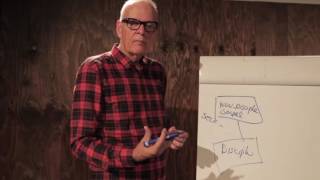
So, you're going to see a graphic on the screen and it it's a box that has one word in it, salvation. And then there's a line that divides the box. And down below it, you will see two words.
On the left, conversion, on the right, disciplehip. That's what we're talking about. That salvation has been divided, separated into conversion and disciplehip.
But all who are called to salvation are also called to disciplehip. No exceptions, no excuses. Because God said, "I have come that that you might have life and that you will live it to the full, that your life will flourish.
" that eternal life begins at the moment you begin to follow Jesus. Now, a number of years ago, I was by default, not intentionally, myself as a pastor teaching a gospel that was incomplete. I was not talking about disciplehip as part of what it naturally means to be saved.
Even though I had written books on disciplehip, I I I believed it, but I just couldn't articulate it. I wasn't able to communicate it effectively. And so I was having lunch one day with a good friend of mine, the great late philosopher Dallas Willard.
And Dallas and I were talking about a theology of disciplehip. And he mentioned to me that he didn't think there was a theology of disciplehip. And I took some uh offense at that because I had written three books that I thought were really relevant along these lines.
One was called Jesus Christ Disciplemaker. A second was called the disciplem pastor. And the third was called the disciplem church.
And I thought, isn't that a theology of disciplehip? And Dallas, he was such a kind man. and he you know one of the most brilliant minds in the 20th century and he laid his big hand upon mine and he said Bill I haven't read all your work but I don't see it there and then that engendered a conversation where we began to think about what really is he what Dallas was talking about was this that you know when we start talking about if and there's a new graphic coming up on your screen right now.
And that graphic is going to have three boxes. It's going to have a top box which says gospel. It's going to have a middle box which says disciple.
And it has a third box which says plan. 98% of discussion about disciplehip begins in the middle box midstream under the category of what and the discussion is something like this. Well, we know what a discip we know what the gospel is.
So, let's just move on to what a disciple is. And so, we define a disciple. And of course, that isn't the easiest thing in the world to do.
But I think a disciple is someone who is learning from Christ how to live their life though as though they were living it. In other words, if Christ were a school teacher, what kind of school teacher would he be? If he were a plumber, what kind of plumber would he be?
If he were a truck driver, if he were a parent, uh if he were a a university professor, what would that look like if it were Christ living his life through you? And so that's what a disciple is. A disciple is someone who follows Christ and learning to live their life as though Christ were living it.
And then you go from there and say, "Well, we need a model. We need we need curriculum. We need a plan.
" And so we go down to the plan. And so most people are talking about the the the middle box, what a disciple is, and the bottom box, what the plan is. But Dallas was telling me, you know, there's a box above the box, and that's that gospel box.
Because here's why. The gospel you believe in determines the disciple you make. So if you have a consumerristic gospel or a prosperity gospel or a legalistic gospel or gospel of the left or a gospel of the right or a forgiveness only gospel, then that is creating the kind of disciple that you have.
What's the problem with that? Well, the problem with that is that Christ was a man for others. The gospel is about loving and caring for others.
And therefore, if we're focused on ourselves, we can't get from point A, which is wanting to be a disciple, and point B, being like a Christ and being a Christlike person. And so that's why we put that second graphic up. But there's another thing I want to do and that is define the disciplehip gospel.
We want to talk about what really is the disciplehip gospel. Now this is def uh elaborated in a book called the disciplehip gospel by Ben Sobels and myself. Uh for those who are more theologically minded, it's Matthew Bates, Dr Matthew Bates, a great theologian in the state of Illinois at Quincy University, has written a book called uh salvation by allegiance alone, which I would recommend to you if you want to dig deeper.
But here is essentially what we would say is the disciplehip gospel. First of all, there's a gospel declaration. Now, this gospel declaration is familiar to most of us as Christians.
It is found in 1 Corinthians chapter 15:es 3-28. There is the story that God has spoken to man. God has invaded man humankind in the form of a person and that person is Christ God incarnate.
So he was born of a virgin but then he lived a perfect life. Not an easy life but a perfect life. He was crucified.
He was dead and buried. It's very important that we understand that he was dead, certified dead and was buried. Then he was raised on the third day according to the scriptures.
According to the prophetic elements of scripture, he appeared numerous times to his followers and once up to 500 people over a period of 40 days. He ascended into heaven after giving the great commission to his followers. He someday will return.
And as he does return, he will be our judge. He will be our king. Now, that is the gospel declaration that he died for our sins, that there's hope in the future and there will be justice for all people.
That is something to smile about. That is something to be happy about. That is something to be glad about.
It indeed is good news. But it would not be good news or good enough news if that was all there was to it. Because there has to be also a gospel response.
If you can't respond, it's not good news. If you're just told, but you don't have any action you can take. If there's no way you can get in on it, it's not good news.
It's just news. So, what makes it really good news is what Jesus told us and what he modeled for us in Mark 1:es 14-18. He says there, "Repent of your sins.
" In the gospel of the kingdom, he says, "Repent of your sins. " That's the first thing. Because some of the best news a person could ever be told is that you're a sinner.
Because that means you're not stuck with who you are. So here we go. Repent of your sins.
Believe the good news. And follow me. Three things.
This is the gospel response. Repent, believe, follow. That's the good news.
And there's one other thing and that's gospel benefits. Now, let me just run down through a few of these and they're found in selected scripture in the New Testament. forgiveness of sin, reconciliation with God and with others, adoption into his family, justification, being declared not guilty before God, called into his service, baptized in the spirit, giving eternal life, promises of God, sanctified, you become a new creation.
So there you have it. You have the gospel declaration. You have the gospel response.
And you have the gospel benefits. That's the good news. That's the gospel that makes disciplehip a natural part of what it means to be saved.
Because when God saved us, he also called us. And this eternal life begins now. That's the disciplehip gospel that I can be his follower as a son or daughter of Christ.
I can follow his example. I can become like him. I can indeed become Christlike and my light will shine and my life will make a difference.
And like an a group of matches laid on a table, one of them is ignited and the others are then inflamed. they like as well. And that's the kind of impact we can have where we live, work, and play.
That's good news. That's the gospel. That's why we do all of this.
That's why it's important. That's why we want to preach this gospel of the kingdom to every nation. And then it says in Matthew 24:15, then the end will come.
So, let me encourage you to fully understand and study what it means to believe in a disciplehip gospel. It's a gospel for others. Jesus was a man for others.
The church is really only the church when it exists for others. And so, may I encourage you, stop the naval gazing and start making disciples.