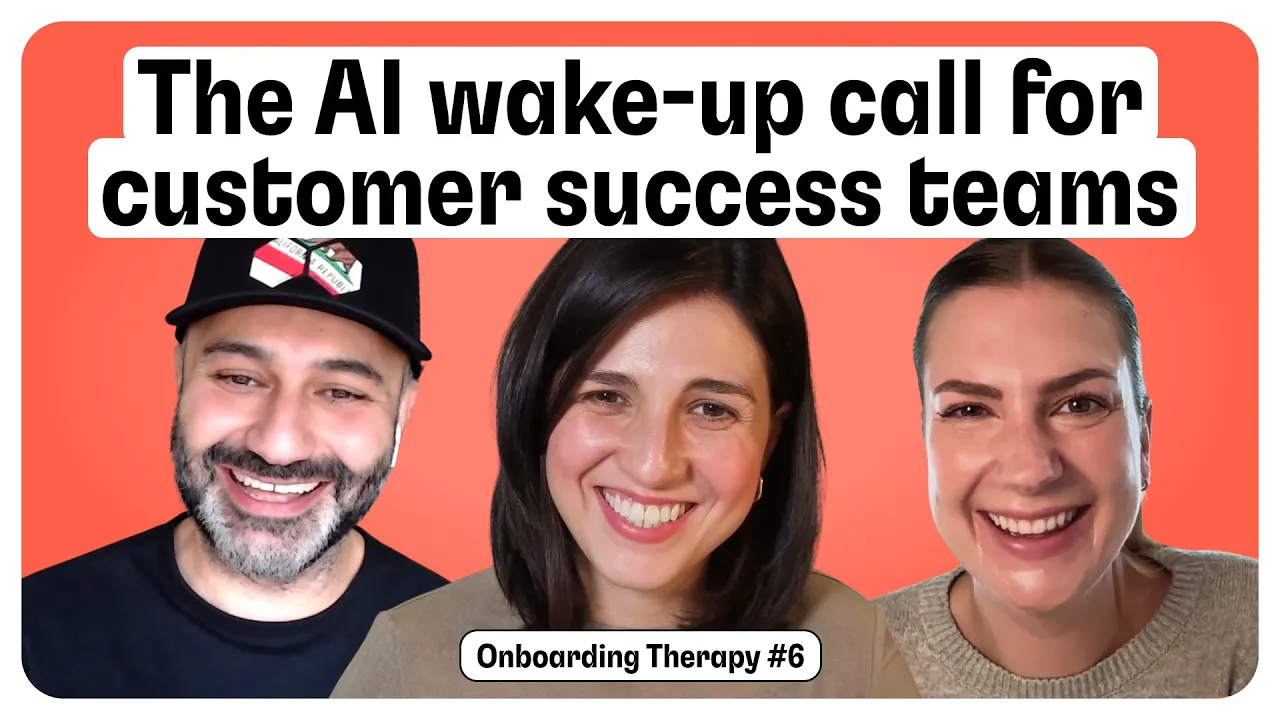
if you're in a company that is not embracing AI right now and their culture they're like we're not going to do this it's too early or we don't trust it if I was a CSM I'd be getting out of there welcome tooing therapy in this episode Charelle and I are absolutely thrilled to be joined by Daphne Costa Lopez We dive into how customer success teams can start thinking about leveraging Ai and then later in the episode we get Daphne's tips for career development I think you're going to love this conversation so let's get into it
well welcome to onboarding therapy and I are really excited to welcome Daphne as a guest on the podcast today DNE I would love if you want to get started with an intro and kind of your background yeah it's such a pleasure to be here I feel like indirectly I'm like part of arrows at this point and that's how much I talk to all of you guys so my name is dhan I am the global director for strategic accounts a HubSpot taking care of our largest customers globally outside of HubSpot I am a success Nerge so
I have a customer success podcast newsletter I post daily on LinkedIn sharing just what I learned about customer success some of my thoughts and I really really love being part of a community uh for me that's a little bit of an act of service as being able to you know pass on the lessons that I've had over 12 years working in customer success I've worked in product before that and I've been in startups scale-ups Fortune 500 companies I've seen CS at basically every stage of the life cycle and the maturity curve so I just enjoy
talking about all things customer success and you always find me in in those channels uh sharing awesome I was going to say if you're on LinkedIn and you're in customer success there's no way you don't know def me all your posts are so great and great so much great conversation happening for and I think it's just really helpful for customer success managers to see a leader that is like caring about the weeds of customer success and like the day-to-day of customer success manager so I think that's great cool okay so one of the topics that
I know you've been talking about a lot Daphne lately and it's just kind of like generally a big Topic in Tech right now is AI and how it factors into customer success I think from My Lens it's honestly customer success is the uh function that it's the least clear for me how it fits in so I think it's really interesting to hear how you're seeing it how you're seeing actual customer success teams use Ai and like what is the value how can csms actually leverage AI for their roles yeah promise of AI and customer success
is huge right and I think a lot of people can conceptualize what a AI agent for customer success will look like somebody that's always with your customer that can brainstorm and strategize with them sometimes even do things for them in your product I think all of those things are really cool and they are hopefully in in the near future of customer success but the reality of of the situation today is that there is a gap on what it can be versus what it actually is on the ground customer success teams are not seeing as much
iryde back from AI as teams like support for example support has I mean the the use case is just so straightforward and we're hearing more and more of how support teams are breaking linear growth of their head count they're being able to solve like 60 70% of their ticket using AI but in customer success the problems that we have are much more complex right they are not a how to or a simple troubleshoot they are brainstorming they are more complex situations where there is you know a a context that a customer will share that's unique
to their organization I think customer success also operates in the intersection of many systems right so it's like the product uses data is in one place the engagement data is in another place the support data is in another place so you have a lot of systems supporting the customer journey and the customer experience which means that AI needs to navigate all of those systems in order to be able to get great Insight we haven't even got to the place where those systems are integrated in most organizations right never mind having a layer of AI that
can leverage all of the insights that are there so I think the gap between the opportunity and the possibility versus the reality of where we're in it's pretty big and I think it all starts with unifying the database until your data is all in the same place your AI Solutions will be Point Solutions so for example I think many customer success teams are using the zoom AI tool for example to summarize to summarize calls or the gong AI tool if you're using HubSpot as a CRM you can do your relationship sumary so there's a lot
of Point use cases where AI is being helpful but when you think about like the potential of AI enabling customer success managers to have better conversations with their customers that are richer in insides and richer in strategy what should a customer be doing what should they be thinking about that that stuff is the is what's to in the Horizon and personally I have not seen anybody doing this well yet I've seen experiments that are very exciting I've seen new businesses like agency come along and like have a a transformative View and idea and vision for
customer success at businesses like hook that does data AI insights for propensity of canellation and growth Etc so I've seen a I've been seeing a lot of green shoots that indicate that we are moving in that direction but I don't think anybody can say or you know we are are AI experts in customer success our team is AI powered and AI enabled I think those are all dreams for now it's so true in that the data is so important the systems in which that lives in is so important and I agree no one's doing it
super well and what that tends to do I think is it causes a little bit of hesitancy too from CS teams and CS leaders to lean in further because it kind of has this negative connotation of like it's only for support or for scale or for managing inpersonal conversations when actually if you really harness the power of what AI tools can do with to your point the proper data and the proper systems it can make our life so much easier like I don't want to be doing some of these manual bits in my day job
every day and I don't want to go look at 10 pages of notes and 20 records in HubSpot to see what happened on that last call just like feed that to me as I'm going into my call somehow so I think there's both a little resistance to lean into it which then probably devalues the bigger picture of the whole Space of AI and Cs and I strongly believe that's the wrong mentality and wrong approach to it because it can actually make our lives very much more streamlined like who wouldn't want more time to focus on
the Strategic conversations and the renewals I don't want to be doing all that how-to stuff all day long in my day-to-day so I'm I mean I say that too but then also in my actual day-to-day I find struggles and how do I use this how do I leverage this you you press the magic button and it's not as magical as you expected and now you're kind of turned off from this whole idea how do you think that gets broken down like how how do we get through those barriers I think I think the way to
get into it is to have low expectations right have low expectations and understand that AI is going to get better over time by learning how you work with it right so you will train that AI model to get better by confirming that those are good answers by having better data to train the model so you have to kind of see it as like think about AI as your CS intern in your company it's somebody that doesn't really know what they're doing they have potential but you're going to have to guide it you're going to have
to invest in it in order to get something out of it and I have the same experience shl than than you of like putting something in front of the team where it's like here is like an AI tool let's go leverage it let's figure out how we can make use of this and the insights not being great coming out of it and everybody losing faith and trust that it's actually going to do anything and then the next time you roll out an update or the next time you bring something else like the team is a
little bit like well and you know this is like a gimmicky thing and it's not really going to help so I think it's like how do you educate the team on the mindset of what it's going to take for us to be an AI driven team it's going to take invest m is going to take all of us making this model better and I think the thing for leaders as well is having patience with that investment because as I said it is an intern initially and you're if you're investing data scientists if you're investing in
tools and you want to see the outcomes pretty quickly this is probably not going to be a place where you're going to see the ROI in three months you're going to probably see the ri in a year's time and it's going to be a little slower now where I do think places where you're going to see quicker is like the the efficiency gains that you just mentioned Cher like can I get a summary of this relationship in the in the CRM record yes this is going to be pretty good from day one getting a transcription
from from a call you're going to get that well you know really high quality pretty much straight away because there are businesses investing on this for years before it gets to you but if you're building something inside your organization or if you're starting off with like a blank canvas it's going to take a little bit of time for you to to see some some results from us yeah I think a lot of the skepticism from csms or CS teams in AI is exactly what you're saying Daphne is it's it there's there's going to be an
investment and csms are so swamped with customer calls and so much work like I feel like there's no CSM that is not completely overwhelmed with calls and those types of things so I feel like it's it's hard for them to say I'm going to take the time to develop this even though I know maybe maybe in a year or in six months my job is going to get easier because I'm investing in training this model or or doing whatever but I think that's just such a big ask for so many CST members and it's just
like a lot of trust in the leader that is bringing on this AI tool or suggesting that this is like the new use case and I think that is just what will require some time and I think like you're saying there's just so few AI tools that are building specifically for CS so there's also low trust there it's like I think generally CS feels underbuilt for there's just not a lot of tools especially in the AIS space who are thinking solely about how can we enable customer success teams so I think there's just like low
trust low visibility into what CS teams actually need and I think it's like a whole hodgepodge of like misalignment that needs to happen and I think there's such a big opportunity but it's just it's just kind of unclear exactly what could help yeah and I think some teams will have to sit back and think about what are some infrastructural investment that they need to make before they bring AI into their organization so for the integration piece I think is a it's a very clear one I looked at a study recently that showed that the customer
success Tech stack is foring tools not obviously every organization will have foring tools but over 50 or 50% of the organizations have 14 tools if you don't have that Tech stack well integrated your first foray into AI should probably not be building a Insight bot for example you should be really thinking about where do we store this data do we have a data warehouse is it in a format that's going to be readable by by AI what does that look like Because unless we have that piece the insights are never going to be good right
because the insights of a siloed system are missing 90% of the picture and I think that's the reality for like product usage information the amount of times I sit with people and their their health scores don't have usage data in them it's like it's it's crazy to think Das that that people build entire Health scores using engagement data now of course engagement data is important but unless people are using your product and getting value from it they're not going to renew no matter how good your relationship is so if you try to build let's say
a a AI driven Health score model that only takes data from your CRM how good is that AI model going to be at predicting and helping csms mitigate risk for churn it's going to be a small slice right of like people that have bad relationships or problems that happen that the CRM can pick up so I think like the infrastructural investment should be the first thing it shouldn't be you shouldn't be building stuff until you have the data to train those models in a a good way doesn't mean you can't leverage the AI That's building
different tools right you could you should definitely be using the gong AI summaries right or the the HubSpot account summaries like you you definitely should be using this stuff the problem is like getting from that one use case into the transformative stuff the stuff that's really going to change the way that we do customer success and will break linear growth for the customer success team I was chatting to a CSM that I mentor and he was giving me he he came to me with a problem he was saying look um my manager wants me to
do more calls and I don't feel like I have the bandwidth to make more calls because it takes me a long time to prepare for each one of the calls so unless I don't prepare for the calls I can't do more calls so I said let's get on a call let's jump in tell me how you're preparing like just walk me through your preparation process and let me see if I can give you some advice on how you can do this better faster and he walked me through um his entire process and Trend and it
took 47 minutes we were 40 I counted because it was so long he walked through five tools 47 minutes of getting information from here and putting in a document and getting information from there and it was like product information part information the information project information and he was taking all of this stuff to build the picture of what the agenda should look like for that customer this this is a CSM who is very interested in having a strategic conversation right they don't just want to show up and say hey customer what do you want to
talk about like what is any questions for me no he wants to come in and have a strategic perspective and an opinionated point of view of what they should be talking about so he's doing all this work 47 minutes of work to prepare for one call one call that's a 45 minutes call so it takes more time to prepare than to actually deliver the call and when I looked at that I felt viscerally for him that pain of I don't have an advice for you on how you can get better unless your operations team is
going to invest the time to take this data points and integrate it and put it in one system where you can see this information where you can leverage AI to get a overview of all this stuff I don't I actually have no advice for you that that was my answer to him so looking at looking at the the picture of how how Was preparing like I feel for what you said Kim that people don't have time to do this so like my advice for leaders would be invest on the infrastructure first right to start there
because even if you don't put any AI on top of it you're already helping your team you're already helping them find the information faster then secondly one of the things that we did a help bot that I think was really well done and um I'm I'm not going to take any credit for it because it wasn't my idea and I don't run the team but it was creation of an experiment mental team a team of csms who have accounts that they work with but a lower number of accounts and their sole role is to test
new ways of delivering success to their customers so before all these Innovations hit over a thousand csms that we have a HubSpot before I goes wide we first test it with those experimental chains they give feedback they make it better but their bandwidth is larger because they have less customers so I think that is a that is a really good way of getting the experiment off the ground and then getting it to a better quality before putting it in front of the team that doesn't have the time because they have hundreds of accounts or they
just they're working with a bigger bigger book of business one I love the experimental team cuz I also get to work with them and they're using arrows to experiment certain parts of their worlds which selfishly is obviously great but I love what you said in there in that and I agree csm's were all swamped and the same breath I I get a lot of csms reaching out and people I Mentor too asking well how do I accelerate my career how do I grow my CS how do I get to your level of career growth and
even if you're swamped at work like this is such an opportunity to make some time outside of that to learn for yourself how you can take advantage of some of these tools like I agree if the data is desperate and all over the place it's going to be hard but can you get a subscription to chat GPT or Claud and start teaching it your own little things and little models and doing your own mini experiments so if you're out there trying to like enhance your career lean into some of this stuff it is scary it
is there's all these Notions that it's going to replace us as humans and I don't actually believe that I think yes it can replace certain tasks and functionalities but what I think about more is like how do I use my human time more efficiently so that I can do more so that I can reach more customers so that I can help add more value across the board um and when you flip that mentality I think it makes makes it a little easier to try and lean in and learn yeah and I think the the the
point is that I don't think AI is going to necessarily replace csms but AI enabled csms will do 10 times better than csms that don't use Ai and therefore they're going to be pretty obsolete so I think like what you said about like using AI to come up with better strategies right if you are able to help your customers with better strategies they're going to get better results if they get better results they are more likely to stay with you so these csms that are using AI are going to have higher quality conversations more impactful
conversations and ultimately get better results which means that they are much more likely to become the top performing csms the csms that get promoted that get paid more money like all the good stuff that we all want want for our careers I think AI is going to help but I think that the fear that people have about AI I I think people need to move on pretty quickly from that fear because the world is going to continue to accelerate things are going to change at an even faster rate and people that don't adapt will be
left behind I think we can all think about a person in our in our lives or our family like an an older relative that didn't really follow the evolution of technology and now struggles to use their mobile phone right don't want to be that person you want to be the person that like as soon as it comes out you play with it you experiment with it you start learning because things are going to keep moving on and and you don't want to be there 20 years later and you actually can't do the job anymore you've
become obsolete because you now don't know any of the tools any of the processes anymore um and then you're going to become bitter because you're going to feel like there's no longer place for you in this world in this career and you're going to be annoyed you're going to be left behind nobody wants to be to be in that position especially you know I think most people listening to this probably have like many many years ahead of them in their careers and you you want to keep growing you want to keep evolving I love I've
been thinking about it as like my assistant cuz I've always joked about I wish I had an assistant like I just wish I had an assistant I've said that in every job I've ever had even like as a entry level support person 20 years ago when I started my career like I just wish I had an assistant but I like your framing of intern that you used earlier better because interns also need some guidance and need some handholding and need some support to start right and that is exactly how these things work like you have
to put in time you have to train it like you physically have to train it if you're using AI models or learning language models like so treating it like an intern and having that mentality that it's not going to be perfect but if I invest a little bit of my time what can I get out of this thing how do I get my own how do I actually get my own little personal assistant which what all these things claim to be and I know that's marketing and you know it's the hype of today's AI world
and everyone wants to put an AI agent and and everything but you actually can have your own little personal intern that can help you with your day-to-day stuff and I love what you said like it's not going to replace the CSM but someone leaning into it as a CSM and leveraging that technology this is like the starting point to your point it's going to accelerate and compound very quickly you're going to get left so far behind and so quickly far behind and then you're going to feel devalued and then in turn your actual performance is
going to suffer so if you thought it was uh hard to climb the ladder and C us today it's going to be 10 times harder when your teammates around you are actually leaning into some of these Technologies while you're sitting there resisting it or potentially um not understanding it as harsh because it's a big thing and most of us don't really understand it but at least not trying to trying to understand parts of it and trying to understand where it can help you in your day job vers versus the resistance that at least I tend
to see from CS people around AI yeah and I I I promis Kim I was going to give her hot take so here's my hot take it's I think it's if you're in a company that is not embracing AI right now and their culture they're like we're not going to do this it's too early or we don't trust it like I If I Was A CSM I'd be getting out of there because that company unless they they change their tune very quickly and they start experimenting and they start thinking about how their business and their
products can get better because of AI they're going to be left behind and then you're going to be stuck in a place that was left behind and you never had the opportunity to test some of these tools to learn from some of these tools and csms that are working in AI Forward Thinking companies they are going to get far ahead from you so if you are an AI Optimist and you want to start trying but your company doesn't favor that they don't support that I'd be seriously thinking about what is my next move this is
why we brought you on the show that's the kind of stuff we want to hear I I had a mentor once tell me don't fight the company and that has stuck in my like Soul ever since then because if you're trying to have this uphill fight against an executive team or a company and that's not to say actually that is to say they're potentially wrong in this case like you should be leaning into this but if if they're not get out go do your own thing like go if that's truly if you believe that that's
going to help you AI or anything like I say this a lot about teams that do onboarding if your executive team is not bought into the concept of onboarding get out because that is so critical to the whole motion of the life cycle so I am so glad you said that and I love that hot take so much and I wish more people and it's easy to say it's harder obviously to go do and make those changes a it scary and finances and life is all involved totally but try like even if you can't move
today what you can do today is make a plan right and that plan can be finding what are the companies that are doing this following to see if they have roles preparing playing on your own time with these tools preparing for interviews networking you can do all those things in a financially feasible and and not very risky way so that you're prepared to make that jump but I think just you know sitting back and what you said fighting the company this is something I with customer success is the same I have had to push water
up the hill so many times in my career trying to convince people that customer success was worth it and then one day I it all flipped for me and I said I will no longer do this because I am spending my time my energy and my potential convincing people instead of doing the work and the less I do the work the less developed I will be in this field and I care about this this is for me is a passion as a mission and I want to spend my time and my energy solving problems that
are to do with these thing that we want to do helping customers succeed help them see value help them grow I don't want to spend my time fighting people to say customer success is important or not so aligning your beliefs and your in your values and your mission to a company when you do that you 10x your potential you 10x your your output and honestly you're not as frustrated I justed should be so frustrated all the time because I just I didn't have a seat at the table I did people didn't take me seriously they
thought it was my little project you know all those gos and it really is demotivating to work in an environment like that so I am like I know it can sound incendiary when I say like leave but you can do this in a a very smart and calculated way that you're not putting your your family your earnings your your life outside working risk so yeah go and make a plan if you're in that situation go take a piece of paper and start making your plan yeah I mean I I have an extreme example of that
where I quit a job after 6 months and I it was what I've talked everyone I've ever managed out of doing which is exactly what you said have a plan have a strategy like but I would I had this job for six months and they just weren't actually bought into to solving this huge churn problem that they hired me to think about and consider and I'm not saying I knew all the solutions but I would point to things where they were clear clear red flags and clear problems and they just weren't getting solved and mostly
was the most like annoying thing was I was just so frustrated I would come home and my wife would tell me I've never seen you this frustr like it takes a lot to get me that wound up and and I'm not naive every company has problems every manager has challenges every CS team has struggles like those are all true no matter where you end up but if The Supporting Cast around you isn't actually trying to help you or solve for the things you're solving for to your point you're going to be so frustrated and and
no matter what then performance will suffer I don't care how good you are how much you know AI how many years of Cs experience you have if that environment is going to fail you you will eventually suffer and then your performance suffers and then your career suffers and then you start to get in your head about you know am I even good at this thing those are the thoughts I was having I still made a plan like yes I quit my job and and left with that one but I had a very clear plan of
I'm going to spend six months trying to find the next thing here are the things that have to be true at that next thing I'm going to it like a job and get up and go and interview and and get a lot of rejections along the way but find something that makes sense so I am very much for that like take take some of that into your own hands and make some movements if you have to and I understand that's scary all those things we talked about are true but it will pay off if you
have a plan and actually believe in the thing you're you're trying to do and then I ended up at a job that I loved and we have the same problems and the same challenges and the same frustrations but I actually enjoyed doing it because we were trying to solve the same pains and problems together and to your point I eventually got a seat at the table and got to put my little that was literally a little project got to put my little project on the map and you know fast forward a year or two and
again it takes time I was presenting at the company all hands on the topic of onboarding which was like wild to me to even say like you get a slot in the entire company's 30 minute Spiel and you get 10 minutes of that to talk about the topic of customer onboarding that's pretty crazy and pretty awesome so it is scary but if you really are navigating your career and looking for that type of advice like some of those hard decisions have to be made and I'm sure you get a lot of this stanie just with
your career trajectory and and profile online everyone looks at that and says well I want to be the global director of Cs that a huge customer focused company but they don't see all the little paths you took to get there and all the rejections and all the Nos and all the projects you had to give up on right and that was you physically navigating your career and making choices to end up where you are yeah which I just love I love that story I love I love the approach to it I think people don't see
what they what they don't see in careers is what you said it's like all of the pain behind the timeline the timeline always looks perfect right because everything makes sense H in hindsight so it's like oh yeah of course she went from this role to that role and to that next thing and jumped to that other company like that all makes sense but it's now that I've figured it out should make sense and now I can explain the trajectory but when I was in the middle of it not a lot made sense and I think
that's why you have to have very clear values and you have to have a very clear picture of where you want to be I don't mean like where are you going to be in five years that's not what I mean I just mean where do you want to be right now right like get in touch with what are the problems that you're enjoying to solve right now they're hard problems they might be like you said things that are hairy and problematic in every company but like what is the environment where you want to solve those
problems what are the people that you need around you to solve those problems like find out that answer and it it can be very much focused on the present it doesn't need to be focused on the next role the next five years it can be completely focused on what do I want to do right now and doing this right now and doing it really well will open the door to the next thing because in two years time when you've solve those problems then there'll be new problems and you can ask yourself the same question is
this a problem I'm passionate about am I in the right place where other people care about this problem that I care about do I have the right resources you know you're never going to have infinite resources but do you even have the Buy in to get enough resources to make a dent in that problem you can ask yourself all those questions as you go I think I have like a big hairy audacious go for my career and I've I've always had that but I manag hundreds of people and I think the the more normal thing
is not to know exactly where you want want to get you and I think people that that feel that way sometimes feel like wish I wish I knew right I I wish I wish I knew since I was five that I wanted to be a doctor or a vet or but like the majority of people don't don't feel that way and it's so fine it's honestly so fine and so normal and focusing on the present I know it sounds very you know mother and and yeah meditation and it's like I'm trying to be the Andrew
hman of customer success no it's the really it's like focus on what's engaging and and giving you energy right now and lean into that lean lean into it and and you find you find your path yeah I have a story to share on this because it's it's so powerful I had a uh this was probably like 10 years ago I had just gotten promoted to senior manager at the company I was asked I was managing other managers and their teams and I was stoked and I I was in a cab with one of my regional
managers and we were heading back to the airport and he asked me Charelle what are you what are you good at and I thought to myself oh this is great like he's setting me up for my next promotion asking me what I what are my passions what am I good at you know and maybe shocking to you too but I rambled for like 30 minutes and talked about all these things I'm good at um and this guy just listened like he didn't say a word I talked and talked I said I'm good at this I'm
good at managing people I like Tech I do this and XYZ and I finished and I looked at him and he said so what are you good at and I was like oh I said like that's when it hit me I was trying to be good at all these different things which was why I was struggling with what is next in my career what are my next steps what should I be working towards or on so I went and he goes spend some time and come back when you're ready to tell me what you're good
at and so I went back and sat down and wrote a lot of stuff and reflected and journaled and one of the best tips I have for folks is I've always kept a list of things I'm good at and things I'm bad at generally in my career and I've always tried to develop these things I'm bad at and in that moment I created a third column which was things I'm bad at that I don't need to be good at and I was shocked at how much I move from that second column to this and it
was just like this weight lifted off of my shoulders and off of my life that I don't have to be good at building spreadsheets for this job that I'm trying as an example right but it helped me get so much more focused on the things that I actually feel like I'm good at and it helped me really understand the things I need to develop in my in that moment in my mind of like what I wanted to do in my career which was to be a regional manager at the time and oversee like a CS
department but it gave me so much Clarity and that's one bit of advice I give to everyone especially in today's world where to your point you're looking at people's highlight reels on LinkedIn and wondering how they got there and you assume that you have to be good at a million things and the truth is like you just need to be really good at a handful of things that are your craft for your day-to-day for your job for your career and it just is so freeing I still keep that list active I go to that things
I'm not good at list every once in a while one of them inspires me but for the most part I look at it and I'm like why would I why was I even trying to be good at that thing like no wonder I wasn't getting promoted in the path I was on because I was focused on so many things but that moment was such like a pivotal one in my career where that regional manager just listened and says okay so what are you actually good at but it was so enlightening so take some time for
yourselves as CSM especially as the year winds down like ask yourself and go to your career conversations with with some of that knowledge this is what I'm trying to do this is what I'm doing today don't worry about the five years from now like you said what do you want to do today and build on that and then lean into resources and tools and and podcast like I listen to your podcast and follow your newsletter and it's great because it 10 years into CS I'm still getting nuggets of advice and things that I can go
learn so never think you know it all because you don't the world is evolving around you quickly so the more you can learn and if if you look at someone like Daphne online and say I want to follow her career then go learn from her what is the what are the things she's doing what are the things she's talking about what are the topics she's leaning into to actually follow the path not always the like High light real is some advice I have for CSM yeah I love that um you know um my previous boss
he had a very similar uh I had a very similar aha moment with him and he had the analogy that he used was think about yourself as a boat so if you're a boat which one of the holes that you have are above water and which ones are below water oh so the ones that are above water don't worry about them these are the things that you're not good at but they make no differ difference in your ability to achieve the things that you want to there are things that you can lean on other people
Etc but then there are the holes that underwater which if you don't fix them you're going to sink right so especially if you have a few of them so if you want to be a manager and you're not good at cross functional relationships that is going to sync you because you can't get anything done if you're not good at that thing so the I think that that this analogy is basically the two columns that you talked about right it's like the the stuff that I'm not good at but that I'm so willing and ready to
work on and what is the stuff that I'm not good about Ash that I'm never going to work on because it just doesn't make any sense for me to do that so I I had the same aha moment with with one of my managers and it's a really powerful one and now with my chams one of the things is it's so so easy for people to know what they're not good at people are very most people are are very self- critical and they will say you know I'm not very good at spreadsheets I'm not very
good at this thing I'm not but then you ask them what are you good at and most people can't can't answer you right like shro you had 30 minutes of things you're good at most people and that's great because most people have very few and I don't know if it's a mixture between trying to come ac across as humble right just kind of weird to say like I am a brilliant Communicator it's not a it's not a natural thing for people to do but what I do for my teams is I do 360 reviews of
often so that other people can tell them what they're good at and if you're in a CS role you can actually enroll a few customers in in that 360 review where your customers will tell you what they appreciate about working with you and again like that's a way for you to say let me double down on the stuff that I do that people really value let me get let me be the best person at this thing instead of investing all of my time trying to get 5% better at spreadsheets let me invest that time in
um my presentation skills and let me become an amazing Storyteller because I already I'm already good at it so I can become incredible so I think that 360 review as well that habit of creating that is is one that can help people identify those those strengths totally part of my reflection was going and asking my actual team like what what do you guys think I'm good at and for the record that those 30 minutes of talking most of those things I wasn't very good at I was just rambling and probably very naive and just young
in my career and then thinking oh if I talk about all this stuff that's going to increase my chances of getting you know promoted and visibility and all that when in reality that's the opposite it's it's doing certain things in your world really well that get you that visibility and that career projection that most of us are after and you're right too some of that is just like there is this I think I noticed this especially in CS I don't know if this is a stereotype or not but that lack of advocating for ourselves and
that lack of life like this this Crossroad of am I not being humble enough or am I being too arrogant and there is a line there obviously but you can be confident without being arrogant or being cocky like you you should be confident and and lean into the things you're good at and talk about them because the truth is in a SE of Cs agents at your at your company you are and this is going to sound bad but you are a number in that moment and if you can't stand out amongst that number then
it is hard to accelerate and you are just feeling like you're checking the boxes and it does feel like it's this constant uphill grind of oh I did my work this year and I got a tiny little bit of a raise and I got you know a meets expectations but if you really want to go beyond that you have to advocate for yourself you have to highlight the things you're good at you have to understand the things that you're bad at and and be willing to really develop them if they make sense for the thing
you're trying to do so yeah ramble for 30 minutes and then write some notes about what you're actually good at and that should help yeah and I'll make a blanket statement for CS people most CS people need to worry about being more humble and most PCS people should do a better job of advocating so if you are listening to this and you're wondering probably don't worry about having more humility and actually you need to probably say what you're good at in front of other people more I love that think there is definitely a um there
is a how to all of this right like you you if saying you're good at something um if you if it's the wrong environment if it's the wrong attitude the wrong tone like it can come across is not being Elmo but like you said most people actually suffer of the the opposite problem which is you know much um uh it means that you're not going to come across as that but I think this humility can actually come across not as humility but as lack of confidence and lack of confidence I think can be very detrimental
like how do you build um expertise for people to see you as an expert and respect you as an expert and um want to come to you for problems and solutions Etc if they don't believe you're an expert so so I think that there's definitely there's definitely a line that you can cross but I think you're probably so far from from that line should they yeah cool well we started with AI we ended with Career Development I think it's helpful on both ends thank you so much for joining us dhne this was so awesome to
talk to you I hope we can have you on again any final thoughts or or last kind of tidbits you want to leave people with I I said I was goingon to talk about customer value and I didn't actually in this convers because that's that is my Mantra like if you go into any of my content that that's what I I talk about but I think I'll I'll connect it all with AI your career how you work with customers make sure that you have a value that you're delivering that's very clear and you can articulate
so if you're going to bring AI to your business what is it going to do like what is the goal what is the objective if you're going to do something with your customer what is the goal what's the objective if you're working on your career what is it what what is that you're you're delivering that's going to create the value that you need in order to step up into a Next Level another role so think about value always I think when you are a giver versus a taker you actually get more out of the world
I know it sounds not super obvious but it is the more you give the more you get so if you can cultivate that value mindset and giving I think in everything that you do you're going to do well cool love that thanks for joining us and everyone follow her newsletter it's it's really good and if you're actually trying to develop your career in CS or if you're a leader trying to better understand CS Daphne has just so much knowledge and so many tangible like points in the newsletter where you read it and don't feel like
you just got bombarded with marketing but it actually is valuable and information that you can use to better your career and your companies