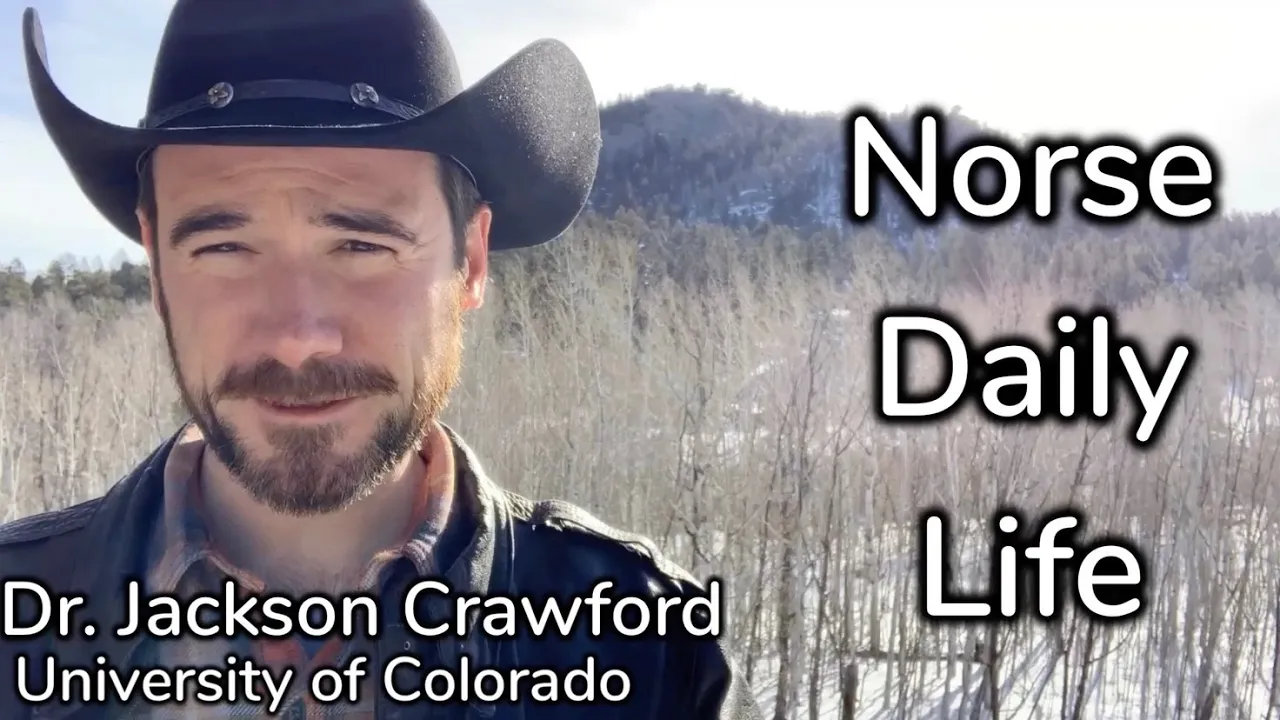
Hi I'm mode Nora specialist dr. Jackson Crawford this video is not just patreon supported but patreon requested as it is one in a series of monthly videos that are actually voted on by my patreon supporters this topic about daily life in the Middle Ages for the Norse is going to consist of a fair amount of inferences from literature and a fair amount of inferences from the reality of rural life today I am NOT an Archaeologist as I have said a hundred times on this channel so I'm not going to focus on things like what somebody's
comb might be made over what kind of spindle orals someone would use and weaving because it's really not my domain instead I want to kind of help you get into the headspace of things that are different whether expectedly or unexpectedly for someone living in this culture and living in the daily realities of life in Viking Age Scandinavia [Music] you to start with let me give you three thoughts right up top that I think are important to shaping expectations of the Viking Age and of many other pre-modern societies here's one sex causes babies this is something
that in today's society certainly in the United States and Europe people don't necessarily think about sex often has nothing to do With children for people today contraception is so widely available and so effective that sex that produces children is almost an exception but for the Vikings sex caused children now that means that the social politics around the relations of men and women are quite different because there is really no such thing as casual sex when any sex causes dependence at least you have to assume that it might this is part of why relations between men
and women can Sometimes seem so guarded in the sagas why families are so protective of their daughters their sisters their wives etc because of course when you have more dependence you have more responsibilities and they have responsibilities toward you of carrying on your legacy you want to make sure that you know the people you're related to and that the proper people have the proper responsibilities to the proper people So probably you'd be living in a family unit that might be smaller might be larger at a minimum you'd probably have the parents and their kids let's
say if the parents have been married for a decade or so you might have three or four kids running around probably more than that have been born but a lot of kids are going to die very early because of disease especially if you're a little bit wealthier or if just the dice fall out in that particular way you might Actually have quite a few more people living with you maybe a dozen maybe twenty they might be extended family they might be hired hands they might be slaves and slaves of course don't think about plantation owners
on the Natchez Trace people often do on the internet because either that's all they can think of in terms of slavery is American slavery and in the 18th 19th century or because you know they're want to be Nazis and and and and and try to project Their modern semi modern racism back onto the Middle Ages which is pretty inapt the slaves are really just more powerless people than you slaves may even be sort of related to you there may be people from pretty close by but they're people who have no power whatsoever for whatever reason
the captured and war they are perhaps people of Oh quite a bit or they just people who are so powerless with the family so so powerless that nobody's worried about Forcing to do stuff and if they have no other option to eat they're gonna stick around and do that stuff especially if everybody else around the garden is the property of somebody else and we'll just bring them back to that person slavery in the Middle Ages in a fairly unorganized society like this really is a matter of fairly it's it's fairly a matter of pecking order
more than the organized racially distinguishing system you might think of From from the history of American slavery but I'm wandering away from my point the sex houses children I just want to set up a notion of households that have a younger basic average age then possibly we do today because not as many people have children people don't have as many children and they probably chosen fairly late relative to medieval people but also to understand who else would be in the household with them all right a second thing the Norse are very Concerned with manliness because
we confuse the Vikings not just with maybe southern plantation owners but with the Spartans we often think of that manliness in terms of I don't know Leonidas people think that every Viking man every Norse man of the Viking Age is a Viking he is a fighter Raider a professional warrior that really isn't a good mental image to have when I say manly yes that Leonidas warrior thing is part of that people are gonna people are Gonna fight a lot probably any given man is going to have a share of injuries from fighting he's gonna have
weapons ready at hand but that's mostly going to be the stranger putting it but somewhat more casual fighting than I think you're expecting disputes with neighbors someone insulting you raids on weaker people across the sea perhaps that kind of thing not so much because he's you know part of some organized regiment so when I say man the first thing you Should think of it's not VN itís the first thing you should think of is probably more like red green right handyman a man who can be depended on to do the things the support his family
and maintain his farm or whatever other means he has for sustaining himself he might be wealthy enough that he actually controls other people's farms and agricultural outputs a man is someone who supports his family well does not engage in anything that might Cause him shame and is ready to fight but probably isn't fighting all the time and isn't getting paid for it so something he's got to do sometimes just like sometimes to get a restart the fire and then a third thing that I want to emphasize right up top is that everything is hard there
is no there's there's really not luxury in a society like this think of how easy it is for us to do just about anything right certainly if you live in The United States and the early 21st century as I do as I'm as I'm talking about this it is not that hard to stay alive now there's always going to be things that are kind of conspiring against you staying alive you might be in a car wreck you might be so unfortunate as to contract cancer or some other kind of disease but day to day until
you get somewhere in your 80s you kind of expect that you're going to wake up the next morning that is not Necessarily a medieval expectation there are so many more diseases that they have no ability to control or remediating I mean just consider how difficult it would be to live with diabetes in the Middle Ages right children are going to have are going to get rambunctious they're going to explore their gonna fall down wells not to not to be to lastly about this but kids are gonna get themselves into scrapes that I'm gonna get them
killed Right if they're not killed but just having measles when they're young and there's no vaccines men are going to be expected to be ready to fight to defend their honor defend their family and might will get killed real early on just from a wound that gets infected and women are going to be pregnant all the time right imagine that ladies again sex causes children and from complications of pregnancy from complications at birth they're going to die and presumably also You know people may speaking of the fantasy people reject on the Vikings sometimes get this
sort of feminist fantasy projected onto them it's really not very true I imagined a lot of Norseman we're not particularly great husbands and there could also be casualties forming in that way you are fighting to stay alive right and these threats of death or right are on top of the fact that you've got to work your moccasins off to keep the fire lit to Eat to to collect water to make sure the water or whatever you drink in a sanitary to build your house to maintain your house to make sure your neighbors think you're strong
and so they're not coming to take your stuff to take care of your livestock whether that be horses cows and or sheep and or pigs and or just your dogs to make your weapons or to do whatever surplus activity you need to to buy weapons to to go out rating which you Need a ship you need oars you need know how to do a lot of things you got to be a jack-of-all-trades and you got to have a lot of energy and there's no b6 vitamins at the grocery store right on the vitamin market you
got to just and there's no coffee right you just got to get up and you got to work your moccasins on from dawn to dusk and then after all right having made those three big points right up top let's look at a few more particular things about life in The Viking Age now life for everyone in a pre-modern time and for most people in modern times except a lucky some is mostly work so what kind of daily work is there to do and how is it different from different members of the household well remember that
human beings regardless of their material circumstances or culture have some basic needs you got to stay warm which means fire in a pre-modern society you know there's no no floorboards or Anything like that if you want to stay warm in the winter you got to chop store start and tend to fire which is a familiar chore to some of us today but a decreasing Li a familiar chore to people today if you want to eat well depending on what you're eating if you've got vegetables you got a tendon more gather them you got a store
them somehow you got to cook them for meat you got to kill the animal if its domestic you got a raise it in the first place if it's Wild you got to hunt it in the first place you got to process the corpse you got a store the meat somehow you got to cook the meat somehow all of this takes a lot of time if you want to have a roof over your head you got a chop wood again you got a know a fair amount I mean it's it's a it's a skilled profession building
houses and probably people are mostly building their own houses at this time I mean I think that's a really Underestimated chore or time expenditure especially for men is building and maintaining residences and other buildings the fundamental distinction between men's and women's work is probably mostly outdoor versus indoor men are expected to work outdoors women are expected to do most of the work inside the house when a woman is married at least a woman of status we see often that she is said to wear which seems to signify her her Dominion Within the house within the
keed area men are also usually praised for having sun sun colored skin the favorable term for that is the O's that are if you're a little too sunburned if you look you know a little bit about some more negative terms for that solar is one yata fur if it's not applied to hair seems to possibly be one of those and so you often see that a slave a man who basically has to work outside and no matter what and whatever conditions is Going to be described by this sort of negative terms for sunburn whereas a
man who's active outdoors but doesn't look worse for it looks better you know more like some tanned will be described as do that like ruddy whereas women are described favorably if they are pale that's actually a pretty common thing terms for for pale imply that a man is a coward but they imply that a woman is wealthy enough that she doesn't have to go outside to do what should rightly be Men's work she's got men and her family presumably her husband or others who do that work so she can stay doing proper women's things inside
and then she's regarded as being more attractive because she's not Sund of course this is pretty different from our culture I guess this varies from decade to decade but you know certainly I think that a lot of men today we regard women is more attractive if they are Sun tanned right rather than than Super pale this is another thing of course it plays into you know internet racist narratives often those people are using really old translations that use terms like swarthy for the slaves to work outside against sunburn that's a pretty bad translation of what
I think is better translated as just sunburned I don't know come on pale I know it's worth a meeting somewhere honey but who says that but people you know internet races take that to mean You know darker-skinned people's because again they can't give you know us-south plantations out of their head another thing about women's work is that it's going to be focused on you if we've got this outdoor versus indoor split between men's and women's work we've also kind of got a situation where men get stuff and women maintain stuff so it's the man who
goes out and gets the food he's the one who's probably doing most of the farming the hunting The animal husbandry that kind of thing where it's the woman who is taking care of that stuff on the inside she's the one who does the cooking she's the one who cleans stuff she makes clothing she probably deals with the what I guess you call kind of the vanity tasks for most members of the family as women who are going to be doing things like cutting hair in fact that's considered a very prototypical woman's job women are of
course taking care of human beings Inside the house there's going to be children around women are taking care of the children they're probably taking care of any elderly members of the family who were around sick members of the family who around that kind of thing that's going to be women's work women seem to do the brewing that's kind of interesting maybe a little bit different from what people would expect today but that seems to be part of a woman's domain men working outside are then Going to be divided somewhat by class there's a real it's
a real powerful insult to call a man of high status anything that has to do with taking care of sheep pigs or dogs so apparently even though of course wealthy farms might have those animals around the care of them is considered a low-class kind of job and so men would probably leave that to their low higher Ling's or their slaves whereas of course touching horses and cattle taking care Of those higher status animals seems fine and even commendable for an upper status man that's actually not too from at least agricultural areas in the west of
the US where cattle and horses have high status and sheep often have very low status but that may be for different historical contextual reasons children are probably going to be working pretty early I would think that would be fairly low intensity work as it often is on farms today children are Probably gathering eggs whether from domestic or a wild fowl children might be going out to the well or to the river what-have-you to get water children might be maintaining the fire inside the house that kind of fairly simple work you would imagine being passed off
to children although of course children especially at a very young age would also be expected to spend some time at play and on certain days and during the evenings adults would be able to Participate in entertainments as well I find that people today often have one of two contradictory opinions about entertainment in the Viking Age or for other ancient and medieval people one of those opinions the sort of simpler one that maybe is a little bit more correct is that people never had any fun that they were always working and yeah they probably were working
a lot more than your average person in 21st century America does and that's a lot sometimes On the other hand you have people and this tends to be the kind of person who has been spending their entire life trying to recapture the feeling of when they saw the Lord of the Rings and theaters the first time if thanks everybody in pre-industrial Life felt that way all the time and nobody felt that way all the time right people got bored just as much in the Middle Ages that they get bored now maybe more but they still
did things for Fun now I'll refer you to another video for a little bit more detail on some of the outdoor entertainment we know they had a ball game it's called in the saga simply cannot Lake a ball game we're not clear on exactly all of the rules and regulations as it were and they probably varied from place to place but it seems to have been kind of a combination of hockey and lacrosse they also had horse fights that was a big spectacle and entertainment you can invite people too Right I've got a mare in
heat I've got a stay on you bring your stallion will have our stallions fight over the mayor that's something that sometimes even a plot point in the sagas such as in the story of Thor stain stick beat up also have made a video about that in discussing the concept at the ranks copper or manliness they had indoor entertainment Stu probably the best-known and I also discuss it in that one video about noir sports and games From a couple years back is the one called navitat ville there's also some other related names for a chess ish
game although this two sites are evenly matched one side is defending a king piece and another side is trying to attack that King piece getting through the opponent pieces that guard that piece anyway it's played on a board a little bit like a chess game again we're not in a position to know all of the exact rules but but just like And then I think one of the biggest entertainment sui forget about is the simple joy of music and the word now unfortunately we actually don't know very much about by King age music the earliest
music from Scandinavia that we know is the one little ditty from the codex Bruna 'kiss which of course becomes the famous song my delenda and de l'homme and Denmark I dreamed a dream I have a video about that little ditty also but we don't have otherwise Recorded music unless poems were sewn which they might have been we don't have musical notation before the Codex Veronica's ditty so we just don't really know that much about what their music sounded like which is unfortunate because no doubt people were making music during the long Scandinavian winter nights I
think that we underestimate just what a just what a nice community experience making music together can be you know for us when I Don't know uncle Kent brings his guitar over you know we might groan and say oh man I don't want to hear this guy play the guitar and much rather just you know listen to something on on my computer but of course they have no ability to just listen to something and so the best musicians they're probably ever going to hear just their random family musicians people who just you know play in their
off hours and it's probably a lot of fun right you know this the only time you're Gonna really hear music is when you get together and and play with other people I think we underestimate what a big deal that probably was partially because we just you know we're so ill informed about their specific music but poetry too in a society like this poetry isn't just I mean you know the poetry is nothing like this to us the closest thing would be something like like song into a certain extent novels and movies poetry is how they
Tell stories and it's also ways to keep your mind occupied when you're doing a lot of other work right you know you're plowing you're nailing you're chopping you're making a fence and you know just reciting poetry to yourself trying to remember a poem that you've heard or to compose a new poem is one way you can keep your mind occupied and it's so different from the tasks you're doing with your hands that doesn't really distract you from it and Then to share poetry at night whether again it's something you heard or something you made would
be a nice a nice family experience and also probably one of the reasons why they're so excited to see guests because hey there's probably new poetry right someone visiting from wherever else or just traveling through probably knows a poem or two that we haven't heard maybe it was a different version of a poem I can remind us about something we haven't Been thinking about for a while you know some poem we just sort of let slide out of our repertoire I think you probably have a fairly fairly high standard actually of poetic memory and even
composition even among pretty average middle-class people just because that's such an accessible and that's where that I'm looking forward and it's too bad that you know I can't just go back and record over myself later because I would sound so so goofy but I'll just stick With the word important practice because of course poets are very highly prized in our society and you look at poets in the sagas and they are some of the I mean they are the the celebrities the and-and-and the prima donnas of their day and the poetry that we see them
composing just on the fly and a saga is of a very high standard I mean I would say basically impossible for poets today but then you see musicians today who improv magician singers rappers whatever Who improv affair amount of music a fair amount of lyrics I think the people who who had a good skill at this probably actually did have pretty amazing improv pretty amazing on the cuff abilities and probably also kept kind of stored up certain lyrics in their head they were waiting for the right moment to deliver certain kennings they might be waiting
for the right moment to deliver don't underestimate how much sharing music and sharing Poetry probably was a big part of what your average Norse man and Norse woman looked forward to well they went about their chores during the day [Music] you two things that go together in Norse culture as in any culture our status and Prejudice people want to enforce their own status and that means associating with people of that status or a higher status and meaning people of lower Status to keep them in their place now the signals of status are sometimes subtle and
sometimes very obvious in our culture they tend a little more toward the subtle alright this is a culture today that has a certain amount of irony built into us a sense of irony now of course if you use Twitter you know that not everybody has a sense of irony and some people take everything literally but we're a culture where a very beautiful woman is not Necessarily assumed to be rich not necessarily assumed to be especially moral not necessarily assumed to be from a very noble family extraction something like that her status may her beauty may
be may it may make may give her status but she may not have other status symbols right I think you could be I think you could find beautiful women who are fairly low status today that really probably would not be the case in North Society because all symbols of status go Together at least in their literature that's how they talk right so if there is a slave in a story the slave is going to be called bad right I mean sometimes like there's actually for example I'm thinking of a particular scene and the saga I've
heard when haderach were a slave is just randomly called bad a few times it just seems to be because he's a slave saves and other people of low status will typically be this described as ugly if something of low character is Done it's probably done by someone who has other early obvious quote-unquote bad things about them like they're fairly ugly or they're poor everything kind of goes together for them and the symbols of status are fairly obvious beautiful people are higher status because of course probably they have enough status that that they can eat well
enough they don't look malnourished and they of course will dress better They will probably dress with more variety you will notice if you read the sagas many of the people who are described as very attractive or very wealthy their clothes are too well done to some degree and often the colours of their clothes are dwelled on to some degree because of course colored clothing is fairly expensive and in a world where people probably have basically most people are gonna have as many clothes as they need and it's going To be one or two sets of
everything right they'll have a shirt maybe two shirts they'll have a pair of pants maybe two pair of pants women might have one or two dresses right that they maybe cycle through when one is being washed they were the other people who have a large variety of clothes and who can spend time getting colored clothes getting dyed clothes are going to be higher status they're going to be more wealthy and it's interesting you know in English we have and modern English we have some some remnants of a society like this in the way that we
talk about things like character right we call people noble if they behave in particularly good ways and of course that goes back to a conception of nobles people who were nobly born being if better behavior than people who were born lower in the same way we talked about villains and villain of course originally means someone who is a Peasant it's originally a peasant so we still have some of that coded into our language even though we no longer really believe this for the most part right we certainly our literature is full of virtuous poor people
and and sinister sinister rich people so probably in daily life you were projecting your status as well as you can if you're wealthy you're wearing nice clothes you are as I mentioned in the chore section you're not doing Things associated with a lower class like maybe attending a lower class animals pigs sheep and lower class people are being probably constantly put in their place they're being probably berated by the people they work for to some degree unless their spirits are just broken and they're submissive any way they are going to be eating differently if you
read the poem breeks fula and the Porta geta you will get a sense for food as a status marker when Baker visits the poor family at the beginning of the poem he's fed what I think we would call wheat bread with lots of stuff in it but this is low status compared to the pretty difficult to make white bread that's served at the at the rich family later in the poem more meat certainly a better quality meat will be eaten by people of higher status and people of higher status will probably be literally bigger in
most respects than those of lower status They'll be taller because they've had a better diet throughout their lives their skin will probably be healthier looking perhaps not a sallow because of nutritional deficiencies they might be fatter although wealthy people aren't usually called people are usually made fun of so for being fat men are not made fun of for being quote unquote deacon which is often translated stout but that probably you probably ought to picture more of a Football player than you know a guy with a beer belly for that it's not exactly clear of course
what BMI or whatever was considered attractive to the north and we probably can't recover that kind of information but most likely your poor people are going to be pretty much scrawny rather than slender they're going to look malnourished for the most part we see in the sagas constantly that there's an expectation that the rich look better Than the poor and you can kind of tell even when they're trying to pretend like when in the saga the bull zooms after the death of Sigmund his wife your Dease switch is closed with her slave and the safe
dhensby her and she pretends to be the slave but all the co King of Denmark is very suspicious of this because the one who's pretending to be a slave just looks better and very likely there was a sense for that and he was probably enforced just by body language and Attitude right I was at a banquet not too long ago that I happened to be invited to as a representative of Cu center the American West and I'm surrounded by millionaires and governors mayors university presidents and people could tell that I'm not someone of that status
in ways I'm not even aware of I don't feel like I'm behaving differently I don't feel like my clothes look worse but just something about the way people carry themselves when they have that Kind of assurance of where their next meal is coming from I think probably shows and is pretty hard to fake and so probably people kind of know your status at a glance from the way you look from the way you dress from the way you carry yourself probably to some degree from the way you talk and from just whether you talk to
people as one who gives commands or is one who takes them and there was probably a certain sense that people were born to do one or the other They have very I mean it's so much more specific than racist it's like familya Stata tude right this family has brave men this family has beautiful women this family is a family of cowards or whatever they have very specific ideas about that and often probably from dealing with only a small selection of families they have a pretty good idea of what family someone is from and pretty strong
prejudices about that person even before that person's ever Opened his mouth because of who he's related to so it's a world of prides and prejudices not too different perhaps in some ways than our own world prides and prejudices but with somewhat different priorities and emphases alright let's talk about the rhythms of life birth marriage divorce death I realize that I realize now the putting it that way makes me sound probably more than anything else I've said like you're depressed middle-aged uncle who's Sitting you down to Tilly is his story but let's actually start with courtship
and marriage because then we can discuss the birth of children as part of that now consider that when you court a woman you are not directly courting her necessarily your expected if you are a respectable young Norseman to be making a deal with her dad alright you want to go to the dad and propose marriage to his daughter you need to present yourself as a Respectable man a trainer you need to present some means of making money and supporting yourself and then your prospective wife and any prospective children you might have and you also need
to you know present some kind of advantage that presumably the father's going to get out of this that he wouldn't get out of marrying her to some other guy where similar material means you know if you have some if perhaps your father had some crucial alliance With this guy's father than offering to continue into the next generation is a pretty good enticement perhaps often we see in the sagas and this could have been fairly normal in real life too that men approach the fathers of women that they want to marry but the fathers find them
a little bit too unproven so far right I mean you're you seem promising but there's not that much that you've done I'm gonna put my daughter on a three-year kind of layaway right during Those three years you go out you know do some Viking raids maybe serve with the King and Norway remember the sagas are often written from an Icelandic perspective and then come back and if you survived and improving yourself then I'll marry my daughter to you now the daughter is not necessarily consulted in the sagas that is always disastrous if she isn't but
she does not apparently have to be the father however If he is caring and if he doesn't want some kind of disaster we'll typically offer the daughter of Vito right I think that it'd be great to marry to this guy but I will let you Vito the suggestion now when men just court women directly that is also pretty bad from the perspective of this culture so for example in the saga of Alfred von that I have the scold the trouble poet halt further really likes this girl coal fauna and he Makes out with her so
much that the father actually approaches him and says hey are you sure your intentions here do you want to marry my daughter if so you need to tell me about it and get married to her but Hallford says no you know I'm just I'm just messing around man just having a good time and of course that makes the dad kind of desperate to get the daughter married off because he doesn't want her of course perhaps to conceive a child that then the father is Going to be responsible for because the man who fought that the
kid is out of the scene so he goes and deliberately gets her married to someone else without talking her gets her engaged to someone else although it's interesting to note that he approaches a friend and says do you have any friends who could come and offer me to marry my daughter because it's also not really considered proper for the father to kind of make the first move and say hey I want to marry my Daughter to you that's considered in improper maybe kind of forward in a strange way the only time I think you ever
see that presented well is in the saga the volsangs where geeky and green Hildur offer their daughter gouthru and to the great hero singer there but then sicker there's the greatest hero ever so it makes some sense that he gets to break rules that the rest of us don't now when you actually get married we don't know much about what that ceremony Is like in fact I remember that when Disney was make it frozen they wanted some kind of Viking marriage ceremony for me and I didn't even know what to tell them part of the
reason why the sagas probably don't describe marriage ceremonies is that they are written for people who are in the same culture so in the same way that I would tell you that you know X&Y got married and you probably wouldn't ask me if the girl wore a white dress or If they said I do because you just assumed those things they're writing for an audience who knows how this works and since these stories aren't romances Lisa in the sense of you know Cygnet paperbacks or whatever they just don't dwell in these details very much we
do know that there's a big feast so in effect we don't know much about the wedding but we know quite a bit about the reception it seems like there's quite a bit of partying a lot of getting Drunk a big feast everybody is invited from both families and from the neighborhood and anybody who's anybody in the area is going to come witness these to get married it's possible that there is a ceremonial bedding up a couple for the first time you watch them get into their bed to bed closeted together but that's not necessarily a
consistent part of how this is portrayed now marriage can't end to divorce as possible And both men and women can initiate divorce at least in the sagas and we do have outsiders who comment on this for instance altar to she who was a Muslim Spaniard who visited had to be the North's trading post in Denmark about 970 commented that women quote married and divorced at their own desire which certainly scandalous to him and may reflect a reality somewhat similar to the sagas where both men and women can present a reason named witnesses and Then divorce
their spouse now in the sagas divorce is more often a threat than a reality where women will threaten to divorce their husbands if the husband doesn't do some particular thing the woman wants him to do perhaps avenge your family member or something like that the husband's been late and acting on because of course if a husband is is slow in his manly duties of course people might begin to think of that household is weak and and begin taking Advantage of them and trying to take stuff from them but when it does actually happen it's more
often for the drama of the saga than for what I would call legitimate marital grievances most of the time you know look at in the OL saga where it's kind of hard to tell why exactly maybe Hall feather doesn't divorce good honor but in something like lock steel a saga you have Gudrun who divorces a husband that she doesn't like in favor of a neighbor that she does Like and in order to get a reason to do so she sews him a shirt that has a neck opening that goes below his clavicle thus making the
shirt feminine Byerly and horse standards and she divorces him in front of witnesses for cross-dressing yes she made him the shirt but he still put it on and in that way violated his manly role she also gets her lover from another farm close by to divorce his wife on the accusation that she's wearing pants and thus cross-dressing so That moves the saga forward but seems like a fairly flimsy pretext for divorcing someone when you would think you know cruelty perhaps would be a more likely reason to divorce someone but then again maybe in the sagas
as in life people are more likely to leave their partners for sort of trumped up charges than for actual physical harm sort of a sad comment anyway the Kuroko slaw code by the way it does define there which is the earliest Assignment Walker does define cross-dressing as something that you can legally divorce someone for quote from the dentist foot Perkins translation if women become so deviant that they wear men's clothing or whatever mail fashion they adopt in order to be different and likewise of men atop women's fashion whatever form it takes then the penalty for
that whichever of them does it is lesser out Lurie the case lies with anyone who wants it Ie anyone can prosecute them for it but it's also grounds for divorce alright now let's say that this couple has gotten married it's no divorce clouds on the horizon and they began having kids let me quote from my translation of the saga of Ragnar lothbrok the time came when oslo felt the birth pangs coming and then she gave birth and the child was a boy the midwives took the boy and showed her then she said That he should
be taken to Ragnar for him to see this was done and the young boy was brought into the hall and laid on Wagner's lap when Ragnar saw the boy they asked him what he should be named he spoke this poem his name will be singer this boy will make battles they will say the son as much like both his father and mother he will be listed prominently in the heroes of Odin's family the boy with the snake I will be the killer of many Robin our took a Golden ring from his hand and gave it
to the boy as a naming gift and when Ragnar reached forward with the bring in his hand the boy turned his back to him and Ragnar took this as a sign that he would hate gold now this is uh by the way the reason that's a good sign is because it means he's going to fight for the sake of fighting and not just make himself rich so what do we see here that's typical for sagas births when the boy is born he's presented to the mother the Art the child's born is presented the mother the
mother inspects the child and then the father inspects the child now exposure is practiced in north Scandinavia that is children that are unwanted perhaps because they have visible disabilities or because the family doesn't have the means to support them at the time can be left outdoors to be killed by the elements or by animals perhaps before they are given a name and thus actually Incorporated into the family but after the father inspects the child he indicates his acceptance of the child right this child is being brought into the family I accept the responsibility for raising
this child by giving him a gift and a name so that the gift is the naming gift the gift given along with the name and so in this case Ryder his name of the kids cigarette quite typical to name a kid after a grandfather Boys that there were almost always in a family not not always almost always there'll be a boy named for the grandfather at least the paternal grandfather and a girl named for the grandmother a grandmother they very often stagger names across generations two grandfathers and grandsons will have the same name and cigarette
is the boy's grandfather the gift that Ragnar gives him is a golden ring of course that's pretty high status but right now as a King other times we see it being much simpler items and we also read about a ceremony in which children are splashed with water the idiom is OSA botany sprinkle with water splash with water this may be somewhat related to baptism although it is attested so widely in so many different sources referring to pre-christian times that it seems that it probably isn't influenced by baptism it seems to be perhaps a separately developed
tradition perhaps sort of Ceremonially washing the kid for the first time and when he's admitted to the family by the way the exposure thing this is another thing kind of like divorce where I suspect that more often in the sagas it is there as a source of drama than to reflect what are probably more like the real world circumstances because of course very often what you've got in the sagas is kids who were exposed but who survived because they're found by somebody else this is what you Get in the saga Finn boogie the strong for
example or this octave green lock Wormtongue where Helga is supposed to be exposed the father says expose this girl but the mom doesn't so the girls brought up elsewhere it's it's it's a drama thing right it's just like our movie trope of the you know the sort of the lost son the Luke Skywalker who comes back that no one knew he was alive that bad that drama now that's when someone is born What about when someone dies what are the funeral practices we're a little bit more informed about this than about about marriage crisis perhaps
one thing to keep in mind is that a funeral is a family matter there's no funeral home there's no professional Undertaker when your loved one dies it is your responsibility to treat the corpse properly and they place great stock on treating the corpse properly for instance the advice of the Valkyrie secretary of our brynhilda de segura includes a warning about treating corpse as well there is a ritual closing of the corpse the eyes are closed and we also read of the mouth and nose being quote closed that may mean that something is is placed in
the nose and mouth least placing the nose and the mouth close the body is washed especially the face the face may be wrapped in cloth and as far as the ceremony goes we have pretty Contradictory information about this some saugus for instance the saga of geese lease or son have fairly detailed portrayals of funeral practices funeral ceremony geese the song includes details we don't read of elsewhere such as hell shoes where someone has particulars tied in his feet for the the walk to the afterlife or the anchoring of the boat that chieftain is buried in
we don't know how common that might have been but much like with weddings the main thing We do know is that there's a big drinking festival everybody has a big facing it's and and and gets drunk probably with wedding we read about someone we worried about how people track produce how they drink the wedding and with funerals we read how they'd rekha atrophy drink the inheritance it doesn't mean what it would mean today drinking you know drinking down all the money you've inherited on liquor but rather that you Were expected to have a big drinking
event to mark this this event at this passing if a wedding and a funeral happened to happen at about the same time you can actually combine the drinking by the way so in the in lakhs Toa Sagra win learn that our other dies at her granddaughter's wedding they say oh how thoughtful for we don't have to have a separate drinking right we just use this big drinking reception or having for the wedding and that'll also Be for for the gram of his funeral now typically people are buried the notion of a Viking funeral being that
someone is put onto a boat and then burned on it is based essentially on partially conflation with Beowulf but probably mostly on the death of Balder and his funeral but Balder is a God your average person is buried with a small mound of Earth placed over them or perhaps the place of burial marked by rocks shaped like a boat or ship that's fairly common In Sweden cremation was apparently practiced pretty commonly in Denmark although probably not again with the dramatic death of Balder kind of cremation much more pedestrian cremation and the body would be provided
with a coffin in big dedicated trading posts like burqa there might actually be dedicated town cemeteries some of these are great sources for the archaeology of the Viking Age and you would be buried with some things we don't always know Exactly why someone was buried with the things they're buried with they may reflect that person station in life for instance you might have a warrior buried with weapons or for all we know they might be buried with weapons because those weapons belong to someone that was close to them they might be mementos or fourth a
dead person rather than mementos of the dead person if that makes sense we don't necessarily know exactly why things are chosen to go with Someone although we do very frequently find dogs buried with people and there's a fair chance that that is sentimental attachment right you're being buried with your your loyal canine companion to go with you to the afterlife now the afterlife is really not a subject for this daily life video but I do have a video about that that goes into some detail about all the very contradictory afterlife notions that we See in
the Viking Age among those I will note that it seems like there's very early on a notion that the afterworld is across a body of water that would seem to explain why the graves are often the grave markers are often shaped like boats or ships and why high status people both in the sagas and in the archaeological record are often buried in ships in fact some of the best preserved Viking ships the cosa beragon the cooks a ship from Norway which you Can see the Viking ship Museum outside also are ships that high-ranking people were
buried in along with massive amounts of treasure and artistic works that are very important sources for the archaeology of the Viking Age let's talk a little bit about food and drink and meal times in the sagas the interrupted meal is as much trope as it is in our TV shows right someone bursts in in the middle of folks having a meal to announce some big news item and for The Norse it seems that after the time they call a very small that means rise time now one brief vocabulary thing at the word mole is one
of the most multi-faceted words in Old Norse you may notice it in the titles of poems like aa mole where it means something like words or speech but it also means a time and from the association with particular times it comes to also mean meal in some instances and of course that is the English cognate of the word is meal but Very small rise time is not a meal time that's probably about 6 a.m. the winter and about 5 a.m. in the summer and then about 3 hours after that you're going to actually eat your
first meal after of course when you get up washing yourself you might just wash yourself in a creek or a pond if that's nearby or you might have children or perhaps slaves who get water from a well Wells being usually hollowed out tree trunks it bring water in for the people house to wash Themselves especially their hands and faces slave women also it seems we're probably washing laundry right after they wake up but in any way about and that would of course be out in out in on frozen water maybe using well water inside in
the end the cold part of the year but anyway two three hours after waking up you would have your first meal today and that is called dog that a better literally just means dog dead talk literally just means day meal later Forms of the word include dog with litter and this is probably the biggest meal of the day this is something that's actually fairly common among agricultural society society's close to the earth that you eat a lot more in the morning because you're powering up for the day and then presumably you're only just kind of
pickin during the day and then there is an early evening meal after the day's work is done and that's called the not Better or later North to order and then that meal is typically going to be followed by a bath you bathe right after dinner that might mean just washing yourself again with with well water creeks water or if you've got access to a hot spring bath in Iceland that would be the time that you would go and relax and you're in your hot tub as it were right I don't want exactly say natural hot
tub because of course you don't usually get right Into the hot springs so you get boiled to death they typically are piping water from the hot spring into a constructed pool and the length of the pipes gives it time to cool off now as far as the tools of eating they don't have Forks that's a strange thing to think about perhaps for us but in the Middle Ages there's not table forks typically every person carries a knife right they've got something that they use both to cut up their food and then to bring it up
to Their mouths so for instance I might take my knife cut off a little bit of this trout and then spike it and bring it up to my mouth now they eat a fair amount of soup to soups and stews probably often this is drunk from the bowl by tilting it up into your mouth by the way that knife people carried since everyone carries one for eating and cutting their food with it is a distinctive part of a person's appearance because everybody Probably has a fairly distinctive looking knife there's no mass production your knife is
probably made at home or made by somebody at at your home and so people may recognize you by your knife and in fact that's a fairly common trope in the sagas where for example in the ole saga and arsonist is recognized because he's dropped his knife on his on his way back from burning a barn or in Loch Stila saga where a mother recognizes that a Message is truly from her daughter because she has sent her knife along with the messenger so in an era before mass production you're carrying a knife that's probably part of
just what people associate with with what you look like and people are gonna recognize you know something about the the hill to the blade or just some decoration you may have added to it that's gonna be distinctive now as far as what they're drinking of course they don't have Coffee not to make this excessively a Cathy cartoon but that's hard to imagine that they do of course have plenty of alcohol now ill which they call old is made with barley with hops so perhaps not too different from beer people might be familiar with today and
there's Mead Old Norse mule though now wanders to notice that this is probably brewed by the women of the house and the beekeeping and honey gathering seems to have been a woman's job to wealthy People might have wine will nor Sabine of course that's going to be imported from the south and there's a drink called leave that is speculated to be either some kind of fruit wine right you might be making it with fermented berries or something like that or a cider but again no coffee or tea that of course also have milk and they
drink way and buttermilk one of the jobs of the lower class women on the farm is to milk the cows and of Course they also make cheese which is a pretty storable food so a big mainstay of their diet now consider seasonal availability for a moment today even in the middle of Colorado I can go to a country grocery store and I can get blueberries from Peru and January they don't have anything like that they're gonna be gathered in berries probably in late summer that's when they're gonna have berries in a similar way they're probably
gonna have more Meat in the early fall because that's when you slaughter a lot of your animals because you don't want as many have to feed through the winter and in fact in the old month names the month that starts in about mid-october and goes to about mid-november is called Gore Monda though which is Gore month because of the gore of the animals you're slaughtering at that time as far as vegetables and fruits the main cultivated vegetables will be Cabbage and onions grown in fields usually plowed by horses rather than cattle another curious little little
note and of course the cultivation of hay for livestock was very important we're gonna tilled Rijn would gather berries blueberries cloudberries lingonberries raspberries strawberries blackberries and then picking fruit probably mostly from wild trees but oil establish farms and the right places might have apple and cherry trees pears And plums are also known when they talk about nuts they are mostly talking about hazelnuts that's the main native nut in most of Scandinavia the walnut is known but it's imported and probably part of only a very wealthy persons table in fact the name walnut and Old Norse
its fall not so made from the same elements the English word means foreign nut it's kind of fun now fishing is also a huge part of the diet Cod herring trout salmon Pike eel shark a lot of fishing This constituted a massive part of the diet halibut flounder white fishes I hear the wolf salmon right now hot time of day for them so actually it's one of the main sort of default background activities people are engaging it in the sagas fishing weather in weather offshore in a rear room whaling is also practiced beached whales and
sharks are eaten and of course whale blubber may be used for cook cooking oil and oil for lights and then fish would be preserved For harder times in various different ways perhaps by smoking as my trout is or hanging out on kind of scaffoldings to dry they still do this in Iceland it produces a kind of fish jerky or you pickle it in brine or by salting it they keep chickens and geese for meat and for eggs tending the fowl seems to have been a woman's job and then a children's job is gathering wild birds
eggs for example puffin eggs and a lot Of iceland and then they probably also catch some poor wild birds and snares including puffins to eat which they still do in ice and today animals you're keeping on the farm for red meat include cows pigs sheep goats sheep of course primarily kept for wool which is the main fabric for clothing and other textile works including sales in Iceland sheep would spend the summer in the mountains this is still a traditional farming practice in Iceland where sheep Are kind of drifted into the mountains for most the summer
and then recollected by their owners toward the fall in the saga ciri dove hunting deer reindeer moose and even bear and otters for me now by the way when I say deer what you ought a picture if your if your North American is almost like a smaller elk what we call elk right there that's the red deer of Europe which is closer related other roe deer I think it's red deer of Europe this closely related to Our elk but smaller if you read European books you will read about them hunting elk too but remember that
in European English elk means what we call moose so you're right to kind of picture them hunting elk but that's what they're calling deer it's a smaller form of our elk and they're hunting moose too and reindeer and otters and walrus and some other things humming would most to be done with heavy Spears or with a bow and then in snares and traps probably Catching things like rabbits and seals or clubbing seals and also hunting wild boar in areas with those at present horses are probably eaten too in the pagan period this is something that's
often banned at early Christian law codes apparently early Christians disapproved feeding horses as do i although what iceland horses are still eaten and based on what they still do a nice end to this day probably a lot more the animal is Eden then we and our comfortable 21st century Western lives would be entirely comfortable with how are the cooking boiling meat seems to been a low class pursuit if you read reg Sula the slave family are eating boiled calf meat soon with something pretty low class but roasting on a spit or baking perhaps just baking
in a pit full of hot stones that would be how you prepare food for a higher status person's table and of course on a on a journey probably be Roasting on an open fire in foods buried with people from the Viking Age we find seasonings such as cumin kind of surprising some people think of that kind of spice being present in the diet also mustard and horseradish and of course salt from sea water and then their bread it's typically rye bread at least on the continent maybe more barley and Iceland as I understand that grows
better than rye there but barley bread would on the continent be regarded as More of a poor person's food again we kind of see that it reeks through them bread in Norse graves often has stuff mixed in with it pine bark seeds and literary sources suggest they're also probably putting butter fairly obvious thing but also animal fat on it to add some calories as far as who's doing the work the baking is probably the wife's job even in fairly high status households but the kneading of the dough is probably the work of children our Slaves
they also cultivate oats both for bread and for horses and it's interesting to note that in spite of our expectations today wheat is a fairly rare cultivar in medieval Scandinavia so bread made with bread that would taste quite like your average supermarket bread in the United States would be a pretty high status pretty foreign kind of item let's talk about clothes rooming hair personal appearance that kind of thing Keep in mind that fashion changes so you know the way that somebody dressed in 1770s America is pretty different from the way that somebody dressed in 1970s
America and then the way that somebody dresses in 2020s America is still pretty different from 1970s America so in 50 years and 200 years you can see a lot of change in ten years you can see some change probably fashion isn't changing as fast in the Viking Age given that there's not As much mass communication that really is no mass communication and ideas and styles aren't moving as fast from place to place but you can still assume that somebody in Iceland and say 800 is dressed and has a different hairstyle probably than somebody and around
1,000 in Iceland maybe not quite as drastic as things might change in 200 years in later centuries or probably still some so we're going to be dealing in generalities let's start with hair the Saga suggests that women were their hair long and that it was actually a symbol of marital status so something like how a man might look for a wedding ring on a woman's finger today to see if she's perhaps married in the sagas you have men asking women if they're really unmarried because their hair is flowing freely apparently just free flow and hair
is an indication of a single woman but tying the hair into some kind of knot in the back of her head is an Indication that the woman is married now men probably have shorter hair certainly when men have really really long hair shoulder length or longer it is remark Thanh the fact that it's remarked on suggests that it's unusual so you know you if you have really long hair like that it probably actually is your nickname something like Harald fairhair of course or old after Kimba all slicked back who has really long slicked back hair
It seems it seems pretty unusual probably because it's pretty impractical for men working hard on the farm we're fighting to have long hair they could be grabbed by somebody else that can get cotton something but in the sagas it is also often a characteristic of men who were relatively quote-unquote dreamy someone like good art and y'all saga so it might also have been looked at that way at least at certain times among Norse women so it seems like probably Men are mostly keeping their hair probably about above their collar of course it's much harder to
keep it really short in an age before tremors but they're not going to be wearing it real role real long and one kind of fun thing that I think is not often reflected in Norse movies in TV although the outlaw lion movie from Iceland as an exception is that men probably kept their hair back off their faces with what we would describe as Lane hippy headbands probably made of leather or cloth now facial hair on men seems to have been basically a social requirement when men are not bearded I think the Wolves again I went
in mid-morning these couple days huh um anyway what was I saying men typically bearded when they don't have beards they're made fun of like an y'all and y'all saw em who's gotten so old that his beard isn't growing anymore beards are part of the visual separator Of what are legally boys and legally adult men so it's a major indication of if you will citizenship of the rights and responsibilities of being a full citizen and I also ought to point out that men are described as handsome in a in proportion to trimmed or often these the
term sharp beard so you probably ought not to picture the kind of ZZ Top beard that certain Viking re-enactors and such today often wear it's probably not it's probably quite a bit longer Than I ever grow but still shaped into a point and not enough that you could grab on to or that it's going to get caught in a shirt or a chainmail or something like that so medium-length probably fairly trimmed and that's the kind of beard that we see on archeological depictions of men such as the faces on the Osterberg card I'll briefly mentioned
tattoos at this point mostly just to say probably not the only medieval source that points to the newer Saving tattoos even fought lon who describes him as being tattooed all over the bodies but of course he's talking about one group the Roose who were not even in Scandinavia they're in modern-day Kazan Russia and could have been mixed with many other peoples they had met along their way there is just nothing in fines in Scandinavia or in Old Norse literature to suggest that anybody's got tattoos in fact there's not an Old Norse word for tattoo the
Modern assigned a court is tattoo which is barred from the same Polynesian sources the word tattoo is in most other European languages so very unlikely that they have tattoos the Norse are probably very clean for early medieval people it's a famous fact that in Old Norse the word for Saturday is now gutter dr. day of Bath and of course that continues in modern Scandinavian languages the region a dark lair dog and the original molnár dog etc And it's also kind of fun to read that in 907 when the Byzantine Emperor signed a treaty of friendship
with five ruse leaders that part of what they demanded in Constantinople was unlimited baths so apparently the Vikings had had a desire for more bathing than your average person did at this time period we also see Old English sermons by priests railing against English women for running off with these Vikings who are you know bathing and trimming their Beards and such combing their hair but if they were very clean in medieval European eyes they did not apparently impress even fadhl on at least again the roost and not impressed you've been fought long as he complains
about them all washing their faces in the same bowl of water into which they also spit and blow their noses of course centers of cleanliness in a medieval Arabic society would often involve the cleanliness of water it's possible the Norse just Didn't care about that particular detail very much but still it disgusted him now before I get into the details of clothes let me recommend to sources where you can get a better information and then pictures a better information the book that is considered the standard by scholars in this field is Viking clothing it's the
name of the book by Thor Ewing very good book very comprehensive makes use of a lot of sources archaeological artistic literary Less literary that I'm that I'm kind of a obligated to follow oh that's an excellent book so I can highly recommend it my second recommendation if you won't get pictures and some organ information is the website first which org I don't know these people I don't know anything about them the website has been along around for a very long time possibly they wouldn't like me recommending them I have no idea like I said I
don't know Them or know anything about them but they have really worked hard on getting the material culture right and their website is as far as I can tell a very good source for this stuff and has great pictures very importantly so check that out if you want to get a little bit more information and of course both the Viking clothing book and the hearse website which is by very dedicated reenactors are produced by people who unlike me know something about clothes Right I think you know I've never sewn anything but my own skin don't
ask and I buy all my clothes off a rack so it's all I said how do we know anything about their clothes one it's archaeological finds although textiles right fabrics don't survive very well over the lengths of time that we're talking about a thousand years or so and often the only fabric that will survive is fabric that's in contact with Metal such as the parts of dresses and cloaks that are right next to the metal brooches that hold them up then there's artistic representations of Viking Age Scandinavians whether they are from skin maybe like the
OSHA bear cart other finds at the O subject burial or the Lewis chessmen are very late Viking Age but they have that could be considered a source from Scandinavia at least skin and even sphere of influence and then there is saga literature in which Characters clothing is described however saga literature is going to lean to Gore describing high-status clothes and can be distorted by the later centuries in which the sagas are written down right look at the way that Renaissance artists tend to draw Greeks is dressed like Renaissance Italians one thing to keep in mind
too is that people probably don't have much clothes if you're a slave or a very poor person you probably basically have one set of clothes and And you're just gonna wear that till it until it wears out people of means probably have several sets it's certainly notable that when people show up at someone's door asking for hospitality as they often do in the sagas that they are very often offered fresh dry clothes so there must be some extra clothes on hand and again houses of means and of course halls Mullen turns three and four recommends
offering dry clothes to a guest clothing would Mostly be made out of wool of course that raise a lot of sheep there's some use of Lennon made from flax though in under clothes if you're lucky enough to have under clothes and of course fur and things like coats and clothes leather trim is often used apparently and in terms of colors the they do have the ability to make several dyes although dyes are pretty expensive so blue apparently was the really high status dye most expensive color to dive green Also being expensive dyes and when people
are described as being in colored clothing that is generally an indication of wealth because of course they can afford to spend the time spend the money getting their wool colored something different than what the Sheep was colored it's interesting that in the stories the Norwegian kings of course there is Harold gray clothed who was called that because he wears just a common man's gray cloak not something That's dyed to show off his influence and wealth as far as what furs are available the prized first seemed to be bear otter and Martin in fact the Sami
people are often taxed in just such pelts women would be wearing probably two layers fundamentally a long under dress made of wool or of linen for comfort and warmer temperatures and then a shorter over dress which would be held up with a leather or cloth belt tied at the waist from that belt she would have A her eating knife hanging as well as probably a small leather bag for her Possible's if she is a married woman who is the the lady of the house she'll probably also have tees hanging either from the belt or possibly
from the brooches that holds her over dress up women wear too often oval brooches four or five inches long at their shoulders which connect the straps from the back of the over dress to the straps from the front of the over dress and these oval Brooches are called the Vedic are dwarves for reasons that might be intended to be humorous kind of like how the wharfs hold up the ball of the sky the dwarves hold up the dress I don't know men also would wear linen under clothes that they were lucky I understand in Greenland
which is a great archaeological icebox there are men's under clothes found that actually even have draw strings to keep them Underpants with draw strings to keep them up men are going to be wearing wool pants as well as often wool whoa is something like later hose owner or long socks which will often be tied outside of the pants and then tied up with leather straps and then he will likely have a knee-length shirt you can use the term tunic for that this is called an Old Norse the kick till obviously related to English colonel the
neckline is fairly high above the Clavicle at least as the divorce court and locks - lusaka suggests and like a woman's dress the man shirt is probably bound with a leather or cloth belt at his waist from which hangs is his knife for eating and other purposes and his small of the bag for his possible men and the sagas also often wear a knife around the neck when they do those seem to be knives that have some kind of greater sentimental meaning something that was passed down perhaps from uh From a family member and they
may have very decorated belt buckles archaeological finds show belt buckles with gripping beasts and other cool designs over his shirt or tunic man is gonna wear a coat or cloak if it's a cloak it's fastened at the right shoulder so that his right arm is freer than his left arm if he wears a sword which a man a very high-status would that is going to be hanging from a shoulder strap down to his waist rather Than from the belt if his coat or cloak is not made of fur or wool but just of skin that
is apparently a sign of very low status so men are made fun of for wearing just skin cloak skin and felder shoes very simple flat without a distinct heel area just one flat sole often leather often ankle-high the sagas often mentioned tying shoes at dramatic points The Awl saga has a chase that's interrupted by having to tie a shoe Thor Stains thirsting stick beats story has a duel this interested by shoe tying and then wearing wool or fur hats that we would probably describe as kind of a Russian stop now I said at the beginning
of this video that I'm not an archaeologist and I think that's really clear from the way that I've treated these subjects I am relying on inferences from Old Norse literature I'm relying on of course my secondary reading and archaeological Source texts and I'm relying to some degree on inferences from rural life as I know it now does that mean that I might be projecting things onto North Society that weren't there yes that's possible but I think it's less dangerous the way that I'm doing it because at least I'm projecting a reality and not projecting my
fantasy onto it I am NOT someone as I've said it before who is trying to be a Viking or tell you how to be a Viking I'm not a reenactor or anything like that I am only interested in spreading information and reasonable inferences from information on my channel and in my books so at least if I'm projecting again I hope I'm projecting a reality of some kind rather than a fantasy and for the most part I don't think I'm projecting if I am projecting fantasies probably those fantasies are the fantasies of the saga authors because
being a language and texts person I rely Quite a bit on Old Norse literature as I said and the sagas probably do reflect just like our westerns do I'm pretty glorified and slightly anachronistic picture of the Viking Age if you want to get a sense for the culture and the sagas though one thing that really surprises me is that so many people who are fascinated they say by Norse culture myth etc the Vikings in general have never read a saga I'm amazed how many times I meet someone who tells me how Wild they are about
the about the Vikings and I say well you know what if you read in the sagas and they'll often sheepishly say something like oh well you know I try to read The Awl saga but I couldn't I couldn't finish it and their literature is somewhat alien to us but I think people do themselves a disservice by trying to read those long huge masterpiece sagas first start with a short saga I might recommend the saga of goon log Wormtongue saga Frothing kill froy's go the the saga of Bjorn the champion of the people of HR doll
saga of Cormac saga Finn boogie the strong some of these are translated in the penguin sagas of ice injures book others are translated in the book sagas of warrior poets I haven't transited any of these and many of those translations suffer from a problem I often complain about where translators try to make things sound too archaic and English instead of writing And in plain English it's similar to the plain Norse of the sagas but at any rate they can give you a little bit of a taste more I would say than just about anything else
you could start reading although the saga the bull sings will give you some of that flavor and I have translated that the saga the volsangs is so mythical in nature that it won't give you the same approach to daily life that any of the sagas of ice endures will well for now I hope this video has Satisfied the mini patreon supporters who asked for it and voted on it and since I started this video with a quote from I got a quote from I started this video by referencing red green let me end this video
by wishing you all the best and saying that if the women don't find you handsome they oughta at least find you handy beautiful Colorado all the best you the poll points of this video-channel The whole point of my books is to bring good information about these subjects to the people who want it in the places where they're looking for it online otherwise the people who know what they're talking about are all trying to impress each other talking to each other in the ivory tower and they're never reaching out to the public the people who are
reaching out to the public on YouTube or wherever else mostly are scared angry people trying to spread Centuries-old cartoonish racialist theories in crazy mysticism that has nothing to do with our medieval sources I want to bring good information about our real medieval sources straight to you in the places where you're looking for it without an agenda without trying to set myself up as some ivory tower a super genius who's better than you you can help me do that by donating small monthly amounts on my patreon and everyone who does that has my Everlasting thanks for
your incredible generosity and the way that you help me make a university of my favorite place in the world the great Rocky Mountain outdoors well from now from the middle of beautiful Colorado and I wish you good thinking good skepticism and all the very best you