WILLIAM FISHER: Drmatic works are almost as close to the heart of copyright law as literary works. The premier example of a dramatic work is, of course, a play. As you might expect, you may not reproduce the script of a play without the permission of the owner of the copyright in it.
Nor may you publicly perform the play without the owner's permission. This rule is not always honored, but the rule itself is clear enough. Choreography is a much more recent addition to the catalog.
One of the reasons for its late arrival is that the particular dances whose status was considered in some of the early litigated cases happened to offend the judges making those decisions. For example, in the Dane case, which was decided by the New York Supreme Court in 1963, the work at issue was a mock strip tease that the plaintiff developed and then performed during an audition for the musical Gypsy. The court refused to extend copyright protection to this routine, reasoning, quote, "the words dramatic or dramatico-musical composition as used in the statute must be held to include only those representations and exhibitions which tend at least to promote the progress of science and the useful arts.
Where a performance contains nothing of literary dramatic or musical character which is calculated to elevate, cultivate, inform, or improve the moral or intellectual natures of the audience, it does not tend to promote the progress of science or the useful arts. Thus, not everything put on stage can be subject to copyright. While the plaintiff's performance was no doubt amusing and entertaining to many, it does not fall within the purview of the statute as a production tending to promote the progress of science and the useful arts.
" Recall our discussion in Lecture Number One of the principle of aesthetic neutrality, which is commonly traced in the 1903 Bleistein case. The passage I just read is one of the many examples of judges ignoring that ostensible principle altogether. The unfortunate effect of such cases is that some famous and deserving choreographers were left out in the cold.
For example, Agnes de Mille choreographed Oklahoma, which was-- and deserved to be-- one of the most popular musicals of all time. Her dances-- in particular, the dream ballet-- contributed importantly to the plot of the play. She was paid a modest contract price by the producers, reportedly $15,000.
However, unlike Rogers and Hammerstein, who composed the musical score for the play, de Mille received no royalties when it was produced, because her choreography, unlike their musical compositions, enjoyed no copyright protection. The gap in the law-- the absence of protection for choreography-- was filled as part of a comprehensive 1976 reform, which became effective the start of 1978. The result is that today, choreographers enjoy the same copyright protection as do playwrights.
Unfortunately, it's not always clear what constitutes choreography. What about figure skating routines, for example? The statute itself does not define the term.
The Copyright Office has developed its own definition, which is set forth on your screen. "Choreography is the composition and arrangement of dance movements and patterns, usually intended to be accompanied by music. As distinct from choreography, pantomime is the act of imitating or acting out situations, characters, or other events.
To be protected by copyright, pantomimes and choreography need not tell a story or be presented before an audience. " Courts, when construing the copyright statute, are not bound by this administrative decision. But they tend to give it weight.
As dance and performance art continue to evolve in the future, tricky questions concerning the scope of this definition are likely to arise with increased frequency. In the United States, choreographers face one more hurdle if they are to secure copyright protection for their works. They have to capture their routines in some stable medium.
As you can see from the language of section 102a, copyright in the United States extends only to works that are, quote, "fixed in a tangible medium of expression," unquote. This so-called fixation requirement is peculiar to the US. Most countries have no such rule.
So what does fixation mean? The term is defined in Section 101. "A work is fixed in a tangible medium when its embodiment in a copy or phono record by or under the authority of the author is sufficiently permanent or stable to permit it to be perceived, reproduced, or otherwise communicated for a period of more than transitory duration.
A work consisting of sounds, images, or both that are being transmitted is fixed for the purposes of this title if a fixation of the work is being made simultaneously with this transmission. " The overwhelming majority of works for which authors might seek copyright protection easily satisfy this standard. Novelists typically write their novels down.
Photographers capture their images in negatives, prints, digital files, and so forth. However, on occasion, potentially copyrightable works fail to qualify for protection because their creators neglect this requirement. So, for example, if a jazz musician in a live, unrecorded performance improvises in an original way on a classic public domain composition, that musician will get no copyright protection in his innovation.
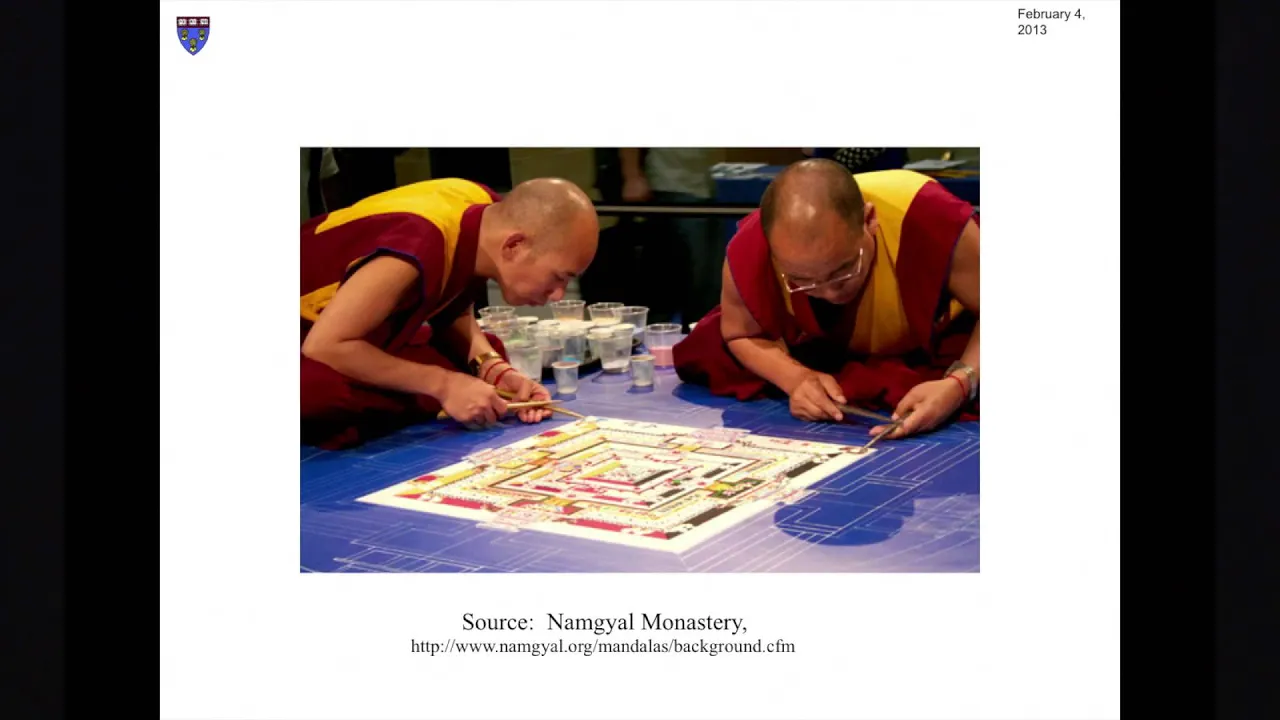
As a matter, this means that a member of the audience, after hearing the performance, is free to perform or record it himself without fear of copyright liability. Here's a hypothetical case that may suggest the scope of the fixation requirement. A mandala is a highly-detailed painting typically made out of fine-grained colored sand by Buddhist monks or priests.
Mandalas represent the dwelling spaces of tantric deities. Most are elaborate, and require a long time to create, but they don't last long. If they're jostled, they disappear.
More importantly, it's conventional, after completing a mandala, to undo it by pouring the sand into a body of water, often a river. Among other things, this custom emphasizes the impermanence of possessions and the importance of not being too attached to them. Traditionally, mandalas were created and dissolved in private religious ceremonies.
Recently, however, the Dalai Lama has encouraged monks to create them in public, in part to educate people about the culture. Some have been created, briefly, in the United States. In the unlikely event that a creator of a mandala sought copyright protection in it, would he trip over the fixation requirement?
In other words, would he lose because this work was not fixed in a tangible medium of expression? Probably not. A mandala is not fixed in the ordinary sense, but it would seem to qualify under the statutory definition.
Its embodiment in sand is, quote, "sufficiently stable to permit it to be perceived or reproduced for a period of more than transitory duration," as is evidenced by the existence of the photo in front of you. Parenthetically, the monk might trip over a separate requirement for copyright-- namely, the originality requirement discussed in Lecture Number One. The reason is that the mandalas created by monks typically replicate traditional designs.
But the fixation requirement would probably not be a problem. Returning, then, to the topic at hand. The primary form of creative work that with some frequency does run afoul of the fixation requirement is choreography.
The reason is that choreographers commonly fail to write down their innovations. In part, this is because it used to be difficult to do so. Dance notation has existed for a long time, but it's cumbersome and incomplete.
Nowadays, it's easier to fix a choreographic work. The standard method is to videotape a rehearsal. Nevertheless, some choreographers still forget this.
In the United States, the result is that they forfeit copyright protection. Stepping back from this example. What underlies the fixation requirement in general?
There are two standard answers. But neither is particularly persuasive. The first answer is that the language of the constitutional provision that, in the United States, underlies copyright law, limits its scope to, quote, "writings.
" An ephemeral work, it is sometimes said, does not qualify as a writing. In light of how broadly the term writing is construed in other contexts-- to incorporate, as we've seen, software and photos, for example-- this textual argument seems weak. The second explanation is that there's an important policy underlying the requirement of fixation-- namely, that it serves a evidentiary function.
Supposedly, it forces authors and artists to write down their works and the result is to provide judges and juries who are called upon to resolve subsequent disputes good information concerning what exactly those works contained. This argument is a branch of a policy argument one finds in many fields of the law. The basic idea is that formalities have important social functions.
So, for example, the rule found in many jurisdictions that a will indicating who gets your property on your death must be written down and signed by two disinterested witnesses serves to caution people concerning the importance of what they're doing when they create wills, channels their behavior into standard forms that are more easily implemented, and, again, provides good evidence concerning what they intended. The conventional justification of the fixation requirement in copyright law fits easily into this family of policy arguments. That conventional justification is also, however, vulnerable to the standard retort-- namely, that formalities are largely ineffective if people are unaware of them, which tends to happen when people are not, quote, "repeat players.
" If many artists-- and many choreographers in particular-- are unaware the fixation requirement, it's unlikely to have a socially beneficial disciplining effect. A further indication that the fixation requirement is unnecessary can be gleaned from the fact that most countries apparently get along just fine without it. So that's enough for now on literary and dramatic works.
We'll turn next to music.


![Upbeat Lofi - Deep Focus & Energy for Work [R&B, Neo Soul, Lofi Hiphop]](https://img.youtube.com/vi/THh4fT0O7IY/maxresdefault.jpg)


![Upbeat Lofi - Power and Energize Your Workday - [R&B, Neo Soul, Lofi Hiphop]](https://img.youtube.com/vi/ONcY0BM5EAg/maxresdefault.jpg)