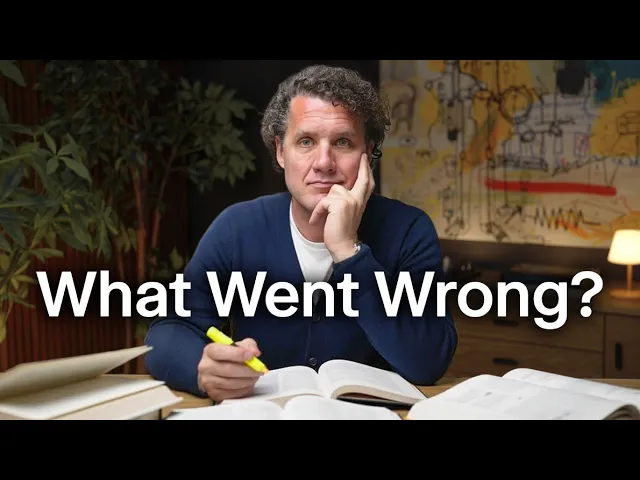
You were the smart kid, the one who aced the tests without trying. The one everyone came to for advice and help. And now you're sitting here all alone on your couch, probably in your 20s or 30s, feeling stuck, watching people who you used to outperform zoom past you in life, wondering what the went wrong, and you can't explain why.
On paper, you're super capable. You're smart. You're talented.
But in reality, you feel like you're watching life through a window while everyone outside is actually living it. You thought intelligence was your superpower. You thought being naturally good at things meant you'd naturally succeed at life.
You thought that early academic success was a preview of your inevitable lifelong awesomeness. But subtly, quietly, something was going wrong the entire time. In this video, I'm going to explore the hidden psychology of why smart kids often struggle as adults, how your greatest strength can often become your greatest weakness, and most importantly, how to break free from the prison of your own unfulfilled potential.
At 18 months old, William James Situs could read the New York Times. By age three, he had taught himself Latin. By five, he'd written a treatise on anatomy and could speak eight languages.
His IQ was later estimated to be between 250 and 300, possibly the highest ever recorded. At age 9, he passed the MIT entrance exam, though Harvard made him wait until he was the ripe old age of 11 to be able to enroll. This still made him the youngest person ever admitted to Harvard.
The media went wild at the time. Newspapers called him the wonder boy and followed his every move. At 11, he gave a lecture to Harvard's math department on four-dimensional bodies that left professors stunned.
His parents, particularly his father, Boris, paraded him as proof that genius could be manufactured through proper education. But the cracks were already starting the show. Situs was bullied relentlessly.
He told reporters that he wanted to live the perfect life. which to him meant complete isolation from others. At his graduation, he announced that he would never marry, saying he detested the idea of any intimate relationship.
The adult Situs became everything people in his childhood hadn't predicted. He took deliberate steps to destroy his reputation as a genius. He worked as a bookkeeper for $23 a week, collected street card tickets obsessively, and wrote under pseudonyms about mundane topics.
When employers discovered who he was, he would quit and disappear. He was arrested at a socialist rally in 1919 and his parents had him institutionalized briefly in a sanitarium. He spent the last decades in hiding, living in boarding houses, avoiding anyone who might recognize him.
When a magazine tracked him down in 1937 and published a mocking article about the fallen prodigy, he sued for invasion of privacy and then lost. He died in 1944 of a cerebral hemorrhage alone in his rented room with no friends or family present. He was 46.
William Situs should have been a cautionary tale, but it's taken nearly a hundred years to process what actually went wrong. To understand, we must look at the childhood brain and how our identity develops. Most people don't know, but it isn't until around age two that a child first has a conception of self.
It's around this age that you start recognizing yourself in mirrors, realizing that there's suddenly a me that is separate from everyone else. By age four, you are able to describe yourself, but only in really concrete terms. statements like, "I have brown hair," or, "I live in a blue house.
" But then something fascinating happens between ages five and eight. Your brain starts to develop what psychologists call trait thinking. The ability to see patterns and behavior and create stable concepts about yourself.
This is when that teacher's comment of, "Wow, you're so smart," stopped being just words and actually became a psychological architecture within your mind. Your developing brain literally built neuropathways around this concept. Every time you got praised for being smart, those pathways got stronger, like a river carving deeper into rock with each passing season.
By middle childhood, around ages 8 to 11, you entered what Eric Ericson called the industry versus inferiority stage. You were comparing yourself to your peers constantly, desperately trying to find where you excel. Your brain was asking, "What makes me special?
What makes me valuable? What makes me me? " And because your prefrontal cortex, your brain CEO that handles complex thinking, wouldn't be fully developed for another 15 years, it settles on simple answers.
Now, these are not obvious choices. You didn't wake up one day and decide, "I shall now build my entire personality and identity around being smart. Instead, your brain simply noticed patterns.
When I do well on tests, adults smile at me. When I know the answer, I feel powerful. When others struggle and I don't, I matter.
" Your brain, always efficiency seeking, consolidated these experiences into a single concrete identity. I am the smart one. And here's where it gets really interesting as well as a bit tragic.
Once your identity is formed, your brain developed what psychologists called confirmation bias. I would call it confirmation bias on steroids. It starts by filtering all experiences through this singular lens.
I am the smart one. Got an A? It's proof that you're smart.
Struggled with something? Better to avoid it. It's for stupid people.
Other kids asking for help validates your identity. Nobody asking for help threats your identity. They must be stupid.
By adolescence, when your brain is undergoing a second major reorganization, these childhood identities should theoretically become more complex and nuanced. You should have been able to think, "I'm good with some things, struggling with others. " And hey, that's okay.
But if you'd spend a decade protecting and reinforcing your simple identity that you're smart, your adolescent brain just doubles down on it instead. The identity stops being something that you have and instead becomes something that you are. This is the identity trap.
An adaptation that was perfectly reasonable for your seven-year-old mind, becomes a prison for your 27-year-old mind. The very mechanism that helps you as a child make sense of the complex world becomes a wall that now keeps you from fully experiencing it. Which brings us to the sponsor of this video, Grammarly.
Grammarly takes difficult writing and makes it easier. Whether you're submitting a job application, writing a memo to your boss, or just publishing your work on the internet, Grammarly is like a patient writing coach and editor. Over 96% of their paying users say that it improves their writing dramatically.
Now, Grammarly works wherever you work. So, there's no copy and pasting, unlike other AI tools. They provide highquality suggestions and understand your context and personality to make sure that you sound the way you want to sound, no matter who you're talking to.
My team and I have found all sorts of uses for Grammarly in our business. From using their AI chat to write social media captions to team memos to brainstorming YouTube script ideas. Grammarly's reader reactions tool can help anticipate readers and viewers critical questions.
The Grammarly keyboard can help me modify the tone of my Slack messages or other writings. And the humanizer feature always makes sure I sound like a natural person. Sign up and upgrade the Grammarly Pro to level up your productivity.
You can use my link below to get 20% off Pro at grammarly. com/mansson2. Now, here's the problem that nobody explained to you when you were getting all those gold stars.
While you were carefully curating your experiences to maintain your smart identity, everyone else was learning something far more valuable. They were learning how to try at something, it up, work a little bit harder, and stick with it. They were learning the most fundamental skill of life, how to struggle well.
This is why today psychologists and parenting experts tell us to praise our children not for their skills or traits but for their effort. Because you don't want to reinforce a child's identity based on their ability. You want to reinforce their identity based on their willingness to try.
Because it turns out that things like tenacity, effort, and the ability to improve are themselves skills. Arguably the most important skills that any of us can develop. They're the meta skills that make all other skills possible.
But you never develop these skills because after all, you're the [ __ ] smart kid. And smart kids don't have to develop skills. They're the smart kid.
You spent your early life avoiding failure like it was radioactive. Every time you encountered something difficult, you had two choices. Struggle and risk exposing that you're not actually that smart, that you're not actually who you thought you were, and that's terrifying, or pivot, avoid, and move on to something easier to maintain your illusion.
You chose the illusion. And unless you are an absolute genius, and I'm sorry to say, but statistically you're not, at some point as you were growing up, you hit a wall. You reached a level where things did not come so easily anymore.
Where success required some degree of failure, embarrassment, and tenacity. But unlike your peers, you had not developed these skills. You'd spent your entire adolescence avoiding the very experiences that were necessary to build them.
So what did you do? You focused on a handful of things you were already good at. You specialized.
You narrowed. You retreated into your comfort zone and told yourself that you were being strategic. But here's the brutal truth.
Those things that you were good at, they don't actually matter in the real world. that AP exam that you aced, history test you dominated, the chemistry quiz that you finished in half the time without reading the book. When you're an adult trying to navigate a career to build relationships, to solve real world problems, nobody cares.
The real world rewards completely different things than your childhood does. It rewards persistence in the face of failure. It rewards the ability to collaborate with annoying people.
It rewards emotional regulation under difficult circumstances. It rewards humility to learn from people who know more than you. And you never developed any of those skills because you were too busy protecting your identity as the smart one.
For this reason, smart kids often grew up feeling profoundly isolated. And this isn't a coincidence. Not because everyone was too dumb to understand you, but rather because you never learned how to be vulnerable and admit weakness, therefore never allowing your relationships to become more than surface deep.
As a result, gifted kids often grow up surrounding themselves with mediocre people, not because they're consciously arrogant, but because those are the only relationships that feel safe. The midwits around them allow them to perpetuate their sense of easy superiority. But in the real world, your network matters more than almost anything.
The people who succeed are rarely the smartest. They're the ones who build genuine relationships with other capable people. They're the ones who can collaborate, who can follow when necessary, who admit when they don't know something.
The gifted kid ends up cut off from the best opportunities because they've surrounded themselves with people who make them feel smarter rather than people who make them better. And to make this worse, the gifted kid doesn't know how to solve these issues emotionally. So, they double down on solving them intellectually.
They study evolutionary psychology and social statistics to try to understand group dynamics. They read books about charisma and practice conversational techniques in the mirror instead of in real life. They become chronically online, obsessed with obscure political and cultural issues, replacing their lack of genuine connection with a cheap feeling of social significance.
But this doesn't help. It only removes them further from intimacy and causes them to feel more alone. For example, Bobby Fischer became the youngest chess grandmaster at 15.
He defeated the Soviets in the world championship in 1972, becoming an American hero. Congratulations. How you feel, babe?
Tell us how you feel about it. With an IQ of up 187, he was undeniably brilliant. But he saw chess as psychological warfare, famously saying, "I like the moment when I can break a man.
" Oh, the greatest pleasure. Well, when you break his ego, this is where it's at. Yeah.
His inability to connect with humans ended up destroying him. After becoming world champion at 29, he forfeited his title and disappeared for 20 years. When he resurfaced, he was ranting about Jewish conspiracies despite the fact that he was Jewish.
Praising 9/11 and living in exile, hiding from US authorities. He died alone in Iceland in 2008, refusing his own medical treatment with no real friends. His reported last words were, "Nothing is as healing as the human touch.
" A tragic recognition from a man who spent his entire life avoiding exactly that. Fisher conquered chess, but he never learned to connect with another human being as anything but an opponent to crush. You could say he won everything at chess and lost everything at life.
And then of course there comes the rationalization, the elaborate theories of why you're alone. Nobody understands you because you're too deep for them. Clearly, people are threatened by your intelligence.
Clearly, society doesn't value real thinkers anymore. Clearly, the world is unjust and completely up. Clearly, the system is rigged against people just like you.
And finally, the identity erects its biggest and most indestructible wall. None of this is my fault. I'm the victim.
The world failed to recognize my gifts. People are too shallow to appreciate what I have to offer. And this mindset doesn't just keep you stuck.
It makes you repellent to anyone who could actually help. So, how do you fix this? How do you escape the smart kid trap that's been suffocating you for decades?
First, stop identifying as the smart kid. That means admitting that you might be dumb. And I mean really admitting it, not just saying it while secretly believing that you're brilliant for being smart enough to admit it or thinking that you're smart by admitting it while being smart enough to admit it while being smart.
Look, let me put this straight. You're a [ __ ] idiot. And that's okay.
People will still love you. I will still love you. But you need to hear it from somebody.
Okay? You're a [ __ ] [ __ ] How do I know? Well, if you were really that smart, wouldn't you have the life that you want?
Intelligence isn't fixed. It's not some character stat that got rolled into you when you were born like a World of Warcraft character. It's a collection of multiple skills.
And like any skills, they develop through practice, failure, and growth. The moment you stop protecting your smart identity is the moment you can actually start doing things required to become smarter. Second, assume everyone else knows something that you don't.
Why? Because they do. When you meet someone new, stop trying to establish your intellectual dominance like a silverback and just listen.
Nobody cares that you mined Bitcoin for a hot minute in 2012. No one cares that you actually read Napoleon's letters and figured out that half of them were counterfeit. Nobody cares that you prefer French bread made in Switzerland instead of in France.
Let people discover your capabilities naturally. Or better yet, let them never fully know. Be mysterious.
Be human. Be something other than smart. What if you listened more than you spoke?
What if you asked questions you don't know the answers to? What if you let yourself be taught something? Third, doing this will force you to embrace discomfort and imperfection.
Not in some abstract philosophical way, but practically and obviously. In other words, you will have to look stupid sometimes in front of people. It's okay.
Let it happen. Join that pottery class and make terrible ceramics. Go to that dance lesson and step on someone's foot.
start that project you've been putting off and let it be messy and imperfect and human and then give up on it. The goal isn't to become good at these things, though you might think it is. The goal is to teach your nervous system that you can survive while being bad.
That your worth isn't tied to your performance. That people are not going to abandon you if you're not super duper impressive all the time. This isn't massochism, it's medicine.
Every time you fail publicly and survive, you're rewiring your brain, teaching it that failure is not death, that embarrassment is not exile, that being bad at something doesn't make you worthless. And here's what nobody told you when you were young. Being average at most things isn't a failure.
It's called being normal. It means you can try without the weight of expectations. That you can explore without the fear of falling from your pedestal.
You can be curious without needing to be an expert. The people you watch succeeding around you, they're not succeeding because they're smarter than you. They're succeeding because they're willing to be dumb.
They're willing to ask obvious questions and they're willing to fall on their face and get back up and do it again.