Over 60? Walking may be helping you, but not protecting you the way you think. Because walking is good.
It gets your blood moving, keeps your joints active, and gives you a sense of routine. But here's the problem most older adults are never told. Walking mostly trains your body to move forward.
It does not fully train the strength, balance, posture, hip stability, and reaction speed that protect your independence after 60. And this is where things get serious. The CDC recommends that older adults do more than aerobic activity.
They also need muscle strengthening and balance exercises every week. Why? Because falls are one of the biggest threats to independence later in life.
And more than one in four older adults falls each year. That's not a small detail. That is a warning.
The exercises in this video are not complicated. They do not require a gym. And they are not about working out harder.
They are about training the systems walking leaves behind. The calves that stabilize your ankles, the hips that protect your balance, the core that supports your spine, and the glutes that power every step you take. And make sure you stay until number one.
Because the final exercise may be the missing piece behind weaker legs, lower back strain, and slower walking after 60. Before we start, drop your age and where you're watching from in the comments. I always like seeing who's here with us, especially everyone over 60 who's still working to stay strong and independent.
Now, let's begin with number six. Number six, wall or incline push-ups. Wall or incline push-ups may look too simple to make a real difference.
But for adults over 60, this is one of the safest ways to rebuild upper body strength without getting down on the floor. And this matters because walking does almost nothing for your chest, shoulders, arms, and upper core. Over time, when these muscles weaken, the body often starts to fold forward.
The shoulders round in. The head moves forward. The upper back becomes stiff.
And posture is no longer just about appearance. It can affect breathing, balance, and how steady you feel when you move. A Cochrane review by Liu and Latham analyzed 121 randomized controlled trials with about 6,700 older adults, and found that resistance training improved strength and physical function.
For someone over 60, that means more than stronger arms. It means pushing, supporting, carrying, and moving through the day with more control. Here's how to do it.
Choose a solid surface at about chest height, such as a wall, a fixed park railing, or a sturdy outdoor exercise bar that does not move. Place both hands on the surface about shoulder width apart. Step your feet back slightly so your body forms a straight line from your head to your heels.
Slowly bend your elbows and bring your chest toward the surface. Then press back smoothly until your arms are straight again. Start with five to 10 repetitions.
The higher the surface, the easier the exercise. A wall is usually the easiest version. A fixed railing or outdoor bar at chest height can make it slightly more challenging.
Choose the height that lets you move with control and without pain. Do not use anything loose, shaky, or unstable. The surface must be solid before you begin.
You do not need to hold the position. The real goal is slow, steady control. Keep your belly gently tightened, your shoulders relaxed, and your neck long.
Do not let your hips sag, and do not rush the movement. This exercise helps rebuild the upper body strength, posture, and support that walking alone does not train. Now, let's move to number five, where we train the brain and legs to work together again.
Number five, standing marching in place. Standing marching in place may look like a warm-up, but after 60, this movement trains one of the most important systems for staying steady, coordination. Because balance is not only about standing still.
Real balance happens when you move. It happens when you turn in the hallway, step around a chair, climb onto a curb, or catch yourself after your foot lands a little wrong. And that is where many older adults begin to notice a change.
The legs may still move, but the timing feels slower. The steps feel shorter. The body needs one extra second to feel secure.
A 2021 cluster randomized clinical trial by Sitthiracha and colleagues tested progressive step marching in 60 older adults, 30 in the exercise group and 30 in the control group. After 8 weeks, the exercise group improved balance, lower limb strength, quality of life, and fear of falling compared with normal activity. For someone over 60, that means marching is not just moving your knees up and down.
It trains the timing between your brain, your legs, and your balance system. >> [clears throat] >> Here's how to do it. Stand tall beside a sturdy chair, counter, wall, or railing.
Keep one hand close to support if you need it. Slowly lift your right knee, lower it with control, then lift your left knee. Let your arms move naturally, like you are walking with purpose.
Start with 30 seconds. Rest, then repeat for two or three rounds. The key is rhythm, not speed.
Do not rush through it. Keep your chest lifted, your eyes forward, and your feet landing softly. If your body starts swaying too much, lower your knees slightly.
If it feels too easy, increase the time or lift the knees a little higher. And pay attention to the arm movement. When your right knee lifts, your left arm should move forward.
When your left knee lifts, your right arm moves forward. That opposite arm, opposite leg pattern helps reconnect the walking rhythm. This exercise trains your nervous system, your legs, and your balance at the same time.
But number four targets a direction most seniors almost never train. And it may be the direction that matters most during a fall. Number four, lateral leg raises.
Lateral leg raises do not look impressive, and that is exactly why so many people ignore them. But after 60, this movement trains something walking does not fully protect, side-to-side stability. Most daily movement happens forward.
You walk forward, climb forward, and stand up facing forward. But real life is not always straight ahead. You turn in the kitchen.
You step around furniture. You move sideways in the bathroom. You catch yourself when the body suddenly shifts to one side.
And if the side of the hip is weak, that small shift can become dangerous very quickly. The main muscle here is the gluteus medius, located on the outside of your hip. Its job is to keep your pelvis level every time you lift one foot off the ground.
When this muscle is weak, the hip may drop, the body may lean, and your walking pattern can become less steady. A 2020 diagnostic accuracy study by Gaffney and colleagues, published in Clinical Interventions in Aging, compared older fallers with non-fallers and found that hip abductor strength helped distinguish between the two groups. For someone over 60, that means side hip strength is not just a fitness detail.
It is part of the system that helps you stay upright when balance shifts sideways. Here's how to do it. Stand behind a sturdy chair or next to a fixed railing and hold it lightly.
Keep your body tall. Slowly lift your right leg out to the side, only as far as comfortable. Pause briefly, then lower it slowly.
Do 8 to 12 repetitions, then switch sides. The most important detail is this. Do not lean your body to make the leg go higher.
Keep your torso steady. The movement should come from the side of the hip, not from swinging or twisting. Keep your toes pointing forward, your standing knee soft, and your belly gently active.
Move slowly enough that you can actually feel the hip working. This exercise helps with turning, side-stepping, balance recovery, and walking with more control. Now, number three may look even smaller, but it trains one of the most important balance systems in your entire body.
Number three, standing heel raises. Standing heel raises may be one of the smallest movements on this list, but do not underestimate what they train. After 60, your calves and ankles become critical for balance, circulation, and the quick corrections your body makes before a small stumble turns into a serious fall.
Your calf muscles are not just for walking. They help push blood back up from the legs toward the heart. They help you rise onto your toes.
They help you climb stairs. And most importantly, they help control those tiny forward and backward shifts that happen every time you stand, turn, or take a step. Fujiwara and colleagues published a controlled heel raise training study in the Journal of Strength and Conditioning Research in 2011.
Elderly women were divided into a heel raise training group and a control group. After 2 months, the training group showed increased soleus thickness and improved postural control, while the control group did not receive the same training effect. For someone over 60, that means heel raises are not just a calf exercise.
They train the ankle and calf system your body uses to stay steady. Here's how to do it. Stand behind a sturdy chair, counter, fixed railing, or wall.
Place your feet about hip-width apart. Keep your hands lightly on the support, not gripping tightly. Slowly rise up onto the balls of your feet as high as comfortable.
Pause briefly at the top. Then lower your heels slowly. Do not drop down quickly.
That slow lowering phase is where your calves learn control. Start with 10 repetitions. As you get stronger, work toward 15 or 20.
If both feet become easy, you can shift a little more weight into one leg. But only if you feel safe and steady. The key detail is posture.
Keep your chest lifted, your eyes forward, and your body tall. Do not stare down at your feet the whole time because your balance system needs to learn to work without depending only on your eyes. This exercise can help with stairs, standing longer, walking more confidently, and feeling more stable through your ankles.
Now, number two takes that lower-body strength into a real-life movement most seniors face every single day. Number two, low step-ups with support. Low step-ups may look ordinary, but this is one of the most practical exercises for anyone over 60 because daily life is full of small steps, stepping onto a curb, climbing porch stairs, getting into a bus, or moving from one level of the house to another.
And here is the problem. Walking on flat ground does not fully prepare your body for stepping upward. A step requires more strength from your thighs, glutes, hips, and calves.
It also requires balance because for a moment, your body has to shift weight onto one leg and control the movement without tipping forward or sideways. A randomized trial by Van Roy and colleagues, published in the Journal of Strength and Conditioning Research, assigned 46 older adults to either stair climbing exercise or machine-based resistance training for 12 weeks. The stair climbing group improved stair ascent performance more, while both groups improved functional capacity measures like fast walking and repeated sit-to-stand performance.
For someone over 60, that makes step-ups more than a leg exercise. They train the exact movement pattern used for stairs, curbs, and daily independence. Here's how to do it safely.
Use a low step, like the bottom stair in your home. Stand near a railing, wall, or solid support. Place your right foot fully on the step.
Press through the whole foot and slowly step up. Bring the left foot up beside it. Then step back down with control.
Do five to eight repetitions leading with one leg, then switch sides. The key is control, not height. Do not use a step that is too high.
Do not pull yourself up with your arms. The railing is there for safety, not to do the work for you. Keep your knee pointing in the same direction as your toes.
If your knee collapses inward, slow down or use a lower step. This exercise builds real-world leg strength. It helps with stairs, curbs, balance, and confidence.
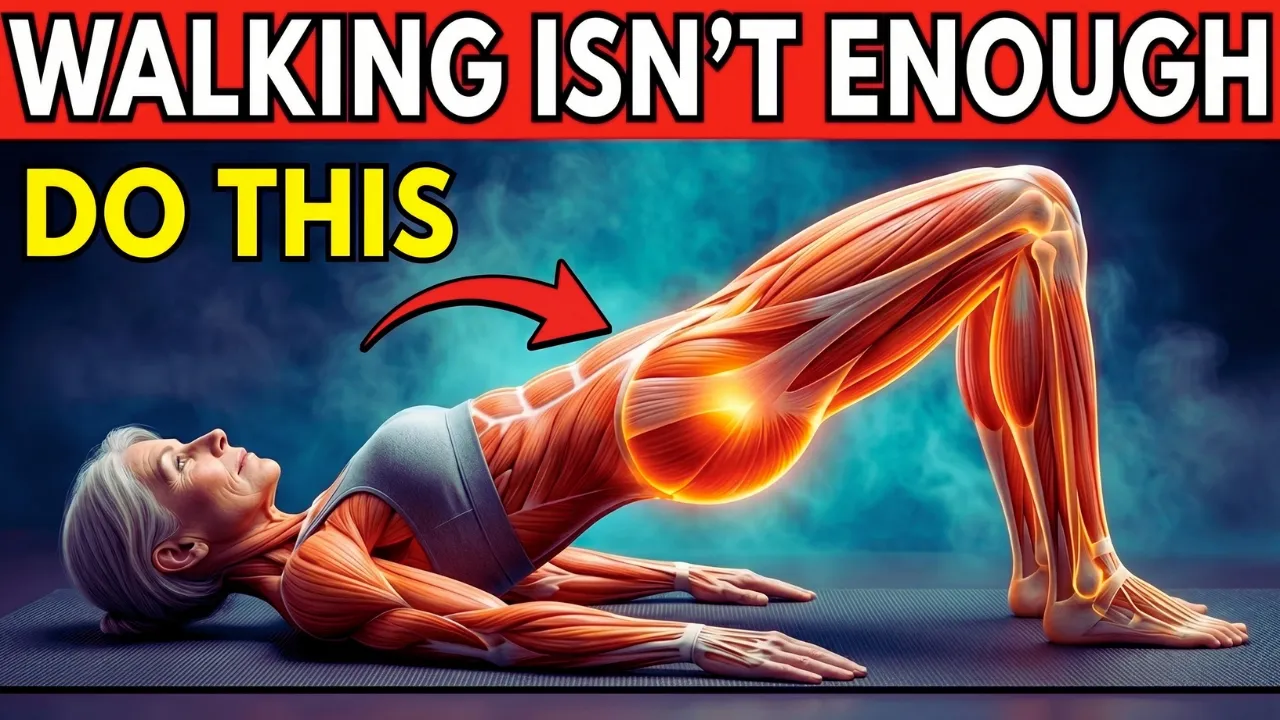
But number one is the movement I saved for last, because it targets the hidden weakness that can change the way you walk, stand, and protect your lower back. Number one, glute bridges. And now, the movement I saved for last, glute bridges.
This exercise may not look dramatic, but it targets one of the biggest hidden problems after 60, weak or underactive glutes. Most people think slower walking comes only from weak legs, but very often the problem starts higher at the hips. When the glutes stop doing their job, the lower back begins to compensate.
The hips feel stiff. The knees may take more stress. Your stride can become shorter, flatter, and less powerful.
And over time, even standing tall can feel harder than it should. You and You published a 2012 study in the Journal of Physical Therapy Science with 20 elderly participants, comparing muscle activity during three different bridge exercise conditions. They measured the L5 paraspinal muscles, external oblique, and gluteus maximus, showing that bridge variations activate both the glutes and trunk support muscles.
For someone over 60, that matters because these are the muscles that help control the hips, pelvis, and lower back when you walk, stand, or climb stairs. Here's how to do it. Lie on your back on a firm, comfortable surface with your knees bent and your feet flat on the floor, about hip width apart.
Rest your arms by your sides. Gently tighten your belly. Press through your heels, and slowly lift your hips until your body forms a straight line from your shoulders to your knees.
Pause briefly at the top, then lower slowly with control. Start with six to 10 repetitions. The key is to feel the movement in your glutes, not your lower back.
Do not arch too high. Do not push through your toes. Do not rush the movement just to finish more repetitions.
If getting down to the floor is difficult, make sure you have safe support nearby or choose a firm surface where you can get up easily. Safety comes first. This exercise helps wake up the muscles that power each step, support your hips, and reduce unnecessary strain on your lower back.
And that is why glute bridges deserve the number one spot. Walking moves you forward, but strong glutes help make that movement safer, stronger, and more stable. So, the point is not that walking is wrong.
Walking is still valuable, especially if it helps you stay active every day. But after 60, so walking alone may leave important systems undertrained. The muscles that help you push, step up, balance sideways, control your ankles, coordinate your movement, and support your lower back.
That is why these six exercises matter. They are not complicated, and they do not require a gym. They simply give your body the kind of strength and control that everyday walking does not always provide.
Start with the safest version. Use a wall, railing, chair, or solid support when needed. Move slowly.
Keep the range comfortable. And remember, the goal is not to prove how much you can do today. The goal is to give your body the right signal consistently.
After 60, your body can still respond. Strength can improve. Balance can improve.
Confidence can return one small movement at a time. Now, tell me in the comments which exercise are you going to try first? And what feels harder for you lately?
Stairs, balance, walking longer, or lower back strength? Thanks for watching, and I'll see you in the next video.