this is the video for the standard level content from d1.1 on DNA replication now when we talk about replication what we really mean is producing a copy so we want to take one DNA strand make an exact copy with identical base sequences there's a few reasons why this is important one of which is reproduction so passing that hereditary information along to offspring and the other is for growth and repair so this is when we need to produce new cells to replace old cells and of course if the if the goal is to make a new
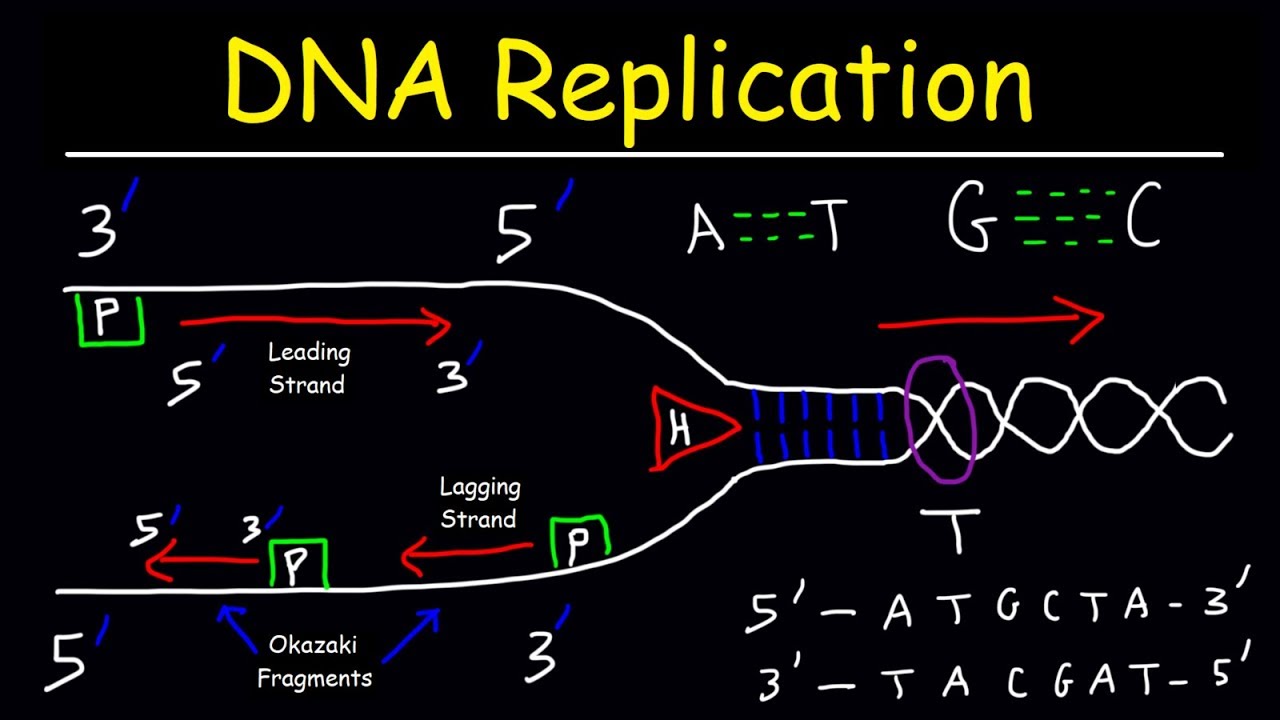
copy of a cell one of the first things we need to do is copy that DNA DNA replication like many processes relies on this idea of complimentary based pairing and complimentary based pairing adenine pairs with thymine and cytosine pairs with guanine there are hydrogen bonds between them now in replication what's going to happen is we're going to have a parent strength Strand and we need to use that as a template to create the New Strand we'll talk about the mechanism in more detail in a little bit but those hydrogen bonds are going to break the
parent strand is going to come apart and then the parent strand is used as a template for creating a new strand okay so I'll do that here in green and this is very important because this follows the rules of complimentary base pairing I'm going to end up with two identical molecules each with one parent Strand and one New Strand and of course those hydrogen bonds would form between them okay so they would go in between here in these nucleotides now this is called semiconservative replication okay each DNA molecule that I've made again consists of one
original Strand and one New Strand there are two very important enzymes involved in that process so first we'll talk about helicase helicase is an enzyme that is going to break the hydrogen bonds between the two parent strands so a lot of students think of this as unzipping the DNA I prefer to use the term separating the parent strands by breaking that hydrogen bond and it also helps to untwist that double helix again once those parent strands have been separated we need another enzyme to actually add those free nucleotides and that is going to be DNA
polymerase so DNA polymerase will be the enzyme that adds new nucleotides creating a bond okay between the phosphate of the free nucleotide and the sugar of the nucleotide that's already in the Strand so we can think of this as like the breaker and the Builder and an easy way to remember that these are both enzymes is that they end in as so helic case breaking those strands apart by breaking the hydrogen bonds DNA polymerase adding those nucleotides using the rules of complimentary base pairing and again um we're going to need to form a bond between
the phosphate of one and the sugar of another great application of our knowledge of replication is something called PCR PCR stands for polymerase chain reaction and it amplifies the DNA sample so that's an a word I want you to keep an eye on here amplification of DNA that means that we're just creating a lot of copies we're increasing the size of the sample dramatically and so it comes in a few steps instead of adding um helicase to that DNA sample to break the parent strands apart heat is used so heat is one of the things
that can break hydrogen bonds so that sever the hydrogen bonds between the parent strands we also need to add in a primer a primer is a short segment of DNA that signals where to start copying so it identifies the the starting point for the replication process along with that we're going to need to add free nucleotides and we need a polymerase enzyme so we're going to add a special type of polymerase called Tac polymerase Tac refers to the bacterium that this polymerase was extracted from why do we have to use polymerase from this bacteria why
can't we just use human DNA polymerase well remember it's very hot so when we add that heat to break the hydrogen bonds that heat would normally denature any kind of enzymes that are there but Tac this bacteria um lives in these hydrothermal vents and it is well adapted to hot conditions including its enzymes so it is a very heat tolerant DNA polymerase and so at that point once we have the separated parent strands we have all these free nucleotides we have the TAC polymerase then replication will ensue as normal and so we get this amplification
of DNA when lots of copies are made while PCR allows us to amplify the sample gel electropheresis is a process that allows us to separate samples of DNA and it separates them based on length so here's how this works you're going to take those uh fragments of DNA and we're going to put them into one end of a porous gel porous means it's filled with tiny holes we're going to apply electricity and it's important that you put the negative electrode at the DNA end so when we think about electrical circuits they have a positive and
a negative end you want to attach the negative electrode to the same end that has the DNA and the positive electrode to the other end and we can see that here in this picture the positive end and the negative end once you do that and you turn the electricity on that negative end of your electrode is going to repel the DNA and it's going to push it through your gel and that is because DNA is also negative so the negative DNA is repelled by that negative electrode and it forces the DNA through the pores shorter
fragments of DNA are going to travel farther through the gel because they're better able to get through those pores larger fragments of DNA are going to get stuck closer to where you put them to begin with one of the applications of this process is testing for Corona viruses so if I want to find out if a Corona virus is present um in an organism I need to take a swab like a throat swab or a nasal swab and I want to isolate the viral RNA so that virus doesn't use DNA as it's genetic material it
uses RNA but wait I need DNA so I'm going to do something called reverse transcription so that's when we are going to take RNA and use that to make DNA and then once I have that DNA I can make lots of copies using PCR so that's going to to allow us to amplify that sample and also add certain fluorescent dyes to different base sequences these are going to be um on really specific base sequences that are characteristic of this specific virus okay now it's very sensitive so that's the good thing these are um a great
um I don't know a very good Pro let's say of the polymerase Chain Reaction but it is unfortunately very expensive and timec consuming the last application that we'll talk about in this video is paternity testing so paternity testing is something that I want to do to figure out the father of a child the biological father now before we practice um identifying that using the banding patterns from Gel electroforesis let's talk a little bit about how we get these banding patterns in each individual we have things called short tandem repeats and these are repeats of a
certain sequence of bases now different people have different numbers of those repeats so for example this individual has seven uh repeats of the sequence AG G A 1 2 3 4 five six seven of those repeats whereas this person only has four and this person has 12 okay and then there are many portions of our DNA that contain these repeats again these are specific to each individual so you want to isolate them we're going to send in enzymes to cut them out and then we're going to use the PCR reaction to amplify that sample to
create a lot of copies of these tandem repeats then we are going to separate them using gel electroforesis and what's very important about this process is that you'll notice because different people have different number of repeats that's going to make different lengths of DNA so this person is going to have a much longer piece of DNA than this person and when they get separated by gel electroforesis that allows us to see a unique banding pattern for each individual now let's practice identifying the parent of this child we know that this child biologically belongs to this
mother now what's cool about children is they get half of their DNA from their mother and half of their DNA from their father so what's not interesting for me is pieces of DNA that clearly come from the mother okay so for example this piece of DNA or this segment of DNA from this child could have clearly come from the mother she has one in the exact same spot what is more interesting are segments of DNA that the child has that could not have come from the mother so for example this piece of DNA right here
in this child could not have come from the mother she doesn't have that number of short tandem repeats in that location however male number one does have that male number two does not have any DNA there so what this tells me is that male number one is in fact the father of this child okay so again what you want to do is look for pieces of DNA that that child could not have gotten from the mother and we want to find a corresponding male now if you take the time to go through you'll find that
every piece of DNA that this child has comes from either the father or the mother and this is how we apply our knowledge of both PCR and gel electroforesis
![D1.1 HL DNA Replication [IB Biology HL]](https://img.youtube.com/vi/OzXIsbkybbk/maxresdefault.jpg)
![D2.1 Cell Division and Mitosis [IB Biology SL/HL]](https://img.youtube.com/vi/i9XPl4ePyxU/maxresdefault.jpg)
![D1.2 Protein Synthesis [IB Biology SL/HL]](https://img.youtube.com/vi/ybso-VivjF8/maxresdefault.jpg)



![D3.1 Human and Animal Reproduction [IB Biology SL/HL]](https://img.youtube.com/vi/nnPd6FVpPvE/maxresdefault.jpg)
![D1.3 Mutations [IB Biology SL/HL]](https://img.youtube.com/vi/HdM5tXf7M-E/maxresdefault.jpg)
![D3.3 Homeostasis [IB Biology SL/HL]](https://img.youtube.com/vi/nKmXluCB6Js/maxresdefault.jpg)
![D2.1 Meiosis [IB Biology SL/HL]](https://img.youtube.com/vi/dpEaR6AUcdQ/maxresdefault.jpg)
![D3.3 HL Role of the Kidney [IB Biology HL]](https://img.youtube.com/vi/Ikmndyc_nMM/maxresdefault.jpg)
![D4.1 Natural Selection [IB Biology SL/HL]](https://img.youtube.com/vi/Rg8TwlaJZFI/maxresdefault.jpg)
![D1.2 HL Protein Synthesis [IB Biology HL]](https://img.youtube.com/vi/dFYBBFEKg6E/maxresdefault.jpg)