Tell a friend to tell a friend. She's back. Welcome back to the Clark updates.
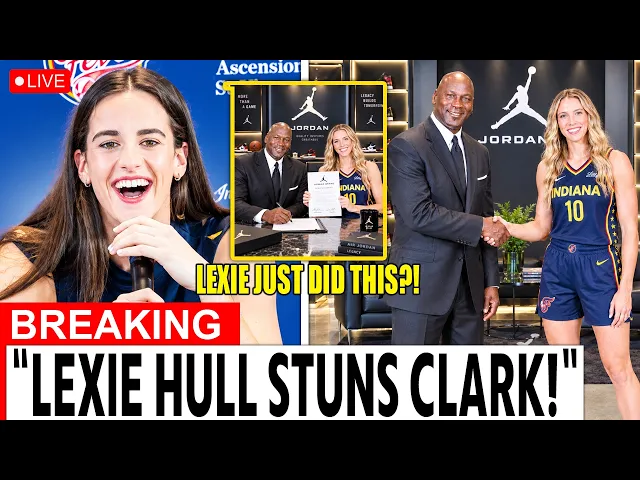
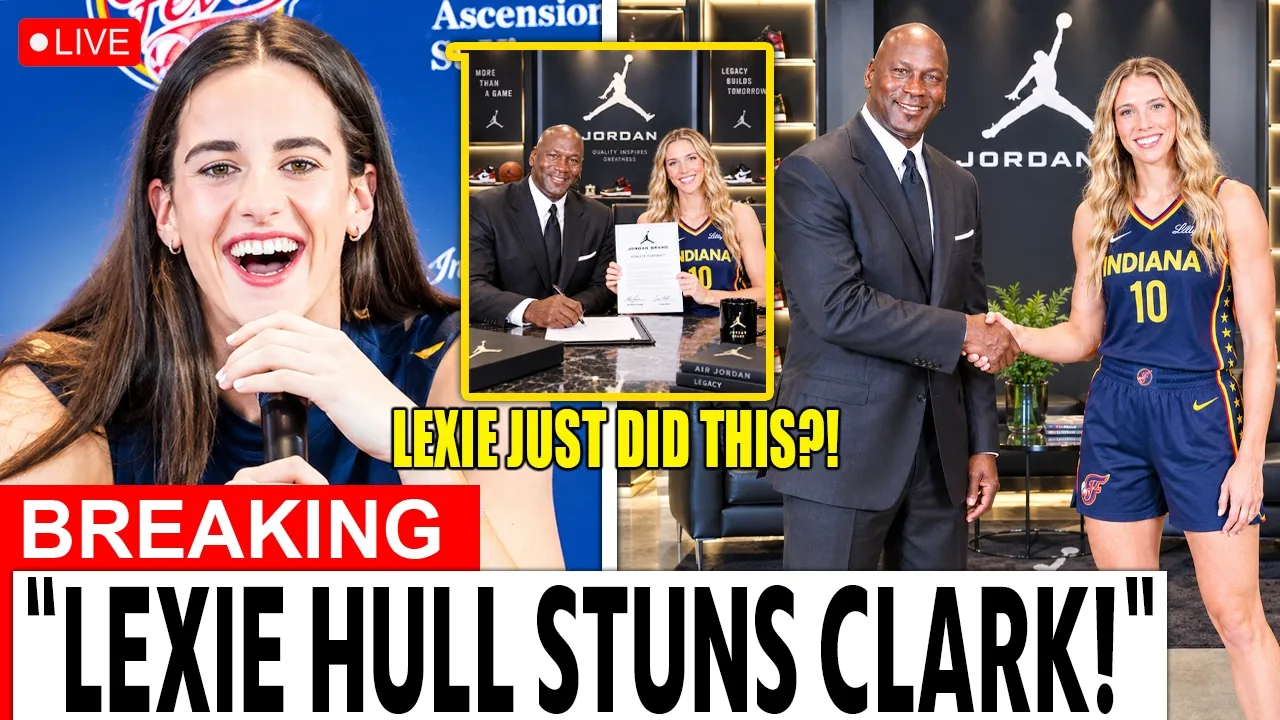
Today we have a huge story involving Lexi Hull, Caitlyn Clark, and a reported $52 million Jordan deal. But what Lexi did for Caitlyn afterward is what nobody saw coming. So what exactly happened and why is everyone talking about it?
Stay with us as we break it all down. Let's dive in. The world of Caitlyn Clark abruptly shifted and it all began when Michael Jordan and Lexi Hull entered the room in an intensely emotional and shocking moment.
The basketball icon and upand cominging talent disclosed an incredible $52 million Nike contract created specifically for Clark. Her eyes grew wide. The audience fell silent.
Fans will never forget the response that ensued. However, why did Hull and Jordan take this action at this time? What does Caitlyn, Nike, and the future of women's sports stand to gain from this historic agreement?
The emergence of an occurrence. Caitlyn Clark had already repeatedly rewrote history long before the confetti fell at the 2024 WNBA draft. She was more than a superb athlete.
The player was her, the beating heart of college basketball for women. Caitlyn transformed routine games into major events starting in her first season with the Iowa Hawkeyes. Something electrifying occurred each time she set foot on the court.
From far beyond the ark, take three steps back. Even the most experienced analysts stopped and stared at the laser's confidence as it navigated narrow passageways. Something amazing has occurred by the beginning of 2024.
In addition to becoming wellknown in every American home, Caitlyn Clark's name had started to reverberate throughout continents. Hours before kickoff, crowds waited in line to see her warm up. Every time her jersey showed on screen, TV viewership skyrocketed.
In reality, in terms of attendance and ticket sales, a number of Caitlyn's college games surpassed NBA games during the 2023 to 2024 season. She created a movement in addition to gaining fans. Her numbers are unbelievable.
Caitlyn Clark broke the NCAA's all-time scoring record in March 2024 inside the boisterous Carver Hawkeye Arena in Iowa City, outscoring all previous players, male or female. The world paid attention. For a moment, it remained motionless.
ESPN provided exclusive coverage. Instant features were introduced by international networks. From digital billboards in Tokyo to serial boxes in the Midwest, her visage could be found every place.
This was no longer just college basketball. Caitlyn Clark was now a worldwide celebrity. Therefore, it wasn't a question of whether she would be selected first on April 15th, 2024, the night of the WNBA selection.
It was the speed at which the Indiana Fever would leap to make the decision. And when they did, it felt more like a coronation than a draft in front of a boisterous audience in Brooklyn, New York. Legends nodded in agreement as the crowd surged and cameras flashed.
However, what came next? The plot really takes a turn at that point because two legendary figures came forward at a time that shocked both fans and insiders. Lexi Hull, a rising talent in the WNBA, and basketball legend Michael Jordan.
Together, they unveiled an unexpected alliance that nobody anticipated. Nike was giving Caitlyn Clark an incredible $52 million deal, not just for shoes, not just for branding, but for an entire empire based on her narrative, her sense of style, and her relentless ascent. In the sports world, what had previously been a whisper about her future turned into a thunderclap.
Caitlyn Clark's expression at that precise moment, captured on camera, told it all. Startled, appreciative, victorious. However, there is more to that arrangement than meets the eye.
A tale of timing, legacy, and how Lexi Hull and Michael Jordan supported a revolution rather than just a player. What happens now if Lexi Hull and Michael Jordan start a revolution rather than just a business deal? To discover out, stay in touch.
Women's sports were rocked by the bidding war. Caitlyn Clark was more than just a basketball sensation by the time she arrived in Brooklyn for the 2024 WNBA draft. She was a phenomenon in marketing.
Corporate behemoths with billion-dollar eyes were already watching every shot she made, every interview she did after the game, and every stride she took while wearing sneakers. Fans weren't the only ones thrilled by her rise. The global endorsement machine had been fully activated.
The fight to sign Caitlyn Clark was intense and involved boardrooms all across the world. Behind the scenes, rumors of huge endorsement offers were circulating in early March 2024. In addition to signing a player, Nike under rower, Adidas, and Puma entered the market to sign the most powerful female basketball player.
Every brand was aware of the risks. Caitlyn Clark was more than just a symbol of exceptional athleticism. In women's sports, she stood for a new age of prominence, fandom, and market dominance.
Under Armour arrived quickly and forcefully attempting offer was exposed in reports that were leaked from its Baltimore headquarters. $16 million spread over four years in addition to the guarantee of a signature shoe, which is uncommon for female athletes of any kind. That was sufficient to garner media attention.
Adidas then made a low-key yet strategic offer. $6 million over a 4-year period. A prototype sneaker that was previously created with Caitlyn's game in mind was another item that caused a stir.
Puma also dabbled on the concept. However, they pulled out of the race when the stakes increased and the numbers surged. It was no longer business as usual.
It was a war. Then, while everyone was holding their breath, Nike took action. It was more than a bargain.
It was a thunderclap. 3 days after the Indiana Fever selected Caitlyn first overall in the draft in April 2024, Nike made an offer that completely changed the game. An 8-year contract with a reported $28 million base.
However, it didn't end there. Performance bonuses, brand royalties, and international activations would raise the deal's worth to an astounding $52 million, according to insiders close to the transaction. Nike didn't end there.
To cement the deal, they brought in two strong forces. Michael Jordan, the great whose Jumpman brand revolutionized the basketball industry, and Lexi Hull, a rising star in the WNBA and astute supporter of fairness in the game. Together, they gave Clark a legacy rather than just a deal.
Caitlyn Clark entered what she believed to be a casual Nike brand meeting at a private event in Los Angeles. Rather, Jordan himself greeted her, accompanied by Lexi Hull, who was carrying a sleek black box bearing her initials. Her first signature prototype is within.
The instant she realized what was occurring was captured on camera. Her eyes widened, bewilderment giving way to tears as her hand shot to her face. The torch was formally passed at that same moment.
What then caused Caitlyn Clark to cry uncontrollably when legends handed her the torch? Keep an eye out. This is something you won't want to miss.
The autograph that made all the difference. Caitlyn Clark unveiled her first signature sneaker, which [music] was bright, sleek, and branded with her name. For her, it was more than just a significant achievement.
It was a moment that reverberated throughout decades of sports history. The world has not witnessed a connection this significant since 1984 when a youthful Michael Jordan inked a historic contract with Nike. However, performance wasn't the only factor this time.
It was about promise, power, and women's sports future. Only a few days after her Brooklyn WNBA draft moment, the announcement was made. Not only was Nike's $52 million offer unprecedented, it included something even more uncommon, a distinctive shoe collection based solely on Caitlyn Clark's personality and sense of style.
As a result, she became just the third player in WNBA history to be awarded this distinction. Even more noteworthy, though, was that she was the first in her professional career to receive it at this early stage. Fundamentally, it was a risky wager.
Nike wasn't merely acquiring a player. They were making an investment in a movement. One that started off with sold out college stadiums and broken scoring records before developing into a fullyfledged corporate powerhouse with a few significant modifications.
It was a contemporary take on the Jordan blueprint. Nike offered more than just a salary when they took a risk on Michael Jordan, an exciting rookie back in 1984. royalties or a portion of each pair of Air Jordan sold were part of Jordan's agreement.
Everything was altered by that particular detail. It helped him develop both as a brand and as an athlete. MJ receives tens of millions of dollars a year from Air Jordan, which is now a multi-billion dollar business.
Not only did the initial contract change Nike, but it also permanently changed sports marketing. In contrast, Caitlyn Clark's arrangement is enormous in scope, but has a different structure. She receives her own shoe, but the contract does not, at least not yet, include royalties on sales, according to sources close to the negotiations.
This implies that even while Clark's name, image, and likeness drive the brand, Nike still controls the revenue. Not everyone was pleased with that particular aspect. The former Nike executive who assisted in signing Michael Jordan in the 1980s, son Ivakaro, publicly commended Caitlyn for her quick ascent and referred to her as one of the most significant athletes of this generation.
However, he also expressed his disappointment without holding back. [music] She ought to have received the full Jordan treatment. In late April 2024, he told reporters, "If anyone deserves ownership in their legacy, it's her.
" Although the fine print sparked controversy, the visual impact was indisputable. At a Nike event in Los Angeles in late April, Caitlyn stood on stage with her trademark shoe next to WNBA player Lexi Hull and Michael Jordan, both of whom had internally lobbied for Clark's elevation. Crowds erupted, cameras flashed, and it became evident that this was more than a deal.
It was a proclamation. But how did Caitlyn Clark's contract with Nike become a daring statement for women's sports? Discover the true implications of Caitlyn Clark's Nike contract for women's sports by watching.
In April 2024, Sunvakaro, the guy who helped make Michael Jordan a worldwide celebrity, made a statement that went beyond sneaker culture. They set the entire sports industry on fire. Caitlyn Clark was not being criticized by Vicero.
He was giving her a lot of praise. At a round table with a media in Los Angeles, he stated that she ought to have received royalties or equity instead of just the check. She is changing culture, not just selling shoes.
And it's hard to argue with him. At age 22, Caitlyn Clark had already exceeded most endorsement veterans. Her highlights swamped social media.
Her name attracted ratings. Her jersey sales surpassed records before she had played a WNBA game. Yet, while Nike's partnership, valued up to $52 million, signified a huge breakthrough for women players, Vicaro claimed it still fell short of the innovative paradigm he helped pioneer with Jordan back in 1984.
They made MJ a business partner. Why not her? That question cut a nerve across the business because Caitlyn Clark's Nike agreement wasn't just a personal achievement.
It became a cultural reckoning. For decades, women's sports had operated in the shadow of the men's leagues. Even when talent, audience engagement, and retail sales clearly demonstrated otherwise, endorsement deals were smaller, media attention came more slowly, and the compensation difference was evident.
Clark's bargain cracked that ceiling. And it wasn't just the number, it was the tone. Nike didn't casually add her to a roster.
They constructed around her. Alongside two Titans, WNBA player Lexi Hall and Michael Jordan, they awarded her a trademark sneaker, which is still uncommon for women in professional basketball. That late April photo taken at Nike headquarters in Beaverton, Oregon, was more than just symbolic.
It was a seismic event. However, it also revealed painful realities. Even though Clark's profits from endorsement skyrocketed, her rookie WNBA contract was only $76,000, less than the price of some NBA front row seats.
A national dialogue was rekindled by the striking disparity. How did one of the most recognizable athletes in the world earn more from one shoe deal than most WNBA players make in a decade? Advocates, athletes, and fans started speaking up.
Comparisons were all over social media. Overnight, articles criticizing everything from TV rights to league contracts to antiquated sponsorship strategies appeared. Even previous athletes entered the discussion, arguing that Caitlyn's contract ought to serve as a warning to the system as a whole, as well as to sponsors.
Despite the disagreement, one thing was certain. [music] Not only was Caitlyn Clark supported, but she was also trusted. Jordan's approach set the standard, but Clark's path may increase it in a new way.
She became evidence that a woman's name could influence markets, sell shoes, and change expectations globally. It was evident that the message was not only being heard, but also being magnified because Michael Jordan and Lexi Hull were standing next to her. Then came Caitlyn Clark, supported by Lexi Hull and Jordan.
Is it possible that this will forever change sports? Watch this space to discover out [music] Nike, Caitlyn Clark, and the recently revealed future. In April 2024, Caitlyn Clark received an 8-year, $52 million contract from Nike, accompanied by emerging WNBA star Lexi Hull and legendary Michael Jordan.
They weren't merely honoring a celebrity. The regulations were being revised. It didn't take long for marketing experts and industry insiders to catch up.
They recognized this right away. A game share for every girl dribbling a basketball at the moment. Not only for Clark, for the entire system of how women's sports are promoted, appraised, and sold to the globe, as well as for every upcoming collegiate star.
Caitlyn's contract has swiftly emerged as the new standard by which all upcoming female athlete endorsement deals will be evaluated. And the explanations go much beyond her numbers. It's her presence, her crossover appeal, and her capacity to illuminate a crowded arena, a screen, or [music] a room.
She is more than simply a baller. She is a brand and a walking advertisement with a worldwide following. Her name has significance every place from downtown De Moines to downtown Tokyo and businesses are now appreciating that worth appropriately.
She was more than just a temporary victory to Nike. She was the focal point of their attention. Writing a viral wave is not the goal of this arrangement.
The play is long-term. Eight years of international marketing strategies, Olympic campaigns, lifestyle branding, social causes, and perhaps even executive partnerships. Caitlyn Clark is more than simply a swoosh representative.
She is contributing to its heritage. The meaning is further enhanced by the fact that Michael Jordan, whose 1984 Nike contract became a global empire, is standing next to her. The model was brought by Jordan.
The movement was started by Lexi Hull. The moment was brought about by Caitlyn. However, the talk isn't limited to what she received.
It concerns the implications of this for future developments. According to experts, Clark's agreement will pave the way for more businesses who had previously been reluctant to fund women's sports are now rushing to reconsider their approach. Why not follow in Caitlyn Clark's footsteps if she can drive ratings higher than some NBA games, sell merchandise, and pull worldwide numbers?
Why not give other female athletes what they really deserve, long-term marketing, equity deals, and signature shoes? However, one aspect of the agreement, the lack of royalties, continues to draw criticism. Clark will make a record-breaking salary, but she won't get a cut of the sales of her signature shoe.
For now, at least. However, observers view this as the new front in the conflict rather than a setback. The subsequent transactions may just move closer to ownership, revenue sharing, and equity if this is the new standard.
Caitlyn Clark now stands for possibility rather than just skill. Additionally, Nike's investment points to a larger initiative, a time when female athletes won't be the exception in the sports industry. They serve as the basis.
Caitlyn Clark isn't just making history either with Lexi Hull's strong support for women in sports at her side and Michael Jordan's illustrious legacy behind her. She is contributing to its future development. Now, the promise of something greater and decades of progress reverberate in every step she takes.
That long overdue future might not be far off. It might already be happening right in front of our eyes. Lastly, what happens when Clark's ascent and Hull's struggle for change collide with Jordan's legacy?
Continue to observe how Michael Jordan, Lexi Hull, and Caitlyn Clark are changing the game's rules. In April 2024, Caitlyn Clark received a record-breaking $52 million contract from Nike, flanked by rising WNBA star Lexi Hull and basketball greats like Michael Jordan. It was more than just a business choice.
It conveyed a message. And perhaps the loudest portion of that statement came from design rather than money. A signature shoe, not a limited edition release or a one-time partnership.
A custom-made sneaker bearing Caitlyn Clark's name, and everything is altered by that. Signature sneakers are an uncommon privilege, even in the world of men's basketball. They indicate more than just skill.
They signify power. They are hardly unknown to women. In reality, Nike acknowledged its active development when Clark sneaker was released.
It will be the first signature sneaker for women's basketball in a number of years. There have only ever been a few. This is the size of it.
The shoe is more than just fashion or athletic wear. It's a cultural transformation encased in logos and laces. Young boys have been idolizing legends through their shoes for decades.
LeBron, Cobes, and Air Jordans. There were souls in their dreams. What about girls, though?
That's the strength of what Caitlyn Clark is producing. [music] Young ladies now have someone who looks like them, plays like them, and leads like them at the top level in gyms all throughout the nation. They will soon be able to put on shoes made just for them by someone who is knowledgeable about their sport.
That's impact, not just marketing. Michael Jordan is fully aware of what that entails. The world's perception of athletes was altered in 1984 when Jordan signed his first contract with Nike.
Performance wasn't the only factor. It had to do with legacy, royalties, and ownership. Jordan's airline grew to be a billion-doll enterprise and served as the model for athlete empowerment in sports marketing.
[music] It was a historic agreement. On top of that foundation, Caitlyn Clark is now constructing something equally significant. Her contract is similar to Jordan's in one important aspect, even if it lacks the royalty clause that turned Jordan into a business tycoon.
Conviction. Nike's 8-year contract, which includes a signature shoe and prominent advertising, demonstrates their long-term commitment to her. She's not working alone.
They're creating a brand around her. During the announcement, Lexi Hull, another representative of the WNBA's future and an unwavering supporter of women in sports, stood alongside Clark and Jordan. Her attendance was more than ceremonial.
It was strong, a reminder that this movement encompasses more than just a single brand, shoe, [music] or moniker. This is a pivotal moment. In the near future, girls will wear shoes designed specifically for their game instead of having to settle for wearing the men's game on their feet.
And not just any shoes, but shoes associated with a player whose ascent was based on dedication, compassion, and performances that made history. From the thunderous stadia of Iowa City to the international stage of Nike, Caitlyn Clark never asked for a second. She deserved one.
Her trademark shoe is more than simply shoes. It's a signal, an indication that girls are welcome here, nor tomorrow, nor next, but right now. With Lexi Hull by her side and Michael Jordan's legend behind her, Caitlyn Clark is entering a future that has never appeared more bright or potent.
What do you think will happen when Lexi Hull, Michael Jordan, and Caitlyn Clark collaborate to create a revolutionary sneaker? Please share your opinions in the comment section. Remember to subscribe, like, and comment.