Well hi everybody thank you so much um thank you for joining us today um we're so excited I'm going to say we because I believe that Melissa's going to be able to join us soon I have to manifest that but in the meantime friends as you uh join us feel free to in the chat box at any time feel free to introduce yourself ask a question uh share an idea or a quote um or share our hyperlink resource for our colleagues um this is an Opportunity for us through this virtual mechanism either today live or
a synchronous later to uh stay connected as we continue to um get more well-versed around the expansion of the udl guidelines so just one uh what is it a cautionary tale when you're in the chat and you're dropping in um your thoughts ideas your name and such just make sure make sure you choose not just all panelists but make sure you choose all Panelists and attendees if that is um your intent uh for our time together so accessibility commitment of course at cast we strive for this um goal we have taken steps to ensure that
this deck is accessible we use the tool to perform an automated check through Microsoft office's accessibility Checker we also check manually to ensure a clear recording order for screen readers and users we provided access to the deck to you I know Patrice is dropping those in The chat and Patrice at any time feel free to just let me know if something's popping um in the chat that I would be happy to connect with uh that means you can personalize your experience as we speak and we welcome any Fe feedback from proving The Experience Alisa can
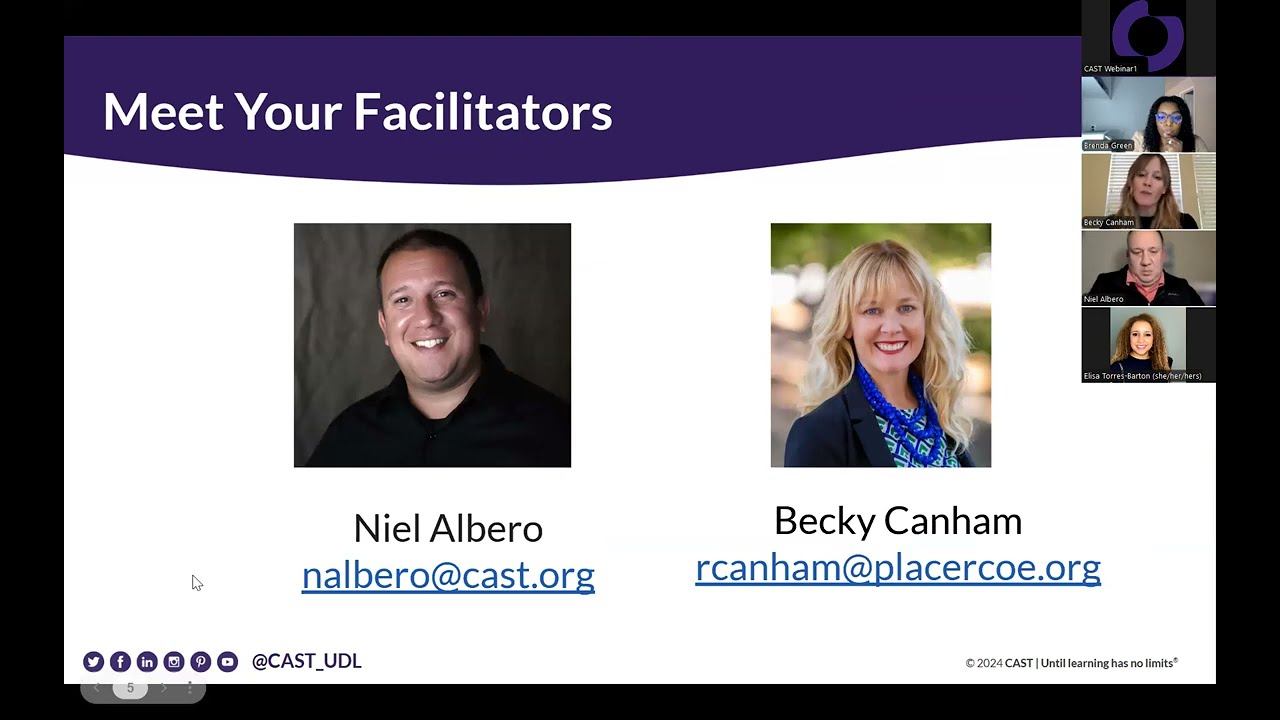
you hear me I can hear you Melissa you here weed it I started to work right on time wonderful wonderful so Melissa perfect segue friend you want to introduce yourself to Our colleagues about 69 of us uh joined in this awesome yay so excited to be here excited to uh be here with Alisa I'm coming to you live from Bennington Vermont where we have uh by I think five Neil standing right by me five of our casties awesome finishing up and what I was doing was schoolwide implementation so same same topic same idea so happy
to be here U my name is Melissa Sanjay I'm most often um zoom in from uh near Boston Massachusetts but as I said I'm In Vermont today and I say most often a little Loosely because I'm often on the road as an implementation specialist uh implementing udl in schools and districts and um and working with teachers District leaders School leaders and thinking about how do we make all of our spaces and places designed with udl but also how do we um how do we support teachers to use udl in their classrooms and we're thinking about
that schoolwide implementation lens prior to um coming To cast about five years ago I was a a first a social worker and then a teacher and then a principal in Boston's alternative high schools so we had was in two different um alternative high schools those are the high schools for the students who were who are one school was 14 to 21 another was 16 to 24 and um working with um those students for whom the traditional system did not serve um so they were either pushed out or Dropped out of their school so that's kind
of where I come to this passion to make schools and places and spaces and instruction and learning wherever it happens Flex um because I saw some of my students were not able to stay with their friends and with their homeschools because um the the flexibility wasn't there for them so I like to say I'm in the business of putting my former self out of business so I love it I love it um Thank you Melissa so glad you're able to hop on friend um so my name is Alisa Torres buron and I get to uh
play often in the field with Melissa and our other Cassy uh colleagues um I am in North Carolina today um supporting a County District out here um but normally I um zoom out of Fresno California I am based at a um California and my um air quotes 9 to-5 is a supporting County offices of education and building the capacity at those levels to support to create teams Of implementation Specialists and so that they can have the capacity to support districts if and when they're ready to do this work of implementation much like Melissa she's been
my uh partner in crime along with uh Dr Brenda green another Cy um we um are diving in deeply into that um sic you'll hear us use that language today which is a school implementation criteria essentially what is the ecosystem that needs to be present in order to support Udl implementation in the classroom level and at all levels right um and so we are kind of geeked Melissa and I are the Geeks around this I know we're not alone if you're on here today uh we know that that's part of your probably your love language
too right how do we minimize barriers how do we reduce barriers but at the system level because we know that um nothing moves on its own so our goals for today are to examine a problem of practice through the lens of The guidelines 3.0 and the schoolwide implementation criteria which from now on I'll start calling it the SIC and so essentially friends we know that you come to this work usually with some in uh some compelling why um either a piece of data um you know qualitative or quantitative uh sometimes we come to this work
with a Learner in mind find either ourselves or for me that Mom hat right as a mom some of the fire in my belly about this work is because of my Mom hat um of course my leadership hat and all the things but so we thought we framed our time together thinking about one air quotes generic because we know it's not a generic problem of practice but then we're going to tap into what might it look like to approach this uh through the guidelines 2.2 and then the expansion of the guidelines 3.0 what might we
consider differently again grounded on this um a broad problem of practice and then we're also going to Explore the implications to the expansion of the guidelines through udl implementation um so we're going to again invite you we're going to look back to look forward right we're going to present a problem of practice we're going to have hopefully we thought we thought it was broad enough that might resonate with you and or your context and we'll look at the before and then through the expansion what might we consider and also heads up we're going To give
you an opportunity to drop in in the chat of course feel free any time um to some of your thoughts are reactions or considerations that um would support our collective learning today so I will pause and I'm going to invite you to consider now that we've shared our hypothesis as to what we're going to do together today uh what are your goals and or questions for today so I will pause and you don't have to put them in the chat feel free to doodle noodle like My daughter says or uh just reflect on something you
want to give your brand and idea as to what to focus on today um and Jennifer asked if uh she says she loves accessibility commitments and ask if they're allowed to share with other people at the institution yes Jennifer you'll even get a recording so um you'll be able to share that recording and they will live if you just want to send them to the cast website the the recordings And materials will live on the um on the cast website great great great great oh Aron is part of Fairfax County Elis and I have been
there yes we have yeah Virginia I remember that W wonderful all right my friend I'm going to do a quick review and then I'm going to have us um you launch us to that um video of the kiddos um so a quick review of udl right we we always Think about these Universal resources these webinars as a as a place that some of you are sitting in a place that like we already do webinars Melissa and Alisa we could do this but we also are such belie in that there should be lots of access points
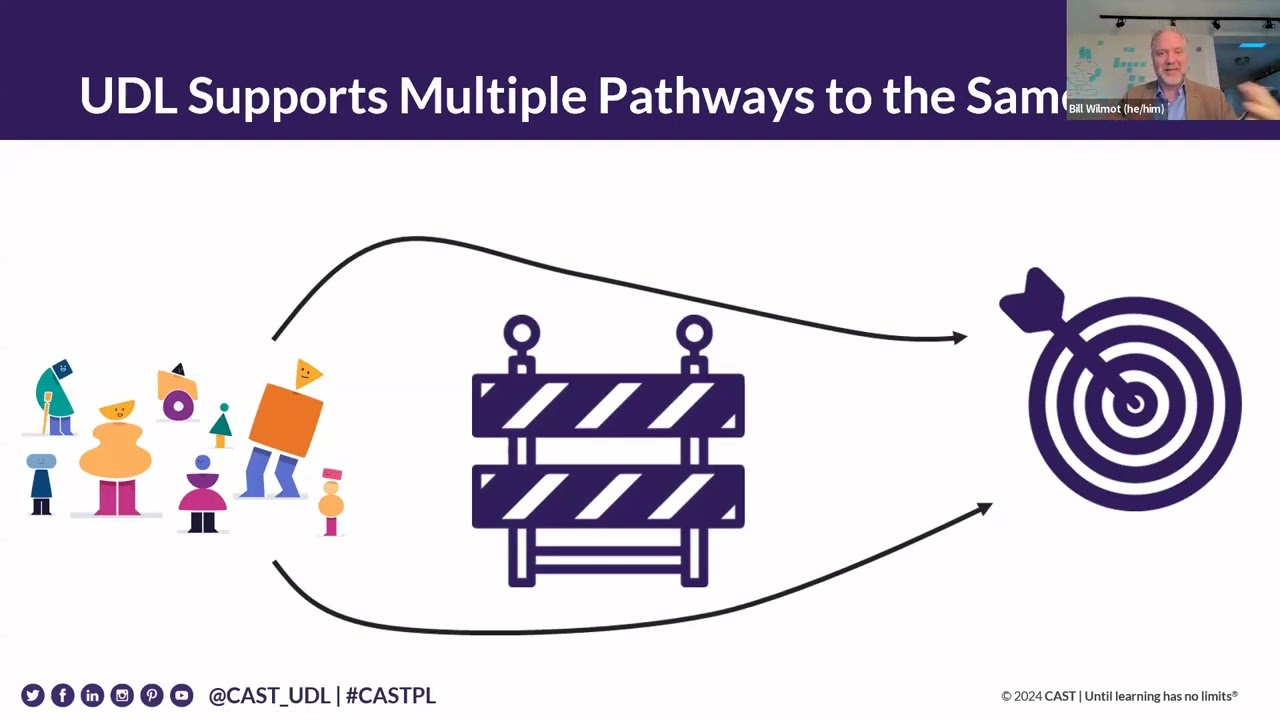
and so we're going to remind us a quick review here of what is this intent of udl so Universal Design for Learning is an approach to improve and optimize teaching and learning for all we could highlight that word we Could have a slide with just the word all in there um because we know that's the aspirational and compelling reason we're here how might we do that we set clear rigorous goals anticipate barriers and proactively design to minimize those barriers and so the concepts of Concepts or principles and again this might be very familiar to you
um is that we look for barriers in the design not the learner we believe and and we're from a space where variability is the norm it Is contextual it can be planned for and we use the guidelines right that Infamous design tool a graphic organizer to support us in designing for all in through the design process we think about clearing uh setting clear rigorous goals like I alluded to earlier anticipating barriers and variability or honoring them and then designing um set up options so U Melissa you want to tap us into the expansion what the
focus areas are for the Expansion so um as most of you know uh we released our guidelines 3.0 in July July 30th of 2024 and so the the guidelines are meant to expand we realized that there are certain areas and certain considerations that we were not thinking about when we were designing so we wanted to expand them and so our main expansions are we are um emphasizing identity as part of learner variability so we still have all the other variabilities that we talked About and we're adding identity as part of you as a part of
learner variability what I love about that Melissa not to interrupt but I know we're going to do this the next hour so that piece of identity right what what is so compelling about identity is because we were thinking about the what the why and the how but the who right it was implied but now is explicit like might we consider the who as part of learn avability Yeah and a lot of this is to be more explicit about including um those cultural variabilities and linguistic variabilities and racial variabilities and be very explicit about it um
as we give teachers things to pay attention to and things to consider when designing and part of that consideration is thinking about individual institutional and systemic bias as a barrier and this a lot of that P A lot of those pieces live in this sic work and this Schoolwide implementation criteria work taking those Equity pauses and really thinking about am I thinking about everybody who isn't represented who who isn't um showing up here in this work um the third is to emphasize the value of interdependence and collective learning so what we mean by that is
we we didn't emphasize that as much before and we want to really emphasize that that learning together space for teachers and for for students and for all learning ERS and then we shifted our language a little bit from uh teacher Center language to learn learner Center language so we want these guidelines to be able to be used aspirationally by both teachers and Learners and on that slide you'll see some full drafts the graphic organizer one pager and uh another webinar about udl guidelines 3.0 that can kind if you're interested in diving a little bit deeper
and all that stuff is also on our Website for sure so as Melissa and I were think about how to launch this we when in doubt we think about our is our work the development of the webinar the design is it centered around student voices um you want to give a little background Melissa as to why we um love this um video that we're about to share so we were trying to think about what are the systemic barriers to um to to learner agency right because that's another big theme in our guidelines 3.0 Moving from
expert learner to learner agency so what are the barriers that keeps Learners from showing up to the learning as their whole selves and really owning that and moving through it and so these are um stories from young people who were in traditional schools that did not work for them and they ended up um going to what New York City calls the transfer schools we call them Boston alternative schools or educational options but those schools For students for whom traditional traditional um schools didn't work and they're going to talk to us from in their own voices
about some of the barriers they faced in those schools [Laughter] [Music] [Laughter] [Music] [Laughter] 7th grade I was homeless my mom was addicted to drugs never met my dad I was 10 years old taking care of like five kids I came from the Dominican Republic I didn't know the English language I have dyslexia as well as like a English is my second language so I would get pulled out of classes I was in fifth grade um and then they realized I actually didn't finish the fourth grade I remember vividly they came upstairs and they're like
actually she has to go back downstairs so I was picked up mid way through the day and they're like This is your new class and no one really explained to me why I was moving classes this high school that I went to was in a really really terrible neighborhood like gun violence was almost every day my first High School had metal detectors and it felt really uncomfortable being padded the way I was every morning it was so invasive constantly just to get to school I was intimidated to go to school from just the police officers
we would be in these common spaces and Fights would break out so you get arrested if you got into a fight with no context I'm used to having like teachers that are predominantly white and they're like well I get paid whether you do the work or not so I mean I don't classrooms are too big if you didn't know something you just had to figure it out or ask somebody else to see if they know something if they didn't know then you both didn't know just you had to just Bally F so it made us
kind of set back And be like oh okay like they just going let do whatever we want you're just thrown textbooks or like a little Chromebook and you're told to go on Google classroom and do the work and then that's it it's just pass and fail the classes were an hour and a half long the teachers didn't know my name I barely met with my guidance counselor I don't even think she knew my name I didn't know my counselors I didn't know the principal of those schools I mean I Was doing terrible my grades were
low I was always cutting some days I would wake up and I just didn't want to go to school because I'm struggling I got to fight answers I got to fight for help some days I just woke up and I just didn't go there was even times that I would cut school go to the football field and climb over the fence just to smoke and nobody ever [Music] found so we're not trying to depress Anybody or discourage it's just that is um that is the lift right that is the lift so as you think about
systems through the lens of udl we're going to invite you to consider these four domains uh School culture teaching and learning leadership and management and professional learning so I want to pause here to invite you to share in the chat or consider what systemic barriers have you seen related to honoring identity we Heard the children talk a bit about that addressing bias this idea of collective learning and learner Center practices what have you witnessed or is your lived experience around these areas so what barriers have you seen Andor what um design options or Solutions have
you witnessed as well so Allison said poverty is a barrier Melissa in the chat and elif Hopefully I'm saying your name correctly otherwise I just say like a Dominican would say it addressing barriers just in bias yeah excuse me bias yes thank you El all right correct was but it's okay it's all good Ashley lack of support from instructors controlling and restrictive languages and policies language that's yeah that's a big one the system itself is a barrier yep can be citizenship and immigration Status to postsecondary so the system around getting into postsecondary institutions deficit thinking
defining students by placement categories making judgments not not identifying that variability right because basment categories have tons of variability within them some Iran has seen exemplifying Lear centered practices that's awesome shortage of facilities shortage Of resources how we Define and measure progress learning and Improvement resources money understanding and so much more I feel like Melissa we're on the air quotes right track of what we hypothesized this slide this this opportunity together not just the slide deck but we're going to um share with you as I started at the beginning of our time together is this
this way of looking at how what we can Control these areas that we can control and how we can use Universal Design for Learning and and the aspirational tenants of udl um to make some moves around this work so um just like um we think about the guidelines being super supportive or we call them a design tool and supporting classroom instruction the schoolwide implementation criteria thinks about or considers ways of of increasing access right that leads for learner agency at the system level so Some crosscutting Concepts that live between both the udl guidelines and the
s i is that there's pieces that are intentionally woing into these domains and elements so they're both going after creating Equitable inclusive and accessible environments and practices honoring variability right that is at the core reducing barriers and bias in the environment designing for learner agency and engaging in data um an empathy-driven iterative improvement and Fostering collaboration and Collective ownership of learner access and agency so in other words think about it this way the guidelines of supporting the classroom piece of course as a site leader of course you're wome you can use the udl guidelines themselves
right that's part of the of the work we do through professional learning is supporting leaders um model this at a staff meeting how we engage with Community Partners and such but the SIC Is going to support us at that system level thinking about barriers in that way so we often talk about go ahead L I can't see your face friend so just jump on whenever you it's gonna be like we're talking on the phone old school back in the I hope others can see my face it's just your Arrangement right yes yes well I'm hoping
nobody's tell me otherwise tell us in the chat if I'm talking from a dark we see what happens yeah go for it and Si I just really Thinking about those cross cutting Concepts supporting all of our spaces and places to design for variability uh and how do we support te in their classrooms at at uh implementing udl so that Learners have agency and access in their learning for sure and so when we talk about barriers when we we're thinking about classrooms we think about the methods materials assessment and environment and those goals right those Buckets
we call them those buckets I call them the four plus one buckets from thinking about how the material is represented how the content is delivered how the learning is being demonstrated that climate culture and of course grounded in the goal at the system level we look at the four buckets School culture and environment teaching and learning leadership and management and professional learning in other words regardless of what's happening in the Classroom right there's implications to As Leaders right sitting in that leadership seat to school culture environment teaching and learning leadership and management professional learning and
my um awesome buddy Bill uh I think it was Bill or NE I don't know which of the two but both can take credit whoop woop is that all of this is in service of teaching and learning all of all of these moves right are in service of teach teaching and learning There's no real hierarchy per se but we also know that things don't happen in a vacuum so what we're going to do today is we're going to think about how might we minimize CL uh barriers from the classroom to the systems level so as
promised here is a broad uh problem of practice um so students are underperforming and open response questions on the math Assessments in our school I have yet Melissa I don't know about you but have yet to visit a school That says we're nailing it in math we have it all figured out please come and copy paste what we're doing here math is a challenge and as a former high school math teacher I so much of this resonates but so what how might we look at right how might we deconstruct this problem of practice through a
lens that allows us to use the guidelines and the expansion right we're connecting it to the expansion um in a different way in an expanded way okay so all right so Thinking about the barrier it could be that currently the students are under under uh scoring on that particular area it could be that the text of an response question is only available on paper right only available on paper we know that that could be a barrier so some of the results could be that some Learners may not be able to see the question right some
Learners may not be able to decode so as we looked at the 2.2 guidelines we thought okay so what would Be a way to minimize those barriers well it'd be great if we offer alternatives for visual information and so we may had offered uh test to speech options an audio version of problems right there's lots of ways that in systems we've heard about offering more um alternatives to visual information so what would be the plus one Melissa as I'm thinking about as we are all thinking about from the 2.2 to the 3.0 expansion how might
we look at this particular problem of Practice as we as we go through um as we go through the the udl guidelines 3.0 um expansions we really think about like what are the other things that we need to consider we've been considering that that perception barrier around go back to show that go ahead We Can't customize the the the display we don't have alternatives for visual but then when we go to our 3.0 perception guideline we will see um an additional guideline there that is um to represent A diversity of perspectives and identities in authentic
ways so is it possible that the open response questions are only representative of the majority culture and as a result the students can't see them elves in the question prach so what are the options that we can design for that from a 3.0 lens is we can make sure to vary um the curate or write math problems from A diversity of perspectives and maybe even go up to that um welcoming interest and Identities um guideline and think about giving students choice in that yeah so I wish we could go back and forth but I think
we're just sharing the process today Melissa about going back and forth into what extent the the guidelines um expand for us so let's go to another example so let's say okay it could have been back to that same problem of math right problem of practice it could have been that the language and syntax of open response is Dense and it's hard to decipher right we know there's vocabulary just in general and there's of course there's content related of language that might be critical and it could be that some Learners may not be able to understand
what the question is asking and so it could have been that we at first we could have thought about o well how might we support decoding of text mathematical notation and symbols therefore one option we could have Considered is to teach a consistent routine for analyzing open response questions and so as I pass the Baton back to Melissa we're not suggesting that we no longer do that right the expansion is literally that language of is expanding um something else that we might do in support of Learners so through that lens of 3.0 Melissa so other
things to consider right um the language of the math problem might not Be in the Heritage language of all Learners and there's no translation options available but the result is the piece here if we look at that result the result is the same the result is some Learners may not be under able to understand what the question is asking so when we when we see that our Learners are not able to understand what the question is asking we have more than one place to look because there may be more than one barrier right so in
this case We might need to cultivate understanding respect across language and dialects or address bias in the use of language and symbols as it relates to our our willingness to offer translation options to our students so we might have the problems in multiple languages or provide translation opportunities or even provide um translation dictionaries have a sheet that has typical math words translated or key math words translated different ways to um cultivate that Respect across uh languages and address bias in the use of language and symbols I love it and so Melissa what this as a
as a former I still consider myself a math teacher as a math teacher what I feel like I thought the guidelines 2.0 was already giving me a superpower as a as a designer thinking about um because I remember I shared this often in rooms that I felt like I was a rockstar engagement teacher because I never liked math I had a horrible experience in math In high school and so I thought when I became a math teacher I'm like I'm going to make it fun and engaging and relevant but there was components of it that
I was not addressing right language and symbols was one of the areas that it could have been um more intentionally designed and so this 3.0 is beefing up even that approach of thinking wow couldn't we provide a scaffold or a point of connection right with the children and the Learners can see Themselves even in the context of a discipline like math so I really appreciate those connections you're um you're making for us with math all right so um the other piece I will say um before we segue to the last example using the guidelines and
then the the 3.0 is that you you came you logged on today because of the um thinking about through the lens of leadership so as we're going through these examples and possible options and We know that these are not the only options consider or think about what might the system component or in tandem might need to be in place or be developed to be intentionally considered in order to support these practices so I love the question you always ask Alisa go ahead how I love the question you always ask how was your system responding yeah
yeah how does your system respond to this to these yeah absolutely these problems yeah because We always we often get the question Melissa about like what does udl look like and is there a walkthrough tool is this this or that and kind kind of well the guidelines is a design tool but what's more critical right from the leadership lens is how does your system respond to variability right in any bucket pick any Bucket from the parking lot to the restrooms to the classrooms to the thing to the commun to the boardroom in what ways your
system like It's as as fluid and effectively as we can respond to variability that's what udl looks like right that's what we're going after okay so we could go about this all day Melissa but all right last last um and then we'll take that same problem practice and look at the SIC so uh students are required to solve the problems independently often the case in mathematics and so the result might be that some Learners may not be engaged in The learning right there's a there's times because of a variability being contextual where we're ready to
talk to a colleague to a neighbor to a student around a math problem but then sometimes we had to work on our own so okay it could be that we offer choice of word problem to solve um could have been one ways in other words to support optimizing individual choice and autonomy so the 3.0 um perspective the expansion of the guidelines Melissa what Would we say uh the barrier students are required to solve the problems independently same result yes some Learners may not be engaged in the learning right but now we're thinking about is it
is we're having another consideration possibly under Foster collaboration interdependence and collective learning or Foster belonging and Community is that where the where the barrier and the option lives and Should we offer both options for independent and collaborative practice um when we're practicing building our understanding of these open response questions yeah and so Melissa what if there's a yeah butt in the room um and that is often like yes we're on board but don't our students have to solve a problem independently like don't at some point um absolutely we're gonna have to in real life whatever
that means real because it's their real life right now Always felt like real life to me exactly exactly sometimes we have to do things on our own and sometimes we have to do things collaboratively and so being very intentional about that being very intentional about that okay so let's collaboratively build our understanding so that we can perform independently preach preach absolutely yeah yeah yeah yeah and wouldn't it be great if the kids could choose right based on what their brain needs and their heart needs At the moment wouldn't it be great um agency moment all
right so last that was using the guidelines and the expansion to consider a problem of practice I'm just talking through the idea of the barrier and notice too that Melissa and I are taking the time to talk about what the result the implications are in other words we know there might be a barrier considering thinking about right what happens if we level down on this barrier that is critical to shifting practice Okay leaders so we know that we have to create there's the knowing doing Gap and that could be a whole other webinar and so
as we we're expanding on our knowing and connecting to the doing one of the ways that we can support uh shifts in practice is to consider what is the result by uh us um just pretending that barrier is not there so let's shift to the system level um students again still the same problem but practice right you're thinking about what's happening In the classroom and the ecosystem that supports it so students are underperforming open response questions on the math assessment at our school so it could be go ahead Melissa if feel G to jump in
front because I can't see you um so I was going just going to say that that that math classroom or those math classrooms that math wing of our school are not operating in a vacuum they're operating in a system they're operating in a culture so when we about School culture and environment where could potential barrier sit in a in a school that would impact students underperforming on open response questions and math assessments so potentially school classroom and cultures don't support identifying tools that work best for each individual or it doesn't fully communicate the value and
possibility of variability maybe we don't support public practice Experimentation and feedback and what does 3.0 give us that's our little green plus signs for what does 3 point will give us as we think about systems maybe our school culture does not support identifying designing for identity and diverse perspectives and that's where we end up with those barriers around I can't see myself in the math problem right I how is this connected to who I am that's what you said as an identity right like is there a space for Me to show up in my whole
self in the context of mathematics or in the context of anything of my um education experience for sure we're really trying to think about these three point .0 guidelines and the main ideas around identity barriers collective learning learner agency and how does the system adjust to support those things happening in the classroom so kind of get out of the way right Melissa isn't that what we talked about to kind of Just get out of the way let the whole child yeah so here's an opportunity for um for us to pause Melissa like to um just
take a moment and give you an opportunity to reflect um as you think about the shifts necessary um around this idea of school culture and environment one of those um sic domains um what might be necessary in order to honor identity bias collective learning and learner Center practices so we invite invite you to go beyond the Math problem of practice that we're just using to uh Center our conversation today um what might be necessary around the school culture and environment component go ahead and throw that in chat what are you thinking Alisa what's coming to
your mind I feel like for school culture and environment it's so much about practicing what we preach outside of the construct of the classroom environment Right so um there's one um protocol we often use when we do data Dives around um mapping out where our kids feel safe on our campus right or their perception of how they feel in our campus literally take a school map and ask your uh Learners and your teachers and your parents their Vibe how they feel around their their campus it'd be interesting to see what we learn um because I
have my own P my my own worldview informs what I consider as identity what I what My biases are what I assume is collective learning and so I think about like how will I gather the data um that'll calibrate um our current reality and then what we're working towards around school culture and environment yeah and Claudia is saying something very similar first creating a sense of belonging for all yes Ron is talking about thinking intentionally about the wording inside of the resources and assessments and that intentionality is Key to udl we intentionally reduce barriers what
we intentionally design using the guidelines using the SIC to reduce those barriers so really interrogating our systems and thinking about intentionality growth mindsets at all levels preach Maria absolutely shift from traditional teaching less lecture getting to know your students stop worrying about the fact that college doesn't allow Collective Practice a culture of learning variability as an asset that's what shamon's telling us yeah uni trust and capabili Trust in the unique capacities of every learner right presume competence all right Melissa let's go to um barriers in teaching and learning still thinking about that prma practice in
math but of course we're going to offer you an opportunity to reflect from any context all right so what might be some Barriers in our systems around teaching and learning maybe we don't have that vertical or um horizontal alignment and there's no consistent approach to problem solving so I'm going from third grade to fourth grade and I have to learn a new a new protocol for how to respond to those open response questions maybe the goals are not clear I'm not sure why I'm doing this problem I'm not sure what I'm learning I'm not sure
what I'm going For it's possible that development of Reading Writing and math skills are not well coordinated across grades across classrooms and then that 3.0 expansion maybe protocols for solving problems collectively do not exist so we don't know how to get together and you harness the power of collective learning because there's no protocol for it uh we don't have a system to make that work so my head goes straight Melissa to um when I think about teaching and learning like Our professional learning communities or what we often call plc's yeah that idea of a protocol
is critical because then it's not so much about um a preference um instead is about a way that we're going to go about creating these systems and structures um the other yes land um to this is that some of the things we've noted here um is that problem solving it is not just a mathematic consideration right we know that that is a very broad Interdisciplinary um uh skill set and so that idea of collectively doing it wouldn't that be interesting go ahead my friend well just to say that protocols um keep people safe they balance
voices they keep the goals at the center so really and they help students de develop those social skills and the interdependent learning skills so that maybe when they're in a group project later on in life they can kind of come up with the the Way to work themselves but those protocols that really help them sort of match and also it responsive variability because if students can choose roles and all of that not everybody is going to want to be the reporter not everybody is going to want to be the note taker so it helps to
also respond to variability yeah so Sherry shared um say that three times fast um Beyond not having a system for collective learning there are many School cultures where individual is held individualism is held as the norm and the best way to be right and sometimes that's the most rigorous right the most rigorous learning yeah we could do a whole other thing on our biases and how that informs um the work all right friends you've already started so here we go here's an opportunity to think about the shifts necessary in the domain of teaching and learning
to design instruction that Honors identity addresses biases um designs for collective learning and exemplifies learner centered practice practices what might that look like so we should give you the Nugget of plc's and protocols and a couple of other things what might be from your experience or what you're thinking about um waen is saying uh shifting to a nurturing educational environment where students feel seen heard and valued and some of the ways we do that Is making that space for identity right representing diverse perspectives addressing bias as it relates to modes of expression Alexis is saying
we need teacher training in these Concepts especially across grade levels and classrooms absolutely and we also know Melissa you know that these domains and we want to make sure that even though we're chunking them this way for this webinar They're not they're all interconnected just like we talk about that with the guidelines right um climate culture is going to affect teaching and learning and teaching and learning affects climate culture and so um that was a almost a problem of practice is we were designing the SIC to think about where what bucket does this go in
and you know are not discreet exactly just learn is messy humanity is messy it's just how it is yeah Beautiful Mess when a let's See they had students in their plc's monthly Shante did oh design some lessons I love that I love that's aspirational right there thank you Shante for say know students in their strengths even if they don't see them and helping them realize or access them training a means of assessment yeah what Keen said oh yeah you just read that yeah yeah is all about the quantitative model yes please got to triangulate our
Data question from Jennifer you want to read that one Melissa question about collective learning not K12 isn't privileging collective learning at all times also an issue that's a lot of stress for introverts yes that's why we would whenever possible we would give an option so um protocols for those that want to work in a group and independent time for those that want to work independently the only time we would not advocate for giving an option is if Group work was the goal yeah so all of this is grounded in our goal right like no matter
what the thing is um one of the things I think obista when I'm designing is like anytime I say you only have or you you will all will which is adorable in any classroom environment you all will anytime I said all will then I'm creating something betting some barriers and so get ready so absolutely absolutely um yeah and then how we define collective learning right there Might be a progression like how does a student who might be work let's say that Melissa the goal is collective learning is there a progression is there Continuum how do
I as a learner who is an introvert and I'm married to one so I totally practice this daily like how do I know um uh what part of me is not because I'm not always an introvert right there's different contexts what we might be differently um is what I would say um and maybe you Know that graduated level of support maybe we start with partners and yeah we move up so there can be a partner option if you're not ready to go to the big group absolutely all right so let's go to the next domain
which is leadership and management still looking at this length of the uh problem of practice so it could be that the schedule doesn't allow for collaborative instructional study especially between G general education And special education it could be that curriculum materials don't support multiple means of representation in action and expression it could be that there's no time for daily collaboration between general education and special education teachers right these are those leadership and management components that could be a barrier to us making an impact in the classroom so what would be the plus there Melissa and
could be that Uh we don't talk about on the leadership level addressing bias it's not a leadership priority so it's not the Forefront of our minds when we're designing spaces faes or math assessments right yeah so it could be we created the structure we have the PLC time we have the collaborative time at the same time it could be that that team only values let's say uh fluency how quickly Learners can do math problems well there's a bias embedded in that Right or it could be that we only value individualism or we only value collectivism
or the word only is what's driving the train only one way too yes it's a good way to start a barrier absolutely absolutely all right so let's hear from you in the field and those of you that watching asynchronously later think about that leadership and management domain what might we need to consider for a system that honors Identity addresses biases uh design designs for collective learning and exemplifies learner Centric practices Melissa as our chat um populates I think about um I had a student um I often had students ask me um where are you from
you know like where are you from never LED with I'm Dominican and I'm born and raised in New York and blah blah blah I never LED from that and as I think about that piece of honoring identity I wonder how often by Not sharing more of who we are that we were not modeling how to honor who we are does that make sense it does yeah modeling that that you're you can I'm showing up as my full self you get to show up as your first self yes yeah and what courage did it took for
the kid to come up and ask me you know you're the principal somebody's going to ask you right this High School kid's G like what talk I'm like and I just never made that connection of like oh they not only do They care but there there's something that's happening the moment I would air quotes open up and share that about them because I thought they were just interested in you know if I was a good principal or not or if I you know anything else but yeah and when I think about this leadership and management
domain one of the elements of leadership and management domain is communicating your vision and commitment to udl and implementation and um with the 3.0 Expansion ideas around identity ideas around bias ideas around collective learning can be part of that sort of mission and vision for udl udl f I was just working with some leaders as they're building a leadership team and Equity was at the middle of that conversation right so and what ways is udl going to advance our equity and how can we explain that to our teachers as we Vision the word yeah it's
definitely common language Right we always often talk about the guidelines um our common language our instruction um there's definitely a space for that so we have Shante saying the importance of spent Educators and general Educators to collaborate at the district level especially when it comes to curricular decisions assessments and policies yeah and then right after that I think it's philit said inclusive leadership approaches right so getting all diverse perspectives to collab at on That leadership is really embedded in that sic as well interdependent learning on the leadership level Alisa absolutely absolutely like if you if
we make decisions in a vacuum W and the K12 setting I'll just say just expect some barriers it's what elsea can you read Pamela's comment let me see I have Ashley I have Ashley provides space and time for faculty and instructors to come Together to learn with each other give them an opportunity to problem to share problems of practice with each other and strategize I think that's the collective Fe you were sharing hen understand and Foster the intersection of personal growth cross culture experience and extrapolate that intersection into contextualized education easy peasy walking that was
easy no but I love the idea that you're thinking about we're you know we're Considering like our whole selves what does our whole selves contribute to what we're trying to do together oh pame um I'm testing my Spanish absolutely she's talking about collaborative work is essential to um go ahead and and move the work um thank you so glad you use your primary language pameela I'm making some assumptions but I'm assuming cor is telling us that a huge part for for them at he's at Mount PR ECT I know Cory was Shifting the training people
teaching from our higher ups to the teachers in the class allowing us to design and address it with each other versus a mandate or a policy so like a Grassroots groundup approach it's made our staff more willing to share adapt try something new and help each other because you gave your teachers agency right they get to choose their goals they get to choose how they learn yes yes and then sher's Sharing this piece about belonging oh love that word just think of how many times the the concept of belonging has been raised today how powerful
could it be if a school includes belonging as a core part of their mission and vision absolutely Sherry sometimes as Leaders we often shy away from things that are not measurable air quotes on that because we could right but this idea of belonging without belonging how can I execute my agency right that's Beautifully said Natalia Costa how do you see this part being implemented especially when there's a mix International students learning a new language yeah so what are some ideas um Melissa about this idea of maybe the students learning a new language um how might
students share and contribute um uh when they possess the superpower of um adding additional languages to their repertoire um contribute it as a colle in a collective learning situation is What you're wondering Alisa or Nathalia yeah there's lots of tools there's um things that you can apps you can put on your phone that are translation tools that you can teach the English speakers along with the um Heritage language speakers how to use that you can each P person can have the phone set up for them to translate from one to the other and they could
have a conversation that way using technology absolutely the other part that this is not my idea I Had a colleague share is um just yesterday Melissa um and our team was thinking about that sometimes we consider the ways to share ideas is only by words either on paper the written um but how about artwork how about um back to Adelina Doodles and noodles right like what are some other ways we could learn about each other and people can share um what they think about what they consider through more mechanisms than um words either written or
Spoken um Perfecto espol Thank you Pam gracias and saludos the Chile Pamela is in Chile she's saying hello to everybody it's a pleasure all right um okay so professional learning um I smile at this one because Melissa don't you and I get brought in a lot to support you implementation and a lots it is invested in professional learning so we know it's critical we know it's important but the yes and or the yand is that we know Professional learning um is also in tandem with what's happening in the classroom and the leadership and management and
theol church but again for the sake of this conversation I'm going to talk about again back to this problem practice what are some things that could have gotten in the way of supporting this um this math assessment component so it could be that there's no clear commonly understood models of inclusion it could be there's not enough Opportunity to see mix uh see models practice around clear and flexible means it could be they aren clear protocols for instructural collaboration and study and also green plus sign Melissa there is no professional learning around designing for equity and
so that something that was said in the chat earlier um to say like we're not having these conversations with teachers then we can't have the expectation that they're Designing using using these new expanded considerations absolutely there's moments my friend that I feel like we've talked so much about Equity right like a lot of us consider ourselves Equity Warriors and that I feel like that's the um the amen yes we're on board but how do we land the plane right thinking about how our professional learning supports our practitioners and Landing that plane about what does it
what might it look like to have equity and of Course us as udl uh and cast we just Advocate that the guidelines and these tenants right these principles with the bar being the design not the learner that is Equity at play right variability being the norm that is equity at play and then um of course this whole idea of learner agency that is Equitable right the moment I make decisions for my Learners and I am the only one making decisions for my Learners then I might how I think about it Melissa is that Like I'm
building in some barriers because I'm thinking that I know what's better for you um so as we think about professional learning how do we support um our our colleagues and our system right how do we become a learning organiz ation again that could be all the webinar um as a learning organization how do we design for equity and everything um that we are touching everything that we're touching so it's not just Theory but some practical ways Nice okay so thinking about reflecting in this domain um think about what are the necessary shifts in the domain
of professional learning to support identity bias collected learning and learner Center practices of course Melissa and I would Advocate that the design process the udl design process of identify in um you know having clear goals and then honoring that variability and the designing ways to minimize goals To excuse me to minimize barriers is one practical way um um how about you Melissa while the chat chat populates practical way to uh to embed those into professional learning I think I think using those as we as we model our professional learning right modeling for teachers how in
my professional learning I'm going to to design for Collective and Independent Learning I'm going to simplify learner Center practice how I will address bias and and hold it up I Love the word address bias and that's what the guidelines the new guidelines say as they say address bias they don't say eliminate because part of our Neuroscience it's part of the way our brains are made to make shortcuts but we stop we recognize and then we do something about it like address bias we hold it up we name it and then we do something about it
and so how can we model that as we do professional learning with our teachers and honor Their identity bringing their identity so some of the new checkpoints around honoring identity in our professional learning um cultivating joy and play is a way to honor identity offering uh content from diverse perspectives is another way to honor identity so those identity ideas are throughout the expanded guidelines so Cheryl Blankman share nothing about me without me is for everyone beautifully Said all right wonderful we're coming to the end of our time uh Maria auno allowing space to make some
mistakes that it will negatively impact their jobs absolutely that's safety piece right which ties to culture ties to culture for sure yeah is critical so as you collectively uh right we've had you uh at the grain size of the domains reflect on what are some of the shifts uh we invite you to give your brain an opportunity to think Holistically what might have affirmed your thinking today like heck yeah we're on the right track uh we're pursuing the right things or right air quotes on that what might have pushed your thinking like some a plus
one that you're taking away today that you thought oh okay I hadn't considered or or this is there's some cognitive dissonance happening here but might and also what my your learners need you to do next um you don't have to respond in the chat feel free to just Chew on that um but we invite you to consider those a Lea said when we are our we and our systems are not aware of the barrier not all Educators open their mindset professional development that aims to design for Equity is there any way teachers can be monitored
and provided feedback on how inclusive their practices are I Lea I would say you ask the teachers right the best type of feedback Right is to ask the practitioner how might they um what how what might inform how they design equitably and how will they monitor to that um because the moment I monitor it then I am putting my own lens on that how about you I I find that the udl guidelines themselves or or even the SIC but in this case probably the udl guidelines can be something that can be outside of both of
us we can discuss because we if we we're implementing udl we've already agreed That this this set of design considerations are what we should be thinking about when we're designing instruction so then we can look at those udl guidelines and say okay so where do we think there's a barrier have you considered this consideration you can start to highlight ones that you might not have seen um and see what the teacher's thinking around um how they're designing for that particular consideration and they might they might Um bring up something that you weren't aware of exactly
yeah so you've got two options at Le not there's more than two options but definitely the one that considered if there's an agreement around the guidelines and if there hasn't even begun to be an agreement around the guidelines then thinking about how do what are their perception they're where they're at around this idea of Equitable um designing for Equity okay so we have extra resources For you there's graphic organizers in six languages there's the research page link the FAQs and the changes if you wanted to see like I want to say three or four pages
of showing from 2.2 to 3.0 we also have a rationale for the document uh excuse me rationale document to describe each update November 4th I cannot believe we're talking about November already Melissa um there's a Universal Design for Learning 3.0 essential updates and practical Applications in the context of representation that'll be November 4th and then um learn with us get in touch for more information to learn on professional learning um offerings and then Melissa you want to speak to this other webinar series that I think there's a workshop a schoolwide Improvement leadership Workshop series The
we push the date back to give an opportunity for more people to join um and I don't know if Patrice knows the Date she can put it in the chat but is going to be using that sic that we started to talk about today and using it to um apply to our systems and design with udl in all of those places and spaces so we'll take time to set ourselves up for Success think about what our Readiness indicators are for udl implementation we'll take some time to really look at Baseline data what what's going on
on the ground what do we want to use udl to address and then We'll start to talk about how to have little small tests of change and start to codify those changes to really provide access and agency for teachers Learners um and leaders all adults in the building wonderful sounds awesome all right thank you for joining us Melissa I'm so glad our Wi-Fi held up friend I know it was it was a close call folks it was a close call thank you so much everyone it was great to be with you take care from whatever
pocket of The world you're in