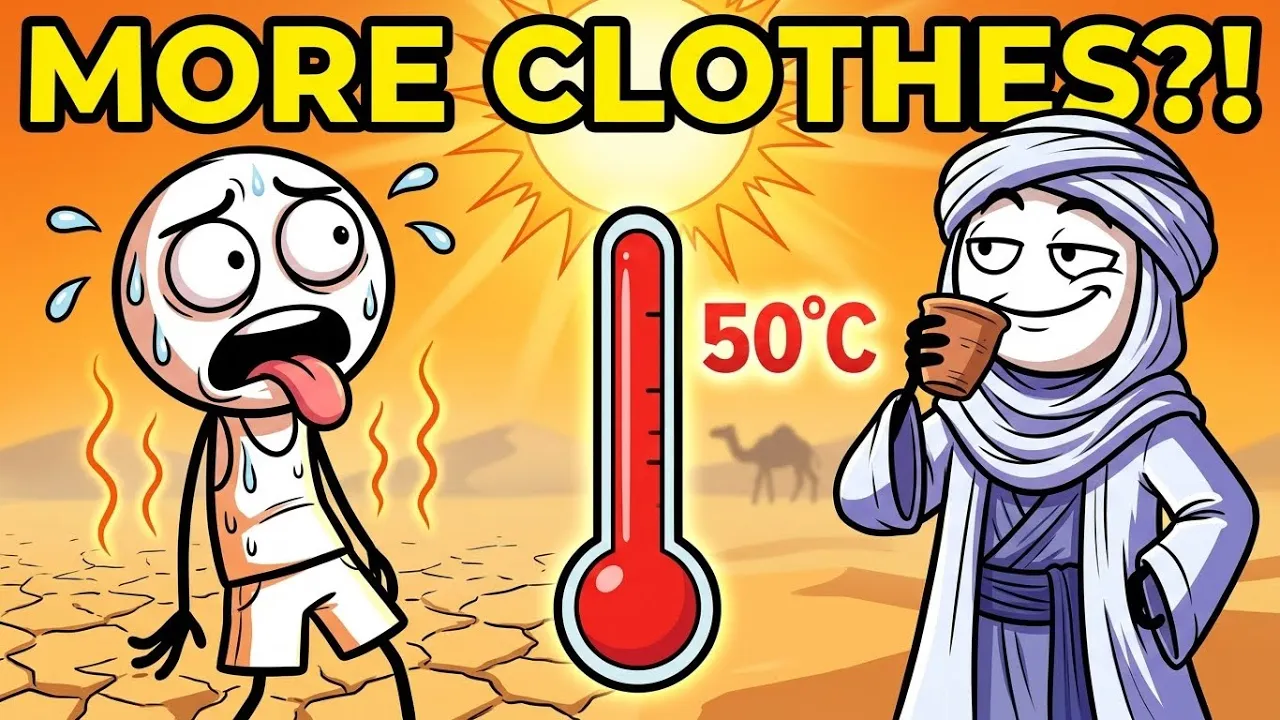
Here's something that makes absolutely no sense the first time you hear it. The people who have lived in the hottest deserts on Earth for thousands of years, in places where the temperature can climb past 120° F, where the sun is a physical weight and the air itself seems to burn, don't strip down in the heat. They do the opposite.
They cover up. They wrap themselves head to toe in long flowing robes, layers of fabric, headscarves, sometimes several garments at once. The Bedawin of Arabia, the Tore of the Sahara, desert peoples across North Africa and the Middle East, all of them in the most extreme heat imaginable, chose to wear more, not less.
And your instinct screams that this is insane. When you're hot, you take clothes off. You want your skin exposed to the air.
You want a breeze on your bare arms. The idea of putting on heavy layers in a blazing desert sounds like a recipe for heat stroke. So, how have these people who understand desert survival better than anyone on Earth, who have refined their way of life over countless generations come to exactly the opposite conclusion?
The answer is a beautiful lesson in how heat actually works. And it turns out these desert peoples understood the physics of staying cool far better than our gut instinct ever could. Covering up, it turns out, isn't just more comfortable in extreme desert heat.
It can genuinely keep you cooler, and it can save your life. Here's why. To understand this, you first have to understand where the heat is actually coming from in a desert because it's not just the temperature of the air.
There are two separate enemies attacking your body under that desert sun. The first enemy is the sun itself, the direct radiation. In the desert, there's little cloud cover and often no shade for miles.
So, the sun's rays hammer down directly onto your skin with tremendous force. This radiant energy heats your skin the way it heats a dark car, pouring energy into your body from above. If your skin is barren exposed, it takes the full force of that solar assault directly.
Your skin burns and heat floods into your body. The second enemy is the air itself. When the air temperature is higher than your body temperature, which in an extreme desert it absolutely can be, the hot air actively heats you up.
Think about that carefully. We're used to air cooling us down because normally the air is cooler than our roughly 98° bodies. But when the surrounding air is 120° hotter than your body, that air is no longer cooling you.
It's cooking you. Every breath of wind, every gust across your bare skin is now delivering heat into your body instead of taking it away. In that situation, exposing your skin to the air doesn't cool you down at all.
It heats you up. And this is the first great insight of desert clothing. If the air is hotter than your body, then bare skin is a liability, not an advantage.
That breeze you're craving on your naked arms is actually pouring heat into you. So, the desert peoples cover their skin, creating a barrier between their bodies and both of those enemies. The burning sun above and the scorching air around them.
The clothing blocks the direct solar radiation from reaching and burning the skin and it shields the body from the superheated air. Right away, covering up is protecting you from two sources of heat that bare skin would leave you fully exposed to. But blocking heat is only half of the genius.
Because if all the clothing did was block heat, it might also trap your body's own warmth and cook you from the inside. The real brilliance is in how desert clothing manages your body's own cooling system. And this is where it becomes truly ingenious.
And the secret is that the clothing is loose and worn in layers, creating trapped air. Here's the key. Desert robes are not tight against the skin.
They're loose and flowing, which means there's a layer of air trapped between the fabric and your body. And that trapped layer of air is the whole secret because air is actually an excellent insulator. That pocket of trapped air acts as a buffer zone, a barrier that slows the transfer of heat from the scorching outside world to your skin.
It's the exact same principle that makes a doublepaned window insulate better than a single pane. Or why a loose down jacket keeps you warm, the trapped air does the work. In the desert, that trapped air layer helps keep the outside heat from reaching your body.
But it does something even more important than insulate. It creates a private microclimate against your skin, a little pocket of air that your own body can control and cool. And the way it cools that pocket is through the most powerful tool your body has, sweat.
Your body's natural way of cooling itself is to sweat and then let that sweat evaporate. When sweat evaporates off your skin, turning from liquid into vapor, it absorbs a large amount of heat and carries it away, cooling you down. This is the single most important cooling mechanism the human body has.
But here's the problem. In an open, bare-kinned situation in a windy desert, when you're exposed, your sweat evaporates almost instantly, flashing off your skin the moment it appears. And while that does cool you a little, it also means you lose that water incredibly fast.
And in a desert, water is life. Sweat that evaporates in an instant is water wasted. And dehydration is the fastest killer in the desert.
Now watch what the loose robe does. As you sweat inside your flowing robe, the moisture evaporates. But instead of vanishing instantly into the open air, it evaporates into that trapped layer of air between the fabric and your skin.
And as it evaporates there, it cools that trapped air, creating a pocket of cooler, more humid air right against your body. So the space inside your robe becomes noticeably cooler than the blistering air outside. You've created your own personal cooling chamber powered by your own sweat held in place by the loose fabric.
The clothing captures the cooling power of your evaporating sweat and keeps it close to your body instead of letting it blow away and be lost. And there's a water-saving bonus that's absolutely critical for dessert survival because the air inside the robe becomes humid. Your sweat evaporates more slowly and more efficiently, which means you don't have to sweat as much to stay cool, and you lose less precious water.
The robe helps you get the maximum cooling benefit out of every drop of sweat, conserving the water in your body. In a place where dehydration can kill you in a day, this is not a minor detail. It's the difference between life and death.
The loose robe cools you and helps keep you hydrated at the same time. And the design gets even cleverer because these robes are engineered to keep the air moving through that microclimate. The loose flowing cut of the robe allows air to circulate underneath it.
As you move and walk and as desert breezes blow, air flows up through the bottom of the robe and out through the top and the neck, creating a gentle bellows effect, a constant circulation that carries away the heat and the moisture laden air and draws in fresh air to be cooled again. The robe breathes. It's not a sealed sweat box.
It's a ventilated self-cooling system, constantly flushing out hot air and refreshing the cool pocket against the skin. The whole garment works like a personal wearable ventilation system powered by nothing but movement and the breeze. Now, this brings us to one of the most famous and puzzling details of all.
The one that seems to defy the whole logic of staying cool because many desert peoples, including the Bedawin, traditionally wear black robes. And this seems utterly insane. We all know black absorbs heat and white reflects it.
So why on earth would anyone wear black in the blazing desert sun? It seems like the worst possible choice. But scientists actually studied this and what they found is remarkable.
In a famous experiment, researchers tested whether bedawins wearing black robes were hotter than those wearing white robes in the desert. And the astonishing result was that it made no difference at all. The amount of heat reaching the body was the same whether the robe was black or white.
And the reason why reveals the genius of the whole system. Yes, the black robe absorbs more heat from the sun. But, and this is the crucial part, that extra heat is absorbed by the outer surface of the loose robe and it's carried away by the air circulating underneath before it ever reaches the skin.
In fact, the black fabric by absorbing more heat actually helps to intensify the convection. The rising of hot air and the circulation of the bellows effect inside the robe, pulling even more air through the system. The heat absorbed by the black cloth gets lost to the moving air before it can reach the body.
So, the black robe is no hotter than the white one, and it comes with its own advantages. Offering better protection from the sun's radiation reaching the skin and being easier to produce from the black wool of desert goats. The very thing that seems like a fatal flaw, the heat absorbing black color is neutralized entirely by the brilliant design of the loose ventilated robe.
And there's one more benefit to all this covering up that we shouldn't forget beyond just temperature. The desert is a harsh, abrasive place, and the robes and headscarves protect against far more than heat. They shield the skin from brutal sunburn, which in constant desert sun would be a serious danger on its own.
They protect against the drying wind that would strip moisture from exposed skin. And critically, they defend against sand and dust, especially during the fierce sandstorms that scour the desert, wrapping the face, and body to keep the stinging sand out of the eyes, nose, mouth, and skin. The full covering is a complete piece of survival equipment guarding against every hazard the desert can throw at a human body.
So, let's put the whole picture together and marvel at just how wrong our gut instinct was. In the extreme heat of the desert, covering up in loose layered robes is not madness. It's a masterpiece of practical physics.
The clothing blocks the burning sun and shields the body from air that is hotter than the body itself. The loose fit traps a layer of insulating air that buffers against the outside heat. That trapped air becomes a personal cooling chamber chilled by the wearer's own evaporating sweat, which also conserves precious water by slowing evaporation.
The flowing design ventilates and circulates the air, constantly refreshing the cool pocket against the skin. And even the color, whether black or white, is managed by the sheer cleverness of the design. Every single element works together into an elegant, wearable cooling system that beats bare skin decisively in the brutal desert environment.
It's a stunning reminder that human instinct isn't always right and that the accumulated wisdom of people who have lived somewhere for thousands of years often contains a deeper understanding than our quick assumptions ever could. The desert peoples didn't cover up despite the heat. They covered up to defeat the heat using nothing but fabric, air, sweat, and an intimate hard one understanding of how the human body and the desert sun truly interact.
So, the next time you see images of desert nomads wrapped head to toe in flowing robes under a blazing sun, and your instinct tells you they must be roasting, remember the truth. They're almost certainly cooler than you'd be standing next to them in a t-shirt and shorts. They cracked the code of desert survival long ago.
And the answer, as strange as it sounds, was to wear more, not less.