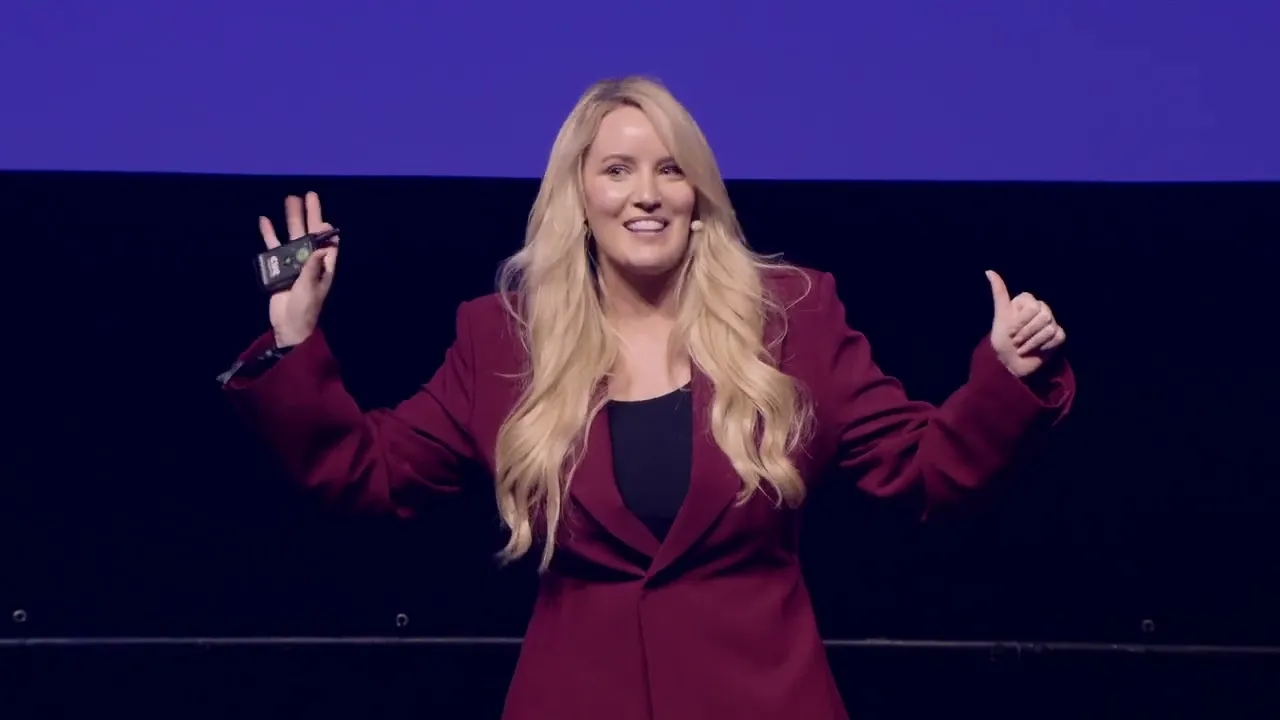
Good morning everybody. I hope you're caffeine fueled. Now for all the people sitting there at the front, I won't spit on you.
I promise. I can't guarantee Joel won't though. He's had a few coffees loaded up ready there to go.
It is so beautiful to be here. Today was a beautiful day. Absolutely gorgeous weather.
Thank you so much. It is my first time here in Oakland and is great to see all your faces. If you're just walking in, feel free to take a seat.
Although I can see it's quite a full auditorium today. I'm going to take you on a little bit of a journey today and I'm very excited about it. And if I see anyone talking, they've told me I've got a laser beam in my uh in my thing here I can shine at you and point at you.
So please would love your attention just for the next 15 minutes as I teach you how to see around corners. A little bit about me. You've just heard that intro, all the bells and whistles.
Something that isn't up there is I'm working on Australia's sovereign AI technology as well. So the data centers that are in Australia creating a sovereign technology trained on Australian data. We've set aside $10 million to buy Australianbased creative projects to train the AI.
So something you guys might want to be thinking about here in New Zealand as well. Uh although there's the bells and whistles up there, there's a little secret I want to tell you and it's so important for me to share. I'm a little bit embarrassed, but we like to start by role modeling vulnerability and empathy.
I didn't finish year 12. I grew up on an island called Tasmania, which is far far at the bottom of the earth. They like to compare it to New Zealand sometimes, but I think Tasmania is better.
Just quietly. Um, so I didn't finish year 12. I'm neurodeiverse.
I'm dyslexic. And I can't put numbers together to save my life. The reason why I share that is if I've been able to become a technology founder that scaled into 84 countries, if I've been able to lead at the forefront of AI, my gosh, you are much better versed and positioned than me.
So, I'm going to take us all along on this journey of how that we can learn the most important skill in today's day and age. It's to be a generalist. It's to learn how to see around corners and anticipate what's next.
Today I'm going to share with you something a little bit different. It's sort of the next step of AI. I'm sure we're all chat GPT and co-pilot pros here.
Uh I know we had a lot of learning and unpacking yesterday, but I'm going to share with you what if your mind, body, and emotions become the most valuable data source. Really going to take you with some out ofthebox thinking here. Welcome ladies and gentlemen, cheeky little gremlins and all you nerds out there to the future.
It is called the internet of you. Raise your hand if you've heard of the internet of cities. Most of us here, a couple of us here, the internet of cities is all of the sensors that work within a cities to bring it to life.
All of the data that happens within cities. Today I'm going to share about the next iteration of that. the internet of you, sometimes known as the IOU, the IY or the IOB.
So, let's reverse engineer this a little bit and look outside of us. We've seen all of these studies lately, and I've got some little scannable uh things there. I like to make everything I share, although it sounds science fiction, I like to make sure it's all evidence-based.
So, if you want to read a little more, just take a little uh screenshot there and have a read later. The BBC shared this article about some great research that's just come out. You might have seen it with your pets as well about how you'll soon be able to understand your pets using AI.
Well, in this one, they talk about how whale song can be understood because of using AI. There's a company here, Effectiva. Once again, if you want to give it a little scan there, you can learn about how they're using facial recognition and emotion sensing in cars for safety.
Rana El Kuraboy, one of my favorite people. She's sort of the leader of emotion AI in the world. She she famously said this recently on the Lex Friedman podcast.
Does anyone here listen to Lex's podcast? If you don't, you should. It's really good.
U she said the car is the first place that we can get a greater snapshot at how humans exist. Raise your hand if you took a car to get here today. Some of us, I think a lot of us take the ferry here because it's so beautiful.
Um tell me, I want people to shout out. I can't see you in the audience, although I do have some friends here today. But while all heads are bowed and eyes are closed, I want you to yell out some of the things that happen in the car where we're the most human.
I want you to keep your ideas above your navl except for farting. We can talk. We all fart in the car.
Joel was telling me before he farted in the car on the way here. It was a really We walked from the hotel, but just yell out. What are some of the things that we're doing in our car?
>> Singing. >> We're singing. We're singing along.
What else are we doing in the car? We're putting on our makeup. Okay, probably shouldn't be doing that unless you've got fully self-driving.
I don't think people want to implicate themselves here. I'm always listening to podcasts. I'm having little conversations with myself.
I'm singing a lot. I crank the music right up. Lily Allen's latest album.
Gee whiz. She's uh really having a serve at her ex-husband there. Luckily, I uh don't have any trauma like that.
But it's a really a place where we can just express oursel. And why am I sharing this? Well, this technology I told you about the emotion recognition technology in cars.
It's not science fiction. Smart eye technology which is the name of their technology is now in 332 models of cars, which is up from 94 car models last year. Did any of us realize this technology was being built into our cars?
No. As we look around, we're seeing this technology is being embedded in public spaces. It's being embedded in airports.
It's being embedded in retail spaces. We need to think about the implications of that, both the positive and the negative, as we work together to build the future. Here are some autonomous pods.
I don't know if you've seen them or maybe if you saw the latest Tesla demo, you saw something similar. They're fully self-driving pods. And uh I'm also very excited to hear I was uh on the receiving end the other day of some special intel, Joel.
Apparently Whimo driverless cars are coming to Australia. Let's see if we can get them to New Zealand as well. Has anyone here been in a Whimo vehicle in Austin or San Francisco or LA?
Okay, a couple. Well, I promise you they do exist. You can get taken from point A to point E B in a driverless car in Los Angeles.
It's called Whimo. W A Y M O. Absolutely incredible.
So, think about in the future how vehicles like this might be able to bring us to this concert, for example. Think of some of the experiences that might happen for us on the way to the concert using some of these senses and some of these uh interactive elements. I'm working with a a healthcare insurance company in the US who is using this technology actually and they are doing in Australia we have you can go into a pharmacy and you can sit down you can get your heart rate you can get your BMI you can get your weight and a few other uh medical details.
What they want to do is send this driverless pod to pick up families on the way to school once a quarter or on the way to work once a quarter to do their health checks in the driverless pod using that internet of bodies and internet of you data. Obviously, it would be given with your consent. But this is how we can use technology more efficiently in the ways that we're already living life.
Not that we're getting here in driveless cars at the moment, but remember, I'm here to teach you how to see around corners. I'm here to help you identify what the future must look like. Now, I can see some of you literally with panic in your eyes.
And what I want to say is I'm meeting you there. I understand technology that senses us not surveil us. It must serve us.
And how do we do that? Well, the good news is there are organizations and there are technologies being built and deployed at the moment that will help us to own our own electronic protected health data. At the moment, we give our keystroke data which is a huge indicator of our mental health away to Giant Tech.
At the moment, big tech and companies can sense within six seconds. I'm I'm trying to hold all my fingers up there. They're all there.
Within 6 seconds, if we have diabetes just from our breath, this data makes up our internet of view, our internet of bodies data, and it should belong to us. And we decide if we want to share that with a fast food restaurant. And we should decide if we want to share those keystrokes and all of those messages that we're sending with big tech.
Something for you to think about there. I want to give you a quick case study here. Wall Street Journal.
This was ran in 2017. It's a seven minutee video, so I didn't want to play it right now. In China, they have sensors that the students wear on their heads.
Once again, this is 2017 here. And it monitors the attention span and the comprehension of the students. I know Joel will talk more about the psychology uh of our integration with technology in the future.
So, this is fully signed off by the parents. The parents and the teachers both get to see in real time a summary of the attention level of the of the child but also uh real time live feeds. Why does this concern me?
While I think technologies in application like this are good, I believe they should be owned by the individual or anonymized because this data is now owned by the state. And when we think about what that means in the future, when we're sending people off to the front line in war and we have all their psychopysiological data about them, that changes things. We have a profile on people's behavior.
And as I said, Joel's going to be uh leaning more into that shortly. But I want to talk about just some of the technologies that we're starting to see. Raise your hands if you own a pair of AirPods or something like it.
Okay, most of the room. Did you know is wait is there anyone here from Apple? Sorry in advance if I'm blowing your cover.
Apple have a patent a patent a patent. It's live. You can Google it.
Just type in Apple AirPods patent. If you can't find it, just DM me on LinkedIn. Just say AirPods and I'll send it to you.
They have a patent about technology that's about to be released and I know the team who's working on it where AirPods will actually monitor the brain waves in your mind and their whole vision is in the future you'll simply be able to send a text message from your thoughts. Now this is the guy if you want to ask questions about how that'll actually happen and to unpack it. But this technology is already patented.
It's already been built and it will soon be in our ears, on our eyes, and in our cars before we know it. You must be prepared. This is the future.
This is how to see around corners. Here are some ways really quickly. We only have a few minutes left.
So, if you want to go into this deeper, feel free to upload this to chat GPT and ask it more questions or ask in the break. Here are some of the ways technology is currently being built and deployed. neural laces like Neuralink, um, like Synchron spun out of Melbourne University, one of the Melbourne universities, all brainto computer interfaces, uh, tooth caps, ingestables, implantables, headsets and handsets, and AirPods.
And just quickly on the uh ingestables one there, do you know in psychiatry there are ingestables that can be taken with medication and it reads the gut biome in real time and lets the psychiatrist or the prison warden know when that inmate has consumed their medication. This technology already exists. The internet of you will be about harvesting and collecting your data and allowing you to keep that data and decide how you want to use it.
It'll monitor your uh psychophysiological states of your body. Maybe match that in with some of your mobile activity data, your tap taps, your swipes, your keystrokes. It'll be time and date stamped.
Uh it'll be your sovereign data, so it'll be personal to you and will learn about you and your behavior in real time. It'll have that geospatial data as well. So pulling in from your maps and where you've been in your cars and your gate and your walk.
Did you know that the military can use gate to identify you? Gate is when you're walking along and how you actually walk and perform. Uh same with uh recognition cameras that they have in China can target you and know exactly who you are simply from your gate without even identifying your face.
And then of course pulling in that ambient noise and video. Now, we think some of this stuff is all science fiction, but ladies and gentlemen, as a proud Australian, I would like to remind you of the coccleia implant that has been working for years and decades and decades. I know a few people who have them.
They're very successful. My dad, here's a great water cooler story you can take home, has a pacemaker installed. It has Bluetooth and it lets his cardiologist know if he's about to have an event or if it needs an update.
I laugh at that because Joel, I was telling you before, my dad's quite in Australia, we call him bogan. He's a bit of a hillbilly. He hates technology.
He hates everything I'm doing, right? He he likes to farm his own vegetables. But I tell him that he is the biggest cyborg out of all of us cuz technology is literally saving his life.
And he hates it, right? He's just like, "Ah, wish I could take this thing out, but he never would. " We've talked about the harvest.
Your data will come from cars. If you want to sound really clever when you leave here today, the second one is looking in a mirror using a technology called photo plethography. Photo plethmography is how you can see uh activity under the skin using mirrors to indicate your your blood vessels underneath the skin and a lot of facial recognition as well.
Smart toilets that measure your ketone levels, whether you're dehydrated, can tell if you've got CO or not. Think about how this will help in primary schools for example to monitor the health of students in age care facilities to make sure our elderly are hydrated or have been taking their medication. How are everyday devices becoming multimodal?
You know, in our ears and in our hands, how are they becoming multimodal data capture vessels? So, I want to ask you, how can we co-create technology that uplifts all of humanity, that's great for all of our businesses, that's great for our lives, that makes our lives better. How can we use that using this new wave of internet of you and internet of bodies that you're now a short subject matter expert on?
Well, I'm going to welcome Australia's favorite nerd, Joel, to the stage now to take you through some of the ways we can actually apply this into our lives. It's been an absolute pleasure. I hope I haven't scared you too much.
I promise everything I've shared is evidence-based. If I like to dump all these ideas onto LinkedIn, my stream is just like open tabs on my computer straight onto LinkedIn. I don't often provide a lot of commentary, but if you want to learn more about some of this stuff, feel free to stay connected.
I do write back on there sometimes as well if you've got any questions, but we do have time for Q&A after this, after Joel's had a chat. So, we'd love to get your questions. Please send them through.
We're here to guide you into the future. I'm Amanda Johnstone. It's been an absolute pleasure.
Thank you very much.





![iOS 26 Settings You NEED To Turn Off NOW! [IMPORTANT]](https://img.youtube.com/vi/jdQWWmJ4Bms/mqdefault.jpg)