hello uh the first half of the lecture dealt with the significance of human rights for international law it also dealt with the development historical development of international human rights law and it dealt with the basic principles that govern the application of international human rights law we talked about the principle of universality we talked about the principle of alien ability we talked about the ergomness nature of the rights we talked about the relativity of most human rights what we will proceed now is to take a deeper look into the substantive rights that have been developed in
international human rights law and to discuss their uh specific manner of application and some of the difficulties that have been encountered in implementing international human rights law the starting point for uh any discussion about international human rights law the the one instrument which is the point of departure for the project of international human rights law in terms of its substantive contents is the universal Declaration of 1948 which we've already mentioned in the previous half of the lecture this is a document that was adopted as a UN resolution on 10 December 1948 which is uh celebrated
as human rights day incidentally the resolution was adopted by a large majority of states there were 48 states that supported the universal declaration there were eight states that have abstained mostly Soviet Bloc countries and there were no no states that opposed the universal declaration hence it is it is fair to say that the Declaration does did reflect at that time a rather broad consensus and that broad consensus has over time increased as the the universal declaration being reiterated and re-endorsed by uh the United Nations and by Regional organizations and in fact the contents of the
Declaration have been heavily influential in in terms of impacting the contents of subsequent human rights treaties but also uh affecting quite dramatically the contents of domestic laws and constitutional Provisions hence while it is fair to say that the Declaration is a general assembly resolution was not part of positive international law it was not a treaty it was not binding when it was adopted in fact the language of the Declaration itself speaks about generating a common standard of achievement namely low acid should be and not law as it currently is still over time the wide acceptance
of the Declaration and the follow-on normative developments have led many scholars to express the view that the Declaration largely reflects at this point in time customary international law and indeed when you are looking at the activities of U.N bodies such as the Human Rights Council that is reviewing State practice in the field of human rights law through processes such as the universal periodic review which examines the human rights standards of each and every state the one standard which serves as the normative Baseline for such evaluation is the universal declaration now the universal declaration is significant
not only in the sense that it serves as The Point of Departure of uh of the Norms of international human rights law it is also important in the sense that it contains a very uh a relatively long list of of Human Rights uh which uh pretty much reflect to this day uh most of the human rights which are recognized in in international law so uh it contains civil and political rights such as the right to life the prohibition Against torture freedom of expression freedom of assembly but it also contains and this is an important dimension
of the universal declaration it also contains economic social and cultural rights such as the right to health the right of adequate standard of living the right to education and in that respects it did cater or we did meet the expectations of both uh Western democracies that historically prioritize civil and political rights and also developing countries and socialist countries which traditionally have prioritized economic social and cultural rights so the universal declaration is a very important Landmark it is important also to to recognize the shortcomings of the universal declaration so as I said before it was not
a treaty hence the Norms that have been introduced in the Declaration were not producers legally binding norms and it took a lot of time for these Norms to graduate into binding norms and even till this very day there is some controversy over uh the precise status of some economic social cultural rights secondly because it was not binding there is also of course no enforcement procedure so the states were basically endorsing a certain set of Standards but did not subject themselves to any meaningful review of of these standards and for that actually subsequent treaties needed to
create enforcement machinery and finally the Declaration although it is a great Improvement upon the charter in the sense that it does provide us with 30 provisions and contains a list of Human Rights the human rights are defined in the Declaration in a quite laconic and abbreviated manner so a commitment to Fair trial or a Prohibition Against torture is of limited relevance when states are not provided with more specific guidance as to what is it exactly that they are expected to do or refraining from from doing and and of course it's quite typical for states to
claim uh not that they violate the right but the practices that they are actually engaged in are not uh are not in violation of an existing right so actually defining precisely rights is a very important uh part of international human rights law and in fact the treaties that were created after 1948 one of their main purpose has been to put flesh on the bone so basically to uh concrete is that to to concretize the the Norms that have been in a very abstract were introduced in Universal declaration so so the Declaration of 1948 was an
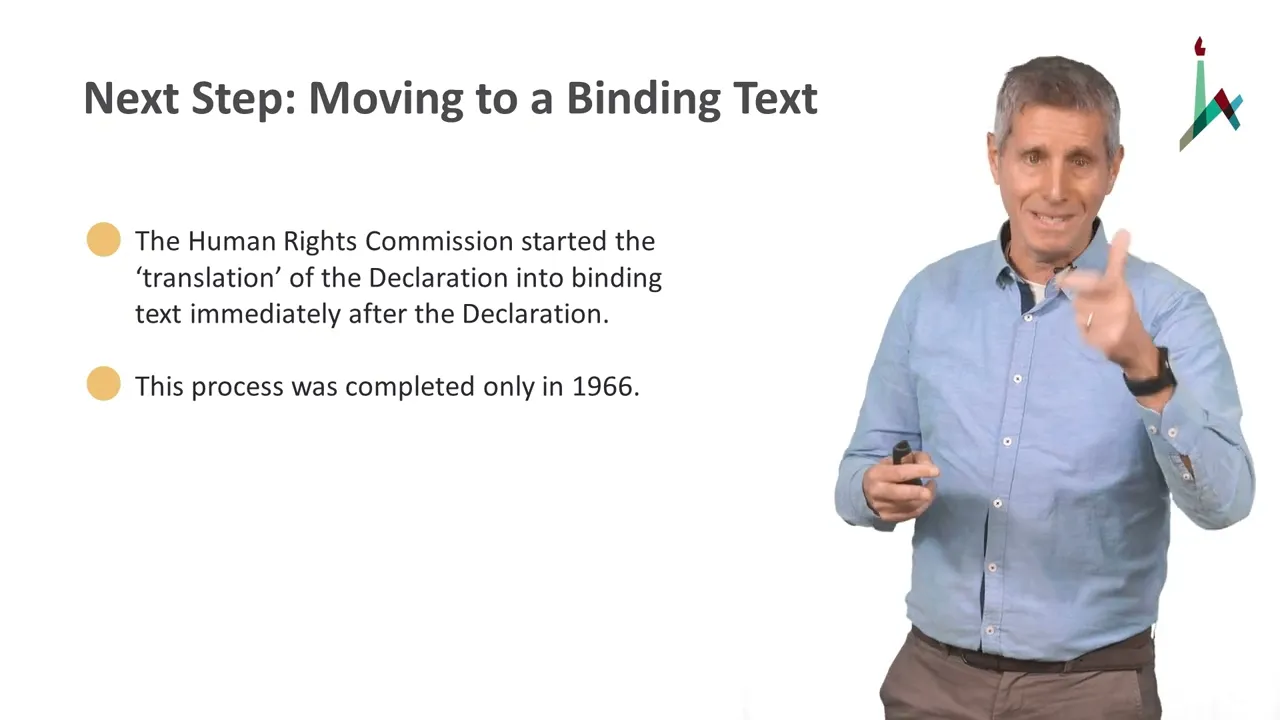
important Landmark but it was clearly just the beginning it was not the end of the process and the next stage that the Human Rights Commission and operating under the UN set itself to do is to uh translate so to speak the Declaration from a non-binding text to A binding text to A binding International treaty uh and that process started almost immediately after the Declaration was uh was concluded but then the process was stuck in 1950 there was some there was a first draft of a human rights Covenant uh but the draft didn't succeed in generating
uh consensus among states uh and in fact it took the Human Rights Commission 16 more years until 1966 to complete the process of translating the Declaration from a non-binding statement to a binding treaty and in fact it took the treaty and we will see the treaties that were concluded 10 more years to enter into effect so the process once moving from non-binding declarations to a binding treaty the process has been longed and and complicated now what what was so difficult first of course there is uh there is one there is a very large gap or
a very large difference in international practice in international politics between a adopting and non-binding resolution and adopting a binding instrument especially on something which is as sensitive for States as human rights law that deals with very important national interests but also has very intimate relationship with national laws and creates certain separation of power concerns within States so it's one thing for states to basically declare a general intent to respect freedom of expression it's very diff it's a it's a very different thing for for state to accept the legal instrument that actually puts standards with regard
to freedom of expression expression that may be in tension with their own constitutional standards so so it's one shouldn't underestimate the difficulty of signing a treaty in this field but more than that we did see come into play as I indicated before the very strong tensions between East and West during that period historical period of time the conclusion of the human rights Covenant or covenants really coincided with the eruption of the Cold War after 1948 and the deterioration of relations between West and and East and in a way the project of concluding a human rights
Covenant became a victim of that tension because for western states it was very important for them to emphasize civil and political rights which were very much in line with their political and legal systems and to use the language of human rights law in order to criticize conditions and developments in the in the Eastern Bloc so a lack of political freedoms and problems in the application of civil rights so on the other hand they did regard a States like the United States did regard and to some extent still regard to this very day economic social social
rights with some degree of Suspicion as an attempt to basically internationalize some core socialist tenets and principles so for um from an American point of view they would not agree to be part of a human rights Covenant again abiding treaty as opposed to a non-binary declaration which has a strong protection of economic social and cultural rights that require extensive government intervention in economic life so as to regulate the work Market to provide Health Care accessible Health Care to all provide free education to all uh take responsibility over the housing market etc etc uh on the
other side the Soviet Bloc was very much interested in advancing um a vision of human rights which prioritizes economic social and cultural rights which they consider to be more fundamental in their nature than civil and political rights because they addressed the very basic needs of an individual they need to to access food to access water to access clothing to access physical shelter to obtain basic health care and and from that perspective the civil and political rights were the rich men's rights and therefore they were to be satisfied only once the society has reached a certain
level of Economic Development and economic justice so for these countries it was unacceptable to conclude a human rights Covenant which does not have these features these economic social and cultural rights as dominant features and that is in a way why the process of including a human rights treaty was stuck in the end a compromise had to be found and it was found although it took a lot of time and the compromise was splitting the baby in half the proverbial proverbial Berry b in half namely instead of concluding one human rights Covenant concluding two human rights
covenants one a covenant for civil and political rights the iccpr the international Covenant on civil and political rights and secondly a covenant on economic social and cultural rights the icscr and each state could choose whether they would join one Covenant or the other Covenant or both Covenant or none of the above and in fact till this very day the United States of America is a party to the iccpr but it is not a party to the icscr and China is the mirror image of that it is the party to the icscr but it is not
a party to the iccpr now add to this uh uh distinction in terms of um what cluster of Rights will be prioritized there was also extensive discussion uh surrounding the manner of application or implementation of these two covenants and the division of the covenants into two uh different uh segments uh also uh facilitated some flexibility uh to cater the needs of the different state parties and in in a way the character and nature of the different rights so in terms of the method of implementation there there is a difference between the two covenants uh one
Covenant the iccpr is based as we will see on treaty Norms that have uh immediate application once the state is uh is is adhering to the Covenant it has to stop torturing individuals it can no longer uh engage in arbitrary killings it can no longer engage in arbitrary infringements of privacy Etc the other treaty on the other hand the icscr does have uh something of a different character it is built on the notion of progressive realization so it's it's quite impossible for state from one day to the other to provide everyone in the country with
housing or with access to Quality Health Care or to Quality education and these these things take time so um the manner of implementation of the two treaties was sort of uh is somewhat different big because of the different nature of the rights the the first cluster which is sometimes referred to in the literature is first generation rights rights which are uh broadly associated with the uh French Revolution the American Revolution the the Revolutions in Europe in the 19th century and the and and the limitations that are being placed on the powers of the rulers to
uh not to abuse their power and to oppress the population these are the negative rights and for them it was agreed in the Covenant to create a somewhat more robust uh process of implementation that would involve a committee a human rights committee that could if States would agree to that specific States would agree to that review individual Communications in a ways which are largely quasi-judicial so they would bring a complaint and the committee would review the complaint and issue a finding which although not legally binding would look a lot like a judgment for the the
other convention and the the covenants sorry the Covenant on economic social and cultural rights because Progressive realization was deemed to be less justiciable less appropriate for uh for a quasi-judicial uh assessment um it was not included in the original uh Covenant in fact there was even originally no no committee to supervise the implementation of the Covenant it was a quite weak process over time I should say the process has has there has been there have been developments and a committee has been established and over time it even got some quasi-judicial Powers but initially in 1966
when the two treaties were concluded they were configured in ways which are very different still it is important to say that the two treaties are the most important human rights treaties that we have uh at the global level and together with the universal declaration they comprise of core purpose that we call the international Bill of Rights most or almost all human rights are found in these three instruments uh the two covenants from 1966 also are are quite elaborate with respect to many rights for instance the right to due process of fair trial is very explicitly
and regulated in a quite detailed manner so as to provide guidance to States as to what exactly they are expected to provide for instance criminal defendants in criminal cases so we have those two treaties there is a difference in the nature of the rights there is also a difference in the manner of implementation of the two treaties but I think it is fair to say that over time uh the dominant approach in international human rights law has moved in a direction that actually minimizes this is this historic called distinctions between the two covenants and regards
both covenants is actually overlapping with one another to a considerable extent in the sense that some rights are actually very similar in nature for instance there is a protection of family life both in the iccpr and the icscr but perhaps more uh importantly that there is an understanding that human rights are interrelated uh interdependent and at a more abstract level indivisible because one cannot really for instance protect effectively the right to life which is an iccpr right without effectively protecting the right to health which is an icscr right or one cannot really effectively engage in
political participation which is an iccpr right without having the right to education taken care of which is an icscr right and moreover it has also been accepted that both treaties actually have not only negative but also positive rights namely not only rights that impose negative obligations on States thou shall not torture Thou shalt not kill thou shall not limit speech they also include positive obligation you should provide Health you should provide education but when you think of this the dichotomy is really not stringent because under iccpr you should provide a court system and under the
ICC icscr you should not prevent parents from choosing which school to send their children to so we see the the work of implementation bodies such as the European Court of human rights in this field taking the position that failure by child welfare authorities within a state to actually address the needs of child that have been subject to uh to molestation or to harsh treatment by by their family by their immediate family that constitutes a form of torture or cruel inhuman degrading treatment or you see the human rights committee basically taking the position that uh not
providing migrants with access to health Healthcare is a form of of discrimination and may even jeopardize the right to life so I think it is fair to say that at this point in time the historical Gulf between civil and political rights and economic social and cultural rights has largely closed down now we will take a short break and after we resume we will talk about other treaties and specifically about mechanisms of implementation





![Ludovico Einaudi [relax, study, sleep, soft, calm, inspired piano medley]](https://img.youtube.com/vi/DIvewN35QT4/maxresdefault.jpg)