You're sitting at dinner with friends and someone says, "Honestly, renting is just throwing money away. " And suddenly, everyone starts nodding. Your parents agree.
Your co-worker agrees. That one friend who bought a house 6 months ago agrees, even though he now spends every weekend at Home Depot looking emotionally defeated. And then you go home, open Zillow, look at house prices, open your banking app, look at your savings account, and think, "Am I behind?
Am I wasting money? Should I buy a house before it becomes impossible? " And here's the thing.
This question, renting versus buying, is one of the most emotionally loaded financial decisions most people will ever make. Because buying a home doesn't just feel like a financial decision. It feels like adulthood.
It feels like success. It feels like stability. And renting?
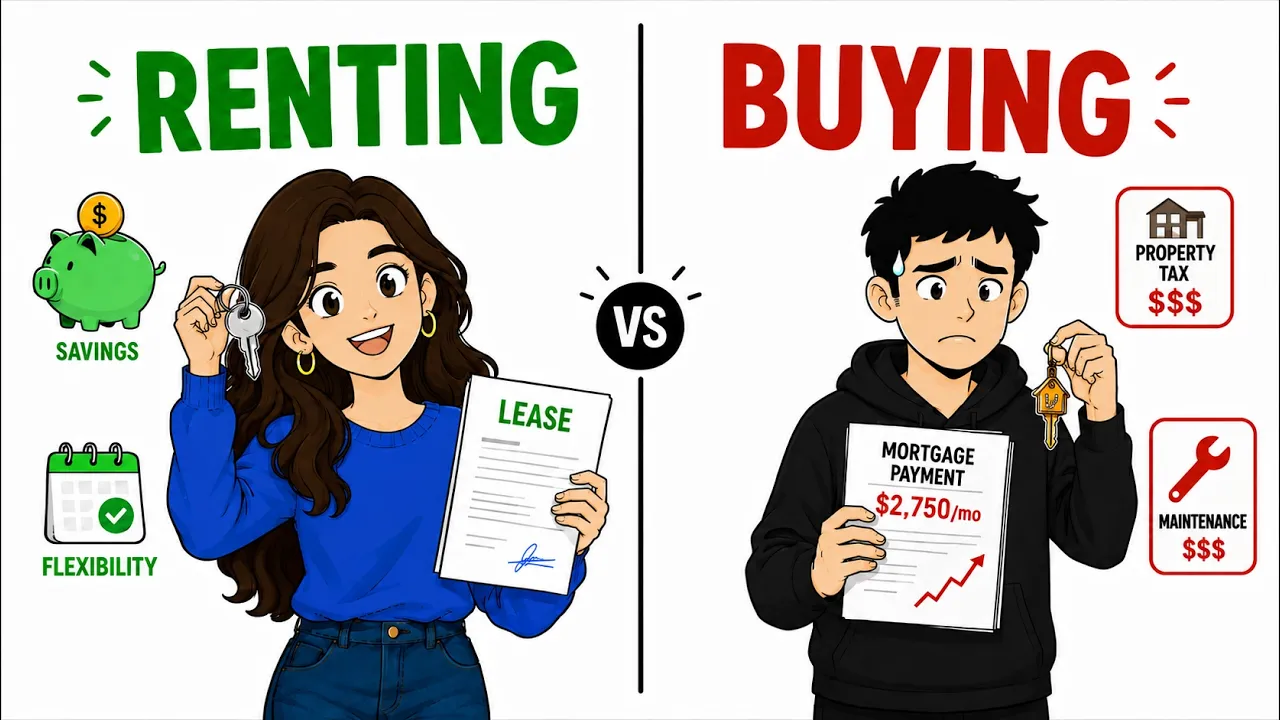
Renting often feels like you're paying someone else's mortgage while your own financial future is standing outside in the rain. But today, I want to challenge one of the most common financial assumptions in the world. Buying is not always smarter than renting.
And renting is not always wasting money. The real answer depends on math, timing, lifestyle, discipline, and the part nobody wants to talk about, your psychology. Because a house can make you wealthy, but the wrong house, bought at the wrong time, with the wrong numbers, can quietly trap your money for years.
So today, we're going to break down the real math, not the emotional math, not the my uncle told me houses always go up math, the real math. My name is Jack. If you're someone who feels pressured to buy a home, but isn't sure whether it actually makes financial sense, make sure to hit the subscribe button and give this video a thumbs up if this helps you out.
Look, I know this topic can get people emotional. Because for many people, home ownership is the dream. And I get it.
Owning a home can be amazing. You build equity. You get stability.
You can paint the walls whatever color you want. You don't have to ask a landlord if you can have a a hang a shelf, or replace the world's ugliest kitchen tiles. But here's where people make the mistake.
They compare rent to a mortgage payment and think that's the whole equation. They'll say something like, "My rent is $1,800 a month, but the mortgage on this house is $2,100. So for just $300 more, I could own.
" And at first, that sounds logical. But that is like comparing the price of a gym membership to the cost of building an entire gym in your basement. The monthly payment is just the beginning.
Let's start with the famous phrase, "Renting is throwing money away. " Um kind of, but also not really. Because when you rent, yes, you are paying money and you don't own the property.
But you are not paying for nothing. You are paying for shelter. You are paying for flexibility.
You are paying for maintenance that is not your problem. You are paying for the ability to move if your job changes, your relationship changes, your city changes, or your life just changes. So rent is not throwing money away.
Rent is buying a service. Just like paying for food at a restaurant is not throwing money away because you don't own the restaurant. Now, buying also has throwing money away costs.
People just don't call them that. When you buy a house, you pay mortgage interest. You pay property taxes.
You pay homeowner's insurance. You pay maintenance. You pay repairs.
You pay closing costs. You may pay HOA fees. You may pay higher utilities.
And none of those things build equity. They are just costs. Here's what most people don't realize.
In the early years of a mortgage, a huge portion of your monthly payment goes to interest, not principal. So yes, you are technically building equity, but in the first few years, you may be building equity very, very slowly. It's like going to the gym, lifting 1-lb weights, and telling everyone you're becoming a bodybuilder.
Technically true, but calm down. Let's use a realistic example. Imagine you are deciding between renting a nice apartment for $1,800 per month or buying a $400,000 house.
Let's say you put 10% down. That means your down payment is $40,000. Your mortgage is $360,000.
At around a 6. 5% interest rate over 30 years, your principal and interest payment is roughly $2,200 and $75 per month. But, we're not done.
Add property taxes, let's say $400 per month. Add homeowner's insurance, maybe $150 per month. Add maintenance.
A common estimate is around 1% of the home value per year. On a $400,000 house, that's $4,000 a year or about $333 per month. Maybe there's no HOA, so we'll skip that.
Now, your real monthly cost is not $2,275. It is around $3,158 per month. So, now compare that to renting at $1,800.
Buying costs about $1,358 more per month. And that does not include closing costs. It does not include furniture.
It does not include the new lawn mower you suddenly need. It does not include the random $9,000 repair that appears at the worst possible time because apparently water heaters are emotional creatures that like to fail right before Christmas. Now, you might be thinking, "Yeah, Jack, but with buying, part of that payment comes back to me as equity.
" Correct. And that's the key. We don't compare rent versus mortgage.
We compare unrecoverable costs. Rent is mostly unrecoverable. But, with buying, interest, taxes, insurance, maintenance, and transaction costs are also unrecoverable.
The part that builds wealth is the principal pay down and home appreciation. That's the real comparison. This is where it gets really interesting.
A lot of people buy a house thinking, "I'm tired of wasting money on rent. " But then, they sell after three or four years. And that can completely destroy the math.
Why? Because buying and selling a home is expensive. When you buy, you may pay closing costs.
When you sell, you may pay agent commissions, repairs, concessions, moving costs, and more closing costs. So, even if your home goes up in value, you might not actually walk away with much profit. Let's say you buy a $400,000 house.
Five years later, it's worth $460,000. That sounds amazing. You made $60,000, right?
Not so fast. When you sell, transaction costs could easily eat up tens of thousands of dollars. You also paid property taxes, insurance, repairs, interest, and maintenance along the way.
So, the house appreciating does not automatically mean you made a great investment. This is why time matters so much. The longer you stay, the more time you have to spread out the upfront costs, pay down principal, and benefit from appreciation.
But if you buy and move quickly, the house can become less like an investment and more like a very expensive subscription box for stress. Now, let's talk about the part that homeowners often ignore. If renting is cheaper than buying, what happens to the difference?
In our example, renting costs $1,800. Buying costs around $3,158. That's a difference of $1,358 per month.
If a renter actually invests that difference every month, the math can become very powerful. Let's say they invest $1,358 per month into a low-cost index fund. If they earn an average return of 7% per year over 30 years, that could grow to over 1.
6 million. Now, obviously, markets don't move in a straight line. Some years are great.
Some years are painful. But, the point is this, renting can beat buying if the renter invests the difference. But, and this is a big butt, most people do not invest the difference.
They rent the cheaper place, then spend the difference on restaurants, subscriptions, vacations, upgrades, Amazon orders, and random purchases they swear were basically necessary. And, this is where psychology enters the room. Home ownership works for many people, not just because houses are magical investments.
It works because a mortgage is forced saving. Every month, you are required to pay. Part of that payment slowly builds equity.
You don't have to be disciplined. The bank forces discipline on you. And, for many people, that structure is incredibly powerful.
Because, let's be honest, a lot of people say, "I would invest the difference. " But, what they really mean is, "I would invest the difference if I became a completely different person. " Here's an important statistic.
Homeowners tend to have dramatically higher net worth than renters. That sounds like proof that buying is always better. But, be careful.
This is where people confuse correlation with causation. Homeowners are often wealthier, partly because they own homes. But, they are also more likely to have higher incomes, more stable jobs, more savings, better credit, and enough money for a down payment in the first place.
So, yes, home ownership can build wealth. But, the house is not the only reason homeowners have more wealth. It is also the behavior around the house.
Saving for a down payment, making consistent payments, staying in one place, avoiding lifestyle inflation because the mortgage eats half your fun money. A home can act like a financial anchor. Sometimes that anchor keeps you stable.
Sometimes that anchor traps you. The difference is whether the numbers make sense. Now, let's talk about the emotional side.
Because buying a home is one of those decisions where people stop using spreadsheets and start using vibes. They say things like, "I just feel ready. I want something that's mine.
I'm tired of paying someone else. I don't want to miss out. " And look, those feelings are real.
But feelings do not pay closing costs. One of the biggest psychological traps is social pressure. You see friends buying homes.
You see people posting keys on Instagram. You see captions like, "God did it. " And suddenly your apartment starts feeling like a financial failure.
But you don't see the other side. You don't see the 30-year loan. You don't see the inspection report.
You don't see the property tax bill. You don't see the couple arguing in the kitchen because the roof repair cost more than their honeymoon. This is why you need to separate lifestyle desire from financial readiness.
Wanting a home is not the same as being ready to buy one. So, how do you know if buying makes sense? Here's a simple framework.
First, buy only if you plan to stay at least 5 to 7 years. Not guaranteed, obviously. Life happens.
But if you already know you may move soon, renting is usually safer. Second, buy only if the full monthly cost fits comfortably into your budget. Not just the mortgage, the full cost.
Mortgage, taxes, insurance, maintenance, utilities, HOA, repairs, and a cushion. If the house only works when everything goes perfectly, the house does not work. Third, buy only if you still have an emergency fund after closing.
This is huge. A lot of people spend every dollar getting into the house, and then the house immediately tests them. The fridge breaks.
The AC stops working. A pipe leaks. And suddenly they are homeowners with no cash, which is just renting from the bank with extra anxiety.
Fourth, compare the cost of buying to renting in your specific area. Not nationally, not based on your friend's city. Your city, your neighborhood, your numbers.
In some markets, buying is a great deal. In other markets, renting and investing the difference can be much smarter. Fifth, be honest about your personality.
If you are disciplined and will invest the difference, renting can be a powerful strategy. If you know you will spend the difference, buying may help you build wealth through forced discipline. That's not a judgment.
That's self-awareness. And self-awareness saves people more money than pretending to be a spreadsheet robot. There's one more hidden cost people forget.
Opportunity cost. When you buy a house, your down payment gets locked into the property. Let's say you put $40,000 down.
That $40,000 is no longer sitting in investments. It is no longer liquid. You can't easily use it to start a business, invest in the market, move cities, or handle a major opportunity.
Now, that doesn't mean buying is bad, but it means your down payment has a job, and you need to ask, is this the best job for my money right now? A house can grow in value, but it can also concentrate your wealth in one asset, in one neighborhood, in one local economy. That's not always bad, but it is not automatically safe just because it has walls and a garage.
Let me tell you about two people. Person A buys a house because they feel pressure. They barely have the down payment.
Their monthly payment is tight. They have no emergency fund left. At first, they feel proud.
They post the keys. Everyone congratulates them. But 6 months later, the roof needs repairs.
Then property taxes go up. Then they realize commuting costs are higher because the only house they could afford was farther away. Now they technically own a home, but they feel broke every month.
They stop investing. They stop traveling. They stop taking risks.
The house didn't make them free. It made them fragile. Now person B rents for a few more years.
They keep their housing costs low. They invest consistently. They build a bigger emergency fund.
They improve their income. They study the market. Then, when they buy, they buy from strength.
They are not desperate. They are not house poor. They can handle repairs.
They can still invest. They own the home. The home does not own them.
Same dream. Different timing. Completely different result.
Here's what most people don't realize. Renting can be a smart financial move when it gives you flexibility, lower monthly costs, and time to build your foundation. Renting is not failure.
Renting is a tool. Buying is also a tool. The problem is that people treat buying like a trophy and renting like a punishment.
But money doesn't care about trophies. Money cares about cash flow, risk, time, and behavior. If renting lets you save $1,000 a month, invest consistently, avoid bad debt, and stay flexible, then renting might be the smartest move you can make right now.
But if buying gives you stability, predictable housing, long-term equity, and you can comfortably afford it, then buying can be one of the best wealth building decisions of your life. The key is not choosing the option that sounds more adult. The key is choosing the option that makes your future stronger.
So, here's what I want you to do after this video. Step one, calculate the real monthly cost of buying. Do not just use the mortgage payment.
Add taxes, insurance, maintenance, HOA, utilities, and repairs. Step two, compare that to your current rent. If buying costs more, calculate the difference.
Step three, ask yourself honestly, would I actually invest this difference every month? Not in theory, not in fantasy, actually. Step four, check your time horizon.
If you may move in 3 years, be very careful. If you plan to stay 7 to 10 years, buying becomes much more attractive. Step five, protect your emergency fund.
Do not buy a house in a way that leaves you one repair away from credit card debt. And step six, ignore social pressure. Your friend's house is not your financial plan.
Your parents' advice may come from a different housing market. Your co-worker's opinion does not know your bank balance. You need your numbers.
Look, the goal is not to rent forever. And the goal is not to buy as soon as possible. The goal is to build wealth without destroying your peace.
A home should support your life. It should not become a financial prison with granite countertops. And when you really understand the math, the pressure starts to fade because you realize something powerful.
You are not behind just because you rent. And you are not automatically ahead just because you buy. You are ahead when your money decisions match your actual life, your actual numbers, and your actual goals.
So, before you sign a lease or sign a mortgage, slow down. Run the math, respect the psychology, and make the decision from strength, not fear. Because the real flex is not owning a house.
The real flex is owning your financial future. If this video helped you understand the real math behind renting versus buying, hit the subscribe button, give this video a thumbs up, and comment below. Are you renting right now, planning to buy, or still deciding?
And remember, the best financial decision is not the one that impresses other people. It's the one that makes your future self breathe easier.