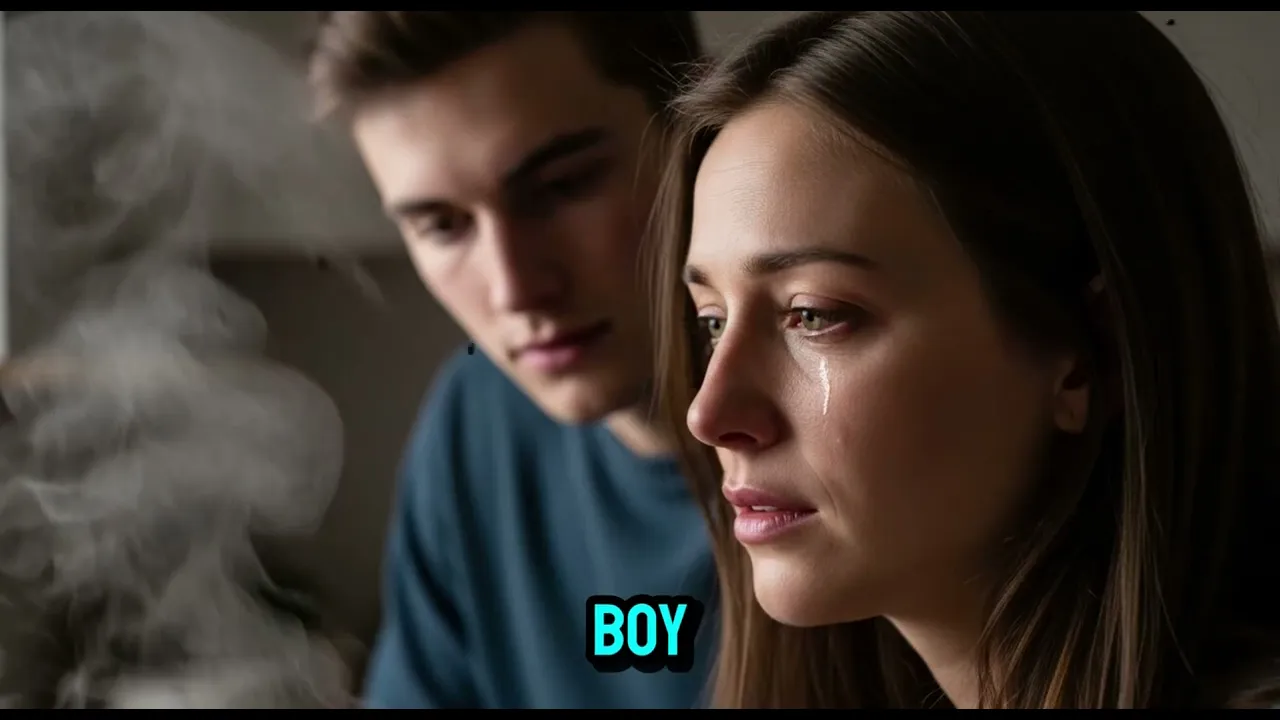
The night it began, the kitchen smelled of rosemary and regret. Rain tapped against the window pane, like a persistent reminder of everything unsaid between us. I had been slicing bread, half listening to the radio when the sound of footsteps interrupted the rhythm.
Adam stood in the doorway, his expression unreadable. my stepson. Though that word always felt too formal, too detached for what life had made of us.
He was 23 now. Leaner, quieter, with the kind of maturity that didn't come from years, but from endurance. Dad's working late again, he asked, his tone casual, though his eyes betrayed something sharper.
I nodded. He said he might not make it home for dinner. He smiled faintly.
a smile that carried more sadness than amusement. He never does. There was no accusation in his voice, but I felt one anyway.
David's absences had become routine. Their reasons always the same. Work, meetings, exhaustion.
Excuses dressed as devotion. Somewhere along the way, our marriage had transformed from a story of survival into one of endurance. Adam walked further in, his presence filling the small space.
He moved with the quiet assurance of someone who belonged, yet questioned why. He poured himself a glass of water, leaned against the counter, and studied me. "You cook too much when you're lonely.
" He said suddenly. The knife paused midslice. I turned toward him, startled by his bluntness.
"That's an odd observation. It's true, though. " His gaze softened.
You used to cook for him. Now you cook for yourself. I should have laughed.
Should have deflected like I always did when truth got too close. But that night something in his voice, gentle, almost protective. Made deflection impossible.
You notice too much, I murmured. I grew up watching people pretend they were fine, he replied. You learn to see through silence.
It struck me then how easily he had mapped the contours of my unhappiness. There was no romance in it, no impropriy, just a recognition that hurt knows its own kind. Still, his words unsettled me.
They made me aware of how exposed I was, how transparent my loneliness had become. He lingered for a moment longer, then set down his glass. You don't deserve to feel invisible, he said quietly.
and before I could answer, he was gone, leaving me alone with the echo of his words and the steady drip of the faucet. I stared at the door he had disappeared through, my chest tight with a mixture of confusion and guilt. It wasn't what he said that haunted me.
It was that he was the first to say it aloud. That night, I realized something dangerous had shifted. Not between us, not yet, but within me.
And that was how it started. Not with betrayal, but with recognition. David and I met during a season of repair.
Two broken people convincing ourselves that shared loneliness could become love. He had just lost his wife to illness. I had lost faith in promises that faded too easily.
Together, we built something that looked stable from the outside, though inside it always trembled. Adam was 15 when I first moved into their home. A quiet boy, guarded but observant.
He carried grief in the way he walked. Shoulders slightly hunched as if bracing against memories. I tried to reach him in small ways.
Dinners he rarely attended. Gentle questions he rarely answered. In time politeness became our language, safety our boundary.
Years smoothed the edges of that distance, but they never erased it. When he left for university, the silence he left behind felt like an achievement. Proof that he had found his own life beyond the walls of our fractured family.
David and I, meanwhile, settled into an arrangement that resembled contentment. We shared a bed, shared bills, shared a history, but rarely shared ourselves. When Adam returned years later, older, thoughtful, carrying a heaviness that didn't belong to youth, I told myself it was only temporary.
He had lost his job. He needed time to reset. But from the moment he stepped into the house, the air changed.
It wasn't dramatic, just perceptible. The way a familiar song can sound strange after too long. He helped more than I asked him to.
fixed leaky faucets, replaced light bulbs without being told, spent evenings in the kitchen while I cooked, talking about everything and nothing. At first, I found comfort in it. The quiet companionship, the easy rhythm of conversation.
But comfort has a way of turning into dependency when your life is built on absence. David noticed none of it. Or perhaps he chose not to.
His career consumed him. His phone was always buzzing with meetings, clients, excuses. When he did come home, his affection felt rehearsed.
A kiss on the forehead, a half-listened story. One evening, I found myself watching Adam as he spoke about his future, his hands gesturing with quiet conviction, his eyes bright with sincerity. There was a steadiness in him I had once admired in David, now long gone.
That realization frightened me. It wasn't desire that unsettled me, but recognition. The unbearable awareness that someone saw me again without expectation or obligation.
And once you've been seen after years of invisibility, returning to blindness feels impossible. That night, as I lay beside David in the dark, listening to his even breathing, my thoughts wandered back to Adam's words in the kitchen. You don't deserve to feel invisible.
He had said it as comfort, but it lingered as prophecy. I closed my eyes, knowing something unspoken had begun its quiet descent. Not with defiance, but with the kind of inevitability that ends stories before anyone realizes they've started.
The shift between comfort and danger is rarely loud. It arrives quietly in softened tones, prolonged glances. The spaces between words.
That evening, the house felt unusually still. David was away on another overnight trip, and the clock's steady ticking seemed to echo louder than it should have. I stood in the kitchen, stirring a pot of soup I no longer wanted, when Adam appeared at the doorway, sleeves rolled up, eyes tired, but kind.
You should sit, he said. You've been on your feet all day. I almost laughed at the irony.
Him caring for me when I was supposed to have been the one looking after him. But instead, I nodded, watching as he took over the stove. The gesture was simple, domestic.
Yet, it carried an intimacy I couldn't ignore. For a while, neither of us spoke. The silence was oddly soothing, though my thoughts were anything but calm.
I found myself studying the way the like caught his hair, how his expression shifted between focus and restraint. He had grown into someone self assured, yet still carried traces of the boy who once avoided my gaze. When he finally spoke, his voice was softer than usual.
You seem sad lately. I hesitated. I suppose I've been tired of him.
The question hung in the air, heavier than steam. I'm tired of pretending, I admitted, surprising even myself of keeping everything steady while he drifts further away. Adam's eyes met mine, full of empathy and something dangerously close to understanding.
You don't have to keep fixing what he keeps breaking. That sentence struck deeper than it should have. My throat tightened, words catching on guilt.
Adam, don't. I'm not saying anything I shouldn't. He interrupted gently.
I just hate seeing you hurt. There was no accusation in his tone, only a quiet sincerity that disarmed me. I turned away, gripping the counter for balance.
The nearness of him, the warmth of his presence. It felt like standing too close to a flame. I wasn't ready to acknowledge.
A moment later, he switched off the stove. Dinner's ready," he said softly, his voice returning to its usual calm. But as we ate, the air between us shifted, not in words or gestures, but in awareness.
Every glance lingered a second too long. Every silence stretched thin. When David returned the next morning, I caught myself avoiding his eyes, unsure whether he could sense the quiet fracture that had formed in his absence.
Nothing had happened. Not yet. But something had undeniably changed.
And once a line blurs, pretending it's still clear becomes the greatest lie of all. The night the truth surfaced. It wasn't through words, but through silence.
David had left early for a conference, leaving the house in its familiar emptiness. I spent the evening cleaning, wiping countertops that were already spotless, organizing shelves that didn't need order. It wasn't about tidiness.
It was about control. Adam found me there. Sleeves rolled up, my reflection blurred in the kitchen window.
You do this when you're anxious, he said gently. I didn't realize I had habits that obvious. He smiled faintly.
You do. You hide your hurt in motion. I turned toward him, the overhead light softening the edges of his face.
Maybe it's better than saying what I really feel. Maybe you should say it anyway. The challenge in his tone startled me, quiet but steady, as though he'd been waiting for me to acknowledge the storm.
Neither of us dared to name. I set the cloth down, pulse quickening. There's nothing to say, Adam.
Yes, there is, he said, stepping closer. You've been pretending everything's fine, pretending he still sees you when he hasn't for years. Adam, he doesn't look at you the way you deserve to be looked at.
The words struck like a confession, not of love, but of truth. My throat tightened. I wanted to tell him to stop, to step back, to undo what had already been spoken into existence.
But instead, I met his gaze. And in that moment, the air shifted. Fragile, dangerous, alive.
I care about him, I whispered, unsure if I meant David or Adam. I know you do, he replied softly. But when do you start caring about yourself?
His voice trembled slightly, betraying the composure he was fighting to hold. The distance between us had vanished, not physically, but emotionally, as if every unspoken thought had finally taken form between us. And then without meaning to, I reached for him.
Just to steady myself, I told my mind. But the truth was simpler and far more damning. I wanted to feel seen even for a heartbeat.
The moment lasted only seconds, but its weight lingered long after I stepped away. I shouldn't have, I said, my voice breaking. I know, he murmured.
But you did, he turned and left before I could respond. The front door clicked shut, leaving behind an echo that filled the house like a ghost of everything we hadn't said. I sank against the counter, trembling, not from what had happened, but from what it meant, because in that fleeting moment of weakness, I realized something devastating.
It wasn't desire that had bound us, but recognition, and recognition once found, can't be undone. The morning after he left, the house felt unfamiliar, too quiet, too clean, as if trying to erase his presence. But memory doesn't fade with absence.
It settles in corners, invisible yet persistent. David returns 2 days later, suitcase in hand, eyes tired, but unchanged. He asked about Adam only once.
Did he say when he'd be back? No, I replied. my voice steady.
He just said he needed space. David nodded. Accepting it the way he accepted most things now.
Without question, without curiosity, I should have felt relieved, but instead I felt hollow. The truth lay unspoken between us. Not as guilt, but as distance.
For weeks, I moved through the motions of our life together. setting the table, folding laundry, offering conversation that fell flat. David was polite, predictable, and entirely unreachable.
Sometimes I caught myself wondering if he sensed the fracture, if he noticed how I flinched when his hand brushed mine, but he never asked. Perhaps he already knew. And silence was his form of survival.
Adam didn't call. I didn't expect him to. Some wounds demand distance to heal, others to endure.
And yet, late at night, I'd catch myself listening for footsteps that would never return, replaying words that had already rewritten too much. One afternoon, while clearing the kitchen, I found the faint crack on the counter. The one from the night, everything changed.
My fingers traced it slowly, as if touching it might offer answers. It didn't. It only reminded me that even the smallest fractures become permanent when ignored too long.
In that quiet, I understood something I hadn't before. What happened between Adam and me wasn't an affair. Not in the physical sense.
It was the collision of two forgotten hearts, both starving for recognition. The world would call it wrong, perhaps even unforgivable. But to me it was a mirror reflecting all the ways love can fail without ever meaning to.
David and I still share this house. Still perform the rituals of marriage. Dinner at 7.
Polite conversation. Separate silences. But I know now that our story ended long before Adams began.
His arrival only revealed what time had already taken. Sometimes I wonder where Adam is, whether he remembers that night as I do. Not as sin, but as a moment of truth.
We weren't brave enough to face. I don't long for him. I long for the clarity he gave me.
The painful understanding that being seen is not the same as being loved. When I look at the crack on the counter now, I no longer see shame. I see proof that even in breaking something honest can remain.
And maybe that's what forgiveness really is. Not forgetting what happened, but learning to live with what the heart refused to ignore.




![[Review Phim] Anh Công Chức Quèn Bỗng Dưng Nhận Được Siêu Năng Lực Kỳ Lạ - Anh Hùng Tiền Mặt (2025)](https://img.youtube.com/vi/7YSS4Y3YA0c/mqdefault.jpg)