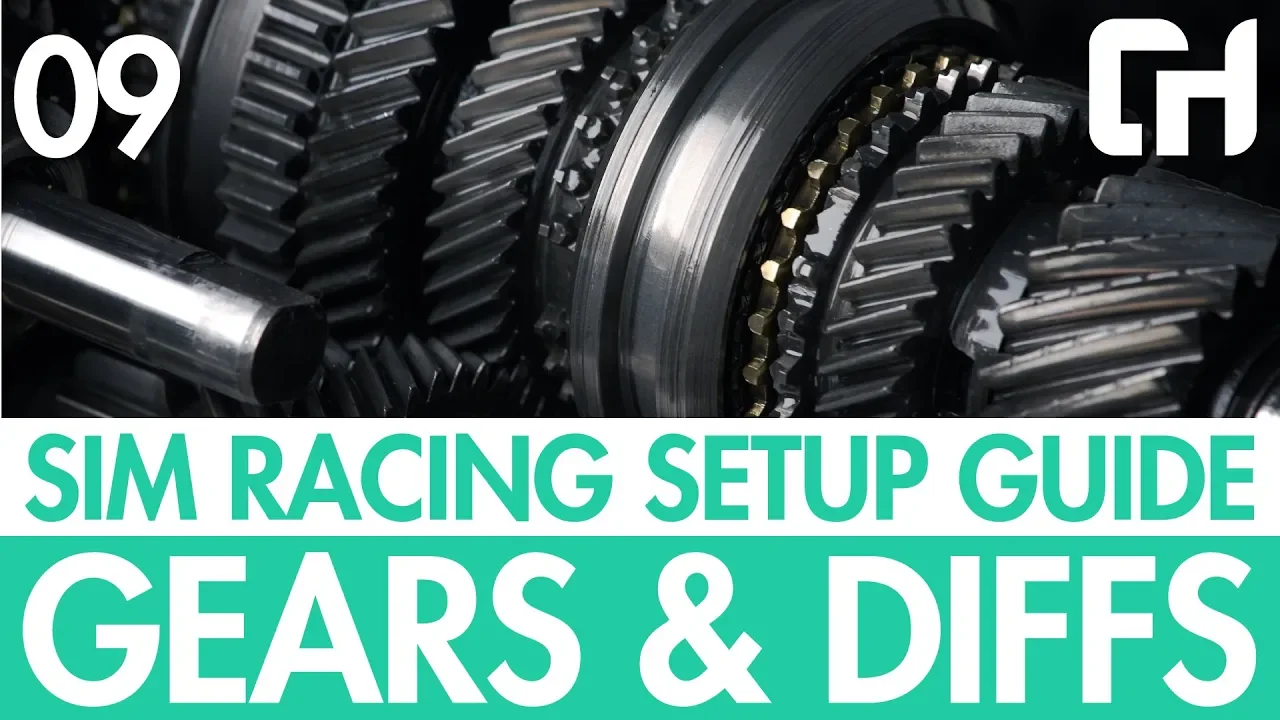
[Music] hello fellow sim racers and welcome to part 9 of this sim racing setup guide today's video is mostly about differentials but I've also crammed in a bit about Giro shows because well they didn't really need a video all of their own if you've not seen any of the earlier parts of this guide then a link to a playlist containing all of my setup videos should be in the top right hand corner of your screen [Music] gear ratios and differentials aren't really all that related aside from being elements of the drivetrain and honestly they're being
included in the same video has everything to do with how I wanted to structure the series and not for any practical or technical reason the purpose of setting the gear ratios in a racing car is to find the optimum balance between acceleration and top speed shorter gear ratios provide more torque and therefore better acceleration but will limit the top speed the cars capable of attaining conversely long or tall gear ratios will allow for a higher top speed but will compromised acceleration Garro shows are probably one of the most circuit dependent settings on a car and
it should be pretty obvious wide ratios that work well at Monaco would be completely inappropriate at Monza most modern racing cars have fully adjustable gear sets meaning that you can alter the individual ratios of each gear as well as that of the final drive however some cars are mandated to run fixed ratios or a limited number of preset ratios by their series sanctioning body so in some cases he may be only able to alter the final drive pick from a selection of presets or make no alterations at all when it comes to setting gear ratios
there are two main areas you can change first and arguably the most important is the final drive ratio this impacts the relationship between the revolutions of the engine and the revolutions of the wheels in all of the gears in a lot of cases adjusting the final drive ratio is all that you really need to do to maximize performance and thankfully getting the final drive setting into the right ballpark is usually pretty straightforward the goal is to run the shortest final drive ratio possible without sacrificing top speed at the end of the straights thereby finding a
good compromise between acceleration and top speed the approach most people take is to see if they're hitting the rev limiter in Top Gear on the longest straight if you're hitting the rev limiter a long way before the braking zone you need longer gearing if you're not hitting the rev limiter at all you should shorten the final drive because you're wasting potential acceleration this is a step that should be undertaken after you've set the angles of your wings and it may potentially need to be adjusted if you make changes in this area later on another consideration
depending on the car is DRS if you're already on the rev limiter when you pop the wing it's not gonna make you go any faster so if you're running in a series that relies on DRS you may want to consider leaving a bit of spare rev range available for those Aero assisted takes in addition to altering the final drive ratio you can also change the ratio of each individual gear most default setups will have evenly spaced gear ratios as this provides a reasonably even acceleration across the entire speed range of the car but you may
find that there are points in a circuit where you feel like the car is in the wrong gear or you have to change it in an opportune moment for example immediately before a braking zone or in the middle of a corner if this is the case to try altering one or more of the individual ratios to compensate but make sure you're not sacrificing laps on furthermore if you're racing in a series with standing starts it can also be beneficial to also first gear to aid traction off the line if you have too much wheel spin
you can lengthen the first gear and if you're bogging down shortening first gear can help however this will compromise anywhere else you may need to use first gear on the circuit so do so with caution finally another common approach is to shorten the first two or three years to provide more low-end acceleration out of the corners and this can be very beneficial at some of the more stop start tracks for those that aren't aware the differential is a component of a car's drivetrain that allows both driven wheels to rotate the different speeds and more importantly
rotate independently of each other this is desirable because during cornering the wheels on the outside of the car have to travel a greater distance than those on the inside therefore the outer wheels must rotate a faster rate to maintain contact with the tarmac the downside of a traditional open differential like you'll find in everyday road cars is that they send more power to the wheel with the least grip and if one wheel has no grip at all it will send all of the power there that's rarely an issue on the shopping run in your Ford
Focus it's nice and safe and it helps preserve tire life but it's not quick so performance cars tend to have some kind of locking or more likely limited slip differential is designed to limit the independency of both wheels or to put it another way a limited slip diff allows both driven wheels to rotate at different speeds but it reduces the variance in power that's sent to each wheel so to go back to the earlier example a car with a limited slip diff doesn't send 100% of the power to with no grip this is important for
racing cars because during cornering braking and accelerating it's rare that both driven wheels have equal grip and not only is sending more power to the wheel with least grip a waste of energy it can also upset the balance of a car but more on that later in the video a differential that allows both tires to move completely independently of each other it's described as open an open differential makes for a very agile car at turning but that comes at a cost more power will be delivered to the wheel on the inside during cornering and as
you'll remember from previous videos this is the wheel with least grip conversely a differential that forces both wheels to rotate at the same speed is described as closed or lock a lock differential provides excellent straight-line traction as both wheels have delivered an equal portion of the power however the downside is that during cornering one way we'll be forced to rotate at the wrong speed upsetting the balance and causing excessive tire wear so like almost everything about car set-up setting the differential is all about finding the middle ground now before I move on it's important to
mention that not all cars have adjustable differentials in general run of the mill road cars have opened ifs while some older racing cars and oval cars have a completely solid driven axle but most modern racing cars have a configurable clutch based limited slip differential meaning that you have the ability to adjust how open or lock the differential is under different circumstances when it comes to differential settings there are three areas we need to look at first up are what are collectively sometimes called differential ramp angles or just power and Coast settings the power setting affects
how open or lock the differential is when you're on the throttle while the co setting affects how open a lot of the differential is when you're not on the throttle or coasting in both cases the higher the number the more locked the differential becomes additionally the preload setting allows you to set a minimum locking force that's applied at all times the impacts of the preload setting can be felt when you're a neutral throttle and when you're transitioning on and off of the power before we move on and talk about specifics a word of warning check
the terminology that's employed by the racing sim you are using the settings in most sims refer to how open or lock to differential is with higher settings referring to more locking force however if the sim in question allows you to set the ramp angle usually from naught to 90 degrees higher numbers mean less locking force check the tooltip or the info panel to be sure so how does all of that apply to the handling characteristics of the car well in the most basic terms possible a car with a lock differential will understeer on turn in
and oversteer on acceleration while a car with an open diff will do the opposite the co settings can be used to find a balance between liftoff oversteer and sluggish turn in behavior and the power settings can be used to alter the balance between understeer and oversteer when you're back on the power at corner exit the preload spring in a differential essentially always applies a minimum level of locking before there's enough talk differential to activate the power or Co settings this means that there's always some amount of locking in the diff even when applying small amounts
of throttle and when transitioning on and off of the power running at lower preload values means that the differential is more open in these circumstances and raising the value increases the minimum locking level of the diff the impact on handling is the same as with the power on co settings a more open diff is more responsive on turnin but under sazon the power while a more lock DIF will understeer at corner entry and oversteer at corner exit but remember these preload values only impact neutral throttle behavior and when you're transitioning on and off of the
throttle so there's quite a bit to sum up this time around changing the gear ratios allows us to set the car up with the best combination of top speed and acceleration for any given track and altering the final drive ratio so that the car hits the rev limiter just before the end of the tracks longest rate is a good way to approach finding the sweet spot additionally you can also change the individual gear ratios to affect low-speed acceleration or to make certain parts of the circuit more comfortable for the driver moving on limited slip differentials
in race cars can be configured to provide optimum power delivery to each of the driven wheels the power setting is used to impact behaviour when you're on the throttle and the co setting takes over when you're off the throttle by changing the amount of locking in the differential in these two states you can alter how the car behaves through the corners and these settings are particularly helpful for dialing out liftoff oversteer and defining the car's behavior when you jump back on the throttle so that about wraps things up for this video on diffs and gears
in the next video we're going to be talking about aerodynamic downforce and how it impacts and is impacted by other setup changes I hope you enjoyed the video if you did then it would be great if you'd hit the like button and subscribe to my channel and if you think the video will be helpful for others then please consider sharing it as always thank you for donating your precious free time by watching it is very much appreciated it's all that's left to say is goodbye thank you for watching and enjoy the rest of your day
[Music]
![Sim Racing Setup Guide 10 – Aerodynamics [Wings, Splitters & Diffusers]](https://img.youtube.com/vi/_W6Y2pAg1kM/mqdefault.jpg)
![Sim Racing Setup Guide 08 – Brake Bias [Brake Balance]](https://img.youtube.com/vi/bSkKAtWbcLw/mqdefault.jpg)

![Are you making these MISTAKES when braking [Sim Racing]](https://img.youtube.com/vi/fonXd097vks/mqdefault.jpg)