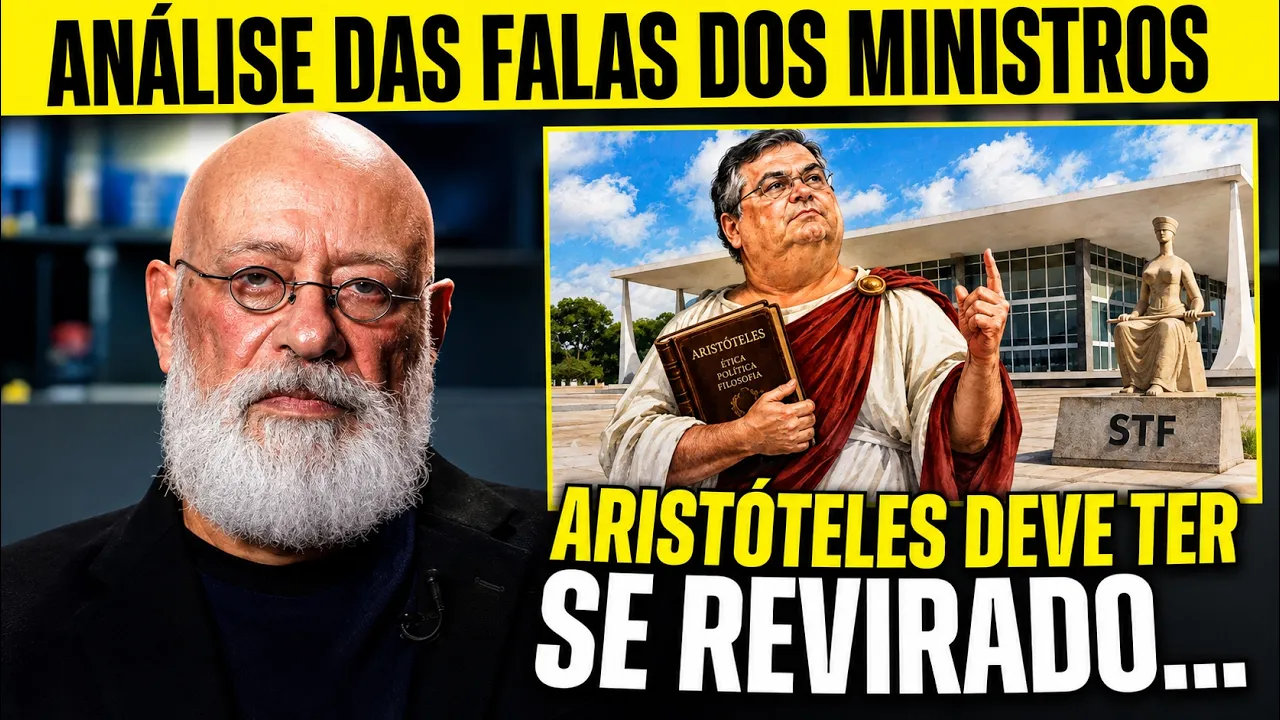
If I felt uncomfortable or co-opted in any way, I would never have voted to confirm the imprisonment of Daniel Vorcaro, his father, and other people involved. But we know that impediments and suspicions do not arise solely from culpability; they are also the result of intrinsic and extrinsic factors, as Dieter Grimm already stated. Well then, Justice Castro is citing a legal philosopher who, if I’m not mistaken, even served on the Supreme Court, and who has a concern for the constitutional judge and the self-restraint of the constitutional judge.
When he says he is not saying he feels impeded due to guilt, which is what everyone usually thinks it is, right? For those watching from the outside, the story about his son, the alleged involvement, the office, the money. .
. But he means that there is, not a question of guilt, but a matter of him realizing that it is better for the court, since there is an external perception that there could be some type of suspicion, for him to limit himself. The topic of self-restraint is a concern that is circulating, you know , among the judges in the debate.
The Supreme Court is a court that is on legal ground, but it is constantly looking at politics. Or rather, politics is constantly looking at it. So, it has to deal with politics, which is perception, interpretation, suspicion, you know, presentation.
And in this movement, by citing Dieter Grimm, he apparently wants to convey the idea that he knows that as a constitutional judge, he must practice self-restraint in favor of the image and the perception that the court has. Therefore, he needs to respect this public perception of the court, which is something that is in quite a crisis. By the way, impartiality can only be ensured in an adversarial system that properly delimits the separation of the functions of investigating, accusing, and judging.
According to Ferraioli, this detachment of the judge from the goals pursued by the parties must be both personal and institutional. This is in the famous book "Law and Reason. " That is why, in Italian doctrine, it speaks of "terzietà," meaning that the judge must be a third party, detached and removed from the interests of the parties.
Well, yeah, right? It's interesting how time passes. Some time ago, with Alexandre de Moraes and that story in Rome, including his family, right?
Many criticisms directed at him were that he was exercising the roles of victim, judge, and investigator, right? And, therefore, he was slightly overstepping the limits of what would guarantee a condition of impartiality in the judge's own activity. This subject is a recurring theme, and there is great concern in this entire debate now as to whether it is possible to ensure that in Mendonça’s case—because the focus there was Mendonça, right?
The focus there was the suspicion that, as Gilmar himself made very clear, right? Right? Even the stones can see that there is a political bias in this, therefore there would be no impartiality, right?
So, his move in this argument is intended to cast, to raise a doubt regarding Mendonça's intention in bringing this up at this moment, right before the first round of the election, near September 7th, right ? As if he were offering ammunition, knowing that by harming Alexandre de Moraes, he would be harming Lula. So this accusation, I think Gilmar's theme throughout this entire debate has been to try to say that Mendonça's intention is not impartial.
He is not concerned with the investigation as such or with the fair course of the protocol process. He is concerned with causing damage to Lula to then preserve the election, as someone said out there , of his boss, I don't know, or his boss's son, which would be Bolsonaro. President, does Your Excellency authorize Justice Gilmar to grant me the floor?
The irony is between the lines. Without a doubt, Your Excellency. Thank you, President.
Irony serves to lighten the mood. Your Excellency knows this. Aristodrates.
President, again I greet Your Excellency and everyone. Flávio Dino is an artist, isn't he? I mean, stage presence, rhetoric, rich argumentation.
At this moment he cites Aristotle, right? Fachin had said that irony is between the lines. Look, irony is a concept in philosophy or a method, as we usually say, the method of irony, which comes from Greece, without any doubt.
Socrates is pointed out as having always practiced irony. And Fachin, he says irony is between the lines, meaning it doesn't need to be explicit, right? You can perceive irony in the distance between two sentences or in the proximity of two words.
And then Dino throws out that irony serves to lighten the mood, which is not exactly the Aristotelian position, right? Aristotle understands that irony is, above all, a gesture someone makes to not show themselves as greater than they are. So, it would be the opposite of arrogance, the opposite of being full of oneself.
The ironic person makes a move to sometimes downplay their own knowledge. I will give a famous example, right, Socrates. The more I know, the more I know that I know nothing.
In other words, unlike you who thinks you know, I, who have been asking about this for a long time, realize that the more I search, the more I realize I still don't know what I wanted to. Do you understand the movement? Therefore, it is not a question of relaxation as such.
Ah, there is also an aspect to irony which is this: practicing irony often works as a way to disarm the other person. So it is like this, the Greek skeptic at the origin also doubted the argument, he doubted the way in which that knowledge was produced, right? The ironist who practices the method of irony, in a way, goes a little further.
He doesn't just suspect the argument; he suspects that something is hidden behind this argument, right? So irony has a certain moral dimension in question, right? Almost a certain moral skepticism.
So, evidently, Flávio Dino knows Aristotle, including from things he will say later. But look, there is no doubt that he is relaxing the environment by bringing up Aristotle. No, look, it's not just anyone, it's Aristotle, mind you, that I'm quoting.
But it's not exactly, we can't even say that irony aims to make an environment light; it aims to produce suspicion, right? Not letting the other person think that I am revealing everything I know. Moderation, consideration, I say this in the briefing, as republican virtues praised again by Aristotle, have the law as a beacon, the norm as a reference, and that is what distinguishes a judge from a vigilante, a trial from a lynching.
Let's go. Great. Dino is invoking Aristotle in the following sense, and correctly so, that for Aristotle, the supreme virtue of a leader is prudence.
And one of the ways to exercise prudence is to always follow the norm and not the opinion of one person. In this sense, following the law, following the ritual, would be maintaining prudence. Aristotle does indeed speak of this, moderation, but not moderation in the sense of staying in the middle, it is moderation in the sense of being prudent.
Be careful with what you say. Including the idea that a prudent institution is an institution that knows how to restrain itself. And this self-restraint means operating within the norm that defines and sustains it.
If any minister committed any illicit act such as an act of corruption or whatever, then what should happen is that they should be investigated. However, Dino and the group most closely associated with Alexandre raise doubts about the competence of the justice who called this into question. Therefore, in his opinion, by accusing Fachin, he wouldn't be acting prudently because he would be following a justice motivated by issues that have nothing to do with the law, but rather with political, ideological, and electoral interests.
Fachin has been accused of being weak, right, by a lot of people, including them as well. But it seems that he, Fachin, tries to practice prudence, to proceed with caution, precisely so that this doesn't leave room for someone to raise an objection, saying it's invalid , it's null. But it's interesting, because Dino, in his argument, in his rhetoric, is implying that Fachin, by opening the door to something like this , by giving prominence to what Mendonça did—lifting the seal and so on, suspending the secrecy—was not being prudent as a leader.
He was not being prudent because he created the environment, created a situation where the Supreme Court was exposed, and this exposure happened at a fifth-grade level at times, right? It happened at the level of a bar fight, a public spat , as they say. So this accusation, packaged in Aristotle, that Dino makes against Fachin is in that sense.
What we need to think about is, beyond Dino’s argument, whether it actually applies to what Fachin did, right? I can only think it applies to what Fachin did if I start from the assumption that there is no reason at all to investigate Alexandre de Moraes. Do I start from that assumption or do I start from another?
If I’m going to address the Moraes matter, I’ll address the Mendonça matter, because they are symmetrical: one is being accused of participating in some passive corruption scheme, while the other could be accused of putting the honor of Justice Moraes, and the honor of the institution, at risk, right? in the name of political interests. That’s why, look, I imagine for us, normal mortals out there, how difficult it is to manage to perceive that there is an argument, there is a philosopher behind the argument, there is the use he makes of it to corner someone with that argument, and whether Dino is right or not in what he is doing.
There is no doubt that, from the point of view of Aristotelian prudence, the idea of airing your dirty laundry in public can indeed be called into question, right? Because airing dirty laundry in public. However, on the other hand, Doing this in a closed session could go against a certain democratic spirit that seeks to limit power through the power of the people, who are sovereign in a democracy.
Therefore, we have to see what is happening. If a court president can remove a rapporteur at their own whim, besides being inappropriate in light of the Constitution, the Loman, the Code of Criminal Procedure, and the Internal Rules, the result is a disaster. Hobbes , President Hobbes, a war of all against all.
The rapporteur for the INSS case, chosen by lottery, is Justice André Mendonça. I even disagree with his handling of it, as Your Excellency said at the beginning, but I disagree within the case files. I cannot take his case away, nor can Your Excellency.
Uh, so now let's talk about Hobbes, right? You correctly cited Hobbes, right, in the way that is most well-known, direct, and synthetic: war of all against all, of all men against all men, right? Man is a wolf to man, everything in the pre-political state, right?
Once you establish the state, the Leviathan, as Hobbes says, then things become organized because the Leviathan will then have the legitimate power of violence, and it is legitimate insofar as it reduces violence in the fabric where it is sovereign, right? in the society where it is sovereign. Dino is going to accuse Fachin of having crossed his limit as president, director, chief, leader—whatever you want to call it at the STF—which is an administrative function above all else, and having taken over the rapporteur's role from Mendonça.
And Dino says, even though I disagree with him on the merits, meaning I'm not saying I agree with what he's saying, he is the rapporteur by lottery. So he is not the rapporteur because someone told him to be; it was contingency, right, a lottery. And, therefore, contingency preserves the process from the suspicion of someone having chosen, "You will be the rapporteur, because being you and so on and so forth," right?
What one could say is that with Mendonça, space was opened to suspect that he is working for Flávio Bolsonaro, but it was a lottery, right? Now, the citation of Hobbes, what he means is that in the role of, let's say , leader of the STF, or Fachin, or the leader of the STF would be a kind of Leviathan, right? It isn't, of course it isn't, because he lacks that Hobbesian power, but he would have a responsibility, for example, to calm tempers, keep the process moving, and not rock the boat, so to speak, right?
Not to get into a situation where minister X lifts confidentiality and casts doubt on minister Y, creating this whole mess, because by doing so, he would have created the conditions within the Supreme Court for them to turn against each other. That’s what he means when he cites Hobbes. He means that Fachin is not exercising the duty of the sovereign, you understand?
In other words, he opened the door to an environment where it's every man against every man, where all the justices turn against one another. You destroy the internal social organization and create the conditions for chaos, for disorder. But all this argumentation from Dino, just like Gilmar, and Moraes himself, always starts from the assumption that Alexandre's investigation is unjustifiable because it, Mendonça, would have an electoral intention.
They are, they are framing the context very well. What matters there is to maintain the argument, accusing Fachin of creating chaos within the Supreme Court , humiliating the Court, right? Hearing the minister, who they almost said was whatever in relation to Mendonça, who left, it seems to me, weakened by the story, and sweeping the Banco Master problem under the rug, and their solution is not to say there's no reason to investigate Moraes, but to say: "I only accept it if investigated along with Mendonça; both must be investigated to see if that produces a certain kind of annulment.
" So he uses Hobbes correctly, but someone could say that the Supreme chaos we’ve been witnessing wasn't created exactly by Fachin's attitude, but by the attitude of the Supreme Court or certain elements of the Court. Let’s not forget Toffoli, right? Which is as follows, corruption is everywhere, and not just in the Supreme Court, right?
It is everywhere. How did he manage to buy so many people? The answer is that the Republic is for sale, regardless of which philosopher is cited.
I think, I am one of those who believe that corruption does not justify a corrupt fight against corruption. And by corruption here I do not mean, I repeat, in the sense of misconduct, but rather in the Aristotelian sense, corrupted forms of exercising power. And that is the reason, Minister Gilmar , why I took the.
. . Point of order to Your Excellency, with full conviction, nothing personal against Your Excellency.
Yeah, he knows it like that , including the backtrack he makes. I'm talking about improbity, I'm talking about corruption, corruption in the way power is exercised, according to Aristotle, which has become a classic, right? I mean in the moral debate, in the political debate, and I imagine in the legal one among experts in the internal laws of the legal world as well.
Because it's that thing we were already thinking: Dino and "Moraes ' team," in quotes, to make it easier because it's not a team, but within the context, the argument, when he says: "a suspicion of corruption cannot be investigated in a corrupt way. " There's the argument. The suspicion of corruption raised against Justice Alexandre de Moraes.
This suspicion cannot be raised in a procedure of exercising power. A procedure that is corrupt, or corrupted, rather. And when he backtracks to say, I'm not talking about improbity, he means, look, I'm not talking here about corruption in the sense that one normally thinks, okay?
I'm talking in the sense of corruption in the way power is exercised. What would be the way that Dino assumes Mendonça exercised it in a corrupted manner? That he might have something to hide, but he's not going to say that, right?
But it hangs in the air, right? Like that, you know? In Brasília, everyone seems to live in a glass house, you know?
This thing that this is an a priori assumption and you could use it to be careful where you step in the federal capital, right? Or who you fight with, right? Who you suck up to, right?
To be careful with that, right? I think Mendonça was naive in this whole story, right? But he, Dino, is saying: "Look, Minister, dear colleague Mendonça, did not use the power he has as rapporteur, in this case, as a Supreme Court Justice, in the correct way.
" That is what he means by corruption. Corruption in the exercise of his power. And therefore, in order for us to evaluate the raising of suspicion of corruption against Alexandre de Moraes, we must also evaluate, investigate the suspicion of corruption, of the procedure of exercising power by Mendonça.
That is the thesis, using Aristotle. Because the natural judge to judge this matter is the plenary. Therefore, your excellency refers it so that the presidency before the natural judge reports on this matter, which obviously has, under the terms of the first item of Article 5, the plenary as its natural judge.
Therefore, Justice Dino, if we agree that it is necessary to follow the bylaws, as Stephen Holmes wrote in a study that became successful during the pandemic, protocols save, method saves, and on this we are in agreement. It is a very well-remembered story about the pandemic, isn't it? Protocols save.
He cites Holmes. Holmes is a philosopher of law, but we can also talk about politics, right? This thing, right?
This entanglement between the Supreme Court is so high, so high, so high in the judiciary that it is leaning against politics, isn't it? In power, because politics is the study of the territory of violence, of the management of limits, of distribution, of conquest, of loss. And in the case where he cites Holmes, he is speaking precisely of a philosopher, a theorist who is concerned with the self-restraint of the institution.
And how do you establish self-restraint, you institution? By following the protocol, following the rule, following the norm. It is clear that we are talking about human beings, we are talking about law, we are talking about norms, we are talking about interpretation.
You can take this norm, push it a little here, push it a little there. This is part of the very human activity of interpreting laws, norms, all of that, right? But what Fachin means, his position, following the norm , I am following the norm, it had to be in the plenary, because precisely when there is a risk of misunderstanding and loss of credibility, following the method, the method saves, right?
The protocol saves. Why? It saves because it keeps you restricted within the objective body of the norm.
That is why for Holmes, you can even reach ideas like when you follow the norm, that is, when you self-limit, you end up having more power than if you were to mess up the use of the power you have, understand? Corrupting the exercise of power is to use power, for example, outside the norm, outside the limitation of power, outside the self-restraint of power. By placing myself below the law, the norm, and the rule, I am saying that because I am an STF justice, I cannot do whatever I want.
This conveys to people that he is self-restraining. He is the institution and he is the justice. This generates credibility, and an institution that has credibility is powerful.
So, the credibility of the Supreme Court is at stake, and that is why the Court is weak, because there is a suspicion that there was no self-restraint, that procedural correctness was lacking, and that there may have even been a corrosion of character, right? You go here, the story of one, the story of another, they did this, they voted that way, and you think, man, how can this institution have any credibility? And the Supreme Court is the heart of the Republic, right?
If you don't view the institution of the Supreme Court as an impermeable space, as much as possible —and that "possible" has to be very significant, because they hold a lot of power, right? You bring down the Republic. That is why in this matter you have the Alexandre de Moraes case, the Mendonça case, electoral interest or not, did he follow the rules or not, was he right to lift the secrecy and request the investigation of Moraes or not?
Kássio, his son, Toffoli, Taiayá , and who knows what else, right? Fux's son. I mean, you look all around, and you even get scared.
There is, in quotes, a person there at the Supreme Court who is also being judged, and the Republic as well. And by opening up the abstract possibility of this individual , monocratic arbitration in assigning rapporteurships and changing them at the discretion of one person, we are tearing up the entire political philosophy from Aristotle to contemporary proceduralists, from the fundamental distinction between the rule of law and the rule of men. That's it.
He is right. I mean, this difference between the rule of law and the rule of men is one of the first things you learn in political philosophy during your undergraduate studies, right? And he is saying—he is saying that, again, on the same path , trying to impute to Fachin not a suspicion that he is allied with someone, right, imposing on him suspicions of ideological corrosion or whatever; no, because he actually thinks the rapporteurship should have remained in the hands of André Mendonça, even if he disagrees with the content, let's say, right?
But he is defending the idea that, once again, the draw for Mendonça preserves the Supreme Court from the suspicion that there is someone there exercising the rule of men. In other words, get out of the way because I want to be in charge. Now, this is dangerous territory from an argumentative standpoint, because there are many people, including those in the legal sphere, who have long accused Alexandre de Moraes precisely of practicing this, the rule of men, of having sometimes gone a bit too far in his duties or confused his functions.
Someone might bring up this argument and say: "Look, you're accusing Fachin of this, but be careful because this has already happened here at the Supreme Court. " There are people who think it has already happened at the Supreme Court. Again, the defense that Fachin cannot keep taking away rapporteurships, assigning rapporteurships, because he would be weakening the law, the world of the law , right?
To give strength to the world of the will of men, in this case, himself, Fachin. And when you do that, right, when he says he tore up Aristotle, or even proceduralists or contractarians in political philosophy, he is saying: "Look, this is a consensus, right? It is better to live under the rule of law than under the rule of men.
Because laws may not be perfect, nothing man makes is, but laws have some degree of objectivity, whereas human will has no objectivity at all. At some point, this objectivity collapses. Why?
Because it's the subject, it's the person, right? In reality, he is again criticizing Fachin's attitude of setting himself up in the position of a powerful figure, taking the rapporteurship away from Mendonça with whom he does not agree in terms of content, okay? This gives him strength, his argument, a lot of strength.
Look, I don't agree with the content of what he did, what's there, but he has to be the rapporteur. Yeah, as I said, someone might say:" No, he prefers Mendonça because Mendonça is weak. "Fachin might be in a stronger position, there's no suspicion about him that he's working for Flávio Bolsonaro and, therefore, I don't want it to stay in his hands, but the argument is correct.
It's law. On one side is the rule of men, the other is the rule of law, and the rule of law respects the norm. The rapporteur could not do that.
So he is wrong. He did it, he is wrong. He instituted for a moment the rule of men within the Supreme Court, and with that, he opens a loophole to break the credibility of the process.
If there is a procedural nothing or a legal nothing. No, never legal. What has been done so far is totally void.
Yeah, I don't agree. That's your perception, but it doesn't respect these no, but it's Aristotle, it's a syllogism, it's a premise. Premise.
So, since we need to have case files, right , to deliberate, we don't have a criminal case, we had a PET. In this PET, under the original rapporteurship of Justice André, procedural instruction acts were carried out, including the request for evidence. uh of conviction, because if there weren't , we wouldn't be here.
Yeah, now he moves more in the direction of pointing out an argument that puts at risk or calls into doubt how Mendonça handled the process, which is his focus, right? So, the big focus of the issue to justify treating Morais and Mendonça symmetrically; even though the two things aren't equivalent, it could, yes , make it unfeasible, because if I can identify that Mendonça made requests and conducted the process to expose Morais. I can say:" Look, hold on, we can't go on like this, right?
"Now, when he gets to Aristotle, the premise story there takes a leap, not that it's not correct, but it takes a big leap, right? Because he's trying to say:" Look, if there's no process at all, how can you do anything? "" A syllogism is a famous argument in Aristotle, so, I'll give the example that everyone knows, that we learn in college, right?
"Man is mortal. Socrates is a man, Socrates is mortal. it's when you have a necessary logical consequence from two previous premises, right?
And if I reach the conclusion, for example, that there was—here I am reasoning from what he is saying, okay? I didn't say, I won't say that he said this explicitly, but I can reason from what he's saying. If we can reach the conclusion that there was indeed some type of improper handling of the process by Mendonça.
And if he lifted the seals and he brought up the accusation, these are two premises from which I can deduce that it doesn't stand. the accusation. Why?
Because from the very beginning he didn't conduct the process correctly. But there is something interesting here that is worth pointing out, which is that a syllogism is here, it's when two premises imply a third conclusion that is necessarily correct and true, like in the case I mentioned here of man being mortal, Socrates, and so on. There is a fallacy known as, well, let's call it a fallacy.
It's when you use two premises and you intentionally lead the subject to the conclusion you want, but it's false. I'll give a classic example too, okay? It's like this.
Women did not vote. Women started voting, the atomic bomb was created. Therefore, the atomic bomb was only created because women started voting.
Get it? Absurd. Logically, in time, it seems like if you catch an unsuspecting person, you'd say:" Wait, one thing has nothing to do with the other.
"The intentional way I led this last argument here is for you to be like," No, but so you mean if before there was no atomic bomb, women started voting, then there was an atomic bomb, so women's votes brought about the atomic bomb? "It's obvious that's not it. So, at the end of the day, I don't know if at some point Flávio Dino won't accuse Mendonça of engaging in a huge sophism in this process.
St.