On March 2, 1973, the Skyline Plaza tower was under construction in a suburb of Washington, DC. Crews had just placed a portion of the floor slab for the 24th story, just two floors short of the project’s final height. Shortly after lunch, workers noticed that the new slab was deflecting.
Suddenly, a portion of the building collapsed, killing 14 and injuring many more. The collapse left a gap in the building 18 meters or 60 feet wide, essentially slicing it in two. Investigators later found that workers had removed the formwork and shoring for the lower floors too early.
Because of cold weather, the already-placed concrete in those lower floors hadn’t gained strength as quickly as they expected. Without the shoring transferring loads into the structure below, the under-cured concrete was forced to bear the weight. And it just wasn’t strong enough.
Concrete is an incredible material. I’ve covered a lot of concrete topics in previous videos. There are good reasons why we use so much of it in the built environment.
But, and this is hard for me to say, it’s not without its flaws. Even putting aside the environmental issues, as a building material, concrete creates challenges that are unique and, in many cases, not that well-understood. Most building materials, after they're fastened or put in place, are immediately ready to use.
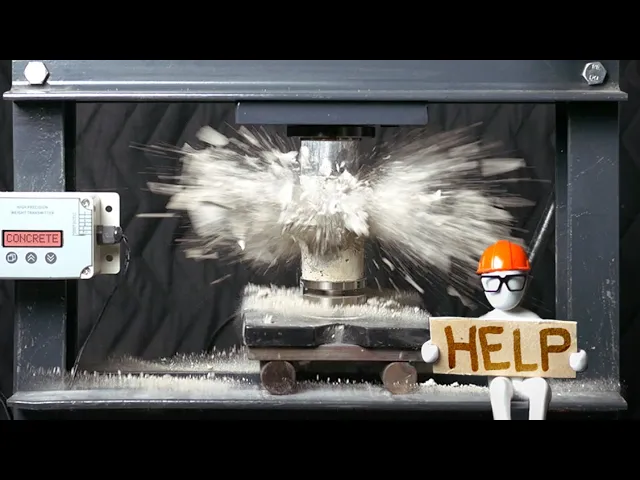
That’s not true for concrete, and even if it seems kind of obvious, it creates some really interesting challenges for engineers, architects, and contractors. So I’ve cast some concrete cylinders in the garage, and we’re going to break them to understand this weird property of concrete and some of the ways we work around it. I’m Grady, and this is Practical Engineering.
As soon as water meets the cement in concrete mix, the clock starts ticking, and there’s basically no stopping it. The working life of concrete consists of two key phases, and they demand almost opposite properties. Phase one has to be workable and easy to shape.
Concrete placement and finishing is a ton of work with a lot of steps that each have to happen at the right time. Of course, the second phase is strength; no matter how beautifully formed concrete is, it’s useless unless it can handle its designed load. The process begins even before the concrete arrives on site.
Most large jobs rely on ready-mix batch plants, where ingredients are measured and blended according to project specifications, then loaded into rotating drum trucks for delivery. Concrete is relatively cheap by weight compared to other building materials. At its most basic, it’s just sand, gravel, cement, and water.
But placing it is labor-intensive, time-sensitive, and expensive, plus many projects use a lot of it. So it’s important that the right stuff makes it to the job. Engineers often put strict specifications not only the the ingredients themselves, but how the concrete is handled on the way to the job site.
Some even put limits on the number of drum revolutions allowed before the concrete is dispensed, helping to prevent ingredient breakdown and loss of entrained air. Once on site, the first task is getting the concrete into the forms. At this stage, workability is everything.
It doesn’t need to flow like water, but it should move easily enough to be placed quickly and completely. You want some flow, especially for complex shapes or when you have a lot of reinforcement. Next is consolidation - usually with vibration or agitation - to get rid of excess trapped air.
For slabs, workers screed the surface to level it, then use floats to push down coarse aggregates and prepare for the final finish. This is physically demanding work, and every step has to be done before the mix becomes too stiff to work with. We do have some tools to manage this process.
Admixtures can adjust the set time and improve workability without adding extra water, which would otherwise weaken the final product. But the water in concrete isn’t a solvent that dries out. Concrete cures through a chemical reaction called hydration.
The water becomes a part of the concrete. And that hydration process can be affected by jobsite conditions like temperature, wind, or delays at the batch plant, which are out of your control. That unpredictability can make a big concrete pour extremely stressful.
You don’t get do-overs. Depending on conditions, concrete typically reaches its initial set in about 2 to 4 hours. That’s when the mix is firm enough that you can’t easily press a finger into it.
At this point, it’s ready for finishing, whether that’s troweling for a smooth floor, brooming for a textured sidewalk, or stamping for decorative work. Each technique has to happen during a short window between the initial and final set, when the concrete is firm enough to support workers but still soft enough to shape. On big projects, timing is critical.
Standardized tests are often used to measure set times and guide trial batches so that each task can be scheduled precisely. After final set, the next phase begins: waiting. I cast a bunch of concrete cylinders to show you exactly what I mean.
It’s 24 hours later, so let’s get these on the hydraulic press. I’ve got Brady in the shop supervising the process. And my scale isn’t calibrated, so we’ll do all the comparisons in arbitrary units of force.
Some people suggested kilogradys last time I used this, so let’s go with that. Even without looking at the scale, you can tell these samples aren’t very strong. Under the press, they kind of crumble more than break apart, and this is pretty typical.
After a day, concrete’s strong enough to walk on. And, depending on the structure, this could be a good time to strip off the formwork, but you’re not going to get away with much more than that. I broke 3 cylinders, and we’ll plot them on the graph like this.
Let’s fast forward to 7 days. For large projects, the concrete specifications often require a test at this point. It’s the same idea as what I’m doing here, just with more sophisticated equipment.
Samples collected on site are put in cylindrical or cubic molds, taken to a lab, and cured in controlled conditions. Then they’re put into a press much more complicated than this, and the force required to break them is measured. The idea behind a 7-day test is that, if the concrete isn’t going to reach its required strength, you want to know as early as possible.
Let’s put these test results in on our graph. The average was 9300 kilogradys so, a 3X increase from the 1-day breaks. Strength gain usually follows a predictable curve, so early results can be extrapolated with reasonable confidence.
If something’s wrong, you can often tell early and start planning accordingly, even if that means tearing out a pour and resetting the schedule. As costly as it sounds, it’s nothing compared to the consequences of trusting concrete that isn’t as strong as the engineer assumed in design. This highlights one of the biggest challenges with concrete: you can’t fully test quality until after installation.
Most building materials go through inspection before arriving on site. With concrete, you can test the raw ingredients and even make trial batches, but the real test is whether the mix you placed in the formwork meets strength requirements after it cures. That uncertainty adds risk.
To hedge against it, suppliers often design mixes with extra strength margin to make sure that, even with some random variation, strength will never come in too low. Sometimes, waiting longer can help a borderline mix catch up. But in some cases, a failed strength test really does mean tearing everything out and starting over.
Another complication is where samples are cured. Standard lab specimens are kept in tightly controlled environments. This helps verify that the supplier met the required mix specifications.
But it doesn’t always reflect conditions in the actual structure, where temperature, humidity, and weather can vary wildly. That’s why many projects also include testing of field-cured samples, which gives a more realistic picture of the in-place strength. If this had been done at Skyline Plaza, the cold-weather delays in curing might have been caught, preventing a costly and deadly failure when shoring was removed too early.
On a well-run job, a good 7-day result gives confidence that everything is on track. Even though the concrete hasn’t reached its target strength yet, you have a solid indication that it will. I also broke some 14-day samples, not typically required on jobs, but useful for seeing the big picture.
The graph shows that strength continues to rise, though the rate is already slowing. Let’s jump ahead two more weeks. 28 days is a fairly arbitrary, but widely used benchmark for when the rate of hydration flattens out.
Usually, when we talk about the compressive strength of concrete - 4000 psi or 28 MPa, or 10,000 kilogradys per square smoot, or whatever it might be - we’re talking about the minimum 28-day strength. A significant amount of concrete engineering is based on this strength. The goal is that 28 days after placement, you can feel confident that the structure will perform up to the maximum loads as it was designed.
My 28-day samples broke at an average force of about 11,000 kilogradys, about 20 percent stronger than the 7-day ones. Pretty close to the rule of thumb that concrete reaches around 75% of its final strength after one week. But you see the problem here.
A month is a long time, and time is money in the world of construction. There are some things you can do in the interim - maybe install anchors or apply light loads. For a sidewalk or driveway that rarely sees heavy vehicles, concrete might be strong enough at 7 days.
But for applications where the margin between expected loads and material strength are tighter, you just have to wait. And this can be a real problem in some cases. Think about concrete roadways.
How long are you willing to wait to keep a lane closed after a repair? Tall buildings have a similar problem. If you wait 28 days for every floor to cure, it’s going to be a long and slow project.
You can see how concrete cure time turns into a serious bottleneck and can often become the critical path on a construction schedule. Luckily, there are a few ways to speed things up. One is just to use a stronger mix.
The logic here is simple. Say you need a 4000 psi concrete, but you don’t want to wait 28 days. If you use a 5000 psi mix design, theoretically, you’ll hit 4000 psi after just over a week.
This adds material cost, but the time savings can make it worthwhile. Other strategies include using “high early strength” cement that’s ground more finely to speed up hydration, or altering the mix ratio by adding more cement or reducing water. Heating the mix water or curing under blankets can also help.
Chemical accelerators are another tool. Calcium chloride is a popular choice because it’s cheap, but it has drawbacks. Chloride ions can speed up corrosion of steel reinforcement, so lots of engineers won’t allow calcium chloride in concrete in their projects.
Non-chloride accelerators (or NCAs) have gotten better over the years and may be a safer alternative, but they still pose challenges. The curing of concrete is an exothermic reaction, so faster hydration generates more heat, which can lead to cracking as the concrete cools. And, of course, it shortens the working time for placing and finishing.
I hope you can see the complexity in all this. There is a lot we ask concrete to do, and because it hardens relatively slowly, there’s a lot riding on how and when concrete gains strength. It’s not just about stripping forms or removing shoring.
In many construction projects, the strength gain of the concrete governs every downstream operation. It determines when floors can support framing, when roads can open, and when a project can move forward. And there’s nothing magical about 28 days.
It’s just four weeks. It’s a number of convenience that makes it easy to talk about concrete strength and compare properties. In fact, most concrete will continue to gain strength for months or even years after that first four weeks, depending on the mix design and steps taken during curing.
And many projects require that it does. Compressive strength isn’t everything when it comes to concrete. There are time- or exposure-dependent failure modes like shrinkage, creep, and long-term degradation from freeze-thaw that play an important role in design.
So some projects like dams and bridges often have 90-day requirements to ensure that the concrete eventually reaches a strength to resist them, even if it doesn’t need to happen right away. But that 28-day convention gives a hint about concrete’s greatest weakness: time. Really, no other structural material requires you to wait weeks before knowing whether it will actually perform as expected.
While most materials arrive on site ready to use, concrete requires a leap of faith. And then, a long pause. Concrete is strong, durable, and incredibly versatile.
There’s nothing like it! It’s a building material worth celebrating in many ways, but only on its own terms. You can place it quickly.
You can shape it into nearly anything. But you can’t rush what happens next. That’s the challenge and the art of concrete construction: it’s a balancing act between acting fast and waiting long enough.
It’s a material that embodies both a sprint and a marathon. A lot of people don’t think about concrete as an academic topic, but because of its importance across the globe, there are a lot of researchers who spend their entire careers studying it. I read a lot of journal articles about concrete as research for this video, most of them helpful if not particularly groundbreaking.
But every once in a while, an academic paper takes on a life of its own. That’s the story told by my friend Kevin of the “Bobby Broccoli” channel in the new documentary, 17 Pages. A single paper sparked a scandal so big it was called the “Scientific Watergate.
17 Pages dives deep into one of the most controversial science ethics cases of the 20th century. And if you want to check it out, it’s only available on Nebula. Nebula’s a streaming platform built by and for independent creators, including channels like Strange Parts, Integza, Real Engineering, and Hacksmith Industries.
You get early access, no ads, and content that’s thoughtful and well-researched. Plus, Nebula’s got a lot of really impressive original content that can’t be found anywhere else, like 17 Pages. If you want to give it a try, it’s basically a cup of coffee month.
If you prefer to avoid subscriptions, we also have lifetime memberships; pay once and keep it forever. It’s normally $500 but you can save $200 by using the link in the description. We also have gift cards if you want to share a subscription with a friend.
Watch 17 Pages and more only on Nebula and use my link, go. nebula. tv/practical-engineering, for a huge discount.
Scan the QR code or click the link below. Thank you for watching, and let me know what you think.