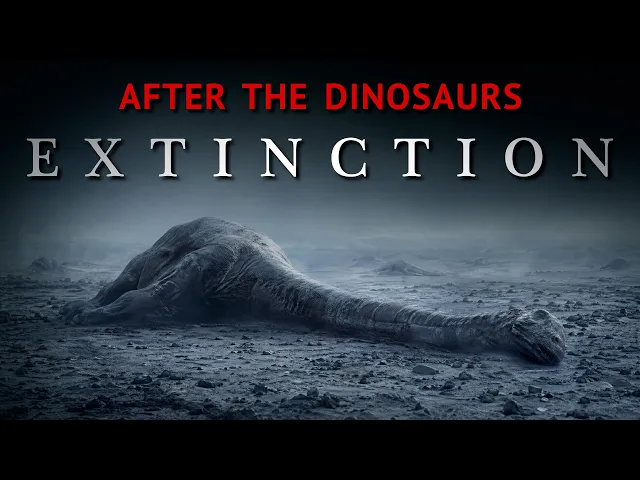
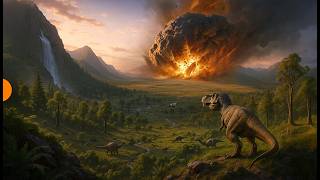
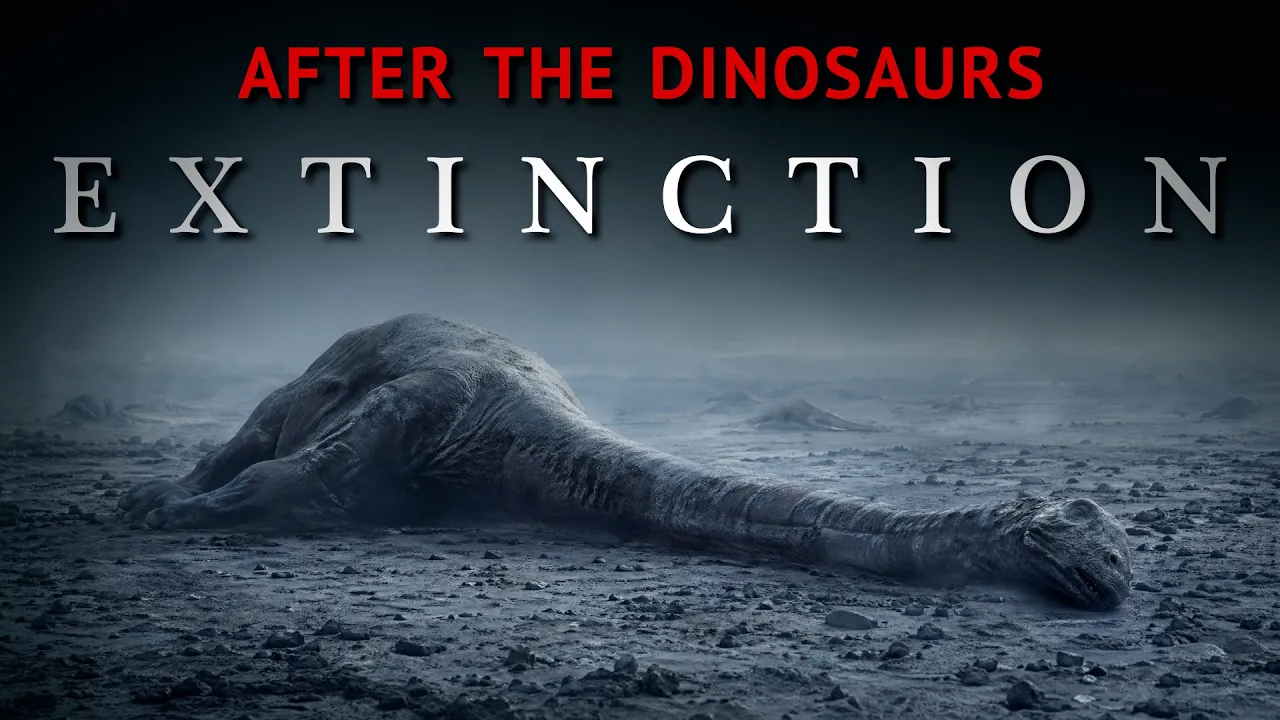
A few hours after the asteroid strikes, Earth is no longer the same planet. The skies, once blue, turn into burning clouds of metal and ash. Shock [music] waves circle the globe.
Forests flatten. Oceans lift into walls of vapor. And the air fills with falling stones [music] still glowing from space.
The temperature on the surface soarses [music] past 1,000°. Nothing larger than a mouse survives out [music] in the open. In every corner of the planet, firestorms rage for days, turning continents into a single sheet of flame.
The oceans begin to boil. [music] When it finally ends, silence follows. A silence the Earth hasn't heard in hundreds of millions of years.
On land, the air tastes like sulfur and burnt carbon. In the forests that remain, nothing moves. No calls, no rustling, just smoke and silence and the crackling [music] of embers.
Dust and soot from billions of burning trees climb into the upper atmosphere, blocking out the sun. For months, daylight [music] disappears. The planet enters what scientists call a nuclear winter.
Photosynthesis stops. Plants wither. Food chains [music] collapse.
The great age of the dinosaurs that lasts for more than 160 million years is over. [music] But in the darkness, life does not vanish completely. [music] Beneath the surface, in burrows and riverbeds, tiny [music] creatures endure the cold.
In the oceans, microscopic plankton cling to survival, [music] feeding on the faint traces of light that filter through the haze. [music] And from these survivors, the planet slowly begins to rebuild itself. The extinction is total but not absolute.
Every end in Earth's history is [music] followed by a beginning. This is the story of those beginnings. The story of what life looks like in the aftermath of extinction?
[music] What happens after the world ends? >> [music] [music] >> When we think of mass extinctions, we picture endings. [music] The asteroid, the eruptions, the sudden dark, [music] but that's only half the story.
[music] The first year is just cold. Not the kind of cold you can dress [music] for, the kind that settles into the ground and doesn't leave. Mornings that [music] feel like evenings.
Evenings that never quite get dark because the sky is already gray. [music] You lose track of time. The sun's up there somewhere, but you wouldn't know it.
[music] The air tastes metallic, burnt. There's a heaviness to [music] it, like breathing in wet ash. When it rains, and it does constantly, the water stings.
It eats through whatever's left of the leaves. Pools of it sit in the low places, murky and still, giving off a smell like old eggs. Nothing grows, [music] or rather, nothing new grows.
What's left from before just sits there, rotting in place. Trees that [music] didn't burn stand bare and gray, their bark peeling in long strips. [music] The ground is covered in a layer of [music] fine black powder that gets into everything.
You'd [music] think it would be loud. Storms, wind, something, but it isn't. It's quiet in a way that feels wrong.
No bird calls, no rustling in the undergrowth, just the occasional crack of a dead branch falling or the soft patter of toxic rain on dead leaves. The food chain isn't [music] a chain anymore. It's more like a few scattered links lying in the dirt.
[music] Take the mammals. Most of them are about the size of your fist. They live in burrows now, deeper than they used to, lined with whatever they could drag down before everything went to hell.
They're not picky eaters. Can't afford to be. [music] Beetle grubs, roots that taste like dirt, fungus growing on bark.
One meal every few days if they're lucky. [music] In the ruins of the forests, a few birds, the last of the dinosaurs, [music] cling to existence, scavenging seeds buried in the ash. In the [music] swamps, crocodiles wait in the mud, their bodies barely moving, their hearts beating once every few minutes.
And deep beneath the ocean [music] surface, far from the cold and chaos above, microbial life thrives near volcanic vents, feeding on minerals [music] instead of sunlight. They don't know it, but these are the survivors, [music] the line between extinction and renewal. Above them, the world continues to unravel.
The rain that falls now is thick and corrosive. It eats through leaves, stone, even bone. It seeps into rivers, turning them acidic, washing away nutrients that once fed entire ecosystems.
[music] The oceans, too, suffer in silence. With no light to [music] sustain plankton, the base of the marine food chain collapses. One by one, the great predators disappear.
[music] The world beneath the waves becomes as still as the one above. [music] And yet even here life finds corners to cling to. >> [music] >> Tiny crustaceans survive in pockets of warmth near the ocean floor.
[music] Some species of fish retreat to deeper, darker waters where [music] temperatures remain stable. The deep sea becomes a refuge, a last safe place on a dying planet. Months pass, seasons lose meaning.
The planet is locked in a perpetual dusk. Ash drifts down [music] in slow, endless curtains. What little sunlight breaks through is too weak to warm the air.
But if you could look closely [music] beneath the dust, beneath the ice, you'd find movement. [music] The faint tremor of roots pushing through ash. spores germinating on rotting wood.
Microscopic [music] life returning to the surface, quietly reclaiming what's left. Because life [music] doesn't surrender easily. It bends.
It hides. It waits. But it never stops.
[music] And slowly the earth begins to change again. The fires [music] are long gone. The skies, though still gray, start to thin.
[music] >> [music] >> A pale light begins to leak through. Weak but growing stronger [music] each week. The first sunlight in months touches the surface [music] of the planet and the ice responds.
It cracks. It melts. The air shifts from poison [music] to breath.
for the [music] first time since the impact. The planet exhales. The trees that survive the cold still look dead.
Their branches are brittle, their roots rotting under layers of soot. [music] The soil has forgotten how to feed them. But in [music] the cracks of that ruin, something new starts to appear.
Ferns. First just a few, then thousands. They [music] don't grow tall.
Well, they don't need to. They just spread quietly, endlessly [music] across the blackened ground. Scientists call it the fern spike, the signature of a world trying [music] again.
Ferns are opportunists. They don't wait for perfect conditions. They make do.
Their spores [music] drift on what's left of the wind, settling wherever the ash is thin enough for roots [music] to grip. Within years, entire valleys are carpeted in green again. Dile, low, stubborn green.
The air still stings when you breathe too [music] deeply, but it doesn't burn anymore. The rain still tastes sour, but not deadly. The world has moved from extinction [music] into survival.
And in that survival, the small [music] things take over. Mammals the size of rats, maybe smaller, venture above ground more often now. They dig through the soft ash [music] for beetles and roots, for anything that smells like food.
Their [music] eyes are still wide and black, built for darkness. They live fast, sleep light, and never stray far from the safety of their burrows. In the ruins [music] of what used to be forests, birds hop across the ground.
They pick at seeds [music] buried in the ash. They scratch through the dust for insects. They don't look like rulers of anything, but they are descendants [music] of giants, the dinosaurs that once dominated the skies.
>> [music] >> The birds that made it through were ground dwellers, runners, [music] foragers, creatures that nested low, fed low, lived low. In a world without trees to land in, without branches to [music] perch on, flight was no advantage at all. The sky belonged to no one now.
The oceans, silent for so long, begin to shift again. It starts with light. As the dust finally settles, as the haze [music] begins to thin, sunlight reaches the water for the first time in months.
Not much. A pale glow, barely enough to warm the surface, but it's enough. Microscopic plankton, the survivors that [music] drifted in the dark, waiting, creep back into the upper waters.
Tiny flashes of green appear. Faint, almost invisible, but real. This is the base of everything that will follow.
The [music] recovery when it comes is faster than anyone expected. Not fast by human standards, [music] but fast for a planet. Within a 100,000 years, the number of mammal species doubles.
Within 300,000 years, [music] the world holds more mammal species than it did before the asteroid hit. And within 700,000 years, a [music] blink in geological terms, something remarkable happens. Mammals grow.
The survivors of the extinction weighed on average about [music] half a kilogram, the size of a rat, maybe a squirrel. Nothing larger could make it through the bottleneck of [music] starvation and cold. But now, with the dinosaurs gone, with the world empty and waiting, there is room.
Within 700,000 years, mammals [music] reach 50 kg, a 100fold increase from the size of a squirrel to the size of a wolf. And they don't stop there. The largest survivors of the extinction would eventually [music] give rise to elephants, to whales, to creatures larger than any dinosaur that ever [music] lived.
But that story is still millions of years away. The age of giants is over. What remains [music] are the survivors, creatures shaped not by strength, but by endurance, not by size, but by patience.
Not [music] by what they could dominate, but by what they could outlast. This is where the next story begins. The planet never returns to what it was.
Too much is gone for that. What follows isn't recovery. It's adjustment.
A simpler world built from what survived, not what was lost.