The second systemic law, the law of balance, has to do with giving and taking. Taking is different from receiving, because taking is active, while receiving is passive. Speaking of taking means seeking what is ours by right; in other words, I go toward what is mine.
Eh, and receiving is a comfortable place of waiting for the other person to deliver to me. Taking is an act of humility, because when I go in search of what I don't have, I admit that I don't have it and I also admit that the other does. Likewise, the act of giving shows that I have it, so I can give.
There is a risk that we do this in an arrogant way. So, in the law of balance, whoever takes makes themselves smaller, and whoever gives makes themselves bigger. Relationships will always tend to be balanced; that is, it will always head toward me taking and giving in the same proportion.
When someone gives too much and the other takes too much, the tendency is for the one taking too much to perceive an unpayable debt and flee the relationship. This is very common when we look at couples, where one person is giving a lot, the other is taking a lot, and then the one giving takes the place of a father or mother, because in parental relationships, it is the parents who give and the children who receive. So, when one gives too much, the other may end up looking at the one giving and saying: " This is too much for me, I cannot reciprocate.
" And they end up fleeing. Sometimes, the person receiving too much might even cause a betrayal as a way to end the relationship because of the debt that was becoming unpayable. This also has to do with the prices paid for things to be.
This has to do with it. We can think of this dynamic in relation to choices and sacrifices. For everything that is, there is something that ceases to be.
The more I can honor what ceased to be so that things are, the more strength I give to what is. Am I making myself clear? The more I dishonor, that is, the more I fail to recognize what ceased to be so that things are, the more strength I lose in what is.
I will give a more practical example. If I am in a profession, I perform a service to the world and this profession has yielded good financial fruits for me. But now I want to change professions; if I do so by dishonoring the profession I had, that is, internally, in my thoughts: that wasn't that important, that didn't do me good, that, that was wasted time.
Generally, I will lose strength in the profession I choose. Now, if I honor that resignation, meaning if I recognize how much that old profession was important to me, generally that is the amount of strength I will gain in the profession I choose. This is a different way of looking at the things we live through, because this is a different way of looking at the way we live.
For example, if I enter a new relationship and I do so by dishonoring the previous relationship, I usually cannot take everything that the previous relationship gave me so that I can prepare for a new one. The vision of love, the love of the spirit, which is a love without conditions to be love , is a vision that embraces, embraces what ceases to be and the price I pay for that to cease to be. In this way, I can look at what comes to be with more depth and, above all, with more completeness.
If I can honor the previous relationship, the pain of the end, and everything I received from that relationship, I will generally gain much strength in future relationships, without needing, unconsciously, to live out the same dynamic here to embrace the previous dynamic I haven't yet been able to take . There is already a bit of the law of balance here and also a bit of the law of order, but for now, let's focus on this giving and receiving. Another way of looking at this giving and receiving is in relation to parents and teachers.
These are two relationships and perhaps the only two relationships where there is no balance, because parents will never be repaid by their children for the life they gave them. A child will never be able to repay their parents for the privilege of being alive. This perspective alone recognizes parents as predecessors, that is, as those who came before, and consequently as those who give, and children as those who take.
A way that many children fail to leave home is by dishonoring what they received, that is, by not acknowledging how much they received, whether it was a lot or a little. Everything children will be able to do, and here a daughter is moving away from her mother, going out into life, right? But it's just a coincidence, everything children achieve in life comes after the life they received from their parents.
So, when we are able to take the life that comes from our parents, and stop demanding more than they were able to give us, that is when we mature in relation to our parents. And in this way, we can walk more freely, without seeking from the other people we relate to what was missing in our family circle. And here it is worth saying that all parents need to do to be parents is simply have a son or a daughter.
Of course, culturally, and if we want to take it to that realm, morally, parents should provide this child with a minimally secure life. Emotionally secure, financially secure, secure in terms of health. But often, parents are not in a condition to do that.
It is not so rare for us to encounter people who were adopted, who were given away, who had to leave their parents 'home very early to be raised by other people. And the most important thing in these cases is that people who went through this dynamic continue to recognize their parents as those who gave them life. Because as we mentioned back in class two, everything they do carries with it who they are, and they are the expression of their genetics and epigenetics.
So, even if you are adopted before you are a year old, everything you express in life, even with the good help you receive from your adoptive parents, will still belong to your original family system and not to the adoptive parents' family system. That is why constellation work often suffers criticism regarding this view it has on adoption. Some people summarize everything by saying adoption is a systemic entanglement.
It is, it isn't, and it is. I don't want to go into details here because this is not a family constellation training course, but it is just a broader way of looking at all of this. Adoption is more than motherhood and more than fatherhood, because whatever adopted children do will never belong to the parents who adopted them.
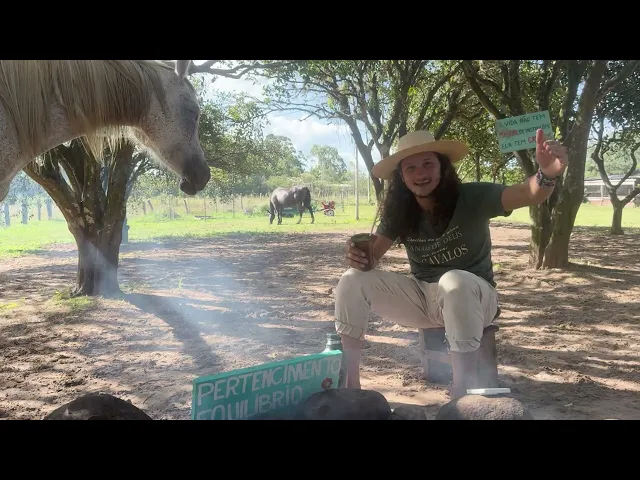
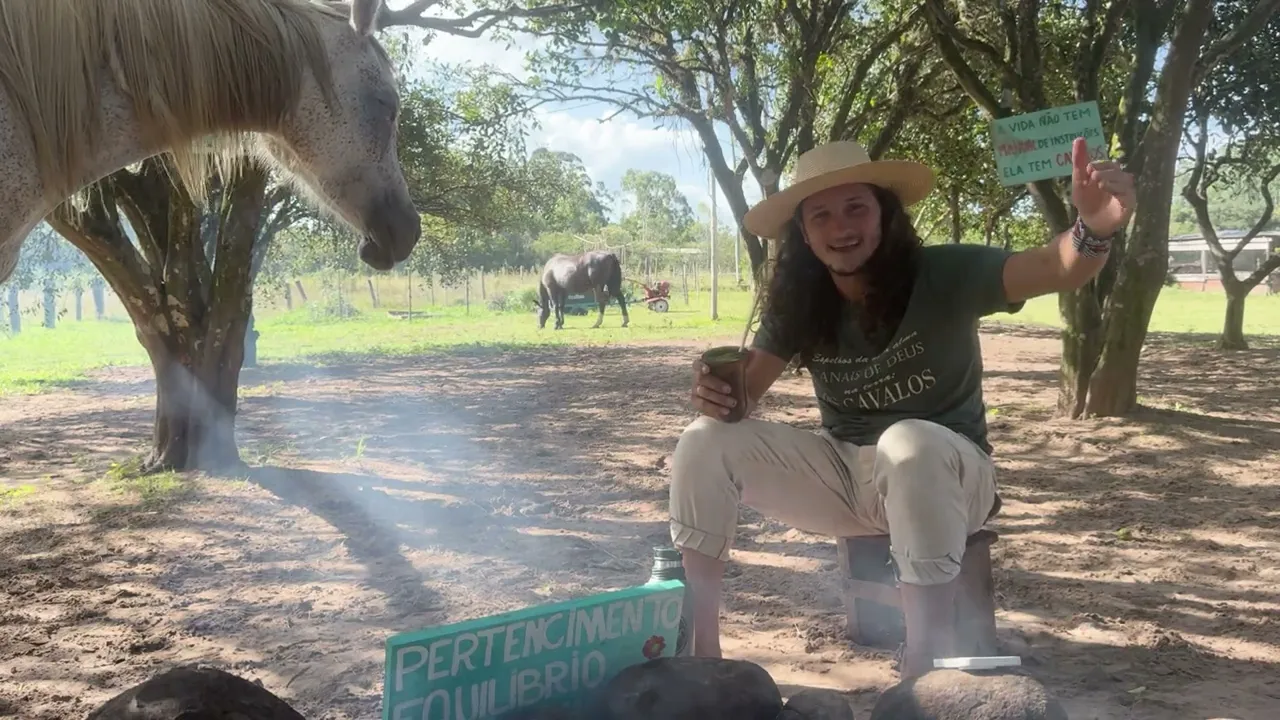
So, we do something very grand when we adopt a child, but the work is only complete when we return them to their original family system after providing good help. And I will show you what is happening here while I am saying this, okay? While I am saying this, this herd of horses, which is in truth a family, is approaching.
In other words, this is a safe environment for the family to belong. So, just to conclude the thought, the adoption process is complete when we return the adopted children to their original family system. The second relationship in which there will never be balance, besides that of parents and children, is the relationship between students and teachers.
And the light of a good teacher is to make their own students better than them. In other words, they will do something good with what they received from this teacher and add to it with their own potential. Actually, we understand gratitude as doing something good with what we receive.
That would be true gratitude. Being grateful is not saying thank you very much, it's not putting your hands together in front of your chest and saying "namaste" or saying "gratitude. " Being grateful is doing something good with what we receive.
So, being able to be grateful to our parents is doing something good with our life, just as it came. Being grateful to our mentors is being able to use their teaching for something that serves the world.