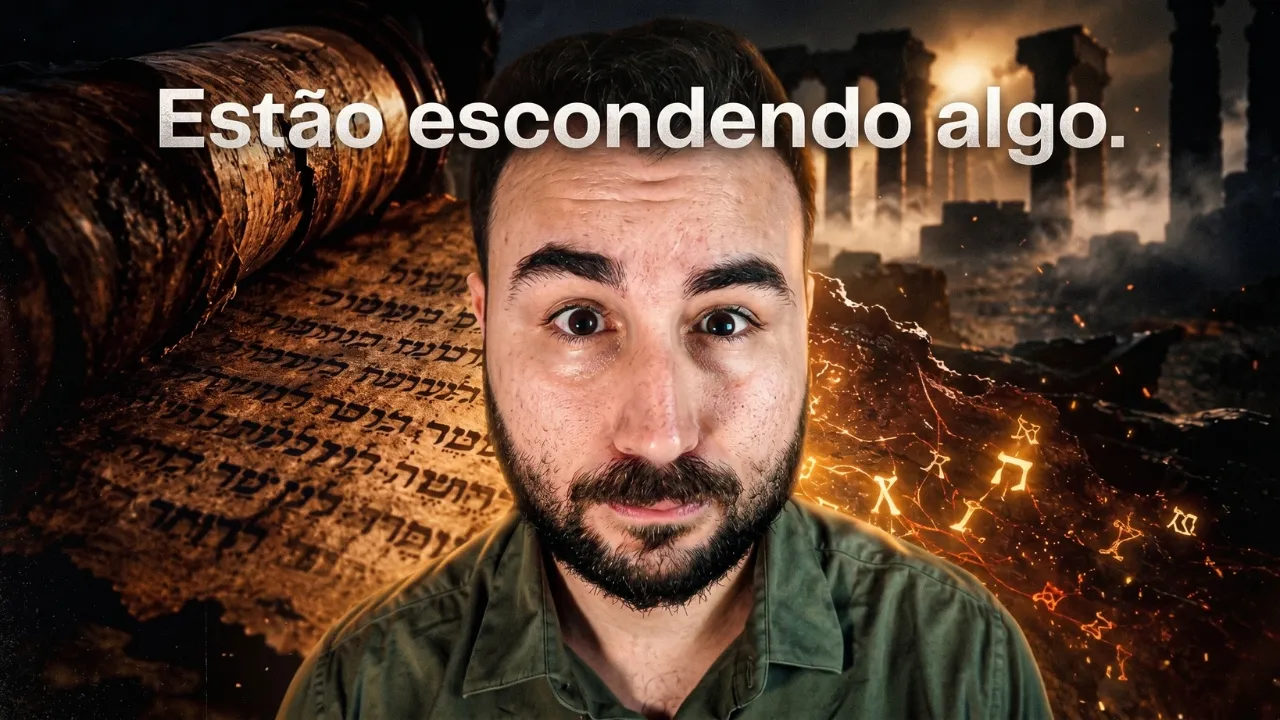
In 1947, a Bedouin shepherd looking for a lost sheep in the Judean Desert threw a rock into a cave and heard the sound of breaking pottery. There began the greatest archaeological discovery of the 20th century. Around 900 ancient documents preserved in sealed jars, of which more than 200 were biblical manuscripts.
Popular culture, influenced by the Dan Brown effect and apologetics, tends to look at the Dead Sea Scrolls through two simplistic extremes: either as the great forbidden secret suppressed by authorities, or as irrefutable proof that the Bible has remained intact and identical over the millennia. Science and textual criticism show a much more human and messy reality. For decades, scholars were looking for the original text, the text from which all variants had supposedly deviated.
But in reality, today the most prevalent attitude among serious scholars is that these biblical texts were always in contention, always under construction, always being modified. In these scrolls, we have physical proof of how the biblical text evolved from Canaanite polytheism to monotheism, how the myth of the perfect original text was destroyed, how books like Isaiah were edited and stitched together by multiple authors, and how modern greed created a million-dollar forgery market that fooled entire museums. Today, we are going to investigate what science and philology really discovered in the Dead Sea caves .
These manuscripts are the oldest copies we have today of the Hebrew Bible. To give you an idea, they are about 1,000 years older than those we relied on before. The annoying exception is the tiny silver amulets from Ketef Hinnom, dated to about 650 BCE, which contain a brief biblical blessing, making them the oldest physical fragments of a biblical text, but they are not scrolls or complete books.
The important thing, however, is that the Dead Sea Scrolls prove an interpolation to eliminate polytheism from the original, where in the original or originals it says Elyon. In our Bibles, we read "the Most High. " And where in the originals we find other gods, the sons of El, in our Bibles we find the children of Israel, altering the meaning.
The Qumran documents belonged predominantly to the Essenes, a separatist sect from the 1st century BCE that viewed the Jerusalem temple and its priests as completely corrupt. Described by Flavius Josephus and Pliny the Elder, the Essenes lived under strict communal discipline, silent meals, and daily ritual washings . They followed a 364-day solar calendar as opposed to the lunar calendar of Jerusalem, which caused their religious festivals to fall on completely different days.
They lived under the radical mentality of an end-of-the-world sect. In the War Scroll, we find a detailed military plan for a 40-year war between the sons of light, with the angel Michael, and the sons of darkness, Belial and the legions of Rome. And here comes the first major statistic that dismantles the myth of unification.
When analyzing the biblical texts found at Qumran, only 45%align with the Masoretic text, the standard medieval Hebrew text; 5% align with the Samaritan Pentateuch, 5% align with the Septuagint, the Greek translation, and 45%are non-aligned, meaning Hebrew versions that do not fit into any of our known biblical traditions. This refutes the idea of a closed canon. Books like First Enoch and Jubilees were copied and respected with the same authority as Isaiah, while the book of Esther does not even appear in the collection.
It is the only book that does not appear in the collection. Furthermore, finds like the Copper Scroll, a metal list of 64 locations with hidden treasures, and the Temple Scroll show how the textual production of the time was vivid and fluid. The most famous find is the Great Isaiah Scroll.
A 9-meter parchment containing all 66 chapters of the book. Apologetics often cite it to demonstrate the fidelity of scribal copying. The problem is that while a more recent manuscript, 1QIsab, has only 183 variants compared to the medieval text, the Great Scroll, 1 QIsaª, has more than 2,600 textual variants.
More than just variants, the manuscript analysis shows that the book of Isaiah is a book composed by several authors stitched together over time. Historians knew that Isaiah is divided into two parts. Chapters 1 to 33 focus on the 8th century BC, the Assyrian threat.
And starting from chapter 40, the tone shifts to the Babylonian exile . 6th century BC, citing King Cyrus the Great by name, someone who would only be born 200 years later. The Great Isaiah Scroll provides physical proof of this editorial stitching: a three-line space.
At the end of chapter 33, column 27, the scribe left three entire lines blank. In the scribal tradition of the Second Temple, this space was used exclusively to mark the end of one book and the beginning of another. Two different sources.
The first half used an intact source manuscript. In the second half, chapters 34 to 66, the source manuscript was damaged at the bottom edge. The scribe would leave gaps to fill later or try to fill them from memory, leading to errors and paraphrasing.
Analysis by artificial intelligence. Studies from the University of Groningen using machine learning proved that the second half was copied by a different second scribe with their own calligraphic habits. Separate storage.
The scroll of the first half remained stored folded for a long time before being sewn to the second half, which was kept rolled. Statistical evidence. Of the 21 copies of Isaiah at Qumran, 80%contain only the first half or only the second half.
They circulated as two separate books in the 1st century BC. As I mentioned at the beginning, the Dead Sea Scrolls also preserved scribal edits that reveal how the biblical text was altered to erase traces of polytheism. The most famous case is Deuteronomy 32: 8-9.
In the medieval Masoretic text, used in most Bibles, it is said that God divided the nations according to the number of the children of Israel. However, in the 4Q DeutJ manuscript from Qumran, the original reading is " according to the number of the children of God," Ben Elohim, the gods. As expert Emanuel Tov explains, the original text portrays the supreme god of the Canaanite pantheon, El Elyon, the Most High, dividing the peoples of the earth among his council of gods.
And the tribal god Yahweh receives his inherited portion, the people of Jacob. To avoid this uncomfortable theology of multiple gods, later scribes simply erased the pantheon and rewrote it as " children of Israel. " The same occurred in Deuteronomy 32, verse 43, where Qumran preserved the command: "Worship Him, all you gods.
" A stanza that was entirely deleted by later Bibles. So, what later became the Judaism we know today simply did not exist at that time . There were diverse Canaanite traditions.
Edits also occurred in the reverse direction, inserting passages; in Isaiah, chapter 2, verses 9 to 11, the Great Isaiah Scroll simply does not have the passage. "Do not forgive them, enter the rock and hide in the dust from the terror of Yahweh. " This violent interpolation was added later by scribes during political crises, such as the Hasmonean revolt or the Roman occupation, reflecting the apocalyptic anxiety of the time.
For centuries, scholars and researchers sought the*Urtext*, which would be the original text from which other variants had diverged. But as I said, today that expectation is not really held. As expert Eugene Ulrich points out, the findings proved that different versions of books like Exodus, Numbers, Psalms, and Jeremiah coexisted peacefully and served different communities.
The Bible has always been a text in development and contention. One of the most interesting examples of this fluidity is the 4Q Sam A manuscript. It preserved an entire episode about the Ammonite king Nahash, who gouged out the right eyes of his enemies.
Which had been completely omitted and lost for 2,000 years from all the Bibles of the world. Although the historian Flavius Josephus knew the story. Thanks to Qumran, modern Bibles like the NRSV have finally reinserted this passage at the end of First Samuel 10.
This reveals an uncomfortable truth for many believers. The Bible you read today is not the translation of a single original manuscript, but an academic patchwork. Modern translators use the medieval Masoretic text as a base, which dates about 1,000 years after the Dead Sea Scrolls that we previously used as the oldest reference.
But they cut and paste a word from the Septuagint here, a phrase from Qumran there, and a Samaritan snippet elsewhere to try and assemble a readable text. So today, when you go to translate a Bible, you manipulate these different sources and try to reconstruct a text that gives unified meaning to this diverse whole. The modern history of the manuscripts is as bizarre as their origin.
In the 1940s, scrolls even ended up in Wall Street Journal ads that read: "Dead Sea Scrolls for sale. " But the most shameful chapter occurred starting in 2002. With the explosion of the private antiquities market, American evangelical institutions and collectors paid hundreds of thousands of dollars for small scroll fragments.
The Museum of the Bible in Washington acquired 16 fragments and put them on display with great fanfare until scientific expertise stepped in. Dr Kipp Davis and his team subjected the fragments to microscopic and chemical examinations. The result was humiliating.
They found modern table salt, cubic crystals processed in the 20th century under the ink of a First Enoch fragment. They discovered ink applied over ancient, deteriorated leather surfaces—old wine skins—writing over parts where the leather had already peeled, which is impossible for an authentic scroll that deteriorated in the desert. In 2020, the Museum of the Bible had to publicly admit that all 16 of its fragments were modern forgeries.
The forger’s motivation: financial greed and ideological bias. We saw a lot about this topic recently in my series on Bart Ehrman's book, which will be in the cards here for you to watch if you haven't checked it out yet. We covered the entire book here on the channel.
One of the fake pieces purchased by a seminary contained verses from Leviticus 18 and 20 regarding the condemnation of homosexuality. The buyer paid a fortune because the fragment perfectly suited their agenda in the American culture wars. The Dead Sea Scrolls are an invaluable find, but not in the way popular myths propagate.
They show us the rigor of scribal copying, but also expose the human stitching of biblical books, the theological edits that erased ancient polytheism, the non-existence of a single original text, and the vulnerability of the religious consumer market to modern forgeries. The Bible is not a monolithic block that dropped ready-made from the sky. It is the complex record of humanity's cultural, linguistic, and theological evolution.
If you enjoy the history of religion seen through the lens of science, philosophy, and philology, subscribe, leave a like, and comment on which of these revelations surprised you most. See you in the next video. True.
It all starts with doubt.