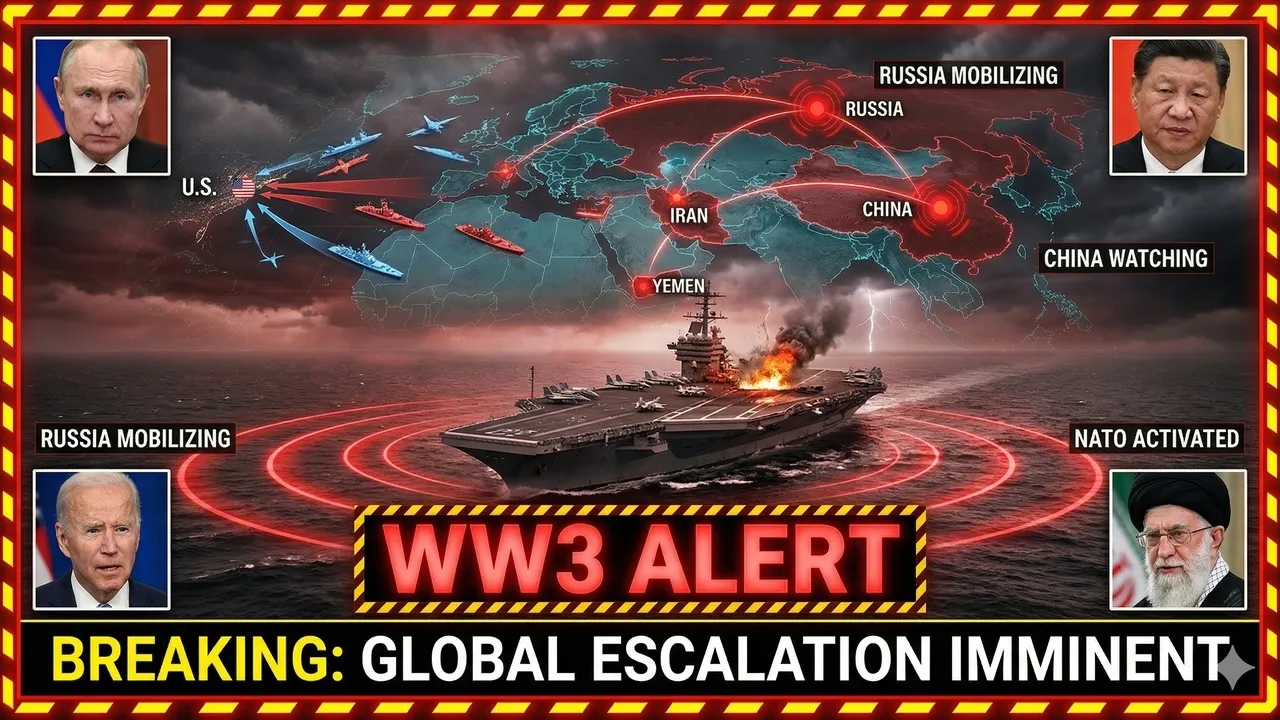
February 14th, 2025. A small, unassuming drone crosses into controlled airspace above the Red Sea. On radar, it looks like noise, a ghost signature.
The USS Abraham Lincoln, one of the most advanced aircraft carriers on the planet, detects [music] it, tracks it. And here's where everything changes. This isn't a random probe.
This isn't a warning shot. This is the Houthis attempting to strike the flagship of American naval power in the Middle East. And if they succeed, if even one of these attacks lands where it matters, the escalation chain that follows doesn't just reshape the region.
It triggers a domino effect that could drag China, Russia, Iran, and NATO into a confrontation none of them can back away from. You think that sounds dramatic? Stay with me.
Because what's happening right now in the waters off Yemen isn't just another skirmish. It's a powder keg with a lit fuse. And most people have no idea how close we are to the edge.
Let's rewind. The Houthis are not a superpower. They're not a conventional military.
They're a militia backed by Iran operating out of one of the poorest countries on Earth. But here's the thing. They've been hitting ships.
They've been launching ballistic missiles. They've been deploying drones that cost a few thousand dollars to build, forcing the United States Navy to fire million-dollar interceptors just to swat them out of the sky. It's asymmetric warfare at its finest, and it's working.
The USS Abraham Lincoln is a Nimitz-class supercarrier, over a thousand feet long, 90 aircraft on board, 5,000 personnel. It's a floating city with more firepower than most countries. It's surrounded by destroyers, cruisers, submarines, all networked into one of the most sophisticated defense grids ever created.
And yet, the Houthis tried to hit it. Not once, multiple times. That tells you two things.
One, they're bold enough to try. Two, they believe they have a shot. Now, why does this matter?
Why does a failed drone attack on a carrier in the Red Sea have anything to do with World War III? Because of what happens next. The moment a US carrier is damaged or, God forbid, sunk, the response isn't diplomatic.
It's not a strongly worded letter to the UN. It's immediate, overwhelming, and it doesn't stop at Yemen. Here's the sequence.
The Houthis launch the attack. Let's say, hypothetically, they get lucky. A drone slips through, hits the flight deck, kills American sailors.
The United States retaliates, not just against the launch site, against the entire Houthi command structure, airstrikes across Yemen, Tomahawk missiles, B-2 stealth bombers flying out of Diego Garcia, total dismantling of their military capability. But the Houthis don't operate in a vacuum. They're funded, armed, and directed by Iran.
Tehran provides the missiles, the drones, the intelligence, the targeting data. So, when the US strikes back, Iran is implicated. And that's when things spiral.
Because now you have two choices. Do you ignore Iran's role and let them continue arming proxies who attack American assets, or do you hold them accountable? If you choose option two, you're hitting targets inside Iran.
And the second you do that, Iran responds, not with words, with action. They close the Strait of Hormuz. 20% of the world's oil supply flows through that choke point.
Tankers stop moving. Oil prices double overnight. Global economy takes a hit that makes 2008 look like a minor correction.
But it doesn't stop there. Iran activates Hezbollah in Lebanon. Hezbollah launches rockets into Israel, thousands of them.
Israel responds with airstrikes into Lebanon and Syria. And because Iranian forces are operating in Syria, Israel ends up hitting Iranian positions. Now you've got a direct confrontation between Israel and Iran.
And Israel has a policy. You hit us, [music] we hit back harder. They don't do proportional responses.
They do existential defense. Meanwhile, Russia has forces in Syria. They're allied with Iran.
They've invested years rebuilding Assad's regime and securing their Mediterranean naval base at Tartus. If Israel or the US starts hitting Iranian assets in Syria, Russia has to make a call. Do they stand aside and watch their ally get dismantled, or do they step in?
If they step in, even indirectly, supplying air defense systems, electronic warfare support, intelligence sharing, you now have Russian and American forces operating in the same theater with opposing objectives. That's not a proxy war anymore. That's a direct confrontation with a nuclear power.
And then there's China. China doesn't care about Yemen. They don't care about the Houthis, but they care a lot about Iran, because Iran supplies a huge portion of China's oil.
If Iran falls or gets crippled by USA strikes, China's energy security is threatened. So, Beijing starts making moves. They increase military activity around Taiwan.
They probe US defenses in the Pacific. They signal to Washington, "If you destabilize the Middle East, we'll destabilize the Pacific. " And now the United States is fighting a two-front crisis.
Carriers in the Red Sea, carriers in the South China Sea. Resources stretched, allies nervous, and every decision made under pressure with incomplete information and zero room for error. This is how World War III starts.
Not with a declaration, not with a surprise attack on a major capital, but with a chain reaction, a single spark in a region already soaked in gasoline. >> [music] >> And the Houthis, they're holding the match. Now, let's talk about why the USS Lincoln is such a critical target.
It's not just a ship. It's a symbol. It's a statement of American power projection.
When a carrier strike group shows up off your coast, it means the United States can launch airstrikes, enforce no-fly zones, support ground operations, and sustain all of it for months without needing a single airbase on land. That's why carriers are called the cornerstone of American foreign policy. You can't negotiate around them.
You either respect them, or you try to kill them. And trying to kill one is a declaration in itself. The Houthis know this.
Iran knows this. And that's exactly why they're doing it. Because if they can prove that a carrier is vulnerable, that a militia with drones and missiles can threaten a hundred billion-dollar asset, it changes the calculus.
It tells every adversary in the world, "American dominance isn't untouchable. " It tells China, "Your carrier-killer missiles might actually work. " It tells Russia, "Your submarines might get closer than we thought.
" It tells every regional power with a grudge, "You've got options. " And that's the real danger. Not the explosion, not the casualties, the perception shift.
The moment the world believes a US carrier can be taken out, the deterrence factor collapses. And deterrence is the only thing keeping half the conflicts on this planet from going hot. So, what's the US doing about it?
Everything. The Lincoln strike group is running layered defense. Aegis destroyers with SM-3 and SM-6 interceptors, close-in weapon systems, electronic warfare jamming, fighter patrols, submarine screens.
They're scanning the skies, the surface, and below the water 24 hours a day. But here's the problem. You can't intercept everything.
The math doesn't work. If the Houthis launch 10 drones and you shoot down nine, that 10th one is still coming. And all it takes is one.
One hit in the right place, one lucky strike on the island superstructure or a munitions elevator. That's it. Game over.
Not because the ship sinks. Carriers are incredibly hard to sink. But because the mission gets compromised.
Aircraft can't launch, systems go offline, personnel casualties, and the optics catastrophic. The headlines write themselves. "US carrier damaged by militia group.
" And every adversary on the planet takes notes. Now, why are the Houthis even doing this? What do they gain?
On the surface, nothing. They're not going to win a war against the United States. They're not going to force a withdrawal.
But that's not the goal. The goal is to bleed us, to force us to spend resources, to tie down assets, to create a situation where we're constantly reacting instead of dictating terms. It's the same strategy the Viet Cong used.
The same strategy insurgents in Iraq and Afghanistan used. You don't have to win. You just have to make winning too expensive.
And right now, it's working. Every drone the Houthis launch costs maybe $5,000. Every interceptor we fire costs up to 4 million.
They can launch a hundred drones for the cost of one of our missiles. That's not sustainable, not economically, not strategically, and they know it. But there's a deeper layer.
Iran is using the Houthis to test American resolve. They want to see how far they can push before we snap. They want to probe our defense systems, gather data, learn our response times, our intercept rates, our rules of engagement.
Every attack is an intelligence operation. And every time we respond, we're giving them information. It's a chess game, and right now, they're three moves ahead.
So, what happens if the Lincoln gets hit? First, immediate damage control. The crew is trained for this.
They'll contain fires, seal compartments, treat casualties. The ship's designed to take a hit and keep [music] fighting. But the strategic response is what matters.
Within hours, you'll see B-52s in the air, Tomahawks launching from submarines, strikes on Houthi positions across Yemen. The US will aim to decapitate their command structure in one coordinated wave. But Iran won't sit idle.
They'll activate sleeper cells, launch cyberattacks on US infrastructure, hit Saudi oil facilities, escalate in Iraq, and then the real question becomes, do we hit Iran directly? Do we take out their drone factories, their missile production facilities, their IRGC command centers? Because the moment we do, we're at war with a country of 90 million people, a country with ballistic missiles, cyber capabilities, and proxy forces in six different nations.
That's not a quick operation. That's a generational conflict. And here's the kicker, we might not have a choice.
Because if we don't respond decisively, we look weak. And looking weak invites more aggression from Iran, from China, from Russia, from North Korea. The entire global order is built on the assumption that if you attack American forces, the response will be swift and devastating.
If that assumption breaks, the whole system collapses. So the US is caught, damned if we do, damned if we don't. And the Houthis are betting we'll blink first.
But there's another factor, public opinion. Americans are tired of war. Two decades in the Middle East, trillions spent, thousands dead, and for what?
Most people don't want another conflict. They don't want to hear about strikes in Yemen or Iran. They want stability.
But here's the reality, stability requires strength, and strength [music] requires the willingness to use force when necessary. If we back down now, if we let attacks on our carriers go unanswered, we'll pay for it later with more attacks, more aggression, more wars. So the question isn't whether we should respond, it's how.
And that's what keeps generals up at night. Because every option has consequences. Every move triggers a counter move.
And in a world with nuclear weapons, hypersonic missiles, and AI-driven warfare, the margin for error is zero. This is the reality of modern conflict. It's not about good guys and bad guys.
It's about choices made under pressure with incomplete information and stakes that couldn't be higher. And right now, the choice is being made in real time. The USS Lincoln is out there, the Houthis are watching, Iran is waiting, and the world is holding its breath.
So here's the thing, this isn't a hypothetical. This is happening right now. And the decisions made in the next few weeks will determine whether we're heading toward a larger war or whether cooler heads prevail.
But one thing's for sure, the age of unchallenged American naval dominance is being tested, and the outcome of that test will define the next decade of global politics. So what do you think? Are we heading toward another major conflict or is this just another chapter in the endless cycle of Middle Eastern proxy wars?
Drp your thoughts in the comments, and if you want to stay ahead of the stories that actually matter, hit that subscribe button. Because this, this is just the beginning.