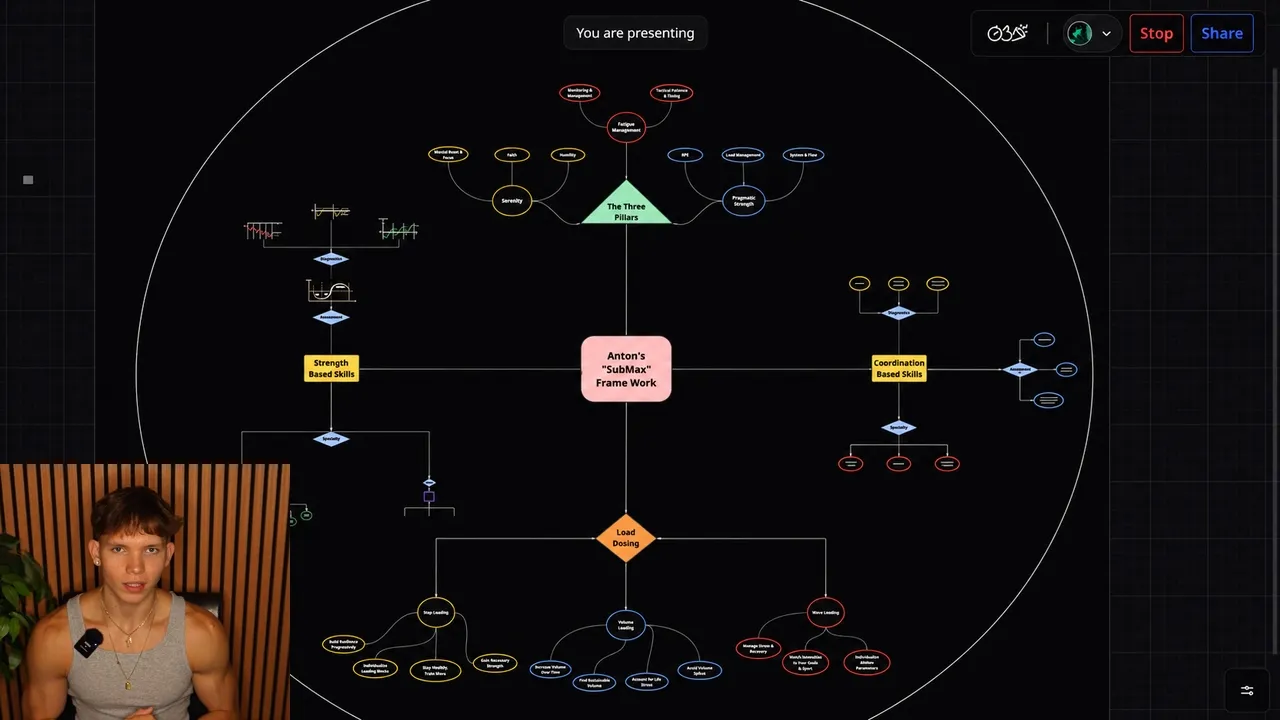
In this video, I'm going to be breaking down my exact thought process when it comes to programming advanced calisthenic skills. Just to put this into perspective for you guys, I have managed to teach hundreds of people advanced calisthenics skills in a relatively short period of time. This video is going to be quite unique compared to my previous ones, as it's actually going to be a full live recording of a meeting that I had with my internal community of clients.
During this meeting, I gave an hour-ong lecture talking about the exact thought process that I utilize when it comes to writing calisthenics training programs and the secret behind my clients and their progress. Make sure you guys watch the entire presentation through because even if you miss one part of it, it's going to make it extremely hard for you to understand how to apply this to your own training. At the end of the presentation, I left it up to my clients to ask me questions in the form of a live Q&A.
So, make sure you stick around till the end as they probably ask questions that you're going to have. Enough talking. Let's get into it.
All right, you guys see everything correct? Someone unmute and be like, "Yeah, cuz right now I can't see anything anymore. " >> Perfect, man.
>> Everything's clear. >> Perfect. Perfect.
Perfect. All right, guys. So, yeah, we're going to be discussing Colin, uh, one of my good friends and also a longtime client of mine.
Uh, we recently stopped working together because he is pursuing his own photography business. But I figured it'd be a great um thing to to review for you guys because if I were to program his next cycle of training, this is how he would it would look like. So Colin's 21 year 21 years old, 6 feet tall, quite tall guy, 165 lbs.
um has roughly 3 years of training experience and being a full-time student and business owner, his life is quite hectic. Now, why are we looking at these variables, right? So, when I write your guys' programs, um all of you guys know that I asked you questions along these lines and then also for you to describe what your day-to-day life looks like.
Part of that being is because I need to know how much stress you're experiencing on a daily basis, right? If you're kind of just chilling at home the whole day, not really doing much, then what's going to happen is the only real thing you're focused on is training. And like we discussed in the previous weekly meeting, neurological fatigue is a huge, huge thing.
So the more that we can minimize external stressors, the better. But of course, life is not perfect, so we have to deal with it. Um, and also with this being someone who already has a lot of training experience, three years of calisthenics training experience, it means that we're most likely not going to have to do any sort of conditioning or basic training.
We can just jump into kind of achieving and brute forcing his way towards his goals. Now, like I just mentioned, full-time student with also his own online business, very unpredictable hours, a lot of stress. So, we do need to keep the volume and frequency at an amount that makes sense for him, right?
He's not going to be training six times a week, seven times a week, most likely around the three to four mark. Um, and obviously cannot handle as much volume as his more timefree counterpart. Right?
In terms of looking at his physique and his height and weight, we can put him at maintenance calories or a small surplus because he is quite lean. Um, we don't need to necessarily get more shredded. We don't necessarily need to bulk.
just kind of maintain the more consistent our parameters are and all these different variables, the better when it comes to tracking progress. Uh, one sec. We have some some people joining here.
Darien. Darien. Guys, fun fact, Darien is actually the first student who I'm going to teach the one- arm front lever to.
He just started one- arm front lever yesterday. So, it'll be very interesting. Um, let me go back here.
Okay. Anyways, uh for anyone that just joined, we were just talking about um Colin. Colin's basically going to be the guy that I'm going to write a program for.
I've been coaching this guy for a long time. Um but just recently, we stopped working together. But if I were to write out his next block, this is how it would look like.
Um we only stopped working together also because he's going to be moving to Miami and pursuing photography full-time. So, he's not going to be focused on training too much. We discuss parameters, right?
Like what do these variables actually tell us? his height, his weight, um, and also we can take a look at his recovery capacity based on how busy he is, right? Running a full-time business and being a full-time student.
So, like we discussed in the previous meeting too, we want to establish a lower and upper bound. So, the lower bound is going to be the most the easiest but most useful exercise that we can utilize to make progress. So, for example, if we're trying to learn the PLCH, you're not going to be doing push-ups because that's going to have absolutely no carryover to the full PLCH.
Something that would be a good lower bound would be a PLCH lean. Upper bound is same thing. The hardest, the most difficult, but the most useful exercise.
So, for example, if someone is barely on the verge of learning a full PLCH, their upper bound would be full PLCH attempts, right? If someone's barely on the verge of learning an advanced tuck plunchch, their upper bound would be nothing more than advanced tuck plunchch attempts, right? If he's doing straddle attempts and he can barely do advanced tuck, that's a problem.
So, our goal is to stay in between these two bounds and systematically update them so that we're never so that our training never outlives one of the bounds. So, for example, if your upper bound is the advanced tuck PLCH attempts, but you can already hold an advanced tuck plunchch for 10 seconds, like that means you're not updating your upper bound. Your upper bound should be updated given the new strength.
And this is all like basic stuff because I want to make sure you guys understand everything before we get into the programming because it's going to be very important. Now, I'm going to skip past this. We're going to come back to this though because this is going to be very important.
So, let's first take a look at his PLCH and his handstand push-up. Basically, these are the videos that he sent me and he's like, "Hey, write my program for the next 6 months. " Right?
So, this is what we're looking at. This is like when I ask you guys, "Hey, send me a video of your current strength level. " Okay?
So, let's watch his >> Okay, so let's rewatch it one more time, and I want to see if you guys see the same thing that I see. Okay. So, he has a very weird full PLCH attempt, but it tells us a lot from this simple thing.
So, if you watch his shoulders right here, right? If you watch his front delts, they never retract. They stay in that strong position.
He maintains the proper scapula position here with protraction. However, his body just sinks and he shortens his lever by bending his legs. Right?
So, watch again. Look at how he pivots around the shoulder joint. So, usually with full PLCH attempts like this, the person when you have a different deficiency, you will just jump into full PLCH and then you will just collapse by leaning more, right?
But he doesn't do that. His body pivots around his shoulder and he never loses protraction. Watch it one more time.
>> All right. So that tells us a lot. Now after seeing this this pattern of maintaining protraction and pivoting around the shoulder joint, I asked him to send me another movement so I can confirm if my hypothesis here is correct.
My hypothesis is that he has really really good protraction. His serratus anterior is firing amazing. He's very strong.
He's maintaining he's not letting his body collapse inward, but his body's uncomfortable at a higher degree of lean. Okay. And this is going to go back.
It's all going to tie back to the previous slide here. If I can go back the previous slide with the underleaner and the overleaner with plch. As you guys can kind of tell already, Colin is an underleaner.
So the upper back stays protracted. His scapula control is good, but he doesn't lean far forward enough. And if we look at his 90, actually we can see the same thing.
Perfect perfect protraction throughout the whole rep. But again, look what he does. Look at his legs.
He pikes his hips and the legs are a little bit bent, but full protraction is still maintained. So it's the same habit in two completely different movements. Okay.
Okay. Shall we continue? So we observe the same habit in two completely different movement patterns.
Right? So this tells us something and it tells us a lot about how we should program his plan training. Okay.
>> Next slide. Okay. So now after seeing these two videos for me the conclusion that I reached is okay obviously he is not comfortable in a more deeply leaned position which is why this he he never collapses at the shoulder at the at the shoulder joint the scapula but he never allows himself to go to that degree because he's scared.
So, we need to expose him to more and more lean through full PLCH presses, heavy zenetti work, and PLCH leans where we're honestly focused on overleaning. Okay? I would rather overexaggerate the lean than underexaggerate and keep the bottleneck as it is because guess what?
If he gets super strong in a more obuse angle of the lean, his plch will explode. And so already for most of his PLCH training, it's going to be straight arm dynamic shoulder flexion movements. Now, if we take a look at his pull, I'm going to come back to the to the previous slide again.
Okay, so let's take a look at his pull, right? Because I looked at his push stuff. Now, we got to look at his pull stuff.
Colin's biggest goal, by the way, is to learn a 10-second full plch and to do a full front lever touch and pull-up. Okay, so let's take a look at his front lever pull-ups here that D70. Okay, probably you didn't notice anything crazy there, but I want you to really pay attention to the drop off on the second rep when he pulls explosively and then it it's like he hits a wall.
Okay. Usually the how do you say the arc the movement arc is much different. It should be more fluid, right?
There's not a hardcore drop off anywhere. Now, if you look at his pull-ups, the first rep, it looks like he can do like 10, right? Because of how explosive it is.
But then look at the second rep. This first rep, it's like he hits a wall, right? And then it's very apparent when he switches to advanced tuck.
Very explosive reps. Now, for me, when I see this, I see that there's a clear weakness in the top position because as you travel from the bottom of the front lever pull-up to the top, the lats start to enter a more disadvantageous position to generate force from and the rear delts have to take over. The higher he gets to the touch, the more the rear delts have to do the majority of the work.
Now, my hypothesis for why he's so bad at the top position is because he's never done anything related to heavy weighted pull-ups with full lockout. And knowing him and the way that I programmed his previous training, we only did very explosive muscle-up work. And so, if we take a look at his muscle-ups here, you'll see the same story, right?
I know it's pretty small up there, but look at how explosive his muscle-ups are. Very clean. So he obviously has a very explosive bias with a weak lockout.
Okay. And so in my mind for his plunchch he has a problem of underleaning. Okay.
So now we need to get him stronger in an overleaned position. Rather just overshoot the weakness and fix it that way. Same things, same kind of idea for his front lever here.
He has a really big weakness with the lockout. I know he wants to do front lever pull-ups. I know that's a goal of his, but majority of the training will not be front lever pull-ups.
It's going to be front lever touch because guess what? If he can strengthen that top range of motion, it's game over. And so what we're going to do is we're going to regress with the touch.
We're going to try to do advanced tuck touches for a long time. We're also going to try to do dead stop pull-up to touch because guess what? If we do advanced tuck or even tuck front lever pull-up to touch, we're going to emphasize locking out and fixing that movement arc that I'm going to discuss here.
Um, and so this is why I want to show this graph. So, ideally, your force production across the pole is quite balanced, right? Kind of like the the gray line here, right?
So that you're not generating 99% of your force at the bottom and then at the top range of motion, you absolutely suck, right? We want to have a very balanced pulling curve. Um, this is when you can start doing things like pull to touch, right?
You can start doing more fun combos because now you're quite strong at the full range of motion rather than just the bottom explosive portion. And so after looking at these videos, now we can kind of develop the skeleton of the plan here, right? And just keep in mind this is what I do for each and every single one of you.
So although this is front lever and PLCH, I know some of you guys are learning handstand, handstand, push-up, muscle up, whatever it might be. This is the thought process that I'm trying to go through in my head for each and every single one of you. You know, when I when you guys send me videos initially, I make sure to take into account all of these different things so I can come up with some sort of plan that's going to target your big bottlenecks because as we know, you're only as strong as your weakest link.
So yeah, the skeleton of the plan will be seven to eight sets per session. We'll see how that goes. May reduce it, may increase it, but just a nice sweet spot to start off with.
Um, one day on, one day off because he is quite busy. We don't want to do anything crazy with six times a week training. But some of you guys are, you know, it's funny, a lot of you guys are training six times a week, some of you guys are training two times a week, and some of you guys are training three to four times a week, right?
All of your guys' programs are extremely different and it all comes down to these all of these different factors, right? The longer I work with you, the better of an understanding I can have of you and your body and thus be able to program your training that much better. Okay?
So, for Colin's example, we'll start off with seven to eight sets per session, one day on, one day off. We'll follow the classic ABC cycle, and we're going to do eight sets of PLCH with eight sets of front levers. So eight supersets.
Now when when I write programs, the first thing I design is the most intense hardcore session, right? Because then deriving the day B and day C, the easier sessions is very easy for me. Um because all it is is going to be derivatives of the movements you're doing on the A days just at a lower intensity with maybe bands or maybe more regress.
Right? So let's look at his intense session. So the golden rule is you start with the hardest thing and you slowly work down to the easiest thing, right?
When it comes to all sorts of programming, also keep in mind the first thing that you do when it comes to any single session is going to be what the nervous system biases more when it comes to adaptations. So that's why, for example, if you guys are learning muscleup, the first thing we do is muscle up attempts and then what do we do? Explosive pull-up work, right?
teaching the lats how to fire explosively. Same thing here for the PLCH. We're going to start off with two max full plunchch attempts.
I do two because sometimes the first one there's you know something goofy happens like your entries off or you know you just you're not warmed up properly, right? So two is is a good sweet spot. Also, same thing for the front line.
We're going to do two sets of max one leg touches. So we saw the video, right? He was doing super advanced tuck pull-ups and then he got to advanced tuck pull-ups.
So, this might be a little bit outstretched for him. Even if he doesn't touch the bar, I still want to see him do this. Okay, our intense days were meant to do things that we cannot do yet, but keep attempting them, right?
And we can measure progress based on the successfulness of each set week by week. So, for example, if he tries a one leg touch max hold and he's, you know, not touching the bar, that's okay because session by session, week by week, we should see him get closer and closer to the bar because, like I mentioned, most of the work, 70% of the work is going to be revolved around touching, just touching the bar. After doing the max full plunchch attempts and the max one leg touches, we're going to move into super sets of straddle plch negatives into a hold and then advanced tuck pull-ups into a touch.
Let's first start off with the straddle plch negatives into a hold. Like I mentioned, Colin is an underleaner. He's not lean enough and it's seen in both his 90° handstand push-up as well as his full plch.
And the funny thing is, let's say someone is an overleaner in their full plch. Guess what? when they do their 90s, you will see the same thing.
If someone tends to have a a tendency to retract during handstand push-ups, guess how their PL is going to look like. That's why some of you guys learning the handstand push-up right now, I like to stress the importance of keeping protraction because this tendency will propagate through every single movement that you do in the future. Okay?
So, some of you guys see these perfect full plunchches online where it's like perfect protraction. Understand that that is a a habit that started at the most basic level of pike push-ups, right? Handstand push-ups and then it propagated through until full plunchch full plunchch push-ups.
Anyways, we're going to emphasize leaning more, which is going to be done with the straddle plch negatives. It's going to force him to control the lean and get really comfortable by holding in that lean position. also using straddle plch as an example here or as the regression here because I know he can hold that for at least 5 seconds.
The advanced tuck front lever pull-up to touch is going to emphasize doing the pull-up but with a different intent not to just explosively pull but to pull and pause at the top. So guess what we emphasize his big weakness of crutching the bar. And then the last exercise for the PLCH is going to be dead stop full plunchch holds into a press.
Again, emphasizing the dynamic portion where we have to lean more. So with the press, you actually temporarily dip into more of a lean. And so what this is going to do is exaggerate and target his bottleneck and get him stronger in his weakest position.
For front lever, we end the workout with some long banded one leg touches. It's just trying to get a lot of volume in that touch position. Now, day B and day C is very, very simple.
So, on the A day here, we had max full plunchch attempts at 100%. Right? So, on our recovery day, we're going to do full PLCH holds banded at 60%.
Right? Very easy. And then we go down the list.
Okay? Strat PLCH negative to hold. Again, use a D for dynamic movements.
We throw on a band here again. So, we use a band and we do the hold, a longer hold for 8 to 12 seconds, still keep it at 60% intensity. So, kind of the the rule here is we take the intense work we did and just slap some bands on or do a regression and do it at 60% intensity, 50 to 60%.
For the day B, cuz that's our active recovery. For the day C, same thing. we take some sort of derivation of these exercises and do them at 60 to 70% for longer periods of time.
So the day B is more of the active recovery day whereas the day C is more of the volume accumulation. I like to call it the the hybrid between the day A and the day B. So utilizing all the same movements, targeting all the same bottlenecks, all we're adjusting is how long each set is and how intense each set is.
But the the principle of programming is spotting the bottlenecks and then building the entire program around those bottlenecks. That's how you program things. Okay?
Because like we all know, you are only as strong as your weakest link. You know, so if you are just only biasing things that you're already good at, you're not going to go anywhere. And you know, the program is never finished.
His program is going to get updated quite frequently. As soon as he's starting to hold one leg front lever touches for, you know, 5 to 8 seconds, guess what I'm going to do? I'm going to go back to this program and guess what I'm going to swap out.
Instead of max one leg touches, guess what it's going to be? Max full front lever touches. Instead of advanced tuck front lever pull-up to touch, guess what?
It's going to be one leg front lever pull-up to touch. And instead of long banded one leg touch, it's going to be long banded full front lever touch. So basically just upping everything by one progression.
And like we discussed earlier, we want to make sure that an exercise never outlives its operable bound because if it does, it no longer is training. It's just [ __ ] Um because it doesn't have any more use for us anymore. Like for example, if he's doing full front lever touches um as his, you know, starting exercise, like I updated his program, there is virtually no point of him doing advanced tuck front lever touches, right?
That is no longer our our lower bound. But in this moment in time, advanced tuck front lever pull-ups to touch does make sense. You guys get what I'm saying?
So you you need to make sure you're constantly updating the program so that it's never too hard, never too easy. And I'll let you guys ask me any questions if you guys want to drop them in chat or unmute. >> Hey man, can you hear me?
>> Yeah, I can hear you. >> Sweet. So um I may be a little specific, but if you were programming this for somebody else who doesn't have the problem of bleeding, but has problem with protraction, like what would you change?
>> Yeah. So with protraction, the biggest thing I would emphasize is doing banded work with a progression that you can probably already hold for a long time. Like for example, usually over leaners are very strong, like very very strong.
They have a lot of straight arm strength, what we call dead strength. So usually very good at things like zenetti presses. Um what I would do is I would really emphasize the mental cue through grease the groove.
So doing things like PLCH leans throughout the day and really emphasizing staying tall in the shoulders almost making it a movement that is now subconscious to you. So you're not even thinking about protraction anymore. It is just happening.
Also another thing that we could experiment with is doing 90° holds because guess what? With 90° holds we take away the straight arm element. So this does two things.
one, the shoulder needs to generate less torque to hold the same position. So, let's just define let's define a PLCH as a straight arm 90° hold and let's define the 90° hold as a bent arm full PLCH. Right?
Both movements you can maintain full protraction in. The serratus has to do the same work to maintain full protraction in a 90° hold and in a full plunchch. The serus does the same thing.
The reason the full PLCH is 10 times harder is because the arm is straight. Two things. It's more disadvantageous for the shoulder joint because the shoulder needs to generate more torque to hold the same position, but the serratus is still firing the same way.
So by utilizing 90° holds, what we do is we target the bottleneck of maintaining protraction without the increased torque requirement from the shoulder joint. Does that make sense? Perfect.
Okay. Um, and we have still got people joining. Let me see.
Maybe not. Yeah. Okay.
Um, okay. Go for it, Stephen. >> Yeah.
Have a question to the thing right now because I can do like 90s on the floor with pretty good projection, I think. But uh a bottleneck with mine is in PLCH is protraction because I think like in when you do 90s like you you're right with the protraction but the arm is like still in in a different angle isn't it? >> If we look at if you want to upload your 90s your 90s I actually pointed this out to you.
You struggle to maintain protraction with your 90s. >> You you hyper extend your neck. And if you look at your scapula position, it's more inwards.
Also, same thing with your handstand push-up. You tend you have a big tendency to retract. >> Okay.
I didn't know that. Sorry. >> Uh, who else?
>> Go for it. Go for it, Kirsten. >> Hey, man.
So, in terms of what we've seen, there are like eight sets in front lever and eight sets in plunge. All right. Is that enough or would you advise him to do any kind of accessory work in addition to that?
Like for example, maybe body weightight pull-ups or weighted pull-ups. So that's my question. Is there anything else that can be added or is that enough?
It all depends on the client's goal. So if his goal is only to do a 10-second full plch and to do full front lever pull-ups and full front lever touch, bodyweight pull-ups would not aid us in this goal, right? I would rather use that extra volume for a more specific exercise that would target the bottleneck that would allow him to learn the skill.
However, if his goal was, for example, hey Anton, I want to get good at this skill and I also want to build my physique a little more, then yes, I would consider adding some sort of body weight pull-ups just for, you know, more volume for the actual musculature. >> Got it. Okay.
Thanks, man. >> Yeah, of course. Um, go for it, Max.
Oh, you wrote something in chat. Okay, let me see. Um, I don't see I don't see your question.
Um, go ahead. Uh, Mark, go ahead, Mark. >> Yo, what's up, coach?
Can you hear me? >> Yeah, I can hear you, bro. >> Yeah.
So, man, you know, I like going hard and uh I I need it. I like I like it. I love it.
I'm still trying to find that fine line between staying at submax and still pushing myself. I'm I feel like I'm just guessing. >> I got you.
So, you feel like are you kind of in the stage where you feel like you're scared to do a little more training because you feel like it's going to impede your recovery? >> Uh I don't know. I feel I always regardless of how I feel the next day, uh I still go hard.
Um so it's just a matter of being optimal. >> Yeah. So listen, at the end of the day Oh, sorry guys.
Wait, my uh my computer's about to die here. The biggest thing if you're scared about you're scared you said you're scared about being optimal, right? That's your big concern.
>> Scared about not being optimal. >> Not being optimal, >> right? Not not Yeah.
>> Okay. So, this is how you you need to view it. If you're trying to go hard every day, this is this is not optimal.
Okay. Because by going hard every day, you are assuming that your body is ready to go hard every day. Unless you are a genetic freak, you most likely cannot do this.
You know what I mean? With you right now, how I'm having you train is we need to fix your stationary handstands because when you balance, you tend to walk on your hands a lot. And if one of your big goals is to learn the handstand push-up, then no amount of training hard and doing dips till failure and doing, you know, pike push-ups till failure is going to fix your problem of getting better at handstand push-ups.
You get what I'm saying? Yeah, understood that makes sense. >> Yeah.
So again, I'm programming everything around your bottleneck. So if you, for example, if you want to mix calisthenics and more kind of hypertrophy work, we can talk about that and I will make changes to the program. But right now, I'm kind of under the assumption that you just want to unlock these skills.
You're right. No, I'm just I'm not focusing on hypertrophy at all. It's just, you know, I guess uh years of just habit and mental No, no.
Yeah, I completely I completely understand, man. I used to be the same way like for a large majority of my calisthenics journey before I did all the skill work. I was just blasting weight at calisthenics, like absolutely balls to the wall.
And then I tried the same thing for static skills, but it just doesn't work. You know what I mean? And so, I'm trying to look out for you and your progress.
And I know it's a little bit of a a learning curve and it feels wrong almost, but just watch in a few months, you're going to look back at today and you're going to be like, "Wow. " Like mind-blowing, you know? >> Got it, coach.
I'm trusting the process. I trust you. >> Yeah, exactly.
>> Yo. Um, so I have a question about the programming again. Like I have a student that I just teach the 90 degree handstand push-up and we want to move on to the PLCH.
When do I know when to move on to another skill? Like for example, should we get it to should we get better at the 90° and some push-up that he can do like clean reps protracted like two three reps or should he straight up jump into advanced tug straddle banded straddle all of this or should he like combine everything? >> Yeah.
So similar with what I did with you, I saw you can do one 90°ree handstand push-up like you can do a lot. So it was already let's just do PLCH. But in fact, I would start PLCH as soon as they can do a handstand push-up if that's their main goal.
Um, like with Josh, for example, as soon as he got literally he got like a pike press to handstand and I was like, "All right, let's go. Let's do full PLCH now. " Um, so it's really going to be up to you as a coach, too.
And also what your client wants. So, if he wants to get really good at 90s and also do full PLCH, I would get really good at 90s while starting to implement some PLCH stuff on the back end, but keep the 90s as the main thing, right? And then once he's like, "Okay, I want to go full in on PLCH.
" Guess what? You've already started conditioning for PLCH. Maybe you're doing PLCH leans.
Maybe you're doing some advanced tucks. Maybe you're doing some light banded straddles. Um, and then you can pivot the full training into PLCH right away and just drop all 90 work.
>> Okay. But now do you like if someone can do a handstand push-up but no 90 degree handstand push-up yet? But his goal is the PLCH would even learn the 90 degree handstand push-up.
>> No, I I wouldn't go that route. No, I would just go to go to a full >> I was going to ask because when I started my working on my handstand push-ups with you, I had a protraction problem, right? and you told me to do the queue where you like turn your hands inside and that was like a game changer for me.
It was a lot it felt a lot more natural uh during the movement and I'm doing most of my work uh on floor like on my hands but if I tried on paralletts h I mean I did try once and I couldn't figure out like the queue while my hands are like in a neutral position you know cuz it's it feels different. So like how how do you maintain protraction in your mind? You know what I mean?
>> The the variation with the with the grip is making you lose the connection shoulder. >> Yeah. >> Yeah.
Very very common. The the very simple answer is we could regress and do pike push-ups with parallettes so that it's much easier because the more intense a movement is, the harder it's going to be to implement mental cues. Um that's why most of the work that we do in static training is more submaximal so that we can implement these mental cues, right?
Grease the groove, implement them. Um and so if you're trying to do handstand push-up is still difficult for you. And so if you vary the grip, it may become too difficult for you to even implement this mental cue and it will also impede your ability to protract even though you can do it in floor.
Right? So, we would do pike push-ups for like a few days. You can do it, grease the groove, figure it out, and then you can take that mental cue that you've learned and apply it to your handstand push-ups.
>> Yeah. Okay. And also uh I noticed because to I today was my push workout and I noticed that I just did a random handstand h the end of my workout but but on paralletts because my wrists were kind of fatigued.
Um, and I noticed that like like freestanding handstand, just holding it is so much easier for me on paralletts than on floor. Even though I only work on the floor, you know, it's like effortless almost uh on parallettes. But everything pushing wise is a lot easier on the floor like on my hands.
>> Yeah, makes sense. With um floor your wrist is like this. >> Yeah.
With parallettes, your wrist is more like this. And so this is more of a neutral position. You're much stronger here.
Like if I gave you a weight, you would be able to do this really hard with it versus this is like very weak because the wrist is like extended. >> Um that's why P bars is easier and you feel stronger in it and why floor may not feel the best, but floor floor is cooler, you know. >> I agree.
I agree. >> That's the reason. >> Yeah.
Okay. Okay, >> thank you. >> Yeah, of course, brother.
Uh, Max, go for it. >> Oh. Uh, sorry.
I didn't know I still have raised my hand. >> That's okay. >> That's okay.
Mark, go for it. >> Yeah, coach. So, um, I'm focusing what my priorities are, the uh the handstand press and the front lever.
So, should I just disregard, you know, I'm also kind of I am I am still putting a little bit of training into one arm pull-up. Should I just disregard that? That's not What do you think?
>> Yeah. So, actually, funnily enough, I don't know if Richie's in here. Um, so, same question I same conversation I had with Richie.
We've been working together for roughly 4 months. He's in Singapore. He just unlocked this full front lever pull-up.
I think he posted in the Discord. Anyways, he wanted to get good at everything. He wanted to get good at weighted pull-ups, one- arm chin-ups, muscle-ups, front lever.
And I said, "Bro, no. We're only going to get good at front lever. " After a few months, he tried his one- arm pull-ups again.
He went from one rep to three reps, okay? Just because his body was already adapted to the one- arm pull-up because he was training it a lot. But then we just improved his base level of pulling strength through front lever and it reflected in his one- arm pull-up capability.
So, what I would do is I would just focus on front lever because it's going to improve your other pulling skills. >> It's a back It's a back workout regardless. Yeah.
>> Got it. Got it. Thank you.
You know, it's crazy, man. It's crazy. Josh Josh, >> I [laughter] went from a PLCH to a full PLCH in a full PLCH press in front of my eyes, man.
It's unbelievable. Unbelievable. >> Crazy.
>> Can't I can't wait. And Darien in here, too. This guy, man, I'm going to teach him one arm front lever.
He's going to be the first student I'm going to teach one arm front lever, too. If you made it this far, I hope you took something away from that presentation. Let me know in the comments if you have any questions or if you want to see more additional weekly meetings that I host with my clients just like this one.
If you find yourself struggling to progress in calisthenics, whether it be a basic skill like the handstand or an advanced skill like the PLCH press, PLCH push-up, feel free to click the first link in the description below. Fill out an application to work with me and me and my team will get back to you within 48 hours if we feel that you'd be a good fit for the program.