My name is Charles Duhigg and I'm the author of this book The Power of Habit. So, imagine for a minute that you have this cookie problem. Okay, a cookie habit.
Every day you go up in the afternoon, let's say you work in a building in Midtown that's called The New York Times and on the on the 14th floor is this cafeteria with this amazing amazing cookie selection. And you put this little note on your monitor that says do not eat the cookie and then every afternoon you manage to ignore that note and go upstairs and get a cookie. And imagine for a minute that this has caused you to put on a little bit of weight.
Let's say roughly 8. 7 lb. And when I say you, what I actually mean is me because I'm describing my life eating cookies.
So, I I was really interested in why I, a successful human being, won a Pulitzer Prize last week. I think I'm a pretty smart guy. Why I have this difficulty resisting cookies, right?
There's a lot of things I can do in my life. I began researching the science of habits, what how habits work and and what I learned is that we're actually living through this golden age of understanding the neurology of habit formation. I ended up writing this book out of it.
And I want to tell you a little bit about what I learned and what it has to do with teaching kids and mindfulness, but in order to do that I first of all have to tell you a story about a rat. Um Anyone here ever experiment with rats before? Anyone ever ride the subway?
Okay, then you've done a lot of experiments with rats. There's a woman named Dr Ann Graybiel who has for years been doing experiments with rats. She's a neurologist and for years she was trying to get sensors into rats' cranium so she could measure what was going on inside their skulls.
This took a long time and a lot of rats. But eventually she got to a point when she could get about 150 sensors inside a rat's skull and she could measure its neurological activity. What she do with each rat after it woke up from the surgery was the exact same thing.
She would drop it in the world's simplest maze. We works the same way every single time. Click, a partition would move, the rat's free to run through the maze and find the chocolate.
Every rat when you drop it in the maze the first time acts like the world's laziest animal. It'll like wander up and down. It'll get to the end.
It'll see the chocolate. It'll go the other direction. It takes on average about 13 minutes for it to find the chocolate.
And for years people thought that this is because rats are unusually dumb. And then if a rat can learn something then any animal could learn it. But Dr Graybiel could actually see inside the rat's head.
And what she saw was kind of fascinating. This is a simplified neurological graph the first time a a rat's dropped in this maze. There's all these spikes in activity, right?
Basically the rat would like scratch the walls and the scratching centers of its brain would light up. Or it'd find the chocolate and the pleasure centers would light up. This is what unmediated learning looks like.
So Dr Graybiel takes this rat. She drops each of them in the maze again and again, 150 times each. Over time unsurprisingly the rat learns how to run through the maze faster and faster and faster find the chocolate.
But what's really interesting is what happens inside its head. As the rat learns to run faster and faster, as finding the chocolate becomes more of an automatic habit, the rat starts thinking less and less and less. This graph on the bottom is a simplified neurological graph of the 150th iteration through that maze.
What you'll notice is this deep valley there, right? That's the same valley you would see if the rat went to sleep. Now, all of us have habits, right?
There's a There's a researcher named Wendy Wood who followed around a couple thousand people to see how much of our daily behaviors are habits. And what she found is about 40 to 45% of the decisions we make actually every day aren't actually decisions. They're habits.
And if somehow I could get 150 sensors into your head, this is exactly what I would see. Your mental activity dropping off in the middle of that habit. When you um you know, remember waking up in the morning and walking in the subway and now you're at your desk but you don't remember what happened in the middle.
Or when you decided that morning to have a salad but you get to lunch and you order a hamburger just like you did yesterday. This is what's happening. Your brain is kind of turning off.
With these two interesting exceptions. At the beginning of the habit when the rat would hear the click, there'd be this burst of activity. And then essentially the brain would power down.
And then at the end when it found the chocolate, it's as if the rat would sort of shake itself awake again and notice what was going on. Within neurology, this is such an important idea and finding that has become known as what as the habit loop. And what it says is that every habit has three components.
There's a cue, which is like an automatic trigger for a behavior to start. And then a routine, which is the behavior itself. And then finally a reward that helps your brain remember that pattern for the future.
Every habit has cues and rewards. And for years everyone from Aristotle to Oprah, when they've talked about habits, they focused on the routine, on the behavior. But what we've learned the last decade is that it's the cue and the reward that influence how habits function.
Uh just to give me an example of this. Does anyone here exercise? It's a young audience.
Anyone here wish that they exercise? I realize this. Okay.
So there was an experiment that was done in Germany where they took a audience like this and they said, "All of you should exercise. " And then they took about a third of the audience and they said, "Okay, look, this is what I want you to do. Choose a cue, like always put your running shoes next to your bed, or go running with the same group of friends.
And then when you get back from working out, give yourself a small piece of chocolate. Right? This is counterintuitive because not many people exercise in order to eat chocolate, or at least not quite that directly.
And yet what the researchers suspected is that even though all of you think that you want to exercise, your brain thinks you're a liar and that you hate exercise. And the only way that I can trick you into exercise is to give yourself a reward you genuinely enjoy, like a small piece of chocolate. And in fact, six months after they did this, they found that 58% of those people were more likely to be exercising.
And they'd stopped eating the chocolate. Cuz their head brain had learned there's endorphins and endocannabinoids, these neurotransmitters that reward us for physical activity. But you kind of have to bootstrap your brain into believing that those rewards are real with a reward that you genuinely enjoy, like chocolate.
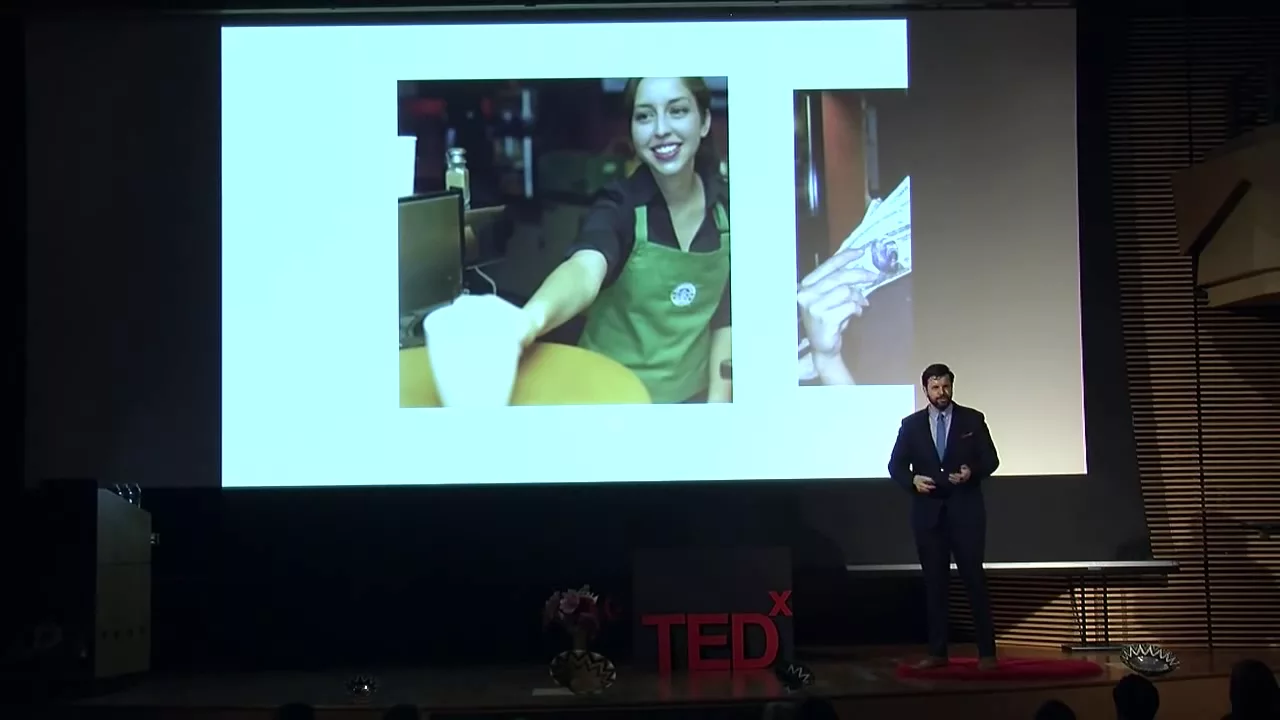
All of which brings me kind of improbably to Starbucks and what Starbucks can teach us about teaching and mindfulness. What does Starbucks sell? Coffee, right?
No, wrong. That Starbucks doesn't sell coffee kind of Starbucks kind of sells coffee, right? They they give you coffee in exchange for your money.
But if you talk to Starbucks, what they will tell you that they actually sell is customer service. This is why they can pay they can charge you $4. 50 for a latte that cost about 13 cents is because when you walk in there's wood paneling and soft music and there's someone who asks your name and they write it in big cursive letters, right?
This Starbucks believes is the centerpiece of their entire business model is customer service. The problem for Starbucks is that most of their employees are high school graduates or high school students or recent high school graduates, people with no professional experience. And the problem is many of you know with being a high high school student or a recent high school graduate is that you act like a high schooler or a recent high school graduate.
You act like a right? Like I acted like a for an entire decade after I graduated. And for Starbucks this is a problem because they had employees who couldn't deliver customer service.
This became particularly a problem in the age of YouTube and I'm going to show you why. Before I show you something, imagine for a minute that you worked at Starbucks. You oversee 250 million dollars a year in advertising.
You've had a long day, you come home from work, you sit on your couch and you open a beer, you turn on the TV and this is what you see. She was a loyal customer of Starbucks, loved the coffee, loved the service, but that changed a few weeks ago. This native New Yorker got steamed, not about what was inside her cup, but something written on the outside.
That's what she called Nina Paneda and ordered a special brew of fully caffeinated 7 On Your Side. And then when you looked at it, what did you think? I was shocked.
I didn't I didn't understand why. Why would they do that? Vicky Reveron is talking about this Starbucks cup.
On the side a Starbucks employee wrote what she ordered, a caramel Frappuccino. But instead of scrolling her name on the side, she says he wrote the B-word. It says My name is not it's Vicky.
So, if you've ever wondered idly what $250 million sounds like going up in flames all at once, turns out it sounds like my name is in beep, it's Vicky. Starbucks went and did an investigation to figure out what happened here. The Vicky was served by this kid named Eduardo, right?
19-year-old kid, employed for 8 months, he'd been doing a great job. The night before Vicky comes in, he had a fight with his mom. And he's hour seven into an 8-hour shift, and this woman comes in who orders this coffee with a bad word on it, drinks the entire cup of coffee, goes home, changes clothes into a nice blue blouse, comes back to the Starbucks, calls a TV camera, waits 45 minutes for the TV camera to show up, and then gives this interview.
Which is all a long way of saying, Eduardo might have been totally right, right? But it doesn't matter. For Starbucks, this is a disaster, right?
Like, it doesn't matter how rude a customer is, Starbucks delivers customer service. This is their basic promise. They are going to treat you nicely regardless of who you are.
So, Howard Schultz and his team, there's been incident after incident like this, and they have this meeting to try and figure out, how are we going to fix this? Because this keeps on happening. And what they discovered, they decide is, we need to increase our employees' willpower.
What they notice is that about 10 to 15% of their employees would do great. And then they would have this one shift where they would fall apart, usually about seven, six and a half to seven hours into a shift. And they figured what they needed to do is figure out how to give their employees willpower to make it through that 8-hour shift, so they don't do something stupid like write a bad word on a cup.
Now, luckily for them, there had been a whole bunch of research that had been done into willpower. Most of you are probably familiar with this cuz since you come from a teaching background, the most famous of course being the marshmallow test. They I I you guys have heard of the marshmallow test?
For anyone who hasn't, this is how it worked. There was this researcher in the 1960s at Stanford. He had a 4-year-old daughter.
He took her and a whole bunch of her friends and he put them in a room one by one. He'd put a marshmallow in front of them and he would say, "Okay, look, here's the deal. You can eat that marshmallow.
I'm going to leave the room for 10 minutes. If when I come back, the marshmallow is still there, then you will get a second marshmallow. " Now, I actually have myself a 4-year-old at home, and so I can tell you that putting a marshmallow in front of a 4-year-old is like putting crack cocaine in front of an addict.
Like there's nothing more tempting. This experiment has been replicated. Let me show you some tape of what happens when you put a marshmallow in front of a 4-year-old.
I'm going to go do something and then I'll come back. It smells yummy. Oh, it smells really good.
Only one of these kids was able to make it the entire 10 minutes. Let me show you which one. How'd you do?
Did you do good? You did? You wanted to eat it, didn't you?
Yeah. So, did I tell you I'd give you another one? Okay.
Now you can have them both. You need them. So, this guy, Mischel, he does his experiment, right?
He finds that about 10 to 15% of the 4-year-olds, they could resist the marshmallow. He writes his results in late 1960s, publishes it, nobody cares. Nobody pays any attention.
And a couple years later, his daughter's in fifth grade, and remember she's one of the test subjects. He's talking to her and he's like trying, struggling to get her to tell him about her day. And he's asking about her friends, and she says, "Well, Susie keeps on getting into trouble, but Jimmy's doing well in class.
" And he realizes he's listening that the kids she says are doing well are the same kids who had managed to resist the marshmallow. So, he goes and he finds them in middle school. He finds them in high school.
He finds them in college and post college. It's one of the largest longitudinal studies that's been done, as many of you know. And he finds that the kids who managed to resist the marshmallow were more successful than their peers by like a stick to a statistically significant amount.
He finds that they were getting their homework done more frequently on time. They're showing up for class more time. They were more popular in high school.
Not necessarily because they were like prettier or richer, but because they were just better at being friends. They got into better colleges. They got better jobs, higher paying jobs.
They got married earlier and stayed married longer. It There's As many of you know, there's literally been hundreds of studies on willpower since then, most notably by Angela Duckworth at the University of Pennsylvania. And all of them have found that willpower seems to be the single greatest correlate with future success, right?
More so than high IQ, more so than having rich parents with a lot of resources. Willpower seems to be this thing that prepares people for life. And for Starbucks, this is fantastic because this is exactly what they want.
They want to teach their employees willpower. But the question is how do you teach people willpower? And the answer is through habits.
By choosing a reaction ahead of time and by making people conscious of what they're going to do when they feel hot blooded in a cold blooded state. Within economics, this is known as the hot cold empathy gap. That basically, in the morning when you wake up and you've had a big breakfast, you are certain that you are going to eat healthy and have a salad that day.
And as soon as you walk into the cafeteria and you're hot blooded, you decide the hamburger looks a lot better. So, how do you preserve that decision making from the morning into the moment of temptation? How do you create more willpower?
What's really interesting is if you look at the tape, if turn off the sound on this one. The kids who fail at this are kids who constantly remind themselves about the marshmallow. Like watch this kid, even when he tries to ignore it, he hits the plate and he reminds himself These kids like they all do these things where they can't help not paying attention to the marshmallow.
Now, contrast that with the kid that I showed you who actually resisted for 10 minutes. When researchers asked him what he did, he said that halfway through he decided that he was not going to look at the marshmallow. That he was not going to pay any attention to it.
That if he had to think about the marshmallow, he was going to imagine a frame around it. So that it reminded him of a photo. This is how we teach willpower.
We teach people to make a decision ahead of time that they apply when they see a cue. And then we give them a reward. That kid who resisted the marshmallow, he said that he had decided ahead of time if he could make it the whole 10 minutes, he was going to shove both marshmallows into his mouth at the same time.
And that's exactly what he did. So, how do you change a habit? How do I change my cookie habit?
The answer is by premeditating the cues and rewards. By deciding ahead of time what you're going to see when you see that trigger, and then what your reward is going to be. And it has to be specific.
Saying, "I'm going to lose weight. " doesn't work. Saying, "I'm not going to eat a cookie today.
" does not bring you success. What you instead do is you say, "At 3:15 in the afternoon, instead of going up to the cafeteria, I'm going to stand up and I'm going to walk over to someone's desk cuz I think part of the reason why I'm going up to the cafeteria is that it's fun to gossip with my friends and all my friends are in the cafeteria. So, instead of going up there, I'm going to look for someone else to go gossip with.
" And at 3:15 you stand up, that's your cue. You walk over to someone else's desk, in this case a guy named Michael Barbaro, and you gossip about whoever happens to be out of earshot for the next 20 minutes. And you decide, "I'm going to gossip hard.
" That's your reward. And then you go back to your desk. And I don't really like to brag about these things, but since then I've lost about 21 lb and it's worked out pretty well for me.
Thanks. The point being, this is what we know about habits. They have cues and rewards.
And if you decide ahead of time, if you engage in this mindfulness in your life where you're aware of what's driving these nearly subconscious behaviors where your brain actually turns off, if you indulge yourself to pay attention to the things that otherwise kind of happen at the peripheries of our consciousness, we know from study after study, you have the ability to change any habit in your life. Thank you very much.