Adriene Hill: Hi I'm Adriene Hill. Mr Clifford: And I'm Mr Clifford. Welcome to Crash Course Economics.
Adriene: Here at Crash Course, we recognize that difficult subjects are sometimes fraught with truly unintelligible vocabulary that's difficult for us regular people to understand. Mr Clifford: But it doesn't have to be that complicated. Remember, economics is the study of scarcity and choices.
We have limited resources, so we need a way to analyze the best way to use them. We need economics to make wise decisions in the future, but it also helps us understand the past. Adriene: Most empires, wars, and human endeavors can be explained using economics.
All you have to understand is who wanted what. The American Civil War wasn't just about freedom, it was fought because southern states wanted to keep using cheap slave labor. It was economics.
Mr Clifford: Econ can explain so much about the world, and that's why we love teaching it, and that's what makes it the greatest subjects of all time. Adriene: Take that physics! We're comin' for ya!
[Theme Music] Adriene: Let's stick with this history theme and talk about the progress of humanity throughout the ages. Using measurements like life expectancy, child mortality, and income per capita, we can show the majority of humans that ever lived had terrible lives. Statistically speaking.
It wasn't until the industrial revolution that people saw significant and sustained increase in their standard of living. Populations skyrocketed, but so did life expectancy and food supplies and hospitals and eventually toilets and refrigerators. Mr Clifford: It was at the beginning of the industrial revolution that Adam Smith, the first modern economist, wrote his book An Inquiry Into the Nature and Causes of the Wealth of Nations or AIITNACOTWON.
He wasn't great at naming books, but he was really good at explaining the source of prosperity. Smith concluded it was specialization, or what he called the division of labor, that made countries wealthy. Let's go to the Thought Bubble.
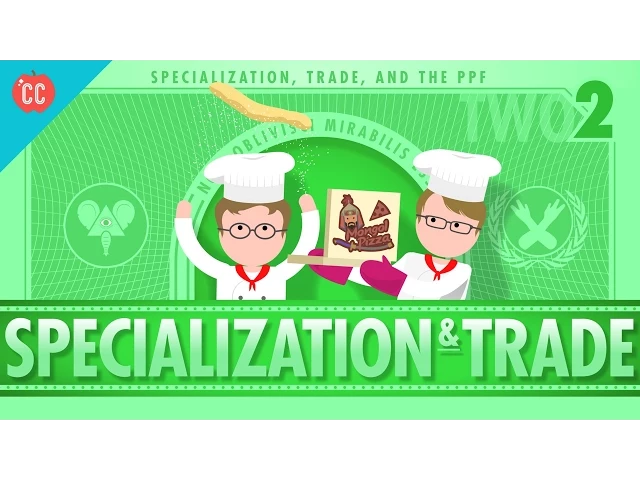
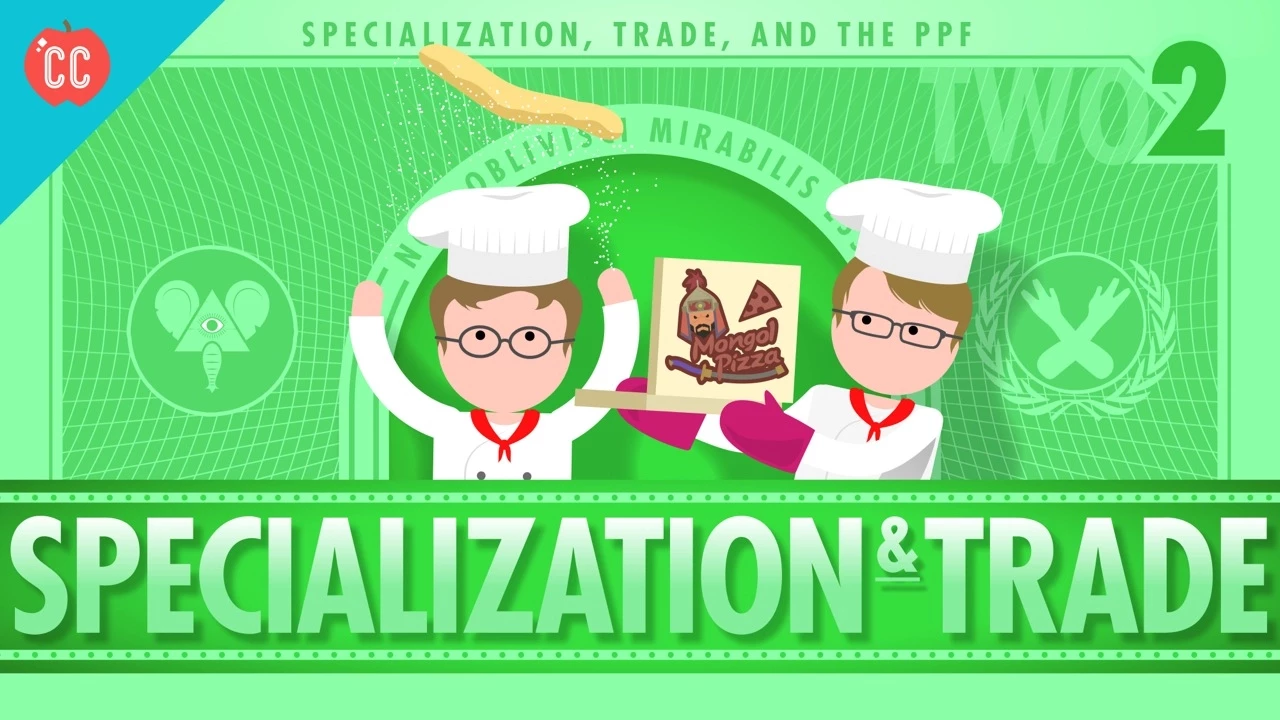
Adriene: When I think of specialization, I think of a pizza restaurant where different workers have specific tasks like preparing the ingredients, making the pizza, putting it in the oven, taking it out and putting it in the box. This division of labor makes each worker more productive since they can each focus on the thing they do best, and they don't waste time switching between jobs. But specialization goes beyond the assembly line for pizza.
To produce the cheese, there was a dairy farmer who specialized in raising cows; the oven was designed and manufactured by people who specialize in engineering ovens; the friendly moustache guy on the pizza box? Someone had to stamp him on there. I love that guy!
Adam Smith observed, "in every improved society, the farmer is generally nothing but a farmer; the manufacturer, nothing but a manufacturer. The labour. .
. necessary to produce any one complete manufacture, is almost always divided among a great number of hands. " Imagine what it would be like to make a pizza completely on your own.
From scratch. You would have to grow the wheat and tomatoes and raise the cow, you'd make the flour, the cheese, the oven, the pan, and then draw the moustache guy on the box. Without specialization, if you want something, you have to make it yourself.
And for thousands of years of human history, specialization was, well, pretty minimal. Of course humans specialized prior to the industrial revolution, it's one of the marks of civilization that we mentioned in our World History series, but the modern era has taken this to the extreme. Think of how many people from how many different specialized fields it takes to make a smartphone, all of them working in harmony so I can tweet my super profound thoughts.
Thanks Thought Bubble! So specialization makes people more productive, but Adam Smith said that it's trade that makes them better off. Assume that John can produce either pizza or t-shirts.
If he's way better at making pizza, then he should specialize in making pizza and then trade with someone else like Hank who's way better at making t-shirts. Everyone knows Hank's better at making t-shirts, right? With trade, each of them can end up with more pizza and shirts than if they tried to make them on their own.
To fully explain this idea of the benefits of trade, we need to show you an economic model, but before we go any further, know that economists geek out over models and graphs. Don't get all worked up about the numbers; they're not that complicated. Models are just visuals to help us simplify and explain concepts.
It's time for the model! So let's go to the runway. Mr Clifford: Now this is the first graph you'll see in an economics textbook.
It's called the production possibilities frontier, or PPF. The PPF shows the different combinations of two goods being produced using all resources efficiently. Now here's a made up example.
If the United States uses all of its workers and factories to produce airplanes, it can produce 500 per day, but they can't produce any shoes. Now if they use all their resources to produce shoes, they can produce 1000 tons per day, but they can't produce any planes. Now because the United States has limited resources, they can't produce any combination beyond the production possibilities frontier, so it's impossible to produce 500 planes and 1000 tons of shoes.
Adriene: Wait wait wait, Mr Clifford, I want to stop you here for a second. We don't live in a world where there are only two things that a country can produce. There are like a million things that US workers can choose to make: toilet paper, zippers, adorable stuffed kitty cats holding hearts, artisanal sauerkraut -- we don't live in a world of just shoes and airplanes, so what's the real world value of the production possibilities frontier?
Mr Clifford: The idea is once you really understand that there's trade-offs between producing two goods, that same logic applies for any number of goods. Adding additional goods makes it more complex but doesn't really add any more insights, so economists usually just stick with two goods. Now, what if American companies mismanage their resources and try to produce planes in shoe factories and shoes in plane factories?
Well, they'd be at a point inside the production possibilities frontier, showing an inefficient use of resources. So every possible combination inside the curve is inefficient, and on the curve is efficient and outside the curve is impossible. Now let's compare this PPF to China's.
China can produce 100 planes per day or 800 tons of shoes. Since the United States can produce more planes than China, they have an absolute advantage in the production of planes. The US also has an absolute advantage in the production of shoes.
Since the US can produce more of both goods, you might think there's no reason to trade, that they should just produce both on their own. Well, no. Remember, specialization and trade makes people, and in this case countries, better off.
Now stick with me, let's calculate the opportunity cost for the United States to produce one plane. Every single time they produce an additional plane, it costs them two tons of shoes. China on the other hand gives up 8 tons of shoes for each plane they produce, and since the US has a lower opportunity cost, they have what's called a comparative advantage.
China has a comparative advantage in the production of shoes. But here's the best part, if the US specializes in planes, they can import shoes from China at a lower opportunity cost than if they produce shoes themselves. For example if these two countries make a deal to trade one plane for four tons of shoes, The US would be better off.
They would rather get four tons of shoes per plane from China than only get two tons per plane by making shoes on their own. Now, China is also better off. They would rather trade four tons of shoes for a plane than give up 8 tons for producing a plane on their own.
Now hopefully your head isn't spinning. Being able to do these calculations is good, but it's more important to understand the main idea. Individual and countries should specialize in producing things in which they have a comparative advantage and then trade with other countries that specialize in something else.
This trade is mutually beneficial. Now that's the production possibilities frontier. In the real world, it's way more complicated than this simplified model, and we're only in the beginning.
Adriene: So this graph is super simplified, but the idea that countries should focus on producing the products for which they are better suited is huge. Way huge. In reality, the US is the world's leading manufacturer and exporter of airplanes.
It produces more than 40% of all planes. At the same time, the US produces less than 2% of the world's shoes, electing instead to import them from countries in Asia. The graphs aren't real, but the concepts are.
Another reason you should learn this is because you might hear a politician or someone on the news argue that international trade destroys domestic jobs, and even though it may seem counterintuitive, economists for centuries have argued that trade is mutually beneficial to whoever's trading. Now you know why. Now to be fair, there are all sorts of other intolerable issues associated with international trade, like child labor, dangerous working conditions and pollution, and we promise to address these in a future video.
But if there's one point on which most economists agree, it's that specialization and trade makes the world better off. No country in recent decades has achieved sustained improvements in living standards without open trade with the rest of the world. Countries like Cuba, Venezuela, Zimbabwe, and Iran that are voluntarily or involuntarily cut off from the world remain less economically developed than they could be.
On the other hand, countries that have opened their doors to trade like Japan and Taiwan, or, more recently, China and India, have seen massive improvements in their standards of living. Mr Clifford: Adam Smith was on to something. Self-sufficiency is inefficiency and inefficiency can lead to poverty.
Adriene: Next time we'll show you how some of these ideas get turned into economic systems and how these systems contribute to the differences between countries. Thanks so much for watching, we'll see you next week. Crash Course is made with the help of all these nice people who've explored the far reaches of the production possibilities frontier to bring you this show.
If you want to keep Crash Course for everyone forever, please consider subscribing over at Patreon. Patreon is a voluntary subscription service that allows you to pay whatever you want monthly and make Crash Course exist. Thanks for watching.
Don't forget to be irrationally exuberant.