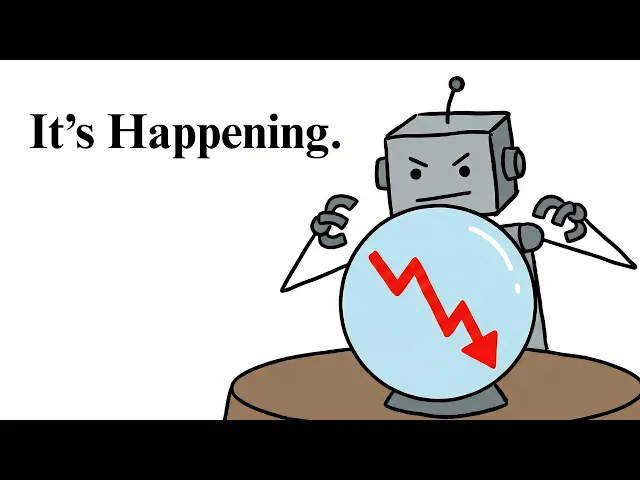
Back in the day, Wall Street was run by the people. You know the type. Suits, nice watches, and egos the size of small countries.
It was the Gordon Gecko and Jordan Belelfford archetypes. Because for most of modern financial history, investing with money managers and financial adviserss was pretty straightforward. You hired a person.
That person read through filings, listened to earnings calls, analyzed trading multiples, and then ignored all of it because he had a hunch about a biotech startup. It was a truly poetic system because sometimes they were right. more often they were wrong, but at least it felt human.
And that's because there was always a story involved. Whether that story was the management looks strong, the balance sheet is healthy, or even just a gut feeling that the stock feels cheap, which if we're being honest, is just astrology for men who wear cufflinks. And for decades, crafting stories was the norm.
Markets were inefficient, data moved slowly, and information advantages actually existed. It was the peak of capitalism in financial markets. But then something happened that changed everything.
The math nerds showed up. Guys named Yang with PhDs from Harvard, three math olympiad medals, and dreams that exclusively consist of probability distributions. And in the late 1980s, these nerds banded together because they realized something.
Markets weren't entirely random. They were statistical. Patterns exist.
Human behavior repeats. And market inefficiencies open the door for opportunities. And this is where quantitative investing began.
Because instead of asking, "Is this a good company? " The quants were asking, "Given these variables, what's the expected outcome? " It was rules over narratives, probabilities over opinions, math over gut feelings.
And it worked. Quantitative hedge funds began popping up out of nowhere like acne on a teenager. And the most infamous of which was Renaissance Technologies, and more specifically, the Medallion Fund.
Because the Medallion Fund is widely considered the most successful investment vehicle in history, and you've probably never even heard of it. It was Renaissance Technologies flagship hedge fund and it was founded by mathematician Jim Simons. He believed in using purely mathematical and statistical models to predict market movements.
Meaning no fundamental stock picking, no CNBC interviews, and no magic genie hiding inside a Bloomberg terminal. It was just purely math, algorithms, and machine learning. And it worked obscenely well because for more than two decades, the Medallion Fund generated over 60% annualized returns before fees and roughly 39% after fees.
And for context, Warren Buffett averaged around a 19% annualized return over his career. Meaning, if you compounded 10K at Buffett's returns for 20 years, you'd end up with around 324,000. But if you invested that same 10K with the Medallion Fund's returns, that 10K would have grown to a little over 7 million.
So yeah, you could say the Medallion Fund was pretty successful and it transformed the industry because instead of humans making all the judgment calls, now people leveraged systems that dynamically reacted to things like price movements, order flow, volatility, and countless other variables. And these algorithms operated at speeds that no human could ever compete with. And while quant funds were quietly becoming one of the favorite investment vehicles for institutions and high- netw worth individuals, there was something else unraveling with the everyday investors.
Because while a very small number of people truly do have the ability to outperform through discretionary stock picking, these people are very few and far between. And by the early 2000s, the data proving this was starting to pile up. Because it turns out that these active fund managers actually kind of stink at picking stocks.
And not just occasionally. And not just during bad years, but consistently. And study after study showed that roughly 90% of active equity fund managers underperform their benchmark over long periods.
And when you consider the fees they take for managing your money, it's even worse. So investors began asking questions like, why am I paying extra to underperform? And this is where index investing enters the story.
It's lowcost, passive, and designed to replicate the entire market's performance. and it was gaining popularity among the average everyday investors. Instead of searching for the needle in the haystack, investors simply began buying the whole haystack.
So while retail investors were moving away from money managers and financial advisers and towards index funds and ETFs, institutions were doing something similar, they were reallocating capital from traditional active fund managers toward other alternatives like quant firms, private markets, and in-house teams. Either way, we began seeing the traditional stockpicking money manager role slowly becoming obsolete. Capital was flowing out of the industry.
Fees were compressing and careers evaporated. But even though this was a dying industry, there was still a demand for portfolio management and the benefits it includes. Things like rebalancing, asset allocation, and tax optimization, the boring stuff.
And that's where we are today and where robo advisers come into the story. But before we go any further, let's clarify something first. If you hear that robo advisor use algorithms to manage portfolios, you'd be right.
But this is not in the same way that quantitative hedge funds use algorithms. Because quantitative hedge funds like Renaissance Technologies or Two Sigma use algorithms to exploit microscond market inefficiencies, statistical arbitragees, and other active trading strategies, all in the pursuit of generating alpha. Comparing how quant firms use algorithms to how robo advisers use algorithms is like comparing a Michelin star chef to chef boyd.
Because robo advisers are essentially just automated investment platforms designed to deliver lowcost market returns with minimal human involvement. They're not trying to compete with quant firms. They're trying to replace the benefits of having a money manager without the fees involved with having a money manager.
Robo advisers handle the asset allocation, rebalancing, tax optimization, and the rest of the portfolio busy work. It's all the boring stuff your financial adviser would charge you 1% a year to do in Excel. And investors love this value proposition.
Platforms like Wealthfront, Betterment, and other robo advisers began exploding in popularity because 10 years ago, Wealthfront had just 2 billion in assets under management. And if you fast forward to today, well, that number has grown 40fold to 80 billion in total client assets. And it's not just Wealthfront.
Globally, Robo Advisers managed around 187 billion in 2017. And by 2023, that number had grown to nearly 2. 8 trillion.
And by 2027, it's estimated to reach 4. 7 trillion. This isn't just a niche trend in finance.
It's a structural shift in a long, stagnant industry. But it's not all sunshine and rainbows either because robo advisers have some blatant issues. But before I jump into that, a quick pause because this video is sponsored by Surf Shark.
Surf Shark is a VPN service and the reason I like it is pretty simple. It's built for people like me who don't want to constantly have to manage their privacy online. With Surf Shark, you just turn it on and your internet traffic is encrypted, your IP is hidden, and your data stays private.
And the best part, you don't need to count how many devices you have because with Surf Shark, you can set up one account and use it on unlimited devices. It also comes with features like the email scam checker, which helps detect fishing attempts and protect your personal information. And if your data does ever show up in a breach, Surf Shark Alert notifies you right away.
And that's why Surf Shark is more than just your standard VPN. It's an all-in-one solution for online privacy. Because whether you're working from home or traveling abroad, Surf Shark helps keep your information secure wherever you are.
And they're so confident in their service, they offer a 30-day money back guarantee. If you want to check it out, you can go to surfshark. com/casual finance or just use code casual finance at checkout and get four extra months of Surf SharkVPN.
Thank you to Surf Shark for sponsoring this video. And now back to Robo Advisers and the issues that nobody seems to be talking about. Because on the surface, robo advisors sell personalized investment solutions.
But while they may feel like a sophisticated, tailor-made solution for your investment strategy, the truth is they're nowhere near as personalized as they appear because they start by asking you to complete a questionnaire. It covers things like your age, income, time horizon, goals, and a few other questions. It feels intentional, thoughtful, and crafted specifically for you.
But in reality, it's not because after you answer the questionnaire, instead of being crafted an individual investment plan for yourself, you're actually categorized into a bucket and slotted into a model portfolio that's shared by thousands of other people with similar answers. And that is where a lot of people misunderstand robo advisors. They aren't some hyper intelligent AI crafting a unique portfolio specifically for you.
They were designed to replace the operational role of a traditional financial adviser. All the stuff that used to require meetings, paperwork, and a guy named Gary to explain beta with a laser pointer is no more. Because for decades, financial advisers weren't really paid for generating alpha or outperforming in the markets.
They were paid for access. Access to markets, access to investment products, and access to information. And for a long time, that made sense.
Markets were opaque. Data was expensive. And investing without guidance felt like trying to assemble IKEA furniture without instructions.
But then the internet showed up, information asymmetry disappeared, market data became free, and research tools went mainstream. And suddenly, financial advisers weren't guarding the gates anymore. And paying someone 1% a year started to feel questionable.
And that's the real draw of robo advisers. And travel agents didn't disappear because people stopped traveling. They disappeared because booking a flight stopped requiring a phone call.
Stock brokers didn't disappear because people stopped trading. They disappeared because clicking a buy or sell button online was faster than calling some guy named Rick on the trading floor. Whenever access in an industry becomes free, the middleman tends to get replaced by technology.
And that's exactly what's happening with robo advisers. They're automating the middleman layer of the investment management world. Which is why this isn't a story about robo advisor being good or bad.
It's a story about what happens when technology finally reaches a stagnant industry. So now I'm curious to hear where you land on things. Have you ever used a robo adviser?
Would you trust one with your money? Drp it in the comments below and let's see how the investment landscape is changing. Because whether it's quant firms replacing discretionary managers or robo advisers replacing traditional financial advisers, the direction is the same.
When technology touches a stagnant industry, it doesn't make small tweaks. It forces fundamental changes.