we began to look at the process of protein primary structure analysis in our last lesson let's take a look at the method used to determine the actual order of amino acids within a peptide Edmund sequencing is a common technique used to determine the amino acid sequence or order within a peptide this process can be automated to determine the sequence of a peptide containing from 10 to 40 amino acids in approximately 30 minutes the limitation is that the signal degrades over time and this is why there is a size limitation on the fragments that can be
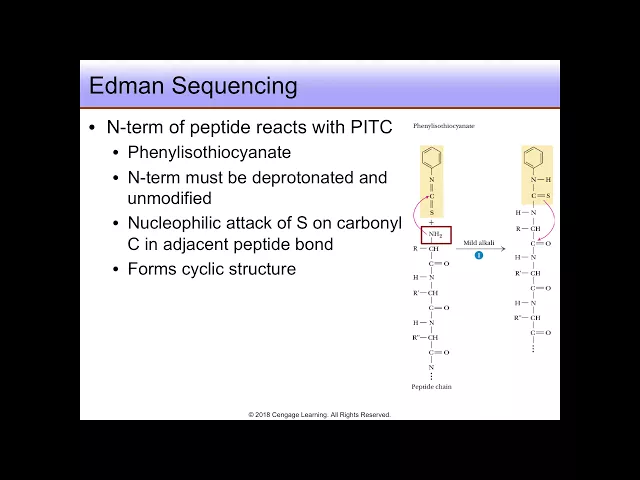
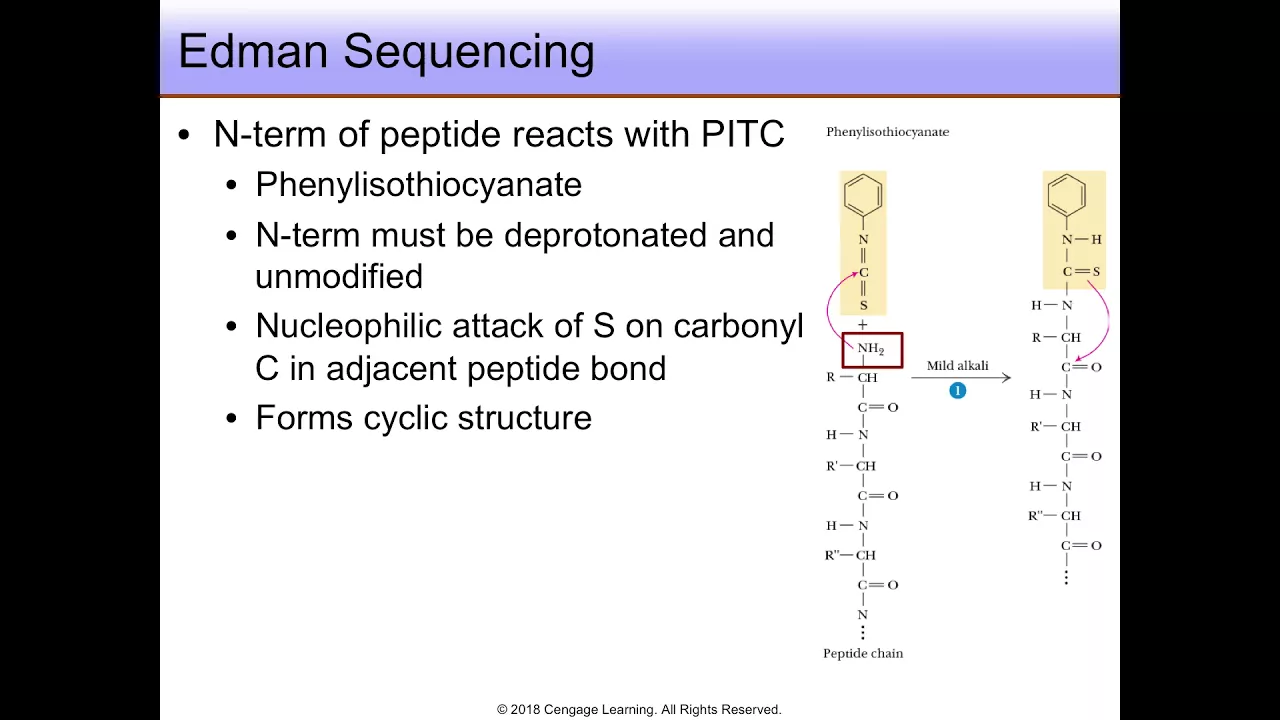
analyzed this method also allows us to determine the two ends of our protein so we need not use a separate method for that the reagent phenol isothiocyanate is added to the solution of protein and it will react with the amine group at the terminus of the peptide the nitrogen atom acts as a nucleophile to attack the carbonyl carbon of the P ITC reagent but it must be deprotonated and unmodified for this to occur this means the experiment must be carried out at a specific pH as shown on the right the sulfur atom then nucleophilically attacks
the carbonyl carbon in the adjacent peptide bond this forms a cyclic structure a thiazole and known derivative as shown here the presence of anhydrous trifluoroacetic acid or TFA hydrolyzes the peptide bond and releases the terminal amino acid as a PTH derivative this can then be compared to a series of amino acid standards in order to determine its identity the value of this technique lies in the fact that although the terminal residue is released the remainder of the peptide remains intact and may be subjected to the next round of analysis each round will discover the next
amino acid in the sequence although it has its limitations this is a powerful technique and one which is very commonly applied