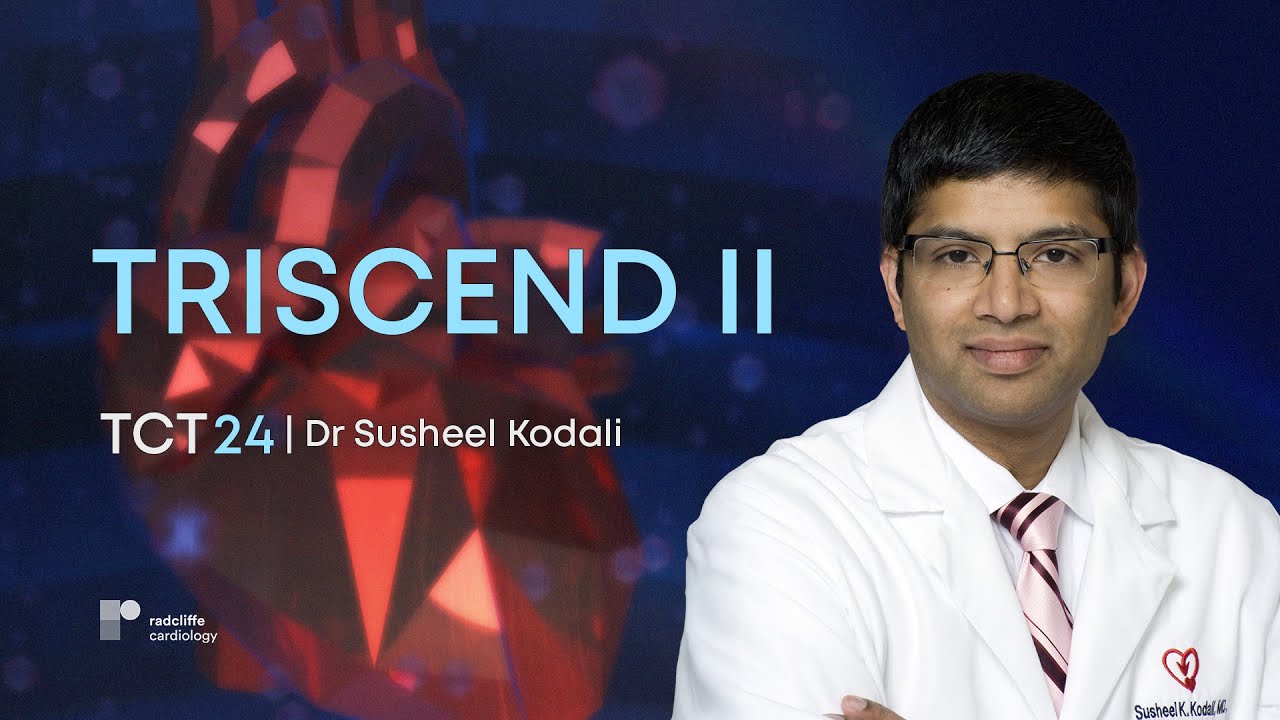
[Music] good morning everyone it's Alex sticky on behalf of PCR online it is a great pleasure today to have a very special guest a leader in structural in the structural field and uh a friend U is a professor at Columbia University Hing Medical Center New York and everybody knows professor kod so it is very a great pleasure and honor to welcome him thank you so much being thank you for having me thank you so much ER we are going to talk about the triend to trial that uh was presented in just yesterday at TCT 2024 so suil what are the main results of this very interesting and Pioneer trial so this was the first trial of trans catheter trus of Val replacement uh first randomized trial comparing it to Medical therapy um and so it randomized 400 patients to either TVR with evoke or continued medical therapy and so overall the results uh were good um I mean and it's important but it's important to look at them closely uh the device was successfully implanted in 95% of patients the main reasons for failure were challenging Anatomy or difficult Imaging but the procedure times in general the device times were less than 1 hour um on average and there is the conversion to surgery in 1. 2% but it's important to note though is in this comorbid population you know mean age 79 you know lot a lot of comorbidities including 20% with the SES 93% of the patients were discharged to home after a median Hospital stay of three days but but when you look at any procedure you got to look at the safety events and there was 3. 1% cardiovascular mortality of 30 days 10.
4% severe bleeding and a new pacemaker rate in patients without a pacemaker of 24. 7% but uh you know but then looking at the other side and the efficacy you know TTV essentially eliminates TR 99. 1% had moderate or less and 95.
3% had mild or less and this is in contrast to tier which you know our goal in general is to get to moderate or less with TTV the goal is essentially to eliminate TR the the primary safety and Effectiveness endpoint was really is it was a high it's a composite endpoint it was a uh in in a calculated hierarchical fashion including hard end points like mortality track valve intervention but also soft endpoints so to speak like NY class Improvement and kcq Improvement and using felstein shonfeld it showed that TTV with the evoke patients did better than those in control with a p viive less than 0. 0 001 um and to calculate the magnitude of a fact you know we calculate a wind ratio um and that wind ratio was 2. 02 and that that shows on in general patients that getting TTV have twice a chance of doing better than those that are conted on optim medical therapy we looked at a lot of different subgroups in this trial and across all the different subgroups there was there was generally benefit but what one of the subgroups that was interesting is although patients with severe benefited those with massive and torrential TR had nearly doubled the benefit and so maybe treating patients with more TR they seem to get more benefit we also looked at sort of you know what is the cap we looked at the K Meer curves for mortality you know there was no significant difference at one year we did a landmark analysis at 30 days trying to account for the safety events and it numerically favored TTV and the lines appeared to sort of separate eight months but uh there was no sign ific difference in in either mortality or heart failure hospitalizations but one area where there was sort of a dramatic difference was in functional quality of life improvements you know patients had greater six-minute walk distance greater improvements in nyj class and kccq um and Suzanne Arnold who presented the results of the kccq of the quality of life substudy uh in the trial um and and she showed that in general at 30 days patients that got evoked had about 12p Point Improvement compared to control in kccq and this Improvement widened to 17.