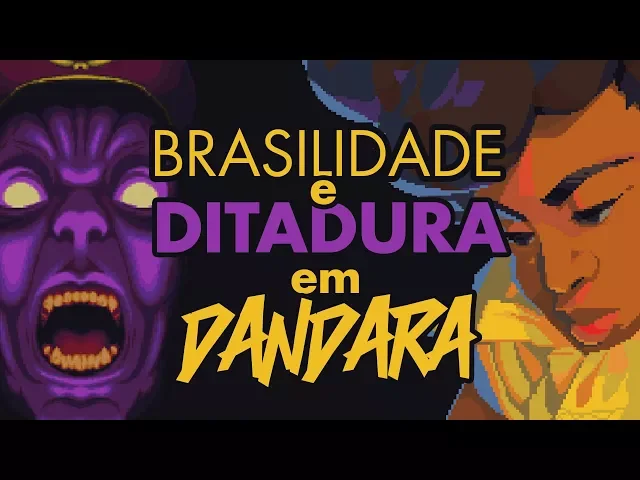
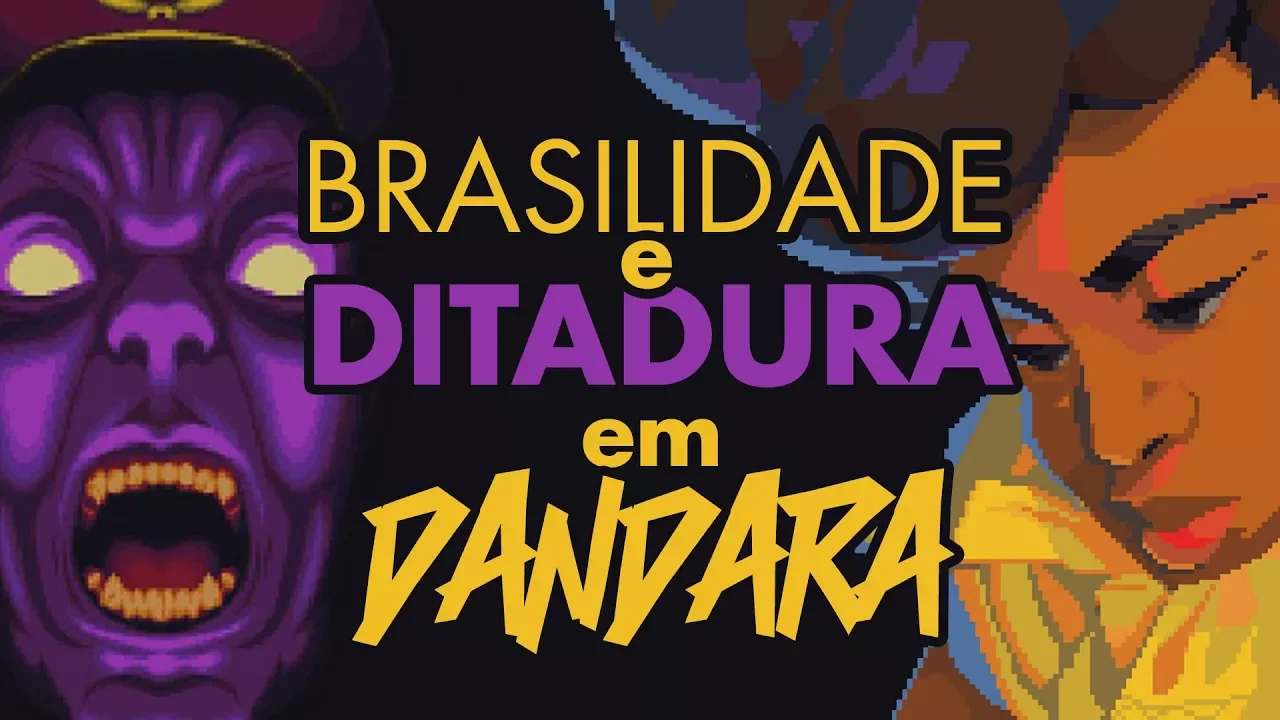
With increasing frequency we've seen Brazilian games That innovate in some way. Be it mechanics, in art, or in narrative. Dandara is one more for that select list of national titles That show a huge talent of our industry.
More than that, it avoids the pure replication of themes, Ideas, and aesthetics of American, European or Japanese games, To assume a strong Brazilian identity. That express a lot about our culture, history and traditions. Dandara was created by the "Mineiros" (people who are from the state of Minas Gerais) from Belo Horizonte: Lucas Mattos and João Brant.
From Long hat House studios. In partnership with musician Thommaz Kauffmann, and Artist Victor Leão. In it's base structure, the game is a traditional Metroidvania With some mechanics that were popularized by Dark Souls.
One of the things that makes it unique are the movement controls unprecedented to sidescrollers. That provides a new dynamic to explore scenarios. The movement is done by leaping on vertical, Horizontal, and even circular surfaces.
As long as they have this kind of. . .
. . .
Glue? Ultimately, if the surface is white you can jump and stick to it. It doesn't matter if it's a floor, ceiling or wall.
This kind of movement causes that from the beginning, Dandara can skip at high speeds through the settings. Leaping on surfaces in it's gravityless world. That completely changes the pace we're used to Explore games from this genre.
And that makes backtracking to me less frustrating. Since you can only get to a location that can only be accessed with a certain skill you don't already own, You can simply turn around so that you quickly reach other paths. Lucas and João understood so well the control system they've created that They've elaborated different kinds creative of challenges and puzzles based on it.
There are moving platforms that move or rotate due to the inertia caused by the shots, Logical enigmas that envolve route planning, And intense fighting sequences that seem to have come out more from a Shoot 'Em Up than a Platformer. But maybe what really stands out in Dandara, Especially for us Brazilians, Is your way of portraying some of the culture of our country. The first thing that we notice is that Salt - the fictional world where the game is set - Has similarities with Brazil.
That is very evident, especially in the beginning of the game. With the poor houses mixed with the crooked posts, kites, And the visual references from the Village of Artists, The first big area of the game. There we find street signs similar to the ones we have in Brazilian cities, Dump buckets, And some graffiti art including this cupcake, A reference to the work of Maria Raquel, That paints this character on the walls of Belo Horizonte.
We can also find a bar named "Garantido", With it's typical plastic or wooden tables and chairs from cheap bars. There are several cultural references in the names of each area That'll only be recognized by Brazilians or people from Belo Horizonte. Also, there's no way to not mention the character Tarsila, That makes an allusion to modernist artist Tarsila do Amaral and it's most famous work, "Abaporu".
Here, that reference seems to represent Long Hat House's own search for a language appropriate to Brazilian games. As was the Anthropophagic Movement for Brazilian Arts in the early 20th century, Degluting the influence that comes from outside the country, But without copying it directly. And of course, Dandara.
Inspired by Dandara dos Palmares. That was a Brazilian warrior that during the 17th century Fought alongside Zumbi dos Palmares against Brazil's slavery system. But instead of literally approach Dandara's history, The team at Long Hat House chose to focus on its more symbolic and universal aspects.
Like the search for freedom in an oppressive environment. And the game does that in literal and subjective ways at the same time. Literal because if you look in a purely concrete way, You have a simple story about a female hero overthrowing a totalitarian system.
But when we look close at these elements and try to identify what they represent, We have something with a higher degree of meaning, And way closer to our history. Well, here I'm going to express some of my personal interpretation of what I think Dandara is trying to tell us. And that involves to approach advanced sections of the game.
So here's a spoiler warning, ok? One way or another, Dandara seems to make it clear that it's world is More of a conceptual than a physical representation, That it's only a conscious artistic manifestation from the minds of its creators. Ok, let me explain it more clearly.
One of the first character you meet in the Village of Artists is Thommaz, That gives you the skill to move platforms with the power of music. Thommaz is the game's composer. Like, for real.
Pretty close to where you find him there's another character, Jonny B. , That is said responsible for the blockages that initially prevents Dandara from going through. He's the one who gives you a rocket for breaking those walls and allow you to progress.
Just like Thommaz, This character represents something more embracing. Take a look when he says he "creates rules". However, unlike the rules imposed by the oppressive forces in the game, His rules are.
. . fun.
Note that this character is also holding a Nintendo Switch, Which is one of the platforms that Dandara was released for. And he's in a room where you can spot a computer and. .
. . .
. Uh. .
. Megaman and Samus amiibos? Recalling that Super Metroid was one of the influences for the creators of Dandara.
Well, that this character is an allusion to a game designer with his talk about rules, I have no doubt about it. But is the game not blatantly saying that we're dealing its creators here? And that they have something to say?
Also, it's not only a coincidence that they're in the Village of Artists. And in game, the artists being targeted by the pursuit of this oppressive force. The first boss, Augustus, Who's basically a giant head of a military general.
Says clearly that the Village of Artists has to be forgotten. Historically speaking, artists are one the most oppressed classes by those who seek to take the power by force. After all, art leads us to reflect on reality.
Having as one of its purposes the denunciation of injustices and inequalities. It is no wonder that dictatorships impose censorship as a way of controlling how people think. Artists are treated as a threat by any form of totalitarian government.
And that seems to be what Dandara is trying to subtly tell us. And again, it's a game that it's approaching, even if indirectly, Something close to our reality. The military dictatorship in Brazil interdicted theaters, tortured and exiled artists.
Even in the present day, Where we have our freedom of expression guaranteed by democracy, We still see the same kind of violent reaction towards the artistic class. This allegory is made even more clear when we consider The Writer, That lives in a deep state of melancholy and hopelessness. To me, he represents the creative spirit, repressed and shut up by oppression.
And again, a symbol of art. At the end of the game, we invade the command center, Freeing enslaved people - it's worth pointing out - Until we reach the leader of this organization. That again, is more of a conceptual representation than a character in itself.
He appears to be a tycoon. That accumulates and shows off his wealth, And controls the media and information. Something that's quite obvious when you fight a boss that's basically a giant television?
Dandara defeats the oppressive force, And the Writer, now free, Overcomes his block and begins to write stories of freedom. I don't think anyone who plays Dandara will reach the same conclusion as me. Because it's a very subjective game.
But to me, it's an allegory to a fight against any form of oppresion. Especially those of minorities and artists. Dandara represents a manisfestation form against the totalitarian system.
And she's the one who brings back freedom of speech and creation. And there's no symbol stronger than this than a historical figure, Of extreme importance for the Brazilian black population, That dedicated its lives to fighting for the freedom of an enslaved people. If you enjoyed this kind of content Likes and Shares are much appreciated.
That helps us to reach more people that can potentially contribute to our crowdfunding campaign, Which is what keeps Overloadr alive. We also have many other videos that may interest you. So take a peek at our playlists.
Thanks for your attention and until next time.