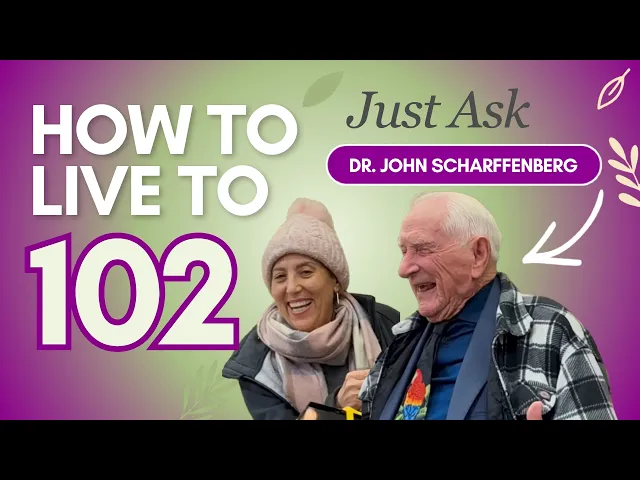
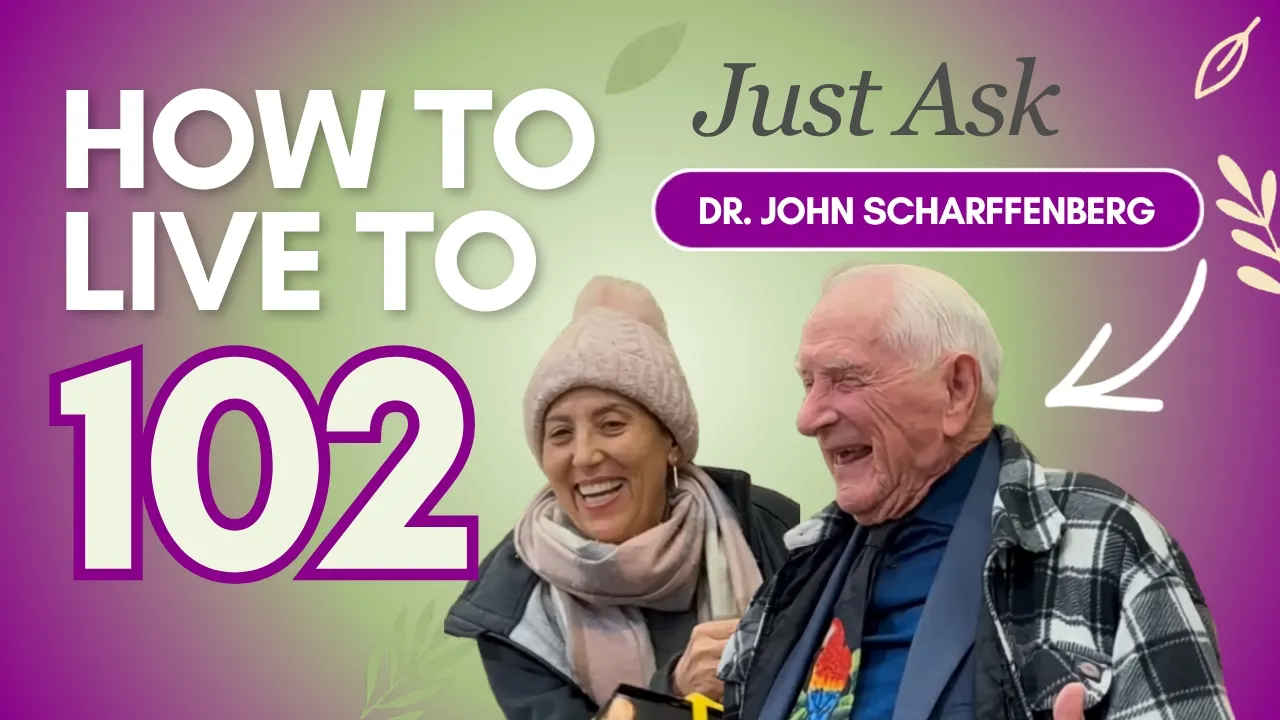
We have somebody on this piece of paper that has a robust YouTube channel that's asking you to be a guest. So, would you want to take this and fold it up and remember and keep it in your pocket? Okay. All right. So, today is almost 102nd birthday of Dr. John Scharffenberg. It's actually Tuesday. Everybody that asked me to get on TV says she's a friend of F Chef AJ. Yeah, I just >> say they're friends of hers. Right. I I gave him his start in the business on my channel. He has more views than anything
I got, but since then he's taken off and doesn't need me anymore. But, how many people here want Dr. John Scharffenberg to move back to this area? How many would like him to stay where he is? Boo. >> [laughter] >> We would love for you to move back cuz we miss you so much. It's been at least a year, I think, since we've seen you, hasn't it? Yeah. So, we're going to get questions from the audience, but why don't you just talk a little bit about, you know, your life, your work, and what it's like
to be 102? And I can hold the mic or you can hold it. Okay. This 102 business is very interesting. You know, every year I'm getting another year older. >> [laughter] >> And I've outlived my two older brothers that have already passed away 16 and 19 years. Wow. Wow. And every year it's getting one more. Well, how come what what's different about the way you lived your life than your two brothers? The main thing is exercise. I quit my job at Loma Linda teaching nutrition and found the best place to live in the mountains. Northfork.
3,800 ft elevation. And all forest. And I had to spend my spend my time in cutting down trees. I cleared two acres of land for garden. I had a cleared acreage for house and a path down to civilization again. You know, I had about the 26 acres. And back to the national forest. Stream ran the length of the property. Beautiful place. My garden was so good everybody came to look at it, you know. It was neat. And uh it wasn't my wife doing it, either. She was attending to the cooking inside. But, she didn't come
out and help me. I was doing it. And I was praying the sun would set later so I could work longer. Now, that's a little unusual, but I wanted to work longer to keep going. I exercised. I wanted to, but it wasn't cuz I just wanted to. I had to. I had to get fuel for my house. To heat the house. I had three sheds full of wood. I did it all by hand until I got to be 80. And I thought it's time to get a wood splitter. >> [laughter] >> And that helped a
lot. But, still it's a lot of work. It still is a lot of work. So, that cutting the wood kept me in good shape. One year I planted 3,000 strawberry plants. People said, "What do you do with all those strawberries?" I said, "Everybody likes strawberries." You give strawberries to people, you got the meeting out of your hands. >> [laughter] >> They'll do anything you say. So, so strawberries went over real well. Uh my grapes have been the longest lasting thing. We made over 100 quarts of grape juice this last year. I had one row of
grapes, Concord. And better than the grape juice you buy in the store. Tastes better. And I don't know what's better about it, but tastes better. Uh so, I I did gardening. I'm promoting exercise as being important. But, the time of your life when you exercise is very important. Mid-age. That's when people let down. They get more money. They exercise less. They eat more food. They have the money to buy it. They get fat. 50% of our population is overweight or obese. And the kids, particularly, are obese. Little kids. That means later on as adults they're
going to most of them are going to be overweight. So, that is a big problem. And our hypertension is still up there. The the the plant food tends to lower blood pressure. Animal food tends to raise blood pressure. So, scientifically we've got good evidence for what we're talking about, vegetarian diet. We have good evidence for this scientifically. My only question is why does it take so long for the governments to start promoting it? In 1915, as the government usually does, Department of Agriculture, Department of Health, get together, get top-notch scientists to look over and tell
people what they should do nutritionally. Every time it changes cuz they do it every five or six years. And this time the group said, "Tell everybody the vegetarian diet is the way to go." Well, that recommendation came to the Department of Health top man, Department of Agriculture health man. They said, "This is too strict. We can't recommend this." So, they said, "Plus a little lean meat." But, the scientist didn't say that. Scientist wanted a strict vegetarian diet, which to me was kind of exciting that they all said this. The evidence is strong. So, if we
have time to spend with people about the science, we can show it to them scientifically what we know. And uh we haven't had the time to do it. And then you have all this fad stuff and crazy stuff coming on TV. It's the all the same, saying different things. And then you have to knock knock on things that are being said. And you waste time spending all your time knocking what's being said, which is not true, instead of spending your time teaching the truth. And I used to spend all my time telling people what's wrong
that that they're hearing. It's a waste of time. We should spend our time telling the people the truth. What is good that they should know and not spend all our time trying to say something that's bad that you're they're hearing. >> [laughter] >> Okay. All right. So, we have some If you have questions Oh, yeah. Back in 1923, nobody nobody Nobody back then. 23, you were born in 23? Yeah, that's insane. But, okay. That means that you must have met people in the '20s when you were young and maybe even in the '30s that were
in the Civil War. No. >> Do you remember anybody? From 1860 No, 1864. I don't remember any of those. That's only But, I I'll tell you. 60 years before you were born. You know, there was a Chinese girl that did an hour and 17 minutes of me. She had a man from Mountain View doing the picturing, taking the picture. Michelle, we invited her. Yes. And the man who works with with her, he's so good. He got all the people who said, "You ought to do this or you ought to eat that or you ought to
eat that." He got all their things and looked to see how long they lived. And all their recommendations and [laughter] nobody seemed to get any older because of what they were recommending. It's a very good talk that he gives on this. Yeah, the Needle Longevity website. Needle Longevity YouTube. Yeah. Any anyway, I'm excited what we do know and we're we're trying to figure out now. Harvard's trying to do this. Trying to figure out the whole group of people who have certain biochemical signs that are good. They live longer. But, there's about 11% of them that
have those good signs aren't living longer because they are living well. If they all have the good habits, they'd all live [clears throat] longer, too. See, but they aren't. So, we're getting more and more good scientific information uh as we go on. But, yes. Hi, happy birthday. Thank you for having us. Um I have a family history of Alzheimer's disease. She has a family history of Alzheimer's disease. >> Yes, I would like to know how do you keep the brain healthy, sharp, and how Any advice? How do you keep the brain healthy and sharp? Scharffenberg?
>> [laughter] >> Well, you know, Alzheimer's disease, the thing we know for sure scientifically is that it's related to the same factors of heart attack factors. Okay? So, the people who have less heart attack should have less Alzheimer's. Who is that? Well, Seventh-day Adventists, vegetarians, for example. They have less heart attack. They have less Alzheimer's. Two small studies show that. But, so what are those factors? We now know that there are seven risk factors, lifestyle factors, that if you avoid this, you can lower your heart attack rate 80%. You can lower your risk of type
2 diabetes 88%. You can lower your risk of first-time stroke 80%. There's no medicine that can do that good. This is lifestyle. We have the evidence in favor of lifestyle, but our problem is how to get people to live that. And that has to do not eating between meals. We When I was a little kid, even in public [clears throat] school, they taught kids not to eat between meals. Not now. They're feeding them in between meals. >> [laughter] >> That's the way to go. So, I think that is one big thing. Exercise is important. And
we've been saying it for the kids, but we haven't been doing it for the adults well enough. We need to do that. Get people exercise. I think I'm a nutritionist, but exercise I think is even more important than what we eat. I think all of it is important, but I think exercise is probably the most important thing. That's what Jack LaLanne said. He said exercise is king, nutrition is queen, and together we get the king of the kingdom. How old was he when he died? I believe he was 97 or 98. >> Is that right?
You outlived Jack. He should have lived a little bit better. He could have lived longer. >> [laughter] >> His wife is still alive and almost 100, Elaine LaLanne. She spoke at your Adventist church at Hilltop once. Yes. Yeah. Is alcohol health-promoting? Alcohol is bad, and everybody's been arguing about that. They used to say one drink a day for men or for women, and two for men is probably okay. But, then there was this university professor up in Seattle who did a big study, the biggest ever, in 195 different countries of the world. Paid for by
the man who had his health right behind it. Who's the wealthy man? Bill Gates. And that? Bill Gates, that's right. He paid for this study, and uh the man who did the study was a social drinker. He didn't drink a lot, but he drank socially. But, his study came down and proved how much is safe to drink without any problem. It's zero. The answer was zero. Any little bit you take increases your chance of dying from something in excess, you know? So, he's reviewing his whole lifestyle now because of this, which is kind of exciting.
So, alcohol we we should rule out. Now, cigarettes Yeah, they're good, right? >> [laughter] >> In our country, the Adventists have done a good job of stopping the cigarette business. In the church, you don't find Adventists who smoke. You find the occasional one that drinks alcohol. So, we haven't done as good with the alcohol business, but we know these seven risk factors is extremely important. You should know what they are. It's tobacco, alcohol, lack of exercise. Okay? And eating too much, getting overweight, is a big problem. And then, too much meat and sugar. That's six.
That's six. So, yeah, that's six. The seventh one? Marriage? Well, you know, marriage has seemed to do pretty well. You You need to be born right. If you're born a woman, you'll live longer than if you're born a man. Now, that's a surprise. And they've studied it well without any answer to why. >> [laughter] >> They don't know why, but the women live longer than men. More men are born than women, but the women live longer than the men. They thought it might have been the estrogens or this that. They've done all these studies, and
they haven't been able to show why that's so. I have a question. Why is it that many people have given up smoking and alcohol, but it seems like most of America still is struggling with their weight. Why is that? Weight is harder to control. It's It's a very exciting how what this eating business is hard to control. And snacking. They've shown that if you stop the snacking, most people will get their weight back to normal without doing anything else. Just stop eating between meals. But, we've never done enough on it. We used to, years ago,
teach that public school, but not any longer. They aren't teaching it because nobody's doing it. But, that's true. We should get people back to that point of not eating between meals. Do you think that it has anything to do with the UPS, ultra-processed foods that are made to be so alluring that, you know, we see them and just like this? Yeah, I I I don't think we've got the answer yet at all. They've tried. All these different books written by the different people. This is what you need to do. That's what you need to do.
And none of it's really worked out. Those people didn't live longer even when they did did those things. So, we don't really have it figured out yet why. But, I think there's enough in nutrition that we do know that we should do. I think vegetarian is is good evidence for that. The animal factor raises blood pressure. The veg plant foods tend to lower blood pressure. That's important. Weight control, same thing. Eating between meals increases overweight. So, these common things that we know that we are not practicing. Probably stop drinking your calories. A lot of people
drinking sodas and stuff, right? So. He's saying a lot of people drink their calories, like in the form of soda. That's right. I You know, the nutritionists have come to the point where they're not recommending juices, even fruit juice. Because orange juice increases the [clears throat] risk of diabetes. Whole orange decreases the risk. You're getting too many calories when you get the juice. So, we got to get back to food in the natural state so far as possible. There's a question. What do you eat in a typical day? Now, what do I eat? Well, the
first thing is how many times do I eat? Twice. And generally it's two. Two times a day. Remember the Bible? And Elijah was worried. He was despondent. He He was under the tree there, and he wasn't eating, and God sent the crows to feed him twice a day. Only twice a day. What is that kind of interesting? But, I understood the Israelites at one time were on a program of only eating twice a day. You see? So, we now have people, dieticians in the United States, that are saying eat but twice a day. Don't eat
anything after 2:00 in the afternoon. Nothing after >> Well, that means no cake for anyone today. So, anyway, how about ketosis? Remember some of these kids who are little kids who have problems with hyperactivity and everything, they put some of these kids on on a low carbohydrate diet. And add coconut oil. And they get into ketosis. They do that for a while till they're under control, and then they take them off of it. So, if you're on two meals a day, not eating supper, there's enough time lag there so that at the end you are
in a ketosis state, a little bit. Uh so, if the ketosis then does any good, that's the way to do it. But don't do like all the physical specialists are doing, telling everybody eat lots of protein. So, you can uh get your ketosis like you should. You shouldn't cuz that's causing difficulty. But if there are people who are skipping breakfast, two meals a day they're on. It's the wrong two meals. They're dying sooner. The people who skip the supper are the ones that are living longer, not the ones who skip breakfast. Uh so, we got
to get that straightened out in people's minds. Do you ever get hungry at night though and feel like I need to eat [clears throat] a little something? What do you do then? Do I ever get sleepy at night? No, she [laughter] said hungry. No, she said hungry. Hungry, do I get hungry? >> [clears throat] >> With my age, I've discovered I I've been a promoter of two meals a day for years, but I discovered that I can't eat that much in those two meals to do what I need, to get what I need. I'm hungry
more often. But we have good evidence that eating more often is not good. Uh two meals a day is ideal, but they should be skipping the supper, not skipping the breakfast. So, what do you do if you get hungry later in the day? Do you just drink tea >> If you're hungry, we know what to tell them. Drink a glass of water. >> [clears throat] [laughter] >> That's what we dietitians always say, "Drink a glass of water." >> [clears throat] >> Uh yes. What are your thoughts on what are periodic extended fasts of maybe multiple
days? >> What do you think about extended medically supervised water-only fasting like they do at the True North Health Center, for example? Yeah. Now, we know that fasting is good for 3 days. Beyond 3 days, the fasting deteriorates your immunity system. They don't work as well, but fasting up to 3 days is fine. Fine. But not longer. So, I'm not really for this 40-day fasting business. I'm not really for So, like once a quarter, like a couple days once a quarter or something go fasting or Oh, well, now now I fast a third of every
day. I do, too. >> [laughter] >> You skip your third meal, you're fasting. Intermittent fasting. But in the US, you're in California. There were dietitians that really promoted this idea, don't eat after 2:00 p.m. So, it's it's better to do it that way rather than skipping the breakfast. Can you also talk a little bit about sleep? What do you think about sleep and what is the best window for sleep? Yeah, sleep is important. And we have uh some health specialists have said uh that our sleep before midnight is worth 2 hours after midnight. So, I
I think going to bed early is the way to go. Well, you have to cuz you're so down hungry. >> [laughter] >> I know, we put our kids on two meals a day growing up, you know. [clears throat] And the neighbors said they turned us in to the food police. A- anyhow, uh they were never hungry. It's a habit. It's a habit. Our kids would go out with other kids and pick cherries in the cherry tree. They all have a bag to put their cherries in, you know. Most kids, every other cherry goes into the
mouth. My kids were used to eating >> [laughter] >> in between meals. They never thought about eating. It wasn't time to eat. And we find out that overweight people are controlled more by what they see. They took rooms, had the clocks go 1 hour too fast or 1 hour too slow, and put overweight and normal weight into the different room, and they discovered that the overweight people are controlled by the clock. If it says it's time to eat, they think they're hungry, whereas the the normal people don't. My stomach doesn't say it's time to eat
yet. Or >> [clears throat] >> you will walk by the donut shop on your way to work, and the donut comes out and talks to you. It says, "Now, you always get your donut when you go by here. >> [laughter] >> It's here. It's ready. Come get it." And so, you go get it. And but what you got to do is plan another way to go to work. In fact, don't have any coins in your pocket to put in the slot machine to get the in-between meal snack. Uh But this is going to be hard
to try to get a a population to change any eating between meals. I mean, food companies want to sell their food. They want to make bigger boxes of breakfast cereal, bigger box. Everything bigger. If you buy this company's, you get more for your money. And it's not the way to go. So, it's going to be hard to change some of these habits. Somebody had a question? Um this is actually something I've really struggled with, like this whole idea of longer in between times cuz I would get really hungry, and and sometimes at night I wouldn't
be able to sleep, you know, if I had like get hungry, I wouldn't be able to sleep. And I've been struggling with it now. Would this tie in with like I mean, Dr. Fuhrman talks about if you have trouble with the fasting is because you're going into detox. >> [clears throat] >> Okay, so do do you want to come up and ask it yourself? Just so that I get a Yeah, would you mind coming just cuz it's a longer question? And And while she's coming up, you mentioned you only eat twice a day, but you
actually didn't say what you eat at those two meals. >> [clears throat] >> Well, I'm heavy on fruits. According to the Bible, in the Garden of Eden, before sin, vegetables weren't a part of the diet. It was fruits and seeds, not vegetables. I used to argue with a colleague of mine. He said this was better than the fruits. And but according to the Bible, vegetables weren't a part of the diet. That they were a part of the animals' food. Genesis 1:20-29. And they were a part of the animal diet. And then after sin, some of
that was given to the humans to eat, and not just animals. So, we stole some of the animals' food. Uh Now, it's very interesting in the Bible, Genesis 9:3-5. After the flood, there was no food growing right away. So, God forbade the people to have clean meats, not the bacon, but clean meats. But even those were not to have the fat or the blood. They were to be kosher. According to the Bible. Now, that's kind of exciting because the the the Jewish people today, now you know more about this than I would. Oh yeah, I
do. But But the Jewish people today, the Jewish people, say we don't have enough kosher butchers. So, they're recommending their people go to the total vegetarian diet. Which is kind [laughter] of exciting because they don't have enough butchers to get kosher food. It So, it is kind of exciting. Uh So, so what is a typical breakfast and a typical lunch, and what are the times you eat those? Okay. So, you should eat in the morning, and I'm for this idea of skipping supper, but I say don't eat after 2:00. Now, Gary Fraser, who did the
Adventist Health Study work, he says 3:00. >> [laughter] >> I say 2:00, and I think most people are saying 2:00. Don't eat after 2:00. So, you only have time for two meals. You don't have time for three in there. So, it comes naturally. It's not something you have have to push just to say don't eat after 2:00. And then I think exercise is also extremely important. What What is your lunch? What is your breakfast? And what is your exercise look like today without the wood splitter? Well, I I like fruits. I eat a lot of
food. I had mangoes here today. So, I like fruits. I like grains more than vegetables. So, what [clears throat] did you have for breakfast? So, for breakfast? Uh-huh. Granola is a good thing. >> Granola, you have it with >> I my homemade granola. If you buy it from the store, they have 20% sugar to it. We don't have to add sugar in granola. So, I like granola and fruit on top. What do you put in your granola? Well, there's all different kinds you could do, but almost any whole grain would be fine. Yeah. Do you
put some other liquid in or something when you bake the granola? Do you bake it? Yes, you bake it. So, I think granola is a good food, but you can get other things in the natural state. Like maybe oatmeal or oat groats? >> Oatmeal, oat groats. I always look on the box to make sure there's no more than 5 g a teaspoon uh 5 g of sugar per serving. But, I saw a few that had less than that, but had a lot of salt. >> [laughter] >> Is salt a Is salt a big deal? You
know, salt is a big deal, but not big enough for anybody to want to do it. Get rid of it entirely. See? You You can get people to cut down. Cutting down is not doing the trick. You've got to get it way way down to a third of what people are eating. Otherwise, it's not going to do you any good. So, the public health people in general have said let's just forget about salt. They know it works. If you don't have the salt, you know it works. Blood pressure comes down. The Amazon people down there
in the Amazon basin don't use hardly any salt. They don't have any hypertension. So, we know it works. But, you have to cut down enough. Well, you can make laws that they don't put so much in the bread. If they got down to where it should be, it won't taste so good that nobody's going to buy it and they're going to go out of business. That's the problem. So, it's a commercial thing. Selling something. Uh but it will work if you can get people to do it. But, you have to make everything from scratch in
the kitchen. And that's what people don't want to do anymore. Now, every man should know that his wife when she goes in the kitchen, she goes there to put in sugar, salt, oil, all the things that they don't need to put in. That's what cooking is called. >> [laughter] >> And they should know that. That's what cooking means. So, food in the natural state without all those extra things like that is the way to go. But, a lot of people are too tired to try to fix it that way. And they make all these processed
foods, things that have this oil, sugar, salt added. Uh so, it's get It's hard to get people back to that natural state. And the public health people in general in their mind have given up on the salt issue. They know it will work if they can get lower but they don't see how they can get it lower now. You have a question? Okay. So, So, this idea of having two meals a day, you can hear me okay? Okay. I've really struggled with, right? Cuz I get too hungry. Now, I've read different things like Dr. McDougall,
I think even encouraged grazing. Dr. Furman talks about making sure you have time to digest, you know, you have the breaks. And but Dr. Furman mentioned that maybe if you're having too much trouble, it's because you're you're going into detox. Your body's using that time to detox. This kind of makes sense. But, I need to figure out how to get through that, right? I mean, maybe it's just persisting or did you have to work gradually into having two meals a day or how did you go about that? >> You know, I've never had any problem
with being hungry or having my kids hungry. I've never had that problem. It's habit. It's habit. And the way we study these habits is by taking twins. Divide them up where they're adopted into different families. One in >> [clears throat] >> low salt family, high salt families. You know, I see. And we find out that this taste for salt is something that's learned. We're teaching our kids to eat this way. And that's what we got to avoid. Uh so, it's not a matter of hunger. People aren't getting hungry. It's more a matter of habits and
addictions, probably, right? What's that? Sure. Having more habits and addictions. It is It's habit. You get into It's habit. So, if you decide you're going to change your habit or you want to, is there a strategy that helps you change your habits? Well, you should know it takes about 28 days to change change a habit. You work hard at it, you get rid of the H. But, the A B is still there. You work hard at it some more, you get rid of the A, the B is still there. You work hard, you get rid
of the B, the N is still there. >> [laughter] >> So, you keep track of like I really ate now it's the A, now it's the B, now So, it takes a while to get this habit changed, get used to it. And I just raised my own kids. I saw them on this two meal a day thing. Picking cherries. They didn't put any other one in their mouth. It wasn't time to eat. Uh I'll bet your wife was a lot happier with you because she was only preparing two meals. I I tell you, it is
nice for the woman in the house. It's easier not to not to have that extra meal to to to worry about. Yeah, that's right. It's easier. So, you said breakfast is fruit and grain, but you didn't tell us what you normally eat for lunch. >> [clears throat] >> Well, you know, potatoes are still a good food. But, here's the thing. When the scientists are talking about vegetables, eat more vegetables, they don't mean potatoes. Potatoes have a high glycemic index. It's [clears throat] like ice cream. >> [laughter] >> Pushes your blood sugar up, you know? And
so, there's a lot of people post potatoes. Now, let's face on the British people doing studies in Canada. But, every time they do a study, the glycemic index number comes out different. So, I'm not sold on their their belief in this business of being bad, the glycemic index. They It It It depends on what else is in the menu menu. It depends on the whole food thing. So, I'm still for potatoes. Uh I grew up in China. We ate rice. And I came home and I said, I like rice better than I do potato. But,
the other day I reassessed it and I said, I'm back to potatoes. But, I grew up on rice, you know, the brown rice. And uh So, you eat a lot of potatoes at lunch? Uh Or I think potatoes are a good meal. There's so many ways you can fix them. So many different ways you can fix potatoes. But, uh I was in a restaurant the other day and I had a dish I liked very much. So, I went back there and I said, I remember the dish had country potatoes in it. She said, every one
of our dishes that has potatoes has country potatoes. >> [laughter] >> They were one of the most popular restaurants there is in town. Uh but uh Potatoes, you can fix a lot of different ways. All be helpful. But, what do we do? You go in the kitchen, you peel the potatoes. Then you slice them up fine. You cook them, bake them, make chips, sell them for 10 times the price. >> [laughter] >> And people like Put all the salt on it. You see, going the wrong way entirely. We're losing 70% of our potassium because of
doing that. The The peel is good. Some restaurants serve you a plate of just peeling, potato peelings. So, that's that's a good food. Don't throw it out. Uh What's the greatest invention or technological advance you've seen in the last 102 years? >> [clears throat] >> Technological advance? Eating between meals more. >> [laughter] >> I mean, that's habit. It's considered normal and it isn't normal. Uh so, we need to get back to the old-time system. Not eating between meals. I think that's number one. How many presidents did you vote for? How many presidents? Well, I was
in China where we didn't get to vote. I still remember Hoover. We voted for Hoover, Republican. And we thought so glad he got in. Well, he wasn't that good a president by the way. [clears throat] Uh But uh >> [clears throat] >> We voted for Dewey. He lost, remember? Yeah. I wasn't there, but I heard about it. Yeah, I thought Dewey was going to get in. I was surprised. So, you can't always go by how your friends feel. [clears throat] Uh So, you you talked about food and exercise and avoided risky substances like tobacco and
alcohol. What about social connectivity? Is that important to a healthy, robust, long life? We tell people weight control programs that you've got to change your habits. You've got to change your friends. Your social life has to say you've got to get more people who are the size you want to be >> [laughter] >> that eating properly as your friends rather than the fat people as your friends. So, you do have to make some changes in your social life. Uh But I mean, how important is friendship and connectivity just in general? Oh, it's a very very
important, very important. Now, you need to know about how to live to be 102. Uh longevity. Uh that's getting to be question I'm asked all the time now more than I used to be more than I used to be. How do you live this long? If you're born a woman, you'll live longer than if you're born a man. There are more boys are born than girls, but they die faster. Because they're married to women. Yeah, that's right. >> [laughter] >> But it's highly interesting. They studied this very well. With no answers to why it is.
>> [laughter] >> So, we don't know why. Uh now, my family I would say with you that a sense of humor extends your life a lot. Yeah. Yeah. Yeah. I think having hope, having prospect of doing something worthwhile, all that is important. The goals in life and things like that are very important. Uh but gender, then these cardiovascular risk factors, those seven habits, those extremely important. Exercise, I'd [clears throat] say is one of the best. And you know, when the Heart Association said cut down on the meat, sugar, the scientists, so many of them said
this is too much. The administration said this is too much to ask the people to do. So, they changed it. Said eat more fruits and vegetables. That doesn't tell people [snorts] anything much. Okay. Uh So, they're still worried about the cholesterol problem. So, they brought in a new recommendation. Cut down on saturated fats. No more than 5 to 6% of your calories should be from saturated fat. Well, I usually give people a chart that shows where the saturated fat is. Where is it? Animal fat and tropical oils. That's where it is. A lot of people
say coconut oil, health food, food. It isn't. Gary Fraser says of the islands in the Pacific islands where they eat lots of coconut oil, the ones that use the most has more heart attack, more diabetes, more hypertension. And now, I was going to Doug Batchelor's church here. Here. Yeah. You know, and he he's a Jewish man. And it's kind of interesting. He lived in a cave as a nudist for many years out beyond Palm Springs. He started walking into the city once and forgot he hadn't put on any clothes. >> [laughter] >> But uh Somebody
had left the Bible in the cave. He read the Bible and became a Christian. It [laughter] was amazing. And and he'd go into the Sabbath school meetings and and and do a lesson study on the Bible teacher would ask a question, nobody would open their mouth to say anything. And he'd give them the answer. He knew all the answers. Doug Batchelor was very sharp. And uh Uh What was I going to say? But I might be I got off on the story. The lady here has a question, but she can't Yeah. I just wanted to
point out Dr. Sharfenberg does not wear glasses. Is what? Dr. Sharfenberg does not wear glasses. Is what? Uh what? Do you do you wear glasses? I don't get Glasses. It's um Eyeglasses. That's because I had cataracts. Had them removed surgically and put in a 20/20 lens. So, it wasn't anything habit that did that. I did the same thing and here are my glasses. Yeah. Yeah. Well, there are other things you could have. Uh That that would might make you want to still have a glass. I didn't have to have any. When I had my cataracts
out, I threw my glasses away. I didn't need them anymore. But you could have astigmatism, all kinds of other things that you might still have to have glasses. You mentioned that married men live longer. Are you looking to marry again? For what? For what? Are you looking to get married again cuz you said married men live longer. >> [laughter] >> My son's wife died in February. I'm sorry. And he said he couldn't understand why I didn't get married again. I said I'm married to disease. I said what age person should I marry? Somebody same age?
They're all dead. >> [laughter] >> So, maybe you can have you can have all the single women in the room raise their hands. Uh So, anyway, uh a lot of these older people, I just saw one a wedding taking place over in China. This man's wife had died. He was 58 years of age and he was going to marry this girl of 28 or something. >> [snorts] [laughter] >> So, no, I think the age shouldn't be you know, 50 years difference is too much. >> [laughter] [clears throat] >> So, I told my son I I
didn't want to inherit marry a disease again. And most older people have disease. Disease starts in young people and kids. A lot of us don't know that. I I have a friend, a lady, a pediatrician, and she got me interested in that subject. And we have what we call ACES. You know what ACES is? Adverse childhood experience. Adverse childhood experience. Somebody in the family's been in jail. Somebody's been mentally ill. There's about 10 of these. If you have six of them, you might shorten your life just like smoking. 20 years. So, >> [clears throat] >>
what what the the Dell people have just done, donating six and a quarter billion dollars to kids. Is it the right way to go? But they need to add to it. You need to have good people uh to help these kids so that they know to get their exercise, useful, out in the woods, nature, and help them to go in the right direction. Uh But they're addicted to their phones. Like what do you think of Facebook and Instagram and that kind of thing? What's that? That's the right answer. >> [laughter] >> That's the right I
mean, cuz you were saying you want to get kids out in the woods to exercise, but most kids today are glued to their phones and they're scrolling. >> That's true. That's true. And uh Neil Nedley at Weimar gave a talk on what's happening in this society since we started getting all these phones. And we deteriorated. You know, we deteriorated. And uh we didn't say cause and effect, but you got to think about it. >> [clears throat] >> We think there is a cause of this causing a problem. Uh Now, for example, homeschooling. I have some
neighbors. Grandchildren. My grandchildren. With a great round of kids, and they were home-schooled. But now they're getting up in years, 15, he's 6'1, and they decided he needed some help. So, over in Oakhurst, they have a a little school that started to help those who are trying to do home training. And so, he was put in that school. Well, they put him in the the easiest math course, he did it snap. So, they ended up putting him in highest math score class. He aced it. He's having to school in mathematics. >> [laughter] >> And he
hasn't had any formal schooling. Yeah, it's it's just the way you are in your home, the way you talk every day, what you read every day, has something to do with your ability to prosper in educationally. And uh you go into a classroom, 30 kids in the classroom, the teacher has 5 minutes with you. >> [laughter] >> And [clears throat] I home-schooled my kids when you were weren't allowed to. >> [laughter] >> They were threatening to tell the police to put us in jail. But uh I home-schooled my kids. They did very well. They never
had to have a spelling class. They read good literature. And when they learned typing, they learned to spell naturally. They didn't have to have a course in it. When they should have had 6 years of spelling, I tested my daughter, she knew how to spell. I didn't have to have a class in spelling. So, some things just come naturally like that. We brought up our kids on uh about 3 hours every morning, and that was their school. The first thing they did, memorize a Bible text. Next day, two texts in the chapter. Next day, three.
They memorized all of John, all of Revelation. >> [laughter] >> It's just one book after another. It's amazing what they were able to do. And then it came time to reading. My wife had to do a little bit education, phonics, teaching the reading. Once they learned how to read, mathematics, you just give them the textbook. They read it and do it. You don't have to do anything. And [clears throat] so, these kids uh did real well. Now, the truant officer came to our door one day, and our daughter was taking care of a little baby.
She was pretty tall. She came to the door with a baby in her hands. And the truant officer said, "Do you know of two kids in the family here who aren't going to school?" She never thought about herself and her brother. And they didn't think of it either. Here's this girl taking care of this little child. And so, they did very well in their schooling. Uh and she my boy got to be a doctor, married a nurse, my daughter became a nurse, married a doctor. >> [laughter] >> And they were well educated. And yet, I
think of all that background education, it wasn't hard, it wasn't a long time, all day at school. So, I think we could learn how to make education quite a bit easier. What brings you the greatest joy in your life? >> [clears throat] >> I think one of my greatest joys was seeing my daughter pleading [clears throat] to to go to the last grade of high school, and we finally let her go, but they wouldn't let her graduate just because she hadn't been to other schools. They did tell us that if a high school would graduate
her, we'd graduate her. So, I went to the high school, they said, "We would graduate her." They still wouldn't graduate her. So, she was a good seamstress. She made her own graduation dress and all that, wasn't able to graduate officially. [laughter] Uh so, it was disappointing from that standpoint, but she was sharp. She took pre-nursing, and the class the dietitian who was teaching the nursing course would get a hard question, she wouldn't have an answer to it. She'd ask my daughter, "Eloise, what's the answer to this?" Eloise would give her the answer. >> [laughter] >>
So, she was sharp, she was able to do it well with easy training. Wasn't hard at all. Uh but what gives you the greatest joy today, and what do you have to look forward to? What do you want to do with the rest of your life? That's what I'm trying to figure out. >> [laughter] >> But but you know, you do have to have a goal. You got to have something you want to accomplish. I think that's extremely important everybody's living. And uh I I usually have something like that. What's your goal? Well, I made
a goal. I went to the church, and I'm lined up for 26 vestry talks an hour Wow. >> each Saturday evening. Vestry talks. >> And this is the church where you live. Mhm. The church where you live. Uh well, it's our way. Yeah. But I'm just saying if somebody wanted to come. >> way. Yeah, yeah. And anyway, uh And it's [clears throat] interesting how with our different backgrounds, we talk about different things that people are excited about cuz they hadn't heard that before. All these kids coming out like see from the school, all of the
same kind of background, same kind of training, talking the same language all the time. Our kids, all from the self-supporting school, all come from different backgrounds. They talk about different things when they get together. It's not the same old thing. So, uh it's it's worthwhile to have different educational systems. And I think what the country is doing in going from the federal government down to the state level is a a good start in that if I think that's a good start. Do you want to open your presents? >> What's that? Do you want to open
your presents? Open what? Your birthday presents. Oh, my birthday present. Yes, your birthday present. Well, I said I didn't want to open it, but the husband said I had to open it. So, I'll open it. It says 102 right there. They're telling everybody how old I am. Ooh, that's a fancy card. Well, what is in here? Oh. [clears throat] You said it's You You said it's good to have green. >> Look at that. Wow. I can't wait till I'm 102. >> Look at that. I just couldn't believe it. Wow. What are you going to do
with all that cash? I'll hold it for you, don't worry. Yeah. Well, there's more presents on the table. I thought there was something else in here, but it There's also a cake, but in closing, what words of wisdom or advice could you give to those of us young'uns so that we can live a long, healthy, prosperous, meaningful life like you? Well, I think there's a couple of things. One, you got to have a goal, you got to have want to do something and get something accomplished. That's important. But I think you got to exercise. At
mid age, age in mid age is 40 to 70. Mid age, you got to exercise. Okay? And I say useful exercise. I had a Chinese couple living in Australia. They came to see us. And I wanted to know whether they could walk around the hills with us at our home to see some of the beautiful scenery we had. There was a house built around a rock. I wanted them to see that, looking out at the waterfalls and things. Oh, yes, we have a tennis court right in our yard. We play tennis every day. So, we
started out. I was up front with her husband, and and in the back was our child, a little girl, and the wife. And we hadn't gone very far on this up and down stuff, when I heard the little girl say to the mother, "Mom, this is no tennis court. Tell them you're pooped." >> [laughter] >> And it is quite different working in the garden, working on uneven ground, uh rather than tennis court. Mhm. It's quite different. And I think being out there in the orchard doing gardening. We planted 80 fruit trees, 3,000 strawberry plants. Uh,
we had 100 jars of grape juice quarts of grape juice this year. Delicious, better than Concord grape, better than what you bought in the store. I don't know why, but it was tastier. Uh, so we did something worthwhile. I learned how to We were I was away at prayer meeting on Wednesday night. Came home and what my wife had sold the house we were in. A whole trailer site, you know, the whole She had sold it. >> [laughter] >> She said, "We got to have a house." And so we went to the builder, the builders.
My wife says, uh, Yeah, we start building. How much money you have? Well, she said, "I got $10,000." He said, "Uh, the build one room." >> [laughter] >> But I still remember bending all those nails. I'm learning how to use that hammer and that kind of thing. And what old old man, Beaver, was helping us. Volunteering his time. He was real old. He was 75. >> [laughter] >> And he said, "I felt something thumping in my abdomen." I said, "Lay down here. I want to feel it." He had a aorta ready to pop. I said,
"You aren't working today. You're seeing the doctor right now." And he did have it fixed. It saved him 10 years of his life. He could live 10 years longer than he would have had he he been still working. Uh, but it's important to exercise useful exercise. Get something out of it. Grow [clears throat] the strawberries so you have something to eat. But here we're building a house. That's worthwhile. Uh, I think we should have useful exercise. You have a question? We have one more question before we bring out the cake. What in your life are
you most proud of? Well, you know, if I wanted to ask the Lord to give me the training I need to do to do health education, I wouldn't have done anything different than what the Lord gave me. Everything I did fit that exactly. Here I was >> [clears throat] >> went to Harvard, got my MPH, Master of Public Health, in health education. I know it wasn't in health education. I started in health education. And the lady who was head of the department at the first lecture, and you know what she said? She said, I asked
her a question, two scientific viewpoints, opposing viewpoints. Which one does the health educator use? She said the one that's most commonly used. I said, "Then the Earth is still flat." And and the next day she came suggested I change departments. So I became a nutritionist nutritionist instead of a health educator. Okay? Well, here we have a vegan gluten-free cake for you, chocolate of course, and we like to take this opportunity to wish you Happy birthday to you. Happy birthday to [singing] you. Happy birthday, dear Johnny. >> [laughter] >> Happy birthday [singing] to you. We couldn't
They didn't allow candles for this many years without contacting the fire department. All right, thank you everybody. Let's eat cake. >> I can tell by what people call me when they knew me. John Alfred. John Alfred. It used to be two names together. And Johnny. And >> you eat the strawberries. What's that? We'll let you eat the strawberries. I call you Sharfy. All right. Yeah, she she got