Imagine the water flowing from the tap over the sink suddenly stops. You no longer hear the familiar sound. Not a single drop.
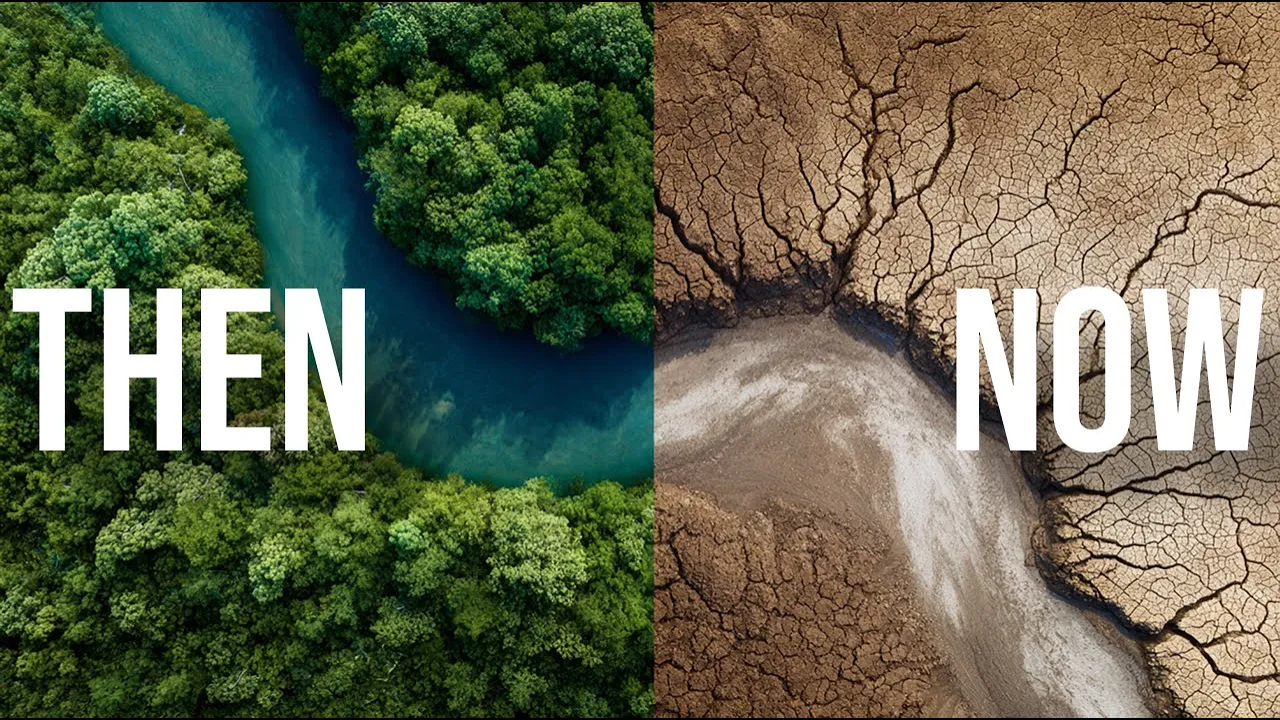
You run out to the river and see only the cracked bottom stretching to the horizon. Fish are still floundering between the cracks trying to catch their breath. But there is no [music] water.
Yesterday the surface glistened. Children were swimming here. Boats sailed.
But today, there is dead silence and the smell of dry clay. The river that fed cities and millions of people disappeared overnight. A fiction, a horror story for those who do not save water, or just a bad dream.
But this is not a fantasy. This nightmare is already breathing down our necks. Every year, the world's freshwater reserves are decreasing.
[music] And one of the most important rivers in the United States, the Colorado River, is on the brink of disaster. What would happen if it dried up not in decades, but in just one day? Who would feel the impact first?
Farmers, metropolises, or the ecosystem? And can people survive without a river that vanished right before their eyes? You'll learn this and much more in today's video.
What if we lose the Colorado River in a day? In spring, the snow caps of the Rocky Mountains melt and flow down in clear streams. They are joined by cold underground springs.
Many small streams merge into one, gaining strength quickly. From this thin mountain stream, a giant river is born. Over 1,450 miles long.
It flows through seven US states and a patch of Mexico. At the end of its journey, it dissolves into the warm waters of the Gulf of California in the Pacific Ocean. Some people listening to all this may think, "So what?
It seems like an ordinary river. " America has longer rivers. For example, the Missouri, which stretches for 2341 mi.
There are deeper ones, the mysterious Hudson, reaching a depth of 202 feet in some parts, or the Mississippi, a giant in terms of water volume, feeding [music] almost half the country. But the Colorado River is a record holder of a different kind. It is the most overloaded river in America, and it reaches its bed in Mexico almost on its last breath.
Just a tiny bit of water gets there because it gives away almost everything along the way. And that's not just a figure of speech. This river flows through the driest states and more than 40 million people use its resources.
In fact, virtually 1 in 10 Americans use water from the Colorado River. It supplies water to Los Angeles, Las Vegas, and Phoenix. It makes millions of hectares of fields green in the middle of the desert.
The Colorado River irrigates over 5. 5 million acres of farmland, including important winter vegetable growing regions. These are areas of California and Arizona where broccoli, onions, carrots, green leafy vegetables, and much more are grown.
Without them, American supermarkets would look much more modest, well, or more expensive. It was the Colorado River that carved a giant scar into the rocks like a sculptor, the Grand Canyon. It is one of the most impressive natural attractions on the planet.
[music] Visited by about 5 million tourists a year, Colorado has 15 large dams, including Hoover Dam and Glen Canyon Dam. Five of them supply electricity to millions of people. But the Colorado River feeds not only humans.
Its waters create habitats for hundreds of species of birds, fish, and plants. But all of this could disappear very soon. But wait, why do we even assume that it will be gone soon?
Since the 2000s, the Colorado River basin has been experiencing a mega drought. The [music] river is thinning and drying up. It is like a live artery that is being drained of its strength every day.
And there are reasons for this. The first one is climate. A century ago, the peaks of the Rocky Mountains looked like sparkling white domes of snow.
They fed the river in spring and summer. Today, these caps have become [music] thin and fragile. They do not reach their former lush volume and melt too quickly.
The Colorado River receives less water from melting snow than it used to. Then there's the heat. The scorching sun sucks the last drops of moisture out of the ground and out of the reservoirs themselves.
The heat absorbs stagnated water even more eagerly. Scientist Jack Schmidt of the Utah State University estimates that nearly 1. 9 million acre feet of water evaporate each year.
That's 13% of the total annual flow. [music] To grasp the scale, imagine a third of Loch Ness disappearing into thin air before your eyes or 936,000 Olympic swimming pools simply vanishing. These are colossal losses.
The second reason is hidden, almost invisible. Farms and businesses compensate for the water shortage by tapping into underground reserves. Thousands of straws hidden from [music] view go into the ground and suck the base out of the river.
These underground sources feed the Colorado River. The more pumps hum, the faster the riverbed runs dry. On the surface, everything is legal.
A deep well 100 m from the bank and the water goes directly to the landowner. On paper, it is their property and the laws often allow drilling and pumping near rivers. But the problem is that these pockets of groundwater feed the river itself and they are rapidly emptying.
Satellites have shown that over 20 years almost 28 million acre feet have been pumped out. That's as much as the country's largest reservoir, Lake Meade, can hold. That water could be enough for 84 million families in the US for a whole year.
Can you imagine the scale? The third reason is population growth. There are more and more people in the region.
Cities are growing. Farms are expanding. Everyone needs access to the river's resources.
Another factor is that the water distribution regulations were written 100 years ago and have remained virtually unchanged and no one wants to give up their share. Why? Because every change is a battle of interests between states, land owners, and farming associations.
As a result, the waters of the Colorado River are distributed according to old quotas as if the world had not changed. The river is thinning, drying up, and becoming shallower. This process is slow.
Year after year, there is less and less water in the Colorado River. It is melting like ice under the scorching sun. But one day, if nothing changes, we may wake up to find that the inevitable has happened.
Day one. The Colorado River has vanished. Where the water was rushing yesterday, there is now an empty riverbed.
In some parts, puddles still glisten with fish flapping with their tails, desperately gasping for air. Frogs, [music] turtles, and river insects flounder in the mud, unable to comprehend where their home has gone. With the first rays of the sun, the moisture [music] begins to evaporate.
By noon, most of the riverbed has turned into a dry, cracked desert. The first to disappear are the fish, unique species that have adapted to this river over millions of years. The humpback chub, which lived in the warm, fast flowing currents of the Grand Canyon.
Razerback sucker, whose habitat was the lower reaches. [music] The Colorado pike minnow, a large fish nearly a meter long, also disappears. It seems that of all the fauna, only birds and wild predators are delighted by the river's disappearance.
Now they don't have to make any effort to find prey. Hundreds of seagulls and [music] crows descend to the riverbed. Bears and coyotes emerge from the thicket.
The fish lie on the bottom. All they have to do is go and grab it. But the feast will only last a few days.
Then there will be emptiness. The animals will leave, abandoning the dead riverbed in search of drinking water. Nature will literally die before our eyes, as if someone had turned off the life of an entire ecosystem with a single press of a button.
And yet, paradoxically, while the river is dying, people hardly notice anything strange on the first day. A family of farmers from Yuma would wake up and eat breakfast. Then they would go out on the porch and turn on the pump.
water would flow smoothly from the irrigation canal. Later, they would return to the house, turn on the TV, and learn from the news that the Colorado River no longer exists. The farmers would chuckle.
The journalists must be exaggerating as usual, and continue to water their crops. In Phoenix, a family of financiers would drink their morning coffee, take long showers, and water the flowers on the balcony. Social media feeds are full of captions.
The Colorado River has disappeared. But most people take it as fake news or a strange prank. This day won't be any different from those when the Colorado River was full.
Water still flows from the taps in people's homes. Why? Because the giant reservoirs Lake Powell and Lake [music] Meade can hold up to 60 cubic kilm of water or 15.
8 trillion gallons. That's enough to supply California with water for almost a year and a half. These reserves create a dangerous illusion of security.
It seems as if everything is under control. But in reality, the disaster is just about to begin. Week one.
The fish swell in the sun and burst. The smell of rot rises into the air. Unbearable even to the most resistant.
It spreads for hundreds of feet, forcing people to hastily pack their belongings and leave. Those who remain close their windows and doors tightly, but echoes of dead water seep through the cracks. Scavengers are already circling above the shore.
Cathart's aura vultures, crows, and black vultures. Their stomachs contain acid that dissolves dangerous and deadly toxins. In a dry riverbed, there are still puddles glistening with moisture and rotting organic matter.
Mosquitoes don't need a whole body of water. These swamps are enough for them. Millions of larvae will hatch at once, and they'll be joined by swarms of flies.
A real insect invasion commences. Their buzzing fills the air for miles around. Meanwhile, migratory flocks are still flying overhead.
They do not yet know that the river has dried up. and all they're going to find is thirst instead of water. 17 million birds fly across the Colorado River Delta in the spring and 14 million in the fall.
They've known this route for thousands of years now. More than 350 species are endangered. Blue gross beaks, western kingirds, and yellowbuild cuckoo will fly here expecting rest and nesting grounds, but will only face the threat of death.
The flora is suffering. Nearby trees are starting to lose ground. Yellow spots are appearing on the leaves of Populus Vermonte.
Their roots used to reach for groundwater, but now the soil is almost empty. In Yuma, the family notices that the water pressure in the hose is weaker, so they have to water longer, but the ground still remains dry. The news of the river's disappearance sounded like a horror story, but now it is becoming part of the routine.
They try to live as before, but there is a lot of anxiety in the air. In Phoenix, stress becomes perceptible. In the evening, the family goes to market and sees a huge crowd.
People nervously grab everything in sight. Their carts are full and there is little food on the shelves. Cues stretch across the entire hall.
Some people are swearing and panicking, while others are just silently clutching bags of vegetables as if they were gold. The numbers on the price tags are rising higher every day. Tomatoes, which cost $2 a week ago, now cost $10.
Cucumbers and lettuce, are the first to go. Yuma and the Imperial Valley, which are fed by the Colorado River, provide up to 90% of the country's winter vegetables. And people understand that without it, these green fields will turn to dust and their usual diet could change in a matter of weeks.
One month, the Colorado Riverbed is becoming unrecognizable. Where remnants of puddles glistened not long ago, there is now cracked ground. The marshes and floodplane forests are dry, and blades of grass break at the slightest touch.
Even the smell of death has disappeared. The remains of fish have long been pecked away by birds and scavenged by insects. Flies and mosquitoes have also flown away because they can't survive without moisture.
For migratory birds, this is a disaster. Their routes are disrupted and mortality rates skyrocket. The American aviset, a fragile bird with long legs and [music] a curved beak, is particularly vulnerable.
For centuries, this species has relied on salt lakes and shallow backwaters for food. Insects, crustaceans, and small animals. These were also the places where avisets [music] nested and raised their nestlings, protecting them from predators.
When the river disappeared, so did their home, a direct path to a decline in the species population. Where sedges and cattails once grew green, only sunscorched stocks remain. The ecosystems of the Sienna de Santa Clara wetland and the hearty river are turning into dusty wastelands.
The plants that have retained moisture and provided shelter for birds for centuries are disappearing along with the water. Without the Colorado River's replenishment, Lake Me's water level drops so low that the river's giant hydroelectric turbines stall. The country loses 4,200 megawatts of energy.
That was enough to light the homes of 5 million people for a whole year. But that's just the beginning. The remaining water will quickly evaporate under the sun, exposing layers of dust at the bottom of the reservoir that may contain heavy metals.
Soon, the wind will pick up this toxic powder and spread it for tens of kilome. People are in a state of panic. Water is only available on a strict schedule.
In Yuma, the family of farmers are losing almost their entire harvest and with it their income. In the evening, they sit in the kitchen and for the first time seriously discusses moving like thousands of other residents. In Phoenix, water is only available for a few hours a day.
The family here rushes to buy plastic tanks, fill them to the brim, and install them along walls and in garages. Now, every decision about water is a dilemma. Use 4 gall for a 10-minute shower or save it for laundry.
Water usage rules are becoming stricter everywhere. A student living in a dormatory complains. 3 minutes for a shower.
We set a timer on our cell phones. Hope is still alive, but along with it comes a growing fear that the better days are over. A year.
Colorado has disappeared completely. The Colorado Delta in Mexico has turned into a salt marsh. Life once bustled here.
Migratory birds, fishermen, human air. Now the sun reflects off salt crystals, blinding the eyes, and the wind carries the bitter taste of dust. The climate throughout the southwestern United States has become harsher.
Heat waves last for weeks with temperatures rising to record highs. Summer is no longer what it used to be. It is like a trial that becomes more difficult with each passing day.
Migratory birds, which have depended on Colorado for centuries, are disappearing from these places. Those who have been able to adapt are changing their routes. Some are heading to California's central valley.
Others are stopping at small lakes and reservoirs. But it's a game of survival. Many species cannot withstand the journey.
The emptiness in the sky is becoming as noticeable as the silence with a river used to be. Scientists are hurrying with experiments. They're trying to desalinate water, drill deeper, and search for new technologies.
Rainwater harvesting remains the best way to obtain moisture. In the Rocky Mountains of Colorado, rainfall is still abundant in some places, more than 60 in per year. Life can be sustained there, but further south, it's different.
On average, along the basin, there's only 6. 5 in, and further south, only 4 in of rain. And in Yuma, only 3 in per year.
The authorities are passing new laws. Tanks are appearing on the roofs of houses to collect every drop. People are being told to save water, count gallons, and ration water for each day.
But even then, there is only enough for domestic needs, and only in the most frugal families. Yuma is becoming deserted. A family of farmers closes their house and moves to Minnesota.
There are many similar arrivals here. Because of this, housing prices in the state have risen. Until recently, renting a house here would have cost $1,800 a month.
Now, it is much more expensive, about 3,000. Their farm, once green and bustling, now resembles a scene from a post-apocalyptic movie. Dr land, dead canals, fences leading nowhere.
They're trying to sell the land, but there are no buyers. Financiers from Phoenix are packing their boxes. Their company's city branch is closing.
Their life here depends on imported water. They live in the dust and heat, counting every gallon. The city has empty swimming pools, turned off fountains, enclosed eeries and hotels.
Food is brought in from other states, and prices are rising every week. A new threat is looming over the city. Dust storms.
The wind carries tons of sand and salt which settle directly on the streets in apartments and on the glass facades of skyscrapers. People are suffocating in the gray haze. The city is emptying as if it is taking its last breath.
Phoenix, once shining in the desert, is now slowly turning into a mirage. Hospitals are overflowing. Thousands of people are suffering from heat stroke.
Children are suffocating from asthma. The staff complains. Every second person in the emergency room is dehydrated, but there is barely enough water for the hospital's needs.
The city is melting away along with hope. 5 years. The southwestern United States has become a completely different world.
On the map, the region now looks like a huge scorched patch. Silence, once rare in this area, is now permanent. There are few migratory birds.
Their routes [music] have almost disappeared along with the river. The branches of trees where nests once hung are empty. Even coyotes and pumas have moved further into the mountains in search of water.
Desert species, rattlesnakes, lizards fight for their lives, but their numbers have dwindled significantly. The wind blows dust and instead of the smell of grass, only dry heat and salt can be smelled. With the disappearance of water, the energy sector has collapsed.
Hydroelectric power plants on the Colorado River have shut down. Some cities are forced to rely on expensive gas and coal, filling the air with smoke and fumes. Solar panels are slowly spreading across rooftops, but it's not enough.
The lights flicker and go out. Electricity has become a luxury with prices rising every month. Las Vegas [music] no longer shines.
Countless casinos stand empty. Hotels are closed [music] and the streets are deserted. The neon lights are out.
And the city, once the entertainment capital of the world, appears to be turning [music] into a ghost town. Yuma has disappeared completely. The earth has cracked like old leather and no longer knows the smell of harvest.
Phoenix is still holding on, but the city is no longer a metropolis. It's almost impossible to live here only to survive. Water and electricity are supplied irregularly.
If it hasn't rained, people travel dozens of kilome for a few water containers. Ice has become almost a symbol of luxury. It is sold in bags for $15.
Pharmacies are running out of supplies. Everything related to asthma and respiratory health disappears from the shelves within hours after delivery. Yuma is turning into the Sahara.
Heat, dust, and desolation rain here. But the disappearance of the Colorado River has also spelled disaster for other places. All states that used to be fed by the river have been hit hard.
People are losing their homes, jobs, and normal lives. Millions are becoming climate refugees, fleeing north to cooler and more humid areas. Changes are sweeping across America.
Labor markets are overheating. Where there were plenty of jobs not long ago, there are now lines of migrants. Competition is growing and wages [music] are dropping.
Housing is soaring in price. Homes that used [music] to cost hundreds of thousands are now selling for millions. The North is taking in refugees, but it feels like the cities are tearing at the seams.
The US is losing not only people, but also food. 5 1/2 million acres of fertile land are turning into a dead crust. 90% of winter vegetables are disappearing.
Their supply is now fully dependent on Mexico and South America. With the shutdown of hydroelectric power plants that supplied millions with electricity, there is now a shortage of power. Even more cities are turning on old gas and coal plants.
And the air is becoming heavier and thicker. It feels like the smoke, soot, and CO2 are not only above Arizona and Nevada, but above the entire country. The world is also feeling the changes.
Prices for vegetables, fruits, and grains are surging. Not only because of increased American imports, but also because of a chain reaction in the markets. Suppliers are cutting back on exports to other countries.
Volatility is hitting the stock market. Inflation expectations are rising and central banks are raising interest rates. Even those far from parched Colorado feel its shadow in their grocery bills and in the fluctuations of global financial markets.
Meanwhile, global warming is accelerating and everyone has to pay the price. The family from Yuma lives in Minnesota. They built a small farm from scratch with their savings, but their income is barely enough to cover their basic needs.
Their memories of Yuma are still alive. The father of the family often opens old photos of the farm on his smartphone where everything is green and shows them to his grown children. This was our home.
The family from Phoenix moved to Denver. Their income allows them to rent an apartment in a new neighborhood. But even here, they are used to keeping water supplies in the house and garage, a habit that has become a reflex.
But wait, can we somehow prevent this? Yes, we are already spending billions to keep the river alive, but if the states fail to agree among themselves, the price will be much higher. The entire region risks turning into a new Sahara.
The federal government has allocated $4 billion to support Colorado. The funds will compensate farmers for reducing irrigation, upgrade canals and delivery networks, and aid cities that cut their water use. Los Angeles is building a $3 billion facility that turns waste water into drinking water.
Carl'sbad already has the largest desalination plant in the US, [music] producing 50 million gallons per day, enough to supply a city of 400,000 people. Nevada has gone even further. It is the first state in the country to completely ban the use of water from Colorado to irrigate decorative lawns.
Las Vegas has paid more than $300 million to residents to remove their grass and replace it with zeroscape. This is a type of landscaping with desert plants, rocks, and gravel that doesn't require watering. But this is still not enough.
We need to stop flooding desert fields and encourage farmers to grow less [music] water inensive crops. Instead of a hose turned on full blast, drip irrigation should be used. This is a method where every drop of water goes directly to the roots of the plants.
Another important step is to store purified water in underground reservoirs. There the water hardly evaporates and can be stored for years. It is also necessary to refrain [music] from building new dams and agricultural projects.
They could take another 400,000 acre feet from the river. That's 197,000 Olympic swimming pools full of water. There is no miracle cure for a drying river.
You can't build one plant or come up with one law and expect a miracle. But if we join forces, there is a chance that the Colorado River [music] will survive. It will determine whether the entire region stays alive or whether one day there will be a blank spot on the map of the United States where the Great River now flows.