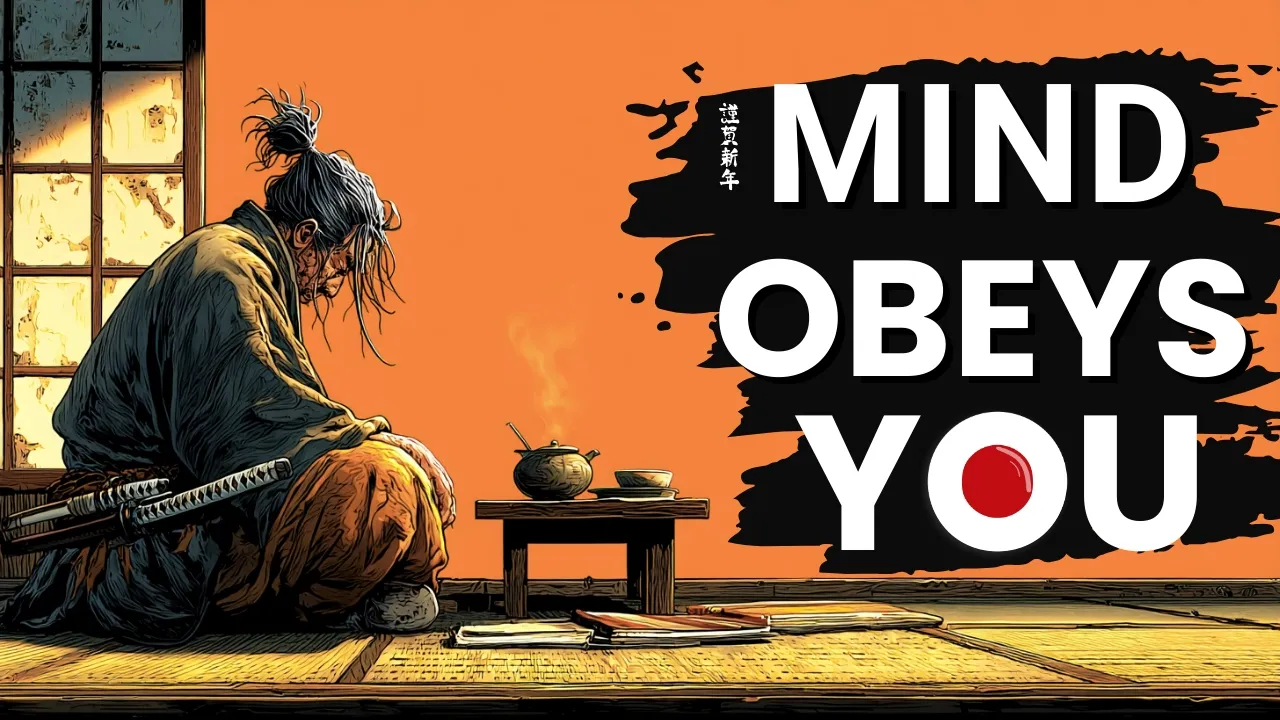
There's a level of mental discipline that makes internal chaos impossible. And today, you'll discover how a 16th-century samurai, who trained his mind like a warrior trains his body, [music] developed a system that eliminates internal rebellion. Have you ever noticed how some people's minds just work with them?
They decide to [music] focus, they focus. They decide to wake up early, they wake up. They decide to stop a bad habit, it stops.
No negotiation. No internal argument. No willpower struggle.
Their mind simply works with what they decide. While everyone else is at war with themselves, while everyone else's mind sabotages their decisions, these people have a different relationship with their own consciousness. And you know what most people think?
They're just naturally disciplined. They have iron willpower. Their mind works differently from mine.
But what if I told you that your mind's chaos isn't permanent? What if the reason your mind resists you isn't that it's broken, but because you've never trained it to align with your decisions? Miyamoto Musashi trained his mind with systematic discipline.
He could decide to act without fear, and fear would diminish. He could decide to focus for hours, and distractions would disappear. He could decide to act, and hesitation [music] would dissolve.
And before he died, he wrote down the exact [music] training system he used to develop complete mental discipline. He called it Kokoro no Shikai, mastery of the heart-mind. And once you understand how it works, your mind will align with your decisions like a trained warrior aligns with a master.
But there's a catch. This training will require you to do something most people refuse. Treat your mind as something separate that must be [music] trained.
Not something you are. Before I show you exactly how this works, subscribe to the channel, like the video below, and comment on how your mind resists you most: [music] procrastination, distraction, fear, doubt. This really helps the channel reach more people, and I love reading and interacting with all of you.
Now, let's begin. Chapter 1: The Awakening. [music] Harima Province, Japan, 1600.
Miyamoto Musashi was 16 when he discovered something terrifying. His mind was his greatest obstacle. >> [music] >> You'd think killing your first opponent at 13 would make you fearless, right?
Wrong. Musashi had won three duels by age 16. His sword technique, [music] exceptional.
His body, trained daily since childhood. His strategy, years beyond his age. But during his fourth duel, something happened [music] that changed everything.
The opponent charged. Musashi's body knew exactly what to do. He'd practiced this counter a thousand times.
His stance was perfect. His grip was correct. His timing was precise.
So, why did he freeze? For 3 seconds, three eternal seconds, his mind went to war with itself. What if his blade is faster?
What if this is the duel where you die? What if you make one mistake [music] and everything ends here? The thoughts came like a flood.
His body was screaming, "Move! " But his mind had hijacked the response. He won.
Barely. His superior technique carried him through, but those 3 seconds haunted him. Because here's what Musashi understood that most warriors didn't.
>> [music] >> In a death match, 3 seconds of mental paralysis equals death. That night, sitting alone in the darkness, Musashi asked himself a question that would define his entire life. I've spent 6 years training my body to respond.
Why have I spent zero hours training my mind. Think about that. Six years of brutal physical discipline, perfect sword cutter, endless endurance training, strategic studies, but his mind completely wild, untrained, chaotic.
And the scariest part? His mind didn't just resist during duels. It resisted him constantly.
He decide to wake at dawn, his mind said, "Sleep more. " And he'd follow his mind. He decide to practice a difficult kata, his mind said, >> [music] >> "This is boring.
" And he'd quit. He decide to skip the sake, his mind said, "Just one cup. " And he'd drink.
Every single day. His mind overruled his decisions. Most 16-year-olds would just accept this.
That's how minds work. Everyone struggles with this. But Musashi wasn't most 16-year-olds.
He made a decision that night that seems obvious now, but was revolutionary then. I will train my mind the same way I trained my body, through systematic discipline, until it responds instantly to my decisions. Why didn't anyone else think of this?
Because most people don't even realize they're not aligned with their own minds. They think they are their mind. So, they have no leverage to change it.
Musashi saw the truth. >> [music] >> You are not your mind. You are the decision-maker.
Your mind is the tool. And tools must be trained to respond. Chapter two, the principle, >> [music] >> Kokoro no shihai.
The next month, Musashi did something strange. He stopped training in sword technique completely. His training partners thought he'd gone insane.
Musashi, there's a tournament next month. Why are you just sitting there? But Musashi wasn't just sitting.
He was studying. What was he studying? His own mind.
He started tracking every moment his mind resisted him like a researcher documenting a wild animal's behavior. Morning. Decision to wake at dawn.
Mind's response: Five more minutes. Result: Musashi obeyed his mind, not his decision. Midday.
Decision to practice kata for 1 hour. Mind's response: This is pointless. Think about girls instead.
Result: Musashi obeyed his mind, not his decision. Evening. Decision to skip the sweet rice cakes.
Mind's response: Just one won't hurt. Result: Musashi obeyed his mind, not his decision. After 30 days of this documentation, Musashi saw the pattern with crystal clarity.
He wasn't in alignment with his mind. His mind was operating independently. And here's the truly disturbing part.
This meant he wasn't really making decisions [music] at all. His mind was making decisions, and he was just following along like a passive observer. You know what's crazy?
Most people live their entire lives like this and never even notice. So, Musashi developed a system. He called it Kokoro no Shikai, mastery of the heart mind.
The core principle was simple but radical. Treat your mind as a separate entity [music] that must be trained, not as something you are. He wrote in his journal, "The undisciplined mind is like a wild horse.
It will throw you, injure you, and take you nowhere you want to go. But a trained horse, it goes where you direct, stops when you direct, responds to the slightest pressure. " But here's the question that stopped him.
How do you actually train a mind? You can see when a horse is trained. You can measure when a body gets stronger.
But the mind, it's invisible. How do you even know if it's working? Musashi realized the same way you train anything.
Through progressive challenge, consistent reinforcement, and removing resistance pathways. Simple in theory, brutal in practice. Chapter 3, progressive commands.
Week 1, the smallest possible victory. Musashi started with something so small it felt ridiculous. Command, sit completely still for 5 minutes.
That's it. Just sit. Don't move.
Sounds easy, right? Try it right now. Seriously.
Set a timer for 5 minutes and sit without moving. What happens? Within 60 seconds, your mind starts screaming.
This is pointless. You should be doing something productive. Your leg itches.
You need to adjust your position. This is so boring. Why are you wasting time?
That's exactly what happened to Musashi. But, here's where he did something different. Instead of obeying his mind's complaints, he gave a direct command.
No. We're sitting for 5 minutes. That's the direct.
You will obey. His mind rebelled harder. The itch on his leg became unbearable.
His back started hurting. Thoughts flooded his consciousness about how stupid this was. But, Musashi held the direct.
5 minutes. When time was up, he acknowledged it. Good.
The mind obeyed. Next day, sit still for 10 minutes. His mind knew what was coming and rebelled before he even sat down.
Not this again. This doesn't make you a better swordsman. This is a waste of time.
Musashi's response, we're sitting. 10 minutes. Obey.
And here's what started happening slowly, gradually. After about a week, the relationship shifted. His mind started learning, "Oh, the master's directs aren't negotiable.
Resistance is [music] futile. " Week two, increasing the stakes. Commands got harder.
"Focus on reading this text for 20 minutes. No wandering [music] thoughts. Practice this kata 50 times with complete concentration.
Meditate for 30 minutes without moving a muscle. " Each time his mind tried to resist, [music] Musashi enforced the direct. And if he failed, if he let his mind win, he disciplined himself by repeating the task 10 times.
"Fail to meditate for 30 minutes? Okay. Now meditate for 30 minutes 10 times in a row.
" Sounds harsh, right? But here's what Musashi discovered. His mind learned [music] basic mathematics.
One immediate responsiveness equals less suffering than [music] one disresponsiveness plus 10 repetitions. Within 3 weeks, his mind started obeying on the first direct. Week three, [music] real-life application.
This is where it got interesting. Musashi started applying the same principle [music] to everything. "Wake up at dawn.
No negotiation. " His mind would say, "Just 5 more minutes. " Old Musashi would have obeyed his mind.
New Musashi? No. We're getting up now.
And if he delayed even once, >> [music] >> he'd practice immediate waking 10 times. "Stand up. Lie down.
Stand up. Lie down. " 10 repetitions.
You know what happened after doing that torture once? His mind never made him do it again. The alarm would sound, and his body would move before his mind could [music] even generate the 5 more minutes thought.
The responsiveness became automatic. Chapter four, cutting escape routes. Month two.
When willpower isn't enough. Musashi discovered something that almost [music] broke his entire system. He'd direct, "No sake tonight.
" And for the first hour, his mind would obey. But then, around evening, his mind would launch a massive counterattack. "Just one cup.
You've been training so hard. You deserve it. One cup won't hurt.
Warriors drink [music] sake. This is normal. You're being too rigid.
" And here's the problem. Sake was sitting in his room, right there, three steps away. The escape path was visible, easy, tempting.
And Musashi found himself walking those three steps, >> [music] >> pouring the cup, drinking. Command failed. But why?
He'd successfully trained immediate responsiveness in other areas. What was different? Then he realized, his mind obeys when there's no visible escape route.
But when escape is easy, the mind will find it. This led him to develop sen, the principle of cutting off escape. He threw away all the sake in his room.
Every bottle, [music] gone. Now, the escape path looked like this. Walk to village, 20 minutes.
Buy sake, money plus social interaction. Carry it back, 20 minutes. Pour it, drink it.
That path required way more effort than just obeying the original directive, "No sake. " His mind did the calculation and chose responsiveness. Musashi started applying sen everywhere.
Want to train every morning? Lay out training clothes the night before. Set alarm across the room so you have to stand up to turn it off.
Tell your training partner you'll meet him at dawn. Now, backing out means social humiliation. Escape path now requires disappointing someone plus finding clothes, plus resetting alarm.
Way easier to just train. Want to focus during practice? Practice in isolated location with zero distracting objects around.
Escape path now requires stopping practice, walking back, retrieving distraction. Way easier [music] to just focus. Do you see the brilliance here?
Musashi wasn't relying on willpower, he was making responsiveness the path of least resistance. Chapter five, immediate obedience. Month three, the gap where resistance lives.
Musashi noticed something subtle but critical. His mind had started obeying directions, but not immediately. [music] He'd direct, "Start kata practice now.
" His mind would obey in five minutes or 10 minutes or right after this thought finishes. He was getting responsiveness, just delayed responsiveness. And that delay?
[music] That's where resistance lives. Because in that five-minute gap, >> [music] >> his mind had time to generate counterarguments. Maybe we should practice a different kata.
Actually, we should eat first. Let's do it in an hour when we have more energy. By the time five minutes passed, the original direct had been negotiated down to something completely different.
Musashi realized, "Between direct and action, [music] there must be no gap. " He implemented a new rule, three-second responsiveness. Command given.
Action starts within three seconds, not five seconds, not in a minute. Three seconds. If his body hadn't moved by count three, discipline.
Repeat the action 10 times. Example, begin kata. One, two, three.
If he's not mid-movement by [music] three, do the entire kata 10 times as punishment. His mind learned this lesson exactly once. After doing a complex kata 10 times because he hesitated, >> [music] >> his mind never made that mistake again.
Within 2 weeks, the gap disappeared entirely. [music] Command instant action. No negotiation period.
No space for resistance to enter. Chapter six, unified mind. Month four, the civil war inside.
>> [music] >> Musashi thought he'd solved it. His mind was obeying. Commands were instant.
Escape routes were cut. But then he discovered a deeper problem. Sometimes his mind obeyed perfectly.
Other times, even with all his training, [music] he'd struggle. What was the difference? Then he saw it, internal division.
Part of him wanted to become the greatest swordsman, warrior self. Part of him wanted comfort and ease, lazy self. When these two parts were of equal strength, whichever was louder in that moment would win.
And Musashi couldn't control which was stronger. It was like directing an army where half the soldiers were secretly working for the enemy. The solution, establish absolute hierarchy.
Musashi created his personal hierarchy of values. Mastery, highest [music] priority. Life, truth, honor, comfort, lowest priority.
[music] He didn't just write this down. He memorized it, made it law, non-negotiable. Now, when his mind said sleep more, comfort, and his decision was >> [music] >> train now, mastery, there was no internal battle.
Mastery was definitionally more important than comfort. The hierarchy decided instantly. No debate, no civil war, no competing desires of equal weight.
The internal division dissolved. And when the mind is unified, responsiveness becomes [music] natural. Chapter 7, the complete transformation.
One year later, Musashi's training partners noticed something had changed. "You're different. " one said.
"You're like I don't know. A machine? You just decide and do.
No hesitation, no struggle. Don't you fight with yourself like the rest of us? " Musashi smiled.
"I used to. Every single day, I was at war with my own mind. " "What changed?
" "I stopped fighting my mind. I started training my mind. There's a massive difference.
" And it was true. After 1 year of systematic training, Musashi's mind had become completely responsive. [music] Not sometimes, always.
Not eventually, immediately. Not with struggle, naturally. He'd wake when he decided.
No negotiation. He'd focus when he trained. Zero distraction.
He'd act when he chose. Instant execution. He'd endure when required.
No complaint. The five principles had worked. One, master-servant relationship.
Established himself as master, mind as tool. Two, progressive forging. Started small, built capacity gradually.
Three, Sen, cutting. Escape. >> [music] >> Removed disresponsiveness paths before directing.
Four, Sokushin, immediate obedience. Eliminated all gaps where resistance could enter. Five, unified mind created value hierarchy that ended internal division.
Chapter 8, the truth about mental obedience. Here's what most people never understand. [music] Your mind's disresponsiveness isn't permanent.
It's trained. Every single time your mind responds to you, and you accept it, you're running a training [music] session. You're teaching your mind, disresponsiveness is okay.
Commands are optional. And every time your mind resists, S, and you enforce the direct anyway, you're also running a training session. You're teaching, >> [music] >> disresponsiveness has consequences.
Commands are mandatory. Think about it. By age 30, most people have run tens of thousands of training sessions, [music] S, teaching their mind that disresponsiveness works.
No wonder their minds don't listen. Musashi ran tens of thousands of training sessions teaching the opposite. That's why his mind became perfectly responsive.
Not genetics, not talent, not mystical warrior spirit. Training. Pure, systematic training.
He saw every moment as a training session. Alarm rings. Are we training responsiveness or disresponsiveness right now?
Impulse to quit. Are we training responsiveness or disresponsiveness right now? >> [music] >> Decision to act.
Are we training responsiveness or disresponsiveness right now? After 50 years of choosing responsiveness in every training [music] session, Musashi's mind was completely trained. He fought over 60 duels, never lost.
Why? Not because his technique was always superior, but because his mind never, ever betrayed [music] him. When other warriors minds screamed with fear, Musashi's mind obeyed his direct, feel no fear.
When other warriors minds froze with doubt, Musashi's mind obeyed his direct, execute now. When other warriors minds created hesitation, Musashi's mind obeyed his direct, act. That's the power of a trained mind.
The warrior's truth. At age 60, Musashi wrote the Book of Five Rings. In it, [music] he included this passage.
I have trained in the way of strategy since my youth. At 13, I struck down my first opponent. Over my life, I faced 60 skilled adversaries and defeated them all.
People ask me the secret of my invincibility. It was not a superior technique. Many had better technique [music] than I.
It was not physical strength. Many were stronger. It was not strategic genius.
Many were smarter. My only advantage was this. My mind obeyed me [music] absolutely.
When I trained focus, my mind focused. When I trained courage, fear vanished. When I trained action, hesitation dissolved.
I achieved this through 50 years of treating my mind as a tool to be trained, not as something I am. Train your mind as you train your body. Make it responsive.
Make it responsive. Make it your perfect tool. I regret nothing.
A life lived with complete mental responsiveness. Not achieved through genetics. [music] Not achieved through luck.
Not achieved through mystical warrior powers. Achieved through training. That's available to you.
Not the sword duels. Not the wandering warrior life. But the responsive mind.
The tool that responds instantly to your direct. The servant that never rebels. Your mind's disresponsiveness isn't permanent.
It's trained. And what's trained can be retrained. Every single time your mind disresponds to you, you have a choice.
Accept the disresponsiveness. >> [music] >> Train more disresponsiveness. Enforce the direct train responsiveness.
Musashi chose enforcement every single time. For 50 years, that's why his mind became completely responsive. If this changed how you see your relationship with your own mind, subscribe to the channel, activate the bell, and tell me in the comments, what's the first direct you're giving your mind today?
Write it publicly. [music] Specific direct. My mind will specific action when I direct it.
Because public commitment is the first step to enforcement. Remember, you're not fighting your mind, you're training it. And training works when you're consistent.
Now go establish mastery. Now go forge responsiveness. Now go train the mind that obeys.
The transformation begins now.