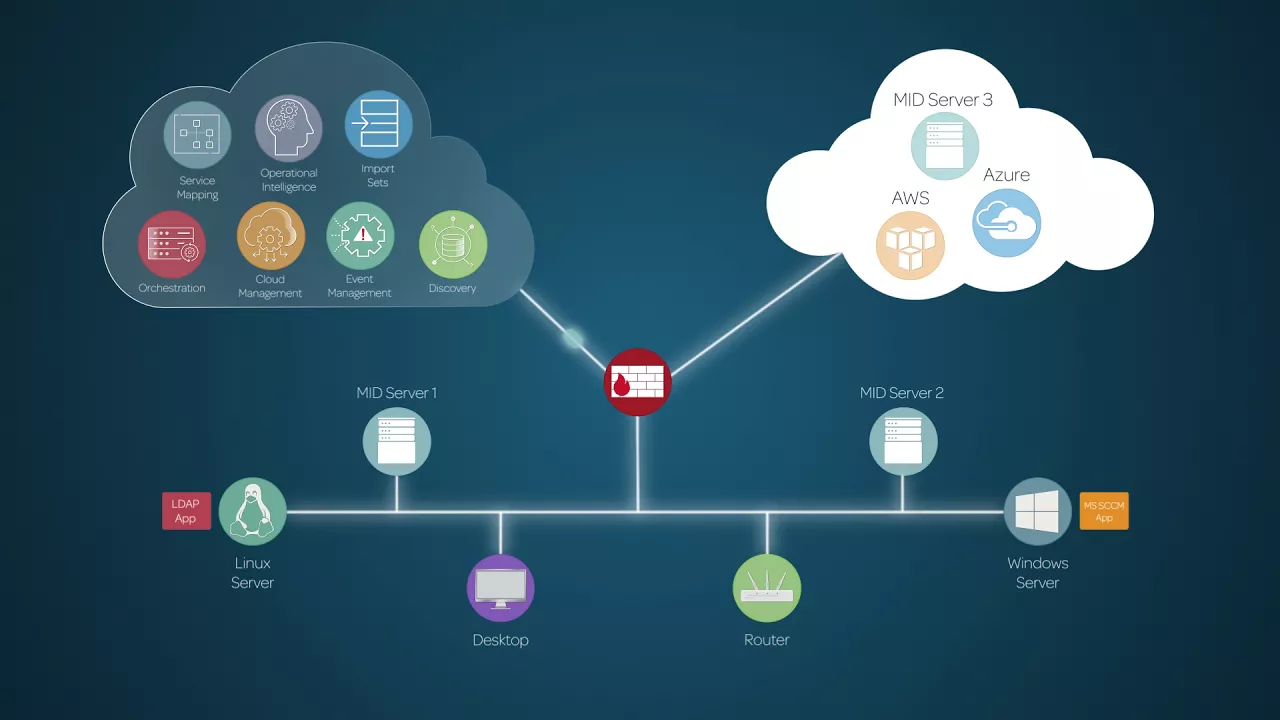
This video is an overview of the MID Server, which the ServiceNow system uses to communicate with external systems. The ServiceNow system interacts with external systems and applications… …on the enterprise’s local network… …or in the public cloud. ServiceNow applications like Discovery and Operational Intelligence interact with these external systems.
Also, the ServiceNow Import Sets module can import data from these external systems in Excel, XML, and other formats. And the ServiceNow system can integrate with external applications like LDAP and Microsoft SCCM. The ServiceNow system accesses those external systems and applications through a MID Server.
The MID Server is a Java application that runs as a Windows service or a UNIX daemon on a server on the enterprise’s network. . .
. . .
on a server on the enterprise’s network, or in the cloud, like in an Amazon Web Services VPC. You can have more than one MID Server to support larger or segmented networks or heavier traffic. The MID Server provides communication and moves data between the external systems and the ServiceNow apps.
For example, with the Discovery app, the MID Server gets a probe from the app. The MID Server sends the probe to an external system to gather information about the system. The MID Server receives the information from the system… …and sends it to the Discovery app.
The MID Server communicates securely with the ServiceNow instance using 128-bit TLS protocol. . .
…often through a firewall. For added security, communication between the MID Server and the instance is always initiated by the MID Server, never by the instance. This way there’s no need for higher-risk inbound access through the corporate firewall.
MID Servers can be configured with the specific applications they support, like Service Mapping and Orchestration. . .
. . .
and capabilities that determine what functions they can perform, like SSH, SNMP, VMware, PowerShell, and lots more. Later videos in this series will show you how to use Guided Setup to install and configure a MID Server. .
. . .
. and how to troubleshoot some common MID Server problems. For more information, please consult our product documentation, knowledge base, or podcast.
Or ask a question in the ServiceNow Community.