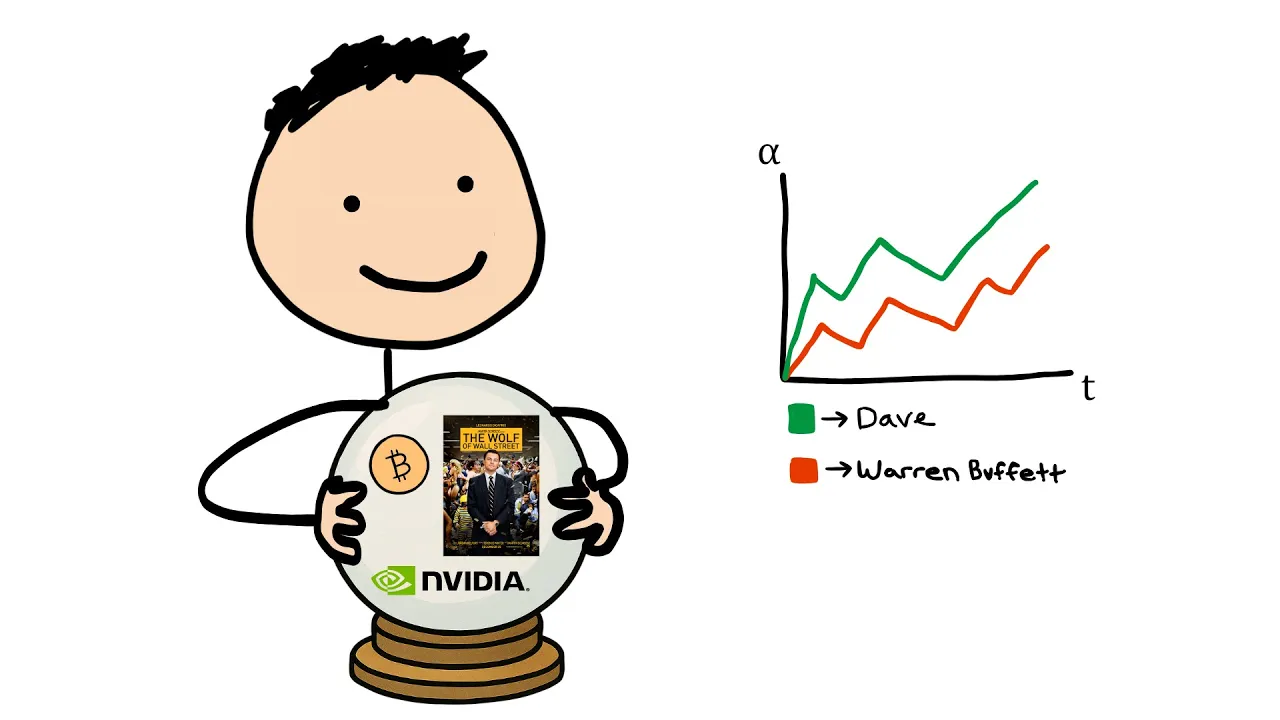
Meet Dave. Dave’s been trading for 2 years, which in Wall Street years is the equivalent of being a toddler who just discovered fire. His portfolio is up 13% year-to-date, he just hit it big on a crypto memecoin, and his confidence is at an all-time high.
Dave’s hobbies include watching the Wolf of Wall Street, telling girls at the bar about emerging biotech companies, and zynning. It’s safe to say, Dave has what it takes to become a full-time trader. So Dave does what any rational person would do: he calls his broker, lies about his net worth, and gets approved for options trading.
Fast-forward three months and Dave is now leveraged to the max on out-of-the-money Tesla calls. His strategy? Buy high, sell higher.
His risk management? Prayer. His wife's concern?
Why is $13k missing from our savings account? Fast-forward three more months and the Federal Reserve decides to hike rates. Dave’s portfolio is now down 67% and his wife’s new favorite hobby is googling “how to divorce a man who calls himself a Market Wizard.
This brings us to the question for the video today: why do the dumbest investors win? The Dunning-Kruger effect is the financial markets version of Darwinism. It explains why dumb people think they’re Warren Buffett, why smart people think they’re dumb, and why Dave believes market manipulation is why his calls expired worthless.
Since 2020, you could have invested in pretty much any stock and you would have made money. And if you were on the left-side of the dunning-kruger curve, where Dave was, you would have significantly outperformed the S&P. Traditional investors think investing is about fundamentals or fair valuations.
But the investors who have outperformed over recent years buy companies at 650x earnings, ride trends that make less sense than pineapple on pizza, and pump their bags to anyone with a pulse. In fact, I believe it was Warren Buffet that once said: Why buy Apple when you can buy FartCoin. And if you zoom out even further, it gets more evident.
We’ve been in the greatest bull market in history — 17 years, 715% returns. The S&P’s basically been on a *bleep noise* bender since 2009. So over the past 17 years, anything you’ve invested in would likely have generated a positive return.
And because of this, investment strategies characterized by high-beta and irrational approaches, have outperformed and generated alpha. Although it hasn’t happened yet, like all great benders, it must come to an end eventually. But, when is this end coming?
And how can you prepare for it? Well, there's two ways. The first: Sit on cash like Buffett has been doing.
But that’s boring and you’re not looking to compound at the risk-free rate. So that brings us to our second option: Continue to go all-in and then blame others when the markets inevitably reverse. You can blame Jerome Powell, Donald Trump, or even market makers, but you gotta blame someone because taking losses on the chin isn’t how investing works.
All this brings us to the answer to the question of today’s video… Why do the dumbest investors win? And the answer is simple. Because retail investors love volatile, high-beta stocks.
Let’s get a little more technical real quick. What is beta and why does it matter? Beta is a measure of the volatility of a stock when compared to the market as a whole.
Here’s a real example of Beta in play: Let’s say Amazon has a beta of 1. 33. This is essentially saying, Amazon is 33% more volatile than the overall market.
So if the markets rise 2%, Amazon is expected to rise 2. 66%. And then if the markets fall 2%, Amazon is expected to fall 2.
66% So why does this matter? Because when the market is up, a high-beta portfolio, aka a retail investor portfolio, will outperform versus the market. And now you got Dave, who’s looking to book a table at Nobu to celebrate his genius.
But when the market is down, a high-beta portfolio is feeling the effects of gravity. And now Dave is looking to see if Pei Wei is hiring. In a bull market, Dave’s high-beta portfolio makes him the next George Soros.
And in a bear market, Dave’s high-beta portfolio makes him the next trending post on WallStreetBets. So next time your friend brags about their 10-bagger memecoin, just remember: everyone’s a genius in a bull market.