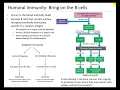
okay now that we understand the um definition of an antibody uh it's the structure of an antibody and how antibodies are made and act as effectors we're finally ready to understand the rest of the picture as far as humoral immunity and that includes the B cells and the B cells are directing the humoral response first of all just a reminder that humoral immunity is a cur in in the body fluids including the blood um it's involving b cells that are going to be making antibodies and these B cells are very specific to a one particular
antigen um they can be specific they can be this specific because their receptors on the cell surface are antibodies as well so remember from our our discussion of antibody classes that on the surface of a B cell igd antibodies serve as the receptors the important thing I want to make sure you understand is that all of these receptors on a single B cell are directed at the same antigen so one B cell might detect one particular antigen and another B cell will detect another particular antigen uh this is where um vdj or sematic recombination comes
in again because these receptors are produced by that randomized process in order to have a particular variable region to detect a particular antigen but it's only one antigen detected per B cell uh let's look at the life history of a typical B cell and while we're at it we'll look at t- cells along the way so this figure on the right shows that in the bone marrow we're starting with st stem cells called plur potent stem cells which are able to differentiate um into all the components of blood notice that one branch uh of ancestral
cells are is called the myoid progenitors and these are responsible for the majority of the solid components of blood for example um urethro urethro sites um platelets and most Lucy all the Lucy except for the lymphocytes the lymphocytes develop from their own little ancestral cell and uh those ancestral cells become B cells and t- cells uh either in the bone marrow or in the thus so in the bone marrow we develop b cells and in monus we develop t- cells those B and T cells then migrate to other lymphatic tissues like a lymph node or
a py patch or something like that and the B cells remain as B cells they just may become activated and function in humoral immunity te- cells can further differentiate into two different types helper t- cells and cytotoxic te- cells and these are both involved in the cell mediated branch of adaptive immunity okay now we're ready to see how B cells are activated remember what we said on the previous slide or what I said on the previous slide B cells have um antibody receptors immunoglobuline receptors we'll just call them B cell receptors but just remember that
they are igd molecules that are very specific for one particular antigen so here at the top of the figure you see that there is a particular antigen that will only bind this one B cell because it fits the receptor appropriately the B cell over here to the right is not going to be able to B that antigen instead it will bind a different antigen let's go back to the B cell in the middle so this B cell uh once it Finds Its particular antigen it's going to internalize that antigen break it down and display it
as a fragment so this is antigen presentation as we've talked about before the thing I want to point out here is that the B cell is going to present antigen with a protein complex called MHC Class 2 uh we'll Define what this means later but the point is right now it's acting as a holder for that particular antigen now that's important because uh a T cell is going to come along and activate or verify to the B cell yes it's okay okay to proceed so B cell uh is not necessarily going to continue through this
activation process in most cases unless a t- cell is involved for that verification process uh notice that it's a helper t- cell we'll talk about T cells shortly uh after cyto stimulation from the t- cell the B cell is going to undergo myosis starts making more of itself and these are activated B cells at this point some of those are further going to differentiate into memory B cells these will survive for years for potentially a lifetime uh and will be important in a secondary uh antibody response should this antigen infect the body again U the
majority of these activated B cells are going to differentiate into plasma cells these are the eector eector B cells basically uh these are the ones on that are going to be making antibodies that are released into the plasma and at this point these antibodies are going to be able to go off and neutralize the bacteria neutralize the toxin activate complement all those things that we talked about uh just a little bit ago few slides ago uh the other thing I want to make sure is clear is that these antibodies are all identical and they all
Rec recogniz the same antigen as the uh as each other and as the original uh B receptor detected as well so in other words see if I can see something else here these antibodies are identical to the um they may be a different class but they're recognizing the same epitope as these Bell receptors did up here at the very start of all this um see the last thing I want to mention on this slide is that some in fact most antigens usually protein antigens require t- Cell Activation for the B cell uh I'm sorry t-
cell um involvement t- cell verification for the B cell to be activated against that antigen so in other words if in this figure here um this antigen is probably protein and it requires a T Cell to activate the B cell to continue on uh that's a so-call t dependent antigen and most antigens are T dependent antigens however there are some that are T independent antigens and those T independent antigens include molecules that are larger and have more redundancy to their structure like a carbohydrate like a lipid perhaps uh that can activate B cells without T
cells so without t- cell involvement at all sometimes B cells can become directly activated by the antigen alone uh the downside is that um the immune response is much weaker and different antibodies are secreted different classes of antibodies are secreted so it's not as strong of a response uh and this is a so-called T independent antigen that would allow that process to occur okay there's a lot to talk about on this slide this is where we're going to start talking about the te- cells now so we're done with B cells for the moment uh t-
cells are involved with the cellular Branch or the cell mediated branch of adaptive immunity uh and this is important because some pathogens are hidden from the immune system inside of cells or this is also important because we have abnormal cells of the body that need to be disposed of so this So-Cal um cellular immunity comes about uh by the te- cells the action of the t- cells okay uh there are two major types of te- cells so-called cytotoxic te- cells uh and helper t- cells so the cytotoxic te- cells can do what their name implies
they can directly attack another cell usually it's an infected cell or an abnormal cell of the body helper T cells do what their name implies they help uh activate other cells and kind of coordinate the immune response they are sometimes known as the master controllers because they literally have a hand in everything U these were the cells the HIV infects that I started the chapter off with and you saw how crippling that could do all right now te- cells have what are called cleverly called uh t- cell receptors or tcrs and and these T cell
receptors are also a result of the somatic recombination process we talked about before and the reason is because these te- cell receptors also have to be very specific for particular antigen and each t- cell is going to be specific for the same antigen or epitope t- cells are not going to bind the antigen directly however uh they will will only be involved with finding antigen that's presented to them it's processed and presented to them from an antigen presenting cell so this is a particular a particularly important distinction with B cells because um B cells bound
let go back actually uh B cells bind the antigen directly and then can go through this activation process t- cells however don't B the antigen directly again they bind processed and presented antigen okay so the story is not over in addition to the t- cell receptor t- cells also have a co-receptor uh called either CD4 or cd8 so we have so-called CD4 T cells or cd8 T cells depending on the co-receptor that they contain cytotoxic te- cells as a general rule of thumb have cd8 co-receptors along with their t- cell receptors and as you see
there helper t- cells have CD4 along with their T cell receptors so we could call um particular helper T cell a helper t- cell uh type one or type two or whatever um or we can call it a cd4t cell okay so there's a couple ways to say it now t- cell receptors and their co-receptors either CD4 or cd8 recognize presented antigen as mentioned a little bit ago and that antigen is presented by uh MHC protein we saw this over here where B cell is an example of an antigen presenting cell here because it is
presenting an antigen peptide with an MHC molecule notice that it's MHC Class 2 so MHC stands for major hisst compatibility complex and this has important implications in tissue typing which we'll talk about in another chapter but here we just want to recognize it as a molecule that presents antigen on an antigen presenting cell uh let's look at the different types so we have MHC class one which is the most common in the body because it's on basically allies cells notice I write here nucleated body cells so basically all cells in the body except for erthrocytes
red blood cells because erthrocytes aren't true cells so they don't do this but basically all other cells do and um MHC class one you know it's not produced necessarily only in response to infection MHC class one is kind of produced all the time and displaying self antigens all the time okay but it might also present you know a naughty antigen in an infected cell MHC Class 2 is basically the same thing as MHC class one except we find these only on specific antigen presenting cells the the really good antigen presenting cells so-called professional apcs uh
this would include macrofagos and dendritic cells primarily um okay so so the antigen is presented by a cell with either an MHC class one or MHC Class 2 molecule and therefore in order to form this MHC antigen combo MHC uh proteins also have to be highly variable in their structure okay so because of that it's kind of the same idea with the somatic recombination to make uh antibodies or tar receptors MHC genes are highly polymorphic there are many many variations of these so that they can bind particular peptides uh of pathogens and then display it
okay so in order to bind that peptide they have to have a particular specific shape and then display it so that we can activate other cells okay all right so now that you're feeling a little bit overwhelmed let's go ahead and try to cement this with the figure on this figure we have this little flow chart where t- cells in the thymus can mature into two different types of te- cells the cytoxic C uh t- cells or helper te- cells let's take the left Branch first so we'll follow the cytotoxic t- cells and technically this
is a little bit incorrect here cytotoxic te- cells are not referred to as ctls yet ctls are only after they're activated so uh we will ignore that for the moment uh and just focus on cytotoxic t- cells so that's what's shown here in part A in part A you see a cell that has a T Cell receptor and a cd8 co-receptor so just like we talked about on the previous slide cytotoxic T cells have the cd8 co-receptor so they're uh receptor combination is a t Cel receptor with cd8 right next to it all right now
we can see what happens when uh this cytotoxic te- cell becomes activated okay so um the cytotoxic t- cell is now on the left I know this is a little bit confusing in this in this figure so it's suddenly changed color so ignore that U the cot toxic T cell is now here on the left it has its cd8 receptor and it's T Cell receptor uh and what's happening is it's finding a body cell that has been infected and this nucleated body cell has processed the antigen and is displaying it with MHC class one so
we're going back back to here MHT class one is on all nucleated body cells and presents antigen especially when infected okay so this infected body cell is doing exactly that the U cytotoxic te- cell has uh recognized it as well and has become activated once it's activated it's referred to as a cytotoxic t-lymphocyte or CTL okay so once activated it's called that and now it can kill the infected cell uh with perforin and granzymes the you know poking holes into it initiating apoptosis all right let's take the right Branch now helper T cells helper c
t T cells as we uh discussed before have a t- cell receptor and a CD4 co-receptor this time so now we have this unique receptor combination and U helper T cells come in two varieties we'll talk about how that happens in just a moment uh so-called um th1 and th2 so two different types of upper T cells as you see here um th1 are involved with activating several uh several different types of cells uh including what we just talked about so the th1 cell here is involved with activating cytotoxic te- cells okay so there's a
little bit of cross talk here U they're also involved with activating uh some of the cells of our innate immune system like the macras is or natural killer cells th2 cells are involved with activating B cells so if we go back a couple slides you see that right here th2 activating a B cell so it can continue its activation process okay The Next Step then is to see how we activate each type of t- cell so helper T cells and cytotoxic te- cells let's start with helper t- Cell Activation uh maturation as well maturation and
activation here's what I'm about to say in words but I'm going to go right to the figure and we'll refer back to the previous slide all right so we're going to start off where this antigen presenting cell perhaps it's a u maccrage perhaps it's a dendritic cell has recognized a um pathogen Associated molecular pattern a pamp on this uh bacterial cell it has engulfed it digested it processed those um antigens and displaying with MHC Class 2 remember that professional antigen presenting cells display their antigens with MHC Class 2 now helpert cells are kind of picky
they only recognize um MHC Class 2 so they don't recognize MHC class one only MHC Class 2 so only professional antigen presenting cells will be able to activate helpert cells here we see two different helper T cells you see the CD4 indicating that that's a helper T cell so it has a CD4 co-receptor and this uh teal colored t- cell receptor right there uh that has recognized bound that antigen and recognized it at this point it was a naive t- cell so maybe this is just a t- cell that's hanging out in a lymph node
or in some lymphatic tissue somewhere but has never been exposed to antigen so now it's finally exposed to antigen its life purpose uh is complete right so it's finally exposed to this antigen and it that stimulates its proliferation so making more of itself notice that we have um some interesting chemical signaling here we have autocrine and paracrine signaling where the activated t- cells are um stimulating each other and their themselves uh a population of these helper T cells are going to become memory helper T cells and a population are going to differentiate further into th1
and th2 um this differentiation right here depends on the I guess chemical environment uh the sort of cyto kind soup that these te cells are surrounded by that will determine whether they become th1 th2 or actually there's a couple more different um helper t- cell sub populations that they can differentiate into and we'll talk about that more in class the T th1 cells as we see on the previous slide um th1 are responsible for activating uh the innate some cells of the in immune system some phocytes as well as um the cytotoxic t- cells th2
are primarily involved with activating humoral immunity and activating the B cells one last thing I want to point out is that this interaction between the antigen presenting cell C and the helper T cell uh not only do we need to have this interaction right here between MHC Class 2 and CD4 and the t- cell receptor but there's also another sort of co- stimulatory molecule that's released from the antigen presenting cell that is necessary for t- Cell Activation and on the previous slide U oops previous slide I mentioned that right here okay so there's there is
a co- stimulatory molecule there's still a little bit of mystery about that but that's absolutely essential to proceed in addition to the T receptor binding uh as we see in this figure so one with a little piece of information there okay next up let's look at how cytotoxic te- cells are maturing and becoming activated it's kind of a similar process I guess we start with an antigen presenting cell um in this example so in this case we have an antigen presenting cell uh that has been infected with a virus or internalized a virus and has
is processing that information and then displaying it as MHC class one now remember that MHC class one doesn't necessarily have to be just on an antigen presenting cell uh MHC class one is common on all body nearly all body cells okay um anyways so antigen is presented the the pathogen antigen is presented by MHC class one this time and that's where cd8 t- cells come in they're able to sort of monitor the status of body cells by looking at their MHC class one antigen combination so that's what these uh cd8 cells are doing they're um
they're binding this antigen that's being presented by them or to them and uh if it's the appropriate antigen if it's recognized as dangerous then the cdat cells will become activated and U they'll start cloning themselves and stimulating themselves notice that we have some input from th1 opert cells okay so this this cyto interaction is is important for the activation of cytotoxic te- cells at this point these cytotoxic te- cells have become activated they are now called cytotoxic T lymphocytes just a small detail there not going to be real picky about that notice that some of
these become memory cells and others are able to go off and uh attack other cells that they have been um sensitized to okay so other cells that display the same antigen as was originally displayed up here in this case a virus any cell that shows that on its surface is going to be killed basically and um the cytotoxic tmpy is going to be releasing horin and granzymes resulting in death of that cell all of that is of course summarized here one last note don't forget that this is all also happening with abnormal cells of the
body because some of the antigens that they display with their MHC class one are abnormal looking and if the cytotoxic t-lymphocytes recognize that antigen as abnormal those cells will be targeted as well all right before we finish uh I want to talk about something that's not as uh obvious uh it's it's a part of the lymphatic system that's um not as obvious because this these clusters of lymphatic tissue is diffuse and and sort of sprinkle throughout some tissues this is a good example you know the the GI tract and respiratory tracts are the major portals
of entry for microbes in the body uh therefore we have to have a a pretty significant defense built up and this is a really good example this SoCal mucosa Associated lymphoid tissue or malt sometimes called gut Associated lymphoid tissue or G if it's in the GI tract it's basically the same thing uh we have clusters of lymphatic tissue basically clusters of lymphocytes and other lucco sites hanging out um sort of monitoring uh the barriers um pyus patch is a good example that you learn about in BIO 202 uh here's a pyus patch for example okay
so here's our epithelium of let's say the intestine and you see our epithelial cells and this is the Lumen up here so there's all kinds of microbes that could potentially breach this mucosal barrier and so we have all these lymphocytes taking up shop just deep to that epithelium uh standing guard and here at the py patch notice that there's an M cell associated with that my mouse okay so the M cell right here is referred to as an M cell because of its structure these folds micro folds and these M cells process antigen from the
Lumen and deliver them to cells below like in this pyus patch for example and these antigens uh in this antigen presenting cell right here uh can sort of be shown around shown around activate any B cells that might recognize it activating T cells at right recognize it or maybe we just go into the lymphatic system go to a lymph node show that antigen around or maybe over here we're doing the same thing um the idea is that we're uh trying to monitor the contents of the Lumen and monitor the situation should the epithelial barrier be
breached so we have all kinds of B cells and t- cells waiting to become activated just deep uh just deep to the epithelium here another interesting example of a defense is a dendritic cell the dendritic cell is reaching its little cytoplasmic arms through the epithelial cells and sampling antigens in the Lumen so that's another way to receive antigen if it's not from an M cell maybe it's directly from Al Lumen and now this dendritic cell can show it off and present it to all these different cells here and travel from one area to another travel
to lymph nodes to another area of the body Etc so a really really important defense here um huge defenses built up in the mucose of our respiratory and digestive tracts especially the GI tract okay at last we've reached the end hopefully it wasn't too bad it's just lots of little details to keep track of uh but here's a really nice summary of adaptive immunity remember that we can divide it up into two major branches we have the humoral branch on the left which is everything that's being shown over here and the cot toxic uh I'm
sorry the cell mediated branch on the right is kind of everything that's being shown here notice that helper T cells are sort of in the middle of it all coordinating everything let's go ahead and start with the humor Branch since it's easier um antigen directly binds B cells because the B Cel receptors are immunoglobulins of class igd and are able to directly by an antigen the B cell uh is activated most antigens require activation by helper T cells th2 in particular of course that would be referred to as a t dependent antigen then and this
B cell can become activated some of those become memory cells the rest become plasma cells which can secrete antibodies all right now let's go ahead and look at this Branch so antigen is first processed by an antigen presenting cell in order to activate t- cells um in this case this antigen presenting cell let's say it's a maccrage present antigen to a naive t- cell th0 and this naive t- cell once activated can differentiate into two different types of helper T cells sorry my mouse is going little wild here um th th1 and th2 so this
helper T cell can become either one th2 remember is involved with activation of B cells and humoral immunity th1 is act uh involved with activating the cell mediated Branch so some of our uh cells of the inate immune system as well as cytotoxic te- cells okay um keep in mind also that some of these helper T cells become memory te cells all right we can also have an antigen presenting cell at the same time activate cytotoxic te cells um cytotoxic te- cells need activation sort of co-activation with th1 once they're activated they can become cytotoxic
T lymphocytes which form some memory cells but also can go and directly kill infected cells and abnormal cancerous cells in the body with perin and granzymes notice that perer is spelled wrong there okay so that's how everything's going to happen the first time we're infected with something now with all these memory cells things are going to go a lot faster the second time you're infected with the same pathogen so that's what's shown in Red so if we have a second exposure to the same exact antigen it's going to activate the t- cells the memory B
cells and cytotoxic T lymphocytes directly so that we don't have to go through any activation steps the memory B cells can become plasma cells and secrete antibodies the cytotoxic T lympocytes can become activated and directly kill virally infected cells and these memory t- cells can become uh helper T cells which activate both branches this is why um the second exposure when you have immunity to something uh the second exposure we're able to take care of it sort of wipe it out so much faster so you don't have all those activation steps