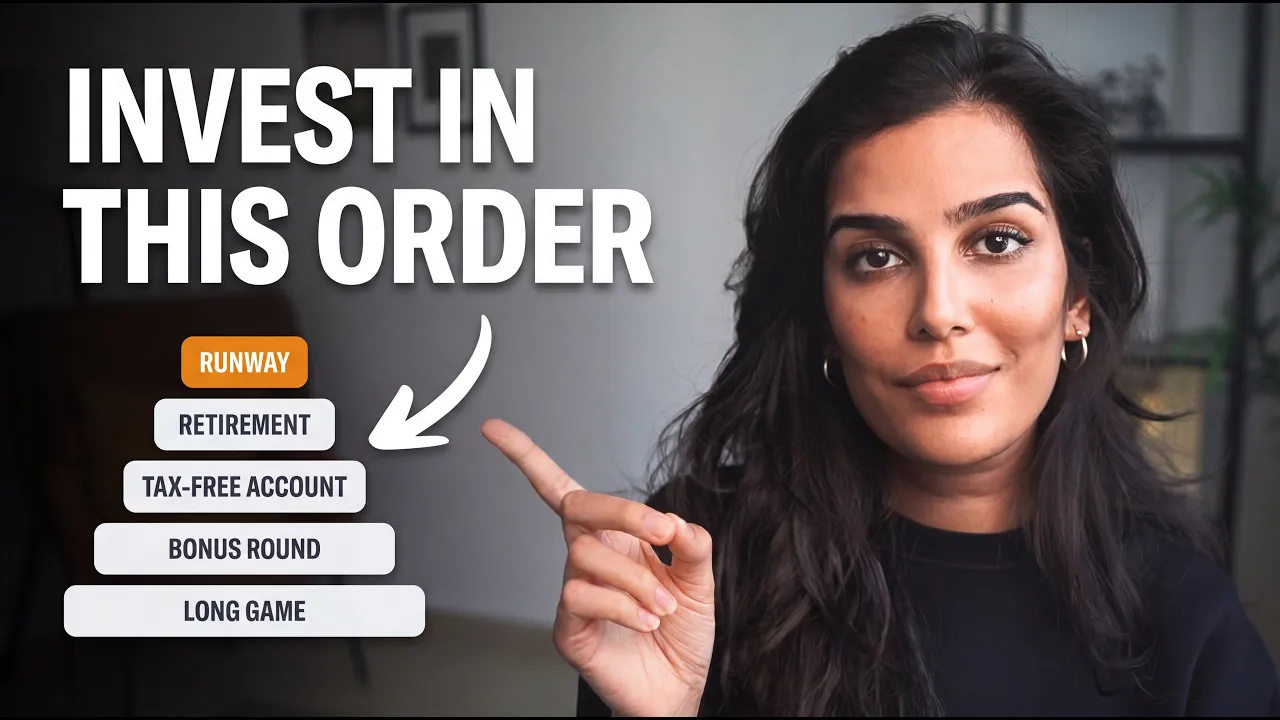
Most people think that the secret to building wealth is having a huge paycheck or making six figures. But, after years working in investment banking, I can tell you that that is not it. In fact, some of the most financially secure people I know don't earn huge paychecks.
They just did things in the right order. And so, in this video, I thought it would be interesting to show you exactly what that order looks like step-by-step. And by the way, if you're new here, hi, I'm Nisha.
I'm a qualified accountant and former banker. And if you're watching this before Sunday, there's still time to join my free investing workshop where I teach you exactly how to start investing with confidence, even if you have no idea what to invest in yet. You can find all the details through the link below.
Let's dive in. I want to start by uncovering the hidden tax. And that is that most people think that their biggest mistake is picking the wrong thing, and it isn't.
It's actually waiting to figure it all. And most people will actually lose more money to waiting than they ever will to a bad investment. I see so many comments on any investing video that I put out asking things like, "Okay, but that's all well and good, but what account should I use?
What should my strategy really be? How much should I put in? Can I really get this 10% return that you're supposedly talking about?
" And all of these questions, while they are totally fair, most of them become irrelevant the moment you just start. What is relevant, though, is how long you wait to start. And I want to show you why to really drive this point home.
So, imagine you invested 100 and earned a 10% return in the first year. So, by the end of that first year, your investment it'll be worth 110. Now, if your investments grew by another 10% in year two, you wouldn't just earn another 10, you'd earn 10% on the full 110, meaning your investment would grow to 121, even if you didn't actually contribute a single penny more.
And over time, this effect can become very, very powerful because each year your money has a potential to generate returns, and then those returns start generating returns, too. Which means growth can start to snowball over time. So, now 100 turning into 121 might not actually sound particularly exciting, but imagine investing consistently for decades instead.
For example, if someone invested 500 a month, let's just say, and earned an average annual return of 8%, then after 30 years, they would end up with over 700,000 despite only putting in 180,000 of their own money. That means the majority of the final amount came from the growth, not the money that they had personally put in. So, okay, this is all good when it comes to theory, but how does that actually apply in reality?
And how does it impact the money in our own pocket? Well, I want to give you two people side by side so you can compare. So, imagine two friends, Sonia and Susie, both age 35.
They watch a YouTube video about investing. So, Sonia is nervous about investing, but she decides to start anyway. She opens an investment account and she starts investing 300 a month earning an average annual return of around 8%.
Susie, on the other hand, she tells herself that she'll start once she's done more research and when she feels a little bit more confident. She wants to, you know, make sure she's making the right decision. 10 years pass, and only then does Susie start investing the same 300 a month.
By the time they both turn 65, Sonia could end up with around 425,000, while Susie might have closer to 171,000. So, they both invested 300 a month and got an average annual return of 8%. The only difference is that Sonia started 10 years earlier than Susie did.
And what's even more surprising is that Sonya's total contributions aren't that much higher than Susie's. Sonya invested 108,000 over a 30-year period from age 35 to 65, and really benefited from a massive 317,000 of growth. Susie, she invested 72,000 over 20 years from age 45 to 65, and her investments grew by almost 100,000.
That difference That difference is the hidden cost of procrastination. Because when you delay investing, you're not just delaying contributions, you're delaying time in the market. And this is one of the biggest things that helps compounding do its job.
And I wanted to start there because the order you do things and still matters It very much matters. And I'm going to share my preferred order with you today. But what I want you to avoid is the trap where you spend years researching, overthinking, and waiting for that perfect moment because perfectionism really can become procrastination.
And procrastination, as you've just seen, is very, very expensive. So, with that in mind, let's take the first step. And that is step one, building your runway.
This is boring, but is an absolute must when it comes to investing your money. One of the biggest mistakes people make when they first start investing is they go all in without any sort of safety net. They jump straight in, they put their money into investments that they convinced that's going to go up.
And almost without exception, it doesn't go the way they planned straight away. And why am I calling this the runway? A runway, it gives a plane the room to take off safely.
And without one, the plane most likely won't fly. Your runway, which is another word for your emergency fund, it works the same way. It what gives your investments the space they need to actually work.
And I know you're here to invest, not really to save, but skipping this step is one of the most counterintuitive things you could do for your finances, and it can really set you back. And I'm not just saying this for the obvious financial reasons. In fact, there's research from behavioral economists that have found that financial stress isn't just bad for your finances, it literally reduces your capacity to make good decisions.
When you're worried about money, your brain is consuming mental bandwidth just managing that anxiety. So, when your investments drop 20% during a market downturn, which happens regularly, you're not just emotionally stressed, you're also less equipped to make the rational call to stay put, to stay in that investment. And so, without a runway, you may have no choice but to act on that stress.
Either you borrow money to cover the emergency, which then costs you, or you sell your investments. If they're down, you lock in a loss. If they're up, your money leaves the market and stops compounding.
So, either way, an alternative would have been better. That's why this runway, which is just a fancy word for an emergency fund, is just as much about your psychology and your well-being as it is about money. So, how much do you actually need?
As a general guide, 3 to 6 months of living expenses is usually enough to cover most emergencies and give you breathing space if you're ever out of work. And if you've got a stable job, strong employment protections, you might actually be comfortable with the lower end. If you're self-employed, a variable income, or dependents, you might aim for the higher end or even more.
Once you've got that initial amount saved up, we can then move on to the next step, which a lot of people miss entirely. And that is step two, which is making sure you're getting the guaranteed return. In all of my years working in finance, I have never come across a guaranteed return on an investment like this one.
Most employer pensions or retirement schemes work like this. As long as you contribute, your employer contributes, too. In the UK, this might be workplace pension matching.
In US, this could be the 401k match. The exact version varies by country and by company, but the principle is the same. The reason why you've got to be using it is there are so many benefits hidden within it.
If your employer matches contributions, say up to 5% of your salary, and you put in that 5%, your money has just doubled before it spent a single day in the market. It's already gotten a 100% return from your company. There is nothing in investing that does that.
You're effectively doubling your money before it's even had any time to grow in the market. It's giving your investment a head start. And then, on top of that, many retirement schemes come with tax advantages, too, which can make them even more valuable.
So, again, using the UK as an example, pension contributions often receive tax relief, i. e. , it's taken out of your paycheck before you pay tax on it.
So, ultimately, the government is effectively boosting the amount that's going into your pension. So, how much should you contribute? At minimum, enough to claim that full employer match.
Whatever your employers are willing to put in, you want every single penny of that, so match that. Beyond that, it depends on your other financial goals. You don't need to max it out straight away, and actually, I never did max it out when I was working in banking because of reasons I'll go into more detail in a second, which is ultimately doing it myself.
But leaving that match unclaimed, that's like leaving guaranteed money behind. So, once you've done that, we can move on to the next step, which is thinking more strategically about how to invest as tax-efficiently as possible, and making sure you don't fall into the tax trap. This is something a lot of people overlook.
They spend hours researching what to invest in, but very little time thinking about the type of account they're using. And actually, the account that you use determines how much of your returns you actually keep. And using the wrong one could actually cost you thousands over time on the exact same investment.
By the way, I'm not going to go into what to invest in in this video, but if you're watching this before Sunday, you can reserve your spot for my free 45-minute investing workshop where we cover everything from how to invest and what to invest in and how to choose. Also, how to accelerate your investment returns over time, the single biggest mistake new investors make and how to avoid it, and how to calculate what you need to eventually live off your investment and so much more. We've had over 75,000 people go through the same workshop when we hosted it back in November and then again in January and we've received really, really positive feedback.
So, we're now releasing it. Again, it's 100% free and I promise you'll walk away having learned at least one new thing about investing and how to get started. You can sign up at nisha.
me/invest before doors close. Now, when it comes to the type of account to invest in, most countries offer tax-efficient accounts specifically designed for this. So, in the UK, the most common one is the ISA.
You can invest within it right now up to 20,000 and any investment gains on that amount is tax-free. In the US, it's a Roth IRA or a traditional IRA. Other countries have their own version.
And as tempted as you might be to just open the first investment account that you come across, whether that's one that's an easy-to-use app or one that you've seen advertised on YouTube, for example, the amount of tax that you pay on your investments, the impact of that can be huge on your overall financial position. So, if the tools exist to help you save and invest tax-efficiently, you absolutely need to use it. And this really is a simple Google search to understand what you have available where you live.
Once you've done that, you can move on to step four, which is the bonus round. These accounts, they exist in most countries, but most people just don't know how to look for them. They're specialist accounts designed to help you reach specific financial goals faster, whether that's buying your first home, education, healthcare.
Governments tend to put extra money inside them as an incentive. So, for example, again using the UK, one option or example of this is the lifetime ISA, particularly if you're saving for your first home or your retirement. If you're eligible, you can save up to 4,000 a year in a lifetime ISA, and then the government will boost your contributions by 25%.
There are obviously some restrictions and guidelines that come with this, but this is an example of one of the accounts that exist. In the US, some people may have access to a health savings account or a HSA, which can be used to save for healthcare costs in a very tax-efficient way. Other specialist accounts may prioritize education saving plans or additional retirement vehicles depending on their circumstances.
These vary so much by country, so it's worth just spending an hour straight after you watch this video researching what's available through a simple Google search or ChatGPT search, literally typing out, "Does my country have a version of the lifetime ISA in the UK for saving towards my first home? " Or "I'm looking to buy my first home. I want to know what government incentives exist in this country to be able to help me save for it.
" Like, there is so much information that is at our fingertips right now, but the principle is really the same that governments want you to save for certain things, and they've created accounts that reward you for doing it. So, when you're looking to buy a big purchase, it's very, very worthwhile just having a simple search because most people never know that these accounts even exist, but now you know. Then, step five, which is the long game.
If you've worked through the previous steps and still have money left to invest, then this is essentially a regular investment account where you can buy index funds, ETFs, shares, bonds, other investments. The only difference is that unlike some retirement or specialist accounts, these accounts tend to, A, in a good way, be more flexible. In many cases, you can access your money whenever you want, for example, which can make them useful if you're investing for goals outside of retirement or if you simply just want more freedom over how and when you use your money.
The trade-off, however, is that these accounts, they don't usually come with the same tax advantages that we've talked about earlier in the video. Depending on where you live, you may need to pay tax on dividends, interests, investment gains. That doesn't mean you should avoid them.
Far from it. I absolutely recommend you max them out if you've done all the other steps in this video. But, it's one of the reasons why I recommend making the most of tax-efficient accounts first whenever you can.
And if you're looking at me right now thinking, "That's all great, but actually, I don't just want an investing breakdown. I want a full breakdown on everything personal finance-related. " Then, this video right here is for you.
It's everything you need to know about financial literacy in 54 minutes. See you.