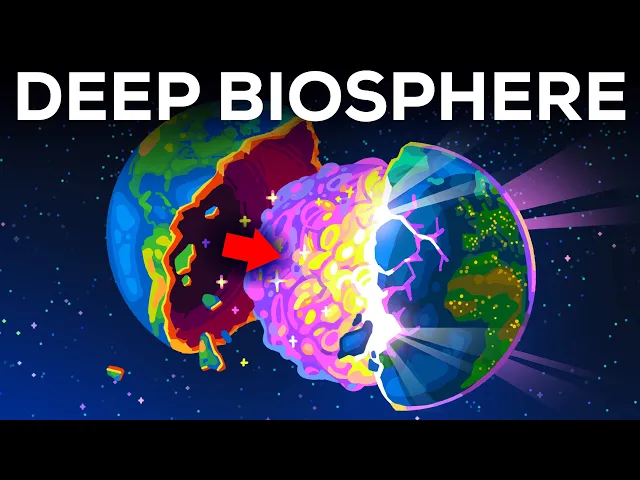
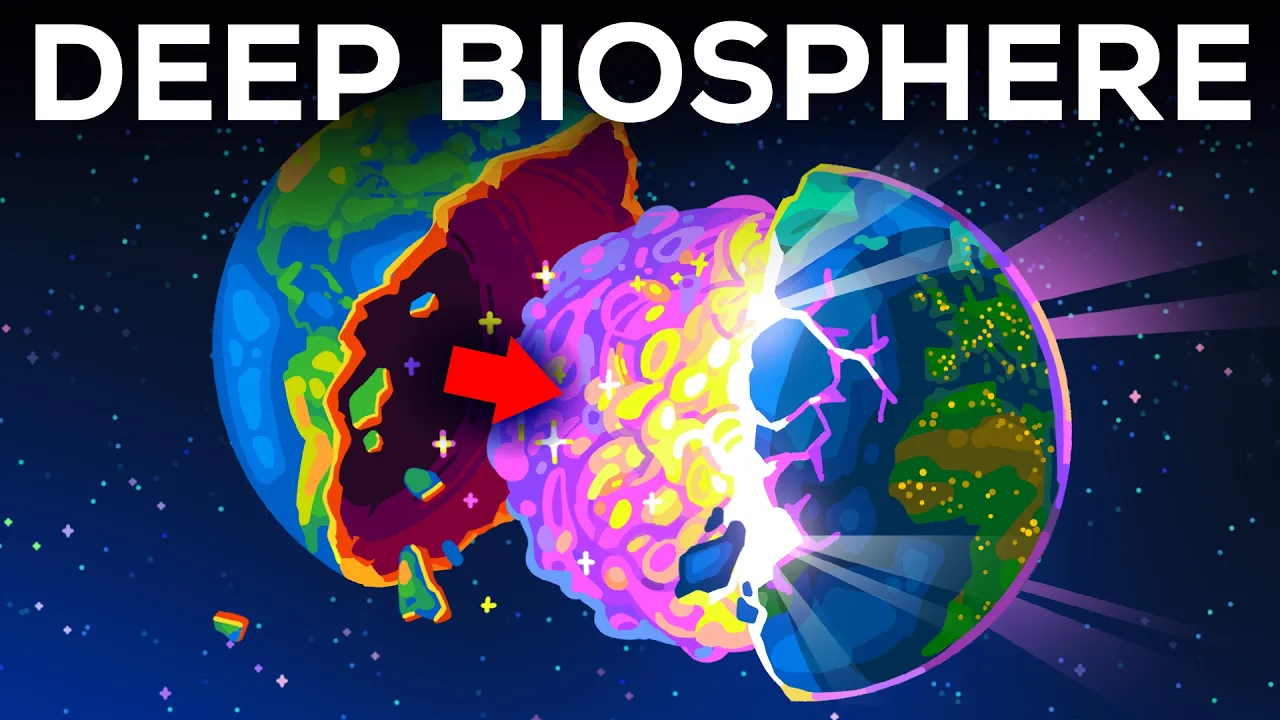
We’ve found a new planet, home to octillions of the most extreme beings living in the most absurd and deadly hellscape. In absolute darkness, crushed by the weight of mountains, starved of oxygen, cooked alive, bathed in acid, salt or radiation. And yet, they live for thousands, perhaps millions of years!
It turns out, this planet is not in space ––– it is inside the crust of Earth! This is the deep biosphere and we basically learned that it exists yesterday. Its volume is at least twice as large as all the Earth’s oceans, home to more microbes than the rest of the entire planet.
Their total biomass is more than 20 times greater than all humans, livestock, and animal wildlife. Let’s descend into this mad, deadly world where none of the rules we thought are mandatory for life apply. Going Deeper and Deeper Deep life seems to be everywhere we look: below the oceans, near volcanoes, beneath the glaciers of Antarctica, under any landscape we can imagine and anywhere we live.
We’ll use a special duck science drill and start our journey in familiar territory: on land, in the soil, where plants grow and animals roam. If earth were an onion, this is the very top of the very top layer. Soil is a lavish four-way partnership of air, water, minerals and organic matter, bathed in endless energy.
Life lives in luxury here. Plants exploit this paradise and produce more than 30 times the biomass of all of Earth’s animals each year, in a constant cycle of growth and decay. Only a tiny fraction of the biomass is buried deeper in the ground, supplying juicy resources for almost half a billion years.
As we dig deeper, most of the air has been squeezed out and we cross the water table into a zone saturated with groundwater, rich in minerals and some organic matter. Roots from the most ambitious plants reach down here, and the most common inhabitants are scavengers living off decay. This layer can be pretty cold because it is still slowly warming up from the most recent ice age.
Klunk We reach bedrock. A foundation of solid rock for all the less solid stuff above, home to fractures filled with water . It can be exposed to the surface, or buried hundreds of meters below stuff.
Here, in the dense bedrock, we’re in a weird planet inside the planet. The most thrilling zone of the deep biosphere. As we drill further down, temperatures gradually begin to rise, and soon it gets really hot and the pressure rises.
Underneath 400 meters of rock, the pressure is similar to the surface of Venus. We drill faster now, down to 1000 meters, deeper than the Burj Khalifa is tall. It is about 30°C , and there is almost no free oxygen left.
We continue and finally stop almost 4 kilometers down. Above us pressing solid rock weighing tens of thousands of tons with pressures as intense as at the bottom of the Mariana Trench. Down here it is on average 120 degrees C , even hotter if a magma plume is nearby.
The heat is a leftover from Earth's formation and from from the decay of radioactive elements like thorium and uranium that shower the crust with a constant wave of radioactivity. To make things worse some rocks are mixed with extreme amounts of salt. Hell.
And yet. Life is thriving. Inside rock!
If we zoom in, we see that solid rock is not actually solid! It’s traversed by cracks, voids and tiny pores. Sandstone, limestone or basalt are so porous that up to 40 percent of their volume is actually empty space.
But even much denser rocks like granite, can be split open by cracks and fractures. We’ve found a gigantic planet spanning system of micro-caves, free real estate filled with water and hardcore microbes! And these caves are moving.
Just like the atmosphere is constantly mixing air to create weather, down here rocks are mixing to create rock weather. Submerged mountain ranges are shifting and ripping, crashing and merging. Continents smash into each other with the energy of millions of nuclear weapons but as slow as your fingernails grow.
Countless tiny and not so tiny earthquakes rip open tiny new fissures and passageways, creating new spaces for life and closing others off forever. In this hot, moving pressure cooker, minerals are forged and baked, and organic molecules are created and destroyed. An insane menu for anyone brave enough to try to survive down here.
Let us venture into the system of tiny caves and meet some of them. The Most Extreme Living Things We think that octillions of microbes live down here, and naturally they are pretty hardcore. The doomsday preppers of the underworld.
Some have big, bulky genomes, living entirely on their own, basically forming their own ecosystem. Like the bacterium Desulforudis audaxviator. It synthesises its own food by nibbling carbon or sulfur from the rock and turning it into organic substances.
If the conditions get too extreme or if there is no food around, it kills itself to survive, by forming an endospore. It divides into a big and a small part, and swallows the small part again, forming a cell, within a cell. The outer cell then sheds its water and kills itself, leaving the spore to float around, maybe for thousands of years until it finds a good place to spring to life again.
Others like some company, like the archaea with the clunky name Altiarchaeum hamiconexum, that have a rare double membrane covered in weird materials that protect them against the extremes. They shoot out nano-sized grappling hooks to tether themselves and seem to live in cracks and fissures filled with water completely devoid of oxygen, harvest carbon dioxide to create biomass, and may sort of eat hydrogen. The conditions in the deep biosphere are so harsh that other microbes share the hard work by forming consortia.
They knit themselves together in a biofilm – a very thin, sticky net that shields them against the extremes. They are miniature cells, often with a small genome, but each good at one thing. One type of microbe eats methane and excretes its electrons.
A second type eats these electrons and converts sulphate into sulfite that is then eaten by a third microbe and so on. Some eat iron, others use electrons to turn nitrogen or carbon dioxide into biomass. Life down here found ways to use stuff that is poisonous to most animals to make food and energy.
But still, life is incredibly hard and resources and energy are super hard to come by. So the most intense strategy for survival down here is to live forever. Like monks who’ve taken a vow of poverty, deep microbes consume very little and conserve their energy.
Their metabolism is up to a million times slower than microbes at the surface. They had a meal when you were born and are still digesting it. For most of their life they exist in a slow limbo – some even slowly cannibalise themselves.
Until a sudden influx of resources arrives by pure chance – and then they spring into action and reproduce. With this lifestyle it seems that extreme microbes can live for centuries, maybe even for millions of years! If they are not hunted to death, of course.
Because kilometers deep in limestone habitats, there seem to be spaces big enough for multicellular predators. We found asexual worms, 100 times longer than microbes, hunting and devouring bacteria. It's not clear if they originated down here or if mini earthquakes opened up fractures for water to carry them into the deep.
But there are other fierce predators like rotifers or arthropods in the depths, hunting immortal microbes. We wish we could tell you more insane things about life in the deep biosphere but there is a problem. We don’t know that much yet.
For one, we can not really get a good look under kilometers of rock. Drlling down could contaminate the samples with microbes from the surface. We found living ones in deep mines and brought them into the lab.
But it is pretty hard to simulate the conditions they feel comfy in – in boiling hot water, squeezed under mountains, submerged in deadly chemicals – and still see them through a microscope. And the microbes live so slowly, for so long that nothing might happen. A lot of what we know about them we got from turning them into a slurry and looking at what their genes could do.
Like “breathing” nitrogen or eating methane. We know that the diversity of life in the deep biosphere must be staggering and that some of the most hardcore and extreme beings live down there. This is a proper frontier of science, super hard to study and most of what we know we learned in just the last 20 years.
There is so much more undiscovered mystery for us, that could bring us progress in medicine, energy, the climate, and more. Let’s end by moving our gaze from the inside to the outside again. Since we now know how extremely large the deep biosphere is and how life down there survives without light, oxygen, sane temperatures or not being covered in poison… could there be deep biospheres all over the universe?
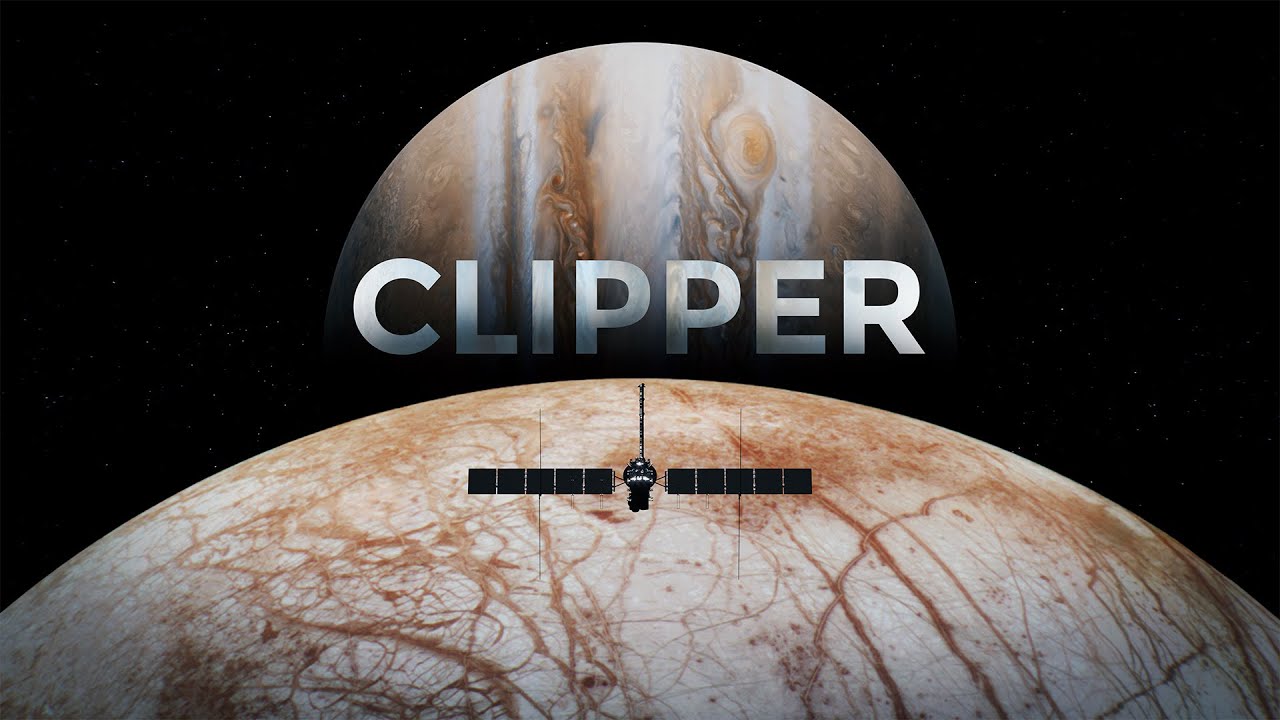
Maybe all you need is a planet or moon with internal heat or radiation. And a chemical composition that allows microbes to build the parts they need. Some scientists suggest that there could be ten of them in the solar system, hiding beneath a seemingly dead and frozen surface.
So as we learn more and more about the life below our feet, we may accidentally learn about life in the universe. You're lucky. YOU dont need to drill dozens of kilometers through solid rock to discover something mindblowing.
You can just order some inspiration right to your doorstep. This is a science project crate from our sponsor KiwiCo who deliver little adventures in a box. Let’s explore: there’s wooden components.
. and bolts and wheels. .
. and –transmitters? It’s the Delivery Bot Kit, that teaches the basics of radio control in a playful and intuitive way.
This crate is part of the new KiwiCo Labs learning club – a subscription that takes you along on a learning journey for young scientists to be. Consecutive hands-on projects help develop and strengthen problem-solving skills on things like science, engineering and robots over time. There are also different programs available on topics like world geography, or art & design, all with their own high-quality crates and exclusive online content to unlock.
We’re not gonna pretend this time that we got it for our own kids, we just ordered it for fun – but we can attest that it makes a great gift for any niece, nephew, godchild or other little one in your life. We like KiwiCo because with their new learning club program they are fostering a mindset of making learning something that is an ongoing exploration, just like we want to. If you want to try out the new KiwiCo clubs, click on the link in the infobox or use the code KURZGESAGT to get 50% off your first month of a monthly subscription to KiwiCo.