All right, welcome everybody to the uh POPS and bioolids uh stakeholder meeting. If anybody has any technical technical assistance needs, they can call 518-428005. Um at the conclusion of the presentation, we will have a uh Q&A. Uh it'll be through the chat box. So, if you have anything uh to ask or any comments, uh you have the uh chat icon in the bottom right hand corner of your Screen. Uh with that, I'll turn it over to Molly Trembbley and we will get started. Thank you. >> Hi everybody. Uh good afternoon. Thanks everybody for a great
turnout. Uh we're here today because we all have an interest in PAS and recycled bioolids. Um I want to start out by framing what this meeting is. This meeting is an initial presentation and chance to ask questions and provide feedback on potential regulatory revisions to our Part 361-2 and three rules governing the recycling of bios. Uh your input from this meeting and any subsequent follow-up will help us as we draft updated regulations to incorporate these emerging contaminants into the existing rules. This is not going to be your only opportunity to comment on these revisions to
the regs. There will still be a formal comment period that comes with the full rulemaking process. Uh we welcome feedback and suggestions or Ideas today definitely but if you um you know if you still have you will still have an opportunity to provide more formal comments and feedback when the draft rags are actually made public. Uh this meeting is a way to bring you in early to the rule making process so you have additional time to consider what may be proposed with the rule and to offer some feedback. Uh we're holding on to the registration
attendee info. Um so I think when you Came in you had to check whether you wanted to be contacted or not. So that we'll hold on to all that and we'll send updates to your email about the rulemaking process so you won't miss any announcements or important dates as we progress. Um I also want to mention before we dive into specifics um there's a larger DECwide PAS work group uh bioolids is but one of many topics that we're tackling uh from aid to remediation water fish and wildlife Solid waste management. Uh there's a lot going
on at DEC and our sister agencies to address PAS in all media and aspects. So, some of these actions were actually outlined recently in the governor's press release. As we know, there hasn't been enough federal action to control PAS contamination, but that's not stopping New York from taking the necessary steps to protect public health and the environment. Uh, DEC is moving forward Regardless, trying to tackle PAS across all environmental media. I'll also mention that this rulem is only part of a larger overall program at DEEC to manage PAS and bioolids. We'll discuss much more of
this uh but I wanted to be clear that we're not just developing regulations. There are multiple program policies on this topic. We are supporting research on the environmental impact of PAS and bioolids both with Sunni ESF as well as Sunni Albany. Uh we Funded two initial sampling programs because we know having data is important to see the impact of what's to come. Uh so regulations are a major piece of this overall effort. All right, let's make sure my slides are moving. Awesome. Great. All right. So, let's move into some of the some of the details.
Okay. Let's start by talking about where bios come from. Bioolids are a byproduct of the wastewater treatment process. So, residential, commercial, and some Industrial sources. So, mostly our homes and businesses send their waste water to be managed by works or water resource recovery facilities. That's where it's treated by several different technologies before it's allowed to be discharged from the plant. We have just over 600 works in New York State, as you can see, from everywhere, rural, small to giant city plants, all different sizes and treatment methods, and they all have to deal with bioolids in
one Way or another. They're a byproduct of the overall treatment process. Uh bioolids settle out or are removed after treatment, and they're sent for one of several different end uses. One of those options is disposal. So that means taking the bioolids and carting them to a landfill or a waste combustion facility. And you can see from the pie charts approximately how much is being managed this way in New York. So the bigger chart there shows the breakdown Of how bofils are managed. So um landfilled, incinerated or beneficially used or recycled. As you can see there
about 70% of it is landfilled. So in total only about 16% total of bioelves statewide are being sent on to some form of recycling or some form of beneficial use whether that be composting, land application or another process. Nationally that number is around 50%. So while it's a small program comparatively here in New York we do think it's an Important one. I'll also add that DEEC does not dictate how a municipality chooses to manage its bioolids. So these decisions are made by the locality based on a lot of different things. uh size, sustainability practices, costs,
hauling, logistics. There's a number of factors that weigh into that decision overall. And DEEC does encourage the beneficial use of bioolids, calling it out in the state solid waste management plan, the climate act goals. But like Any recycling practice, it needs to be controlled if it's done properly in accordance in the with the regulations. It can have real positive impacts. Some communities have invested a lot of money into developing effective and technologically sophisticated recycling facilities. um they want to get this right as well. And so that brings me into our next slide, looking at the
regulations as they exist today. Uh in New York State, the solid waste Management facility regulations part series. Um in order to process biosids, you you need a permit. You always need a permit with DEC to recycle bios. There are no registrations or exemptions or other regulatory tiers for that waste type. uh any amount of bioolids required uh recycled requires a full permit process and New York state's rules were developed in parallel to EPA's part 503 federal regulations. Um but while they are very similar, New York's roles are a Little more stringent. We have additional operating
control, tire pollutant limits which help minimize risk even further. A lot goes into the permit applications here at DEC ahead of approval. All the permit applications need to be certified by a professional engineer and include all relevant plans and maps that are required in part 360. So there's two main areas of bioolids recycling that you'll hear about. You probably know them as class A and class B. Uh this is really referring to the types of processes that the material undergoes to reduce pathogens. Um, class A bioolids are treated to a level that there are virtually
no detectable pathogens in the final product and the end materials typically have a much wider use. Uh, this could be like a a compost, a heat dried pelletized product, uh, something that's undergone another pract process dictated in the reg to remove pathogens effectively to Be determined a class A product. Class B bioolids have significantly reduced but still potentially detectable pathogens and those require um additional management practices for land application. These permits, these class B land application permits um are for applications on usually agricultural land and must follow specific site management strategies to reduce public health
and environmental risks. So this includes things like um limiting public Contact buffer zone requirements, uh slope restrictions, incorporation rules, limits on grazing animals and the types of crop, etc. Class B permits uh require the site operator to analyze the bioolid sources as well as the soil and to detail every uh field receiving bioolids within the permit. So each field that's going to receive bioolids under the permit needs to be looked at to determine nutrient needs of the crop. Um it also looks to Determine application rates which will be different from crop to crop depending on
the crop's agonomic needs. And they also need to um an applicant also needs to include not only in their permit but application but their annual reports um their anticipated plan for next year's applications and and all of that data. So PAS is not currently required to be tested in the regulations federal or state uh for bios. This is why we're moving forward with the role making at This time and we know that revisions to the rags are never a fast process for better or for worse. Um that's why we established two interimm policies to obtain
data and reduce potential risk while we work to finalize new rules. All right. Okay. Sorry if you see me looking to the side that's where my slides are. Um, all right. Our first policy, DMM7. Talk a little bit about that. This establishes interim POS and POA Sampling criteria for recycled bioolids sources. Right? So from the wastewater treatment plants from the WROS and the actions that DEEC will take based on those results. These are the biofields coming directly from the worps or treatment plants and they're either land applied on agricultural fields or sent for further processing
like in a compost process etc. So when DNM 7 was issued it appeared that EPA was moving forward with revisions to federal part 503 to Address PAS and recycled bioolids. It's no longer totally evident that EPA is moving in that direction. So DEEC is not going to wait. Um but part of a rulemaking obligates us to assess the impacts um or the changes that the new rules could have to existing and proposed facilities. So we can't do any assessing if we don't have any data and we recognized this needed to be addressed and that a
program policy was the most effective way to move that Forward. It helps us to um adapt to new test methods to troubleshoot issues at labs or common analytical issues that we're finding with the methods um and also to learn more in order to support the rulemaking as a whole. All right, let me pop over here bring you some of the details. All right, perfect. All right, this policy is taking major steps towards setting the first PAF standard for bio cycles in New York. the the first go. For those unfamiliar with other states like Michigan's extensive
work on this, they were able to analyze their bios and determine which plants were most impacted by industrial sources coming into the plant. Uh we use their results and findings as a basis for the concept of DMM7. In essence, we're limiting bioolids limits to levels that reflect impacts from the home, not industrial sources. So these are PAS that come from Toilet paper and other consumer products. the PAS that homeowners are directly exposed to through the products they use every day as opposed to industrial discharges. All right, so looking at this whole issue through a wide
lens, we know that removing the contaminant from entering the waist stream to begin with, right way upstream really gets us the best, for lack of a better term, bang for our buck in terms of controlling pollutants. Uh, historically plants have had a strong emphasis put on pre-treatment programs and we've seen significant reductions in pollutants from those efforts. Uh, same concept here, right? we remove the industrial impacted materials that move through the wastewater treatment process and end up in bioells. Uh DC is also looking to control those sources through other requirements. Um and a and a
lot more is happening upstream at at pollution Control. So landfill leate treatment rules um prohibitions on the use of PAS in certain consumer products like food packaging, apparel, there's firefighting foam rules right there. We have a lot going on in terms of removing them the pollutants from upstream. Our other big intent here was to start gathering data with this policy. Uh unfortunately at the time there were long lab time frames and we kept hearing about the difficulties affording or Finding labs for a lot of facilities. And in order to address these concerns, BEC decided to
commit significant staff resources and funds to conduct that first round of sampling. So BEC trained dozens of our own staff on sampling methods. We visited every WR that recycled with bioolids and sampled the influent effluent and bioolids there. Uh we also which was about 90 plants total if you remember from the previous slide. Uh DEEC also contracted with Sunni ESF To analyze those samples in their lab and take a closer look at potential sources and PAS changes in the unit operations. So ESF was already engaged with this work at the time and had experience researching
and analyzing for PAS. Uh they're able to take a look at each plant with a research perspective and really see what's going on. Unfortunately, some delays and equipment issues did slow the project down. We're behind where we wanted to be overall, But we're working closely with ESF and as of this week, we have some of the data and we're able to start getting it into the appropriate format to share widely. So, hang tight. I know there's been a lot of requests, a lot of people waiting for it, but we're working on it right now. ESF's
final research report um when that comes to when they're all set and have everything u publicized, we'll also be publishing that on our website when complete. Uh we have a second state funded program that I'd also like to talk about. Um we often work closely with our division of water staff on these issues and they were able to coordinate with a DEC funded u private ELAP certified lab that will be handling additional samples from these same 90ish works that recycle their bioolids. This was done for through um a request for information or RFI process. And
we've sent out about 50% of the sampling kit so far. This one Works a little different in that we're providing guidance, the sampling kits, and prepaid shipping labels to the staff at the works so they can take those samples themselves and have them analyzed at no cost to them. Results are starting to come in from this study as well. You'll be able to see them posted um on DEC's public website. There's actually a an information portal that the Division of Water runs with emerging contaminant information at Speedy's Permittes. And so all the data from that
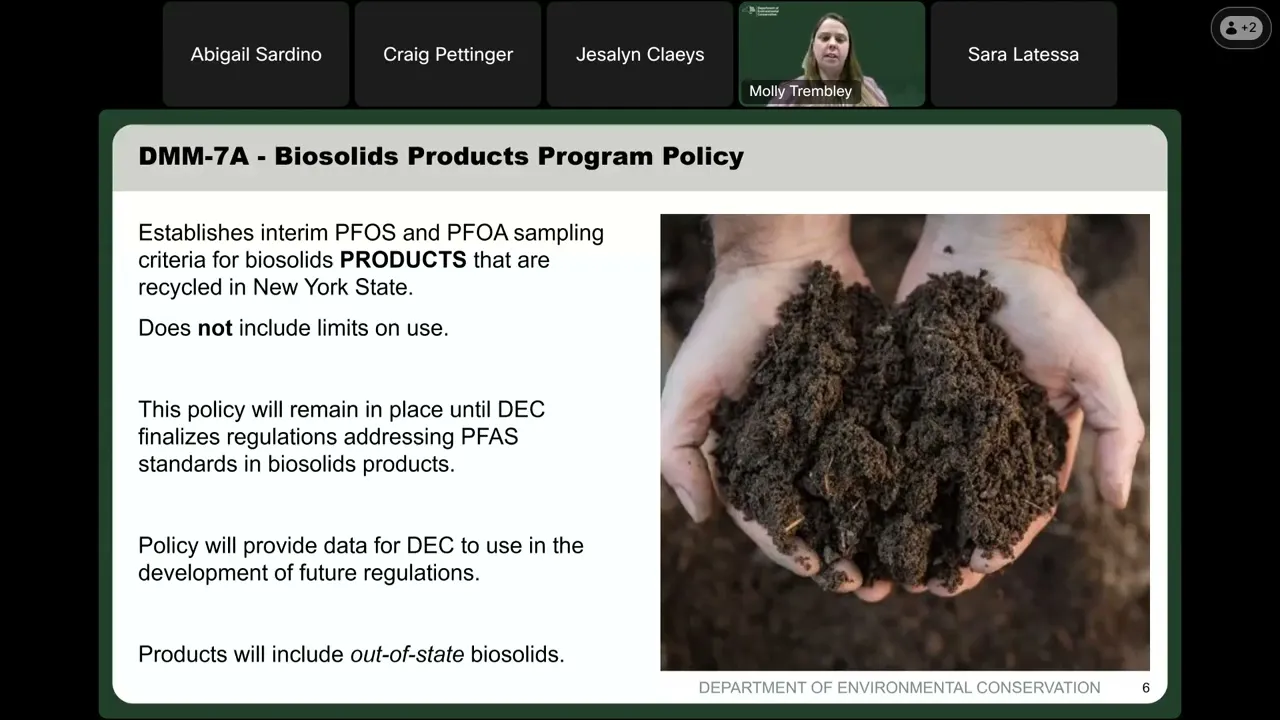
lab um lab study will be posted on that platform. All right. Hop in here. All right. CMM7A. This is a new policy um that just went through a short public comment period. Um we've been reviewing all those comments now and are prepping the final policy to be issued sometime this month. Um DMM7A builds upon the requirements of DMM7 in that it requires more sampling. uh this time we're looking at the products generated from bioolids. So right the the compost the digestates the the class A materials. So where DMM7 focuses on the bioolid sources here we're
looking at end products like compost. So while 7A requires sampling uh I'll say it does not set any standards on or limits on use of the product. So since we are close and involved in the rulem process now that Effort is really the best avenue for product standards and we'll be looking to add that in the draft 361-3 revisions. Um the data that we get from 7A from this policy will help us further understand what impacts would be to existing facilities under potential new regulations. All right to the fun stuff. All right. So, controlling environmental
risk is more than just pollutant standards, right? It's also about controlling overall exposure. Uh, a change being considered in the rules is to further restrict the types of crops that can be grown on agricultural fields where biolids are applied. The time limits would be removed. No food crops can be grown on those sites. Um, another addition is we would be removing livestock grazing as an option. So no livestock grazing at all will be allowed on class B land applied um agricultural fields. These Are conservative restrictions given the soil standards that we're going to propose, but
it provides additional significant uh safeguards. We're also looking at requiring sampling and analysis for PAS in bioolid sources as well as products. So again continuing to require the analyses that we started looking for under DMM 7 and 7A. We're also considering requiring soil sampling at land application sites or FIFAs annually. Each field would need to Be sampled and approved um before land application can actually occur there. Finally, we're considering using the philosophy that our division of environmental remediation uses for unrestricted use of the soil. So, I'll explain that a bit more on the next slide.
Uh something else to note, um we've been working really well with um other agencies when considering uh the EPA risk assessment and moving forward with Our own regulations. Um not only just internally DEEC with environmental remediation and water staff, but also our New York State Department of Health and New York State Department of Agon Markets have been instrumental in helping and guiding us along. All right. All right, here's a summary. This slide is a summary of potential standards that bioolids recycling permittes would need to meet. So you'll see in the top half, Those are what
bioolid sources destined for land application or class B will need to meet to be applied um in the proposed REC. These are also what we are proposing class A bioolids products need to meet. Again, with the data we received from DM7 and 7A, we'll be able to assess the impact as the rulem proceeds. So below those numbers, our next chunk down, you'll see maximum soil concentration on egg sites. So this goes back to what we were talking about with The soil sampling data. But with that field data, we're looking to assess whether the field is
appropriate for biofile application in the first place. So we envision being able to calculate the site life of each field, similar to the process done for metals in the past, but this time for PAS loading. Uh, for those unfamiliar, um, our division of environmental remediation took a really comprehensive look at background PAS so oil levels in New York State. You can Check out the full report on DEC's website. Um, but basically they looked at sites that were unimpacted and uncontaminated by industry and found in various rural areas across New York State. So what we're proposing
here and what concept we'd like to follow is that bioella gland applied should not elevate pest levels in the soil beyond typical rural background soil levels. We recognize this is very conservative Because of the other restrictions we already discussed like no food crops, no grazing. Um a higher level may not actually pose a threat in this scenario but given the uncertainty that still exists concerning leeching, crop uptake, etc. uh at this time this was the appropriate approach. Uh we plan to provide guidance on calculating the site life and impacts of bioolids as it is applied
to land for permities. Um we know this is uh a big Change. There will be a bit of a learning curve as we get going, but we're comfortable providing guidance and and moving forward with helping applicants uh figure out how this is going to work. Uh we want to get a draft rule out to everybody this spring so we can begin the formal comment period and all documentation associated with a formal rule making. In the interim, we'll continue to keep sampling under DMM 7 and 7A and supporting research Efforts to help us fully understand the
impacts of seats and bioolids. All right. Um again, I really appreciate everyone coming out today to listen, ask questions, comment. I'm sure we have some questions that have already come into the chat. I've got some colleagues in the room that are helping me navigate those. Um, but feel free to add anything you want us to answer in the chat box. Now, if you want to add question, Comment, feedback, anything. Um, if we're unable to get to any specific questions today, we'll be sure to follow up. We already have your contact information from the registrations. Um,
but I I hope to get to at least most of them today. Uh, constructive feedback is also always welcome. Um, if you're more comfortable sending feedback outside of this webinar, not everybody likes to speak up or type in the chat. Um, or if you think of something later, um, like Feel free to email our group here. We have a general email address. Actually, I should pop up my last slide here, bioalida.dec.ny.gov. Our whole group uh, manages that inbox and somebody will be able to look at your comments and questions there. Thank you again. Really appreciate
your time. Um, and I think we'll we'll get going starting to look at I'll leave my uh end slide up here so you can see the bioolids email for a little while and I Think we'll just start diving into questions. So, um, feel free again to add things in the chat while we while we prepare and look at those. All right, great. We have a question about how soil concentrations will be calculated. Is it average over specific depth? Is it based on soil type, etc.? >> Yeah. No, that's a good question. And and any feedback
you have on that topic Is appreciated. You're welcome to send it in or or or let us know. But um currently, as we were thinking of proposing it, it would be um soil samples would be required to be composite samples and we would be looking at the median of those soil samples across each field. Um there are will be more specifics in the draft, but if you have any, you know, um proposals for that or or something you're thinking of, feel free to send it in. Um but Yeah, we're looking at median average across each
field. >> Um and then related to that, someone asked, how does the max soil concentration apply to class A products? >> Yeah, that that's different. So um class A products, um as you know, they have different restrictions on them, right? So they're not actually permitted per field that they're applied on. So a final class A product um would not have the same restrictions that a class B Land applied product would. However, if there is a class A product that's going to be land applied um for more than 5 years, I believe we we proposed um
then you would need to come into the department and look at the site life just like a land application site would. So um nothing generally uh required for that. But when uh consecutive um applications are done with the same product, we would look at that site um for for site life. >> Um someone asked, will livestock feed crops still be allowed to be grown at class B sites under the new proposed changes? >> Yep, good question. Yeah, feed crops are still okay. Um the way we're thinking of proposing it now is to restrict food crops.
Yeah. But yeah, livestock feed fine. And then somewhat related, is the livestock grazing ban a deed restriction or a time restriction? And what proposed time frame would you um would we be Looking at if it was a time restriction? This would be a restriction in the permit altogether. I I don't know if I can answer exactly the whole I don't think there's anything tied specifically, but it would be a restriction in your permit document. um >> right it would not be included in a deed restriction which you sometimes see in remediation sites, >> cleanup sites.
This is not that kind of restriction. This is during the life of Your permit and part of this is because we expect to have more information 5 years from now or 10 years from now and see if these things may change. So at this point it's during the life of your permit you are held to that restriction but they're not required to put it in the deed. Thanks. Um we have a question about changes um if any of these changes would be affecting municipalities broadly. I guess in a way yeah so any Municipality that manages
bioolids which is all of them. Um but those that um recycle their bioolids yes it's it's possible um the onus on the permit is on the permit holder right when we do these regulations. So um part the part 61 361 permitted facility uh and the permit holder is responsible for getting us all that data all those analyticals long term. Um so it's it's on that but it will come down to looking at every waste type and bioolids come From a municipal wastewater treatment plant right so um it will affect municipalities in that yeah there may
be different management options that are required for your waist stream. Related to that, another person asked if the department has considered any additional or specific funding mechanisms to assist municipality municipalities with the additional incurred costs these proposed regulations. Yeah, that's a good question. Um, we do have two two funded Sampling programs in the works already to help alleviate this. Um, we've considered other things as well. I I I don't have any specific additional program to discuss at this time unfortunately, but we are looking into that. Um but for now funding the sampling and working in
that direction has been how we can help with that. >> Um we have a question about the background soil concentration um asking how they will be evaluated or monitored And how that's different from the current arrangement. >> One more time. Sorry. >> I think you might have touched on this a little bit. I think this person um maybe just needs a little bit of clarification. They're asking how background soil concentrations will be evaluated or monitored and how this will be different from the current arrangement. >> Yep. So, right now, um there there are Soil samples
taken for pH and things like that to make sure that the um the application is right and the crop's going to not be hurt, etc. But this will add C1633, right? So the PAS um the full suite of PASES to the soil uh to the sorry word to the soil sampling that's required in the permit application. So that field will need to be sampled composite samples across I believe uh every there's a certain frequency that'll be outlined in the Rags of how many per acre. Um and then uh you'll calculate the median of each field
um in order to determine if it's suitable for land application or not. Um, okay. So, this one is kind of a a long one, so bear with me here. >> Um, this person said, "Dec standards in DMM7 are 10 times less protective than main standards, which were created five or 10 years ago before the state banned land application, that state being Maine, um, in 2022. Main standards for PFOA and PFOS were determined based on modeling to avoid groundwater contamination using EPA's um PFAS less than MCL of seven parts per trillion. Main standards were 2.5 parts
per billion for PFO and 5.3 parts per billion for PFOA. New York State's MCL are 10 parts per trillion and EPA set considerably lower MCL's for six different PAS. and Maine has adopted these MCLs and Wisconsin is adopting them. Um, this person also said that Pretending that only PFOA and PFOS matter is very cynical. It has been demonstrated that PAS compounds are transformed into new PAS at wastewater treatment plants and in the soil and at composting facilities. Thanks. Yep. We'll tackle that to start. Yeah. a little bit with what's happening in and not to speak
for Maine but our our understanding of what's going on in Maine in terms of standard setting. Originally there had standards set for Soil based on potential remediation sites and groundwater standards based on modeling of what potential could happen to groundwater. Um they have since then in Maine they've actually went out and sampled the sites all the land done groundwater sampling soil sampling at land application sites and they have found that the modeling for groundwater seems to be overly conservative. They don't see the groundwater impacts that were associated With the concentrations in the soil. So they're
rethinking that issues as well. Also uh looking at again the numbers we're looking for in soil here are come from background soil studies which our remediation group has shown from their sampling to date have not caused groundwater issues. So we expect the same here. Again the numbers we're looking for in the soil here really are the key to great protections for groundwater sources and other there. Question of yeah what parameters of course uh PAS goes well beyond PFOA and PFOS we understand that we are requiring sampling of the host suite that's required under the only
approved test method at this time for PAS so we'll have 40 parameters we have we can only set those standards on what data is present for the most based on toxicity and availability research and right this at now we're comfortable at PFOA and PFOS Meet both the risk standard and the availability of data. That doesn't mean we won't continue to look at those other parameters that that may show up in that suite of 40 or test method increases. We'll also look at top assays, other total flooring, other test methods we're aware of that are out
there to look at these materials. And that's part of why we're sponsoring research at U Albany and other places to look at is there a better way to look at the whole group or Look at the impacts from the beyond just those two parameters. But today understanding it's a dynamic area of research and and looking at impacts we see think this is appropriate for where we are right now. >> Thank you. Thank you both. Um, next up, someone asked, um, I I think this is maybe something where we just need a little bit of clarification.
Uh, why is DMM7 not focused on industrial sources? Molly said only focused on home Uses. Industrial sources would contribute more PAS so that it is the focus not on mass source. >> Yep. No, didn't mean to confuse. Um so DMM7 and the the levels that are uh dictated within it are actually focusing on um removing removing bioolids that have high industrial impacts to them. So we want to uh be able to look upstream and see some of these sources. if they're coming in too high, right? Then they're clearly Industrially impacted and be able to look
upstream and and either potentially remove those industrial sources to the plant or remove that as a a source that can be recycled to a facility, etc. So, it's really looking at having um we we want the solids uh under DMM7 to reflect more of just a homeowner influence as opposed to industrial impact. So, sorry to confuse there. >> Awesome. Um, I'm trying to kind of group our questions together into similar Topics as we're kind of coming in as they're coming in. Um, so we talked about some of this earlier, but some of these questions weren't
in yet. Um, let's circle back to um some of the agricultural concerns. Um, someone asked if there's concern that feed for livestock grown in these fields would lead to contamination of their products such as beef, their beef or their milk. >> Yeah, that's a good question. um from the research that I've looked at to date Um it's not as large of a concern that pathway right so when we're looking at risk that's we look at it through different pathways um food crops for direct human consumption is the one that we're going to be limiting here
that's the one that has the highest impact on you and direct uh livestock grazing research that's been done to date has not shown that these crops fed to livestock are as as as impactful so to date that's what the research is showing Us we're also looking into um there is some research that I believe we mentioned with Sunni Albany uh looking at general crop uptake and so we'll have a lot more information there um about what types of crops may you know uptake it more etc and that research again is is it's really dynamic and
it's really changing every day and still being conducted. So, um, but the short answer to your question, there would be no restrictions on feed crops and no Department's not currently concerned about those materials going to livestock. >> And remembering again that the soil limits we're setting here are based on rural unimpacted soils, unindustrial impacted soils. So these are soils that are out there today without any bioolids, without any other materials, probably not even in agriculture for the most part. So the expect the material crops are already being grown on these Today those kind of things.
So we're looking at levels that essentially background levels as has been determined by sampling. So we think the risk is very low because because of that choosing to take that stance in these regulations. >> Right. Right. That that conservative stance gives us >> uh >> more assurance that there's not going to be a problem. Um, Molly, I think maybe some people are having trouble hearing me. So, someone asked if you could repeat the question before you answer it. So, if we could just do that moving forward. Yep. I'm loud. Sorry. >> I I think I'm
just too quiet. I don't think it's you. Um, so we now have a couple questions on out of state bioolids. Um, first they asked how will you track out of state bioolids? >> Yeah. Um so currently bio out of so the Question is about how do we track outofstate bioolids those are currently permanent um those are currently need an approval to be distributed in state so if you have a class A bioolid material that you're generating out of state and you want to distribute it in New York state you need to come into DEC for
um an approval process it's under our regen 361-3.8 eight. Yep. Um and uh that what that incorporates is um basically you need to Come in and show us that you're meeting the same standards for your class A product that we would expect here in in New York State. So we look at your existing permit in another state. We look at the analytics from the product etc. And there's also an annual reporting process in this. you get a um you would get an approval um if everything checked out for five years and you need to come
in every 5 years and and show us again all the analytics Etc and your existing permit. Um again there's an annual reporting process. So every year they send in the report on like how much was distributed in New York, the analytics, the lab sheets that go along with those products and DMM uh 7A will um it as when it is released um it will incorporate those into it as well. So all of the products coming in from out of state will need to be sampled under DMM7A just like the products that are created in New
York State. So any bioolids product being used in New York state will be covered under DMM7A. So they'll need to start sampling for the full suite of PIA. And then someone asked what kind of new restrictions oversight are being considered for biota being shipped in from out of state. Yep. So I think I I answered that a little bit already but same idea. We are going to hold um biofields coming into the state to the same standards that we have ones that Are developed in state. So that would become a part of um that all
that same sampling and analytics will become part of their approval process just like the ones in state do. >> Awesome. Someone asked if biochar derived from digest state or other more conventional sources such as woody waste fall under DM7A. Um so I I think the question is getting at like wood developed biochar. So the feed stocks for those um typically are Like wood and and you know other carbonheavy products. I don't believe that. So if there's no bioolids right the residuals from the wastewater treatment plant involved in that no then these don't apply to that.
So biochar created from wood waste etc does not fall under the purview of of DMM7A >> but if there is some work and some talk about making biochar from bile solids in that case if the facility is producing biochar from bioolids then these the Policies and the regulations would apply >> right >> but as Molly said it's restricted to those that accept bioolids >> and if someone was making a biochar from a bioolids right of residuals from the wastewater treatment plant process. They would need to come into us for a part 361 permit. >> Awesome.
Um we have a question about um PAS destruction treatment and if DEC Will be supporting PAS destruction treatment tests in the near future. >> Yeah, that's a really great question. I unfortunately don't work in PAS destruction techniques, but I've been doing a lot of research and following along what other divisions have done. Um I mean I would I would keep active and looking for that. There's a lot of work being done not only on the remediation standpoint but at treatment plans and themselves. So keep posted. I Unfortunately don't have a lot of information on that.
>> Good. Um thank you. What are the lab test detection meth levels for PFOA and PFOS in soils? So what are those detection limits at the moment? >> Um it's going to depend on the lab. Uh everything's going to be done under the everything that we are proposing under DMM7 7A and any um upcoming rulemakings are all going to require that they use the most up-to-date um approved method By the EPA which currently is EPA method 1633A. So you can dive into all the specifics of that um if you'd like. So but it's really going
to depend on the the lab, >> right? And Molly did mention on our DEC website there is a rural soil study and you can look at that you'll see the labs were able to get to well below less than one part per billion in the soil. So if the question I think is getting at can you know are the labs are going to be Able to get down to detection limits that were near the requirements we're looking at in the regulations. We don't think that will be an issue. >> Yeah. Yeah. And as issues have
come up um throughout industry, right? There's been um some struggles for example with um like uh high water content sludge, right? So it's it's harder to sample, you know, liquid sludges and solid sludges. These these problems are being worked out by labs as we progress. So There's been multiple ways to deal with that now. And we're starting to see much better detection limits in labs as they progress and figure out exactly what they're doing and and getting a handle on all these methods. Um so sorry here we go. I'm back. Are we anticipating PAS testing
of bioolids that are sent to landfills? They say this could be a big source of PAS for landfill leate and want to hear our Thoughts on that. >> Yeah, it's a good question. Um so we are not proposing that in a 361 rule making. 361 rules really focus on biofal recycling facilities. Um what you will want to look into though is there is a draft rule making for landfill lead if you want to get involved in that discussion. There is also another um uh meeting on I believe February 11th. You can check that out on
our website. Um but no I there we do not have any Intention of requiring bioolids on the materials management standpoint to be sampled um for going to landfill. I'll uh I'll let if anyone from um division of water wants to jump in if they know of anything that's required but as far as our rule making goes nothing's going to be required of bioolid facilities that are just disposing of their bioolids. >> Right. It may be required by the landfill, remembering that the landfill Owner operator always has the ability to require testing and setting limits themselves
of stuff that they accept into that landfill. So there's really two levels. What DEEC requires of that landfill before accepting material and then what that landfill itself may go beyond that to what they require. So you really need to talk to the landfill directly. >> Right. That's true. Yeah. always check with the disposal facility to see if They're accepting that when they can, if they can, and what requirements may be on that just for that facility itself. >> Has the department given consideration to banning the use of bioolids on agricultural land completely? >> Um, has
the department given consideration to banning the use of bioolids on agricultural land completely? >> Yes, we have considered that. Um, obviously that's one of the many options That could could happen. We've we've talked about it. We've looked at it. Um, but we feel that these restrictions that we're proposing now and uh not like not only the analytical standards, but also just the site restrictions, you know, incorporated with what we already have, the buffers down, the slopes, the incorporation requirements, public contact limitations, no more grazing, no food crops. We feel like all of this put together
minimizes the risk and we Decided this is the right approach. Um but yeah, we had considered that we had considered um completely ending class B land application. We think that this is the right approach to go forward at this point. Um we're really looking forward to getting more and more data back to see what everything's looking like as we've started peaking so far. Um most of the samples that have come in have been under the MM7 limits. So, we're um optimistic that, you know, we're in a Good place here. Um but yeah, it was considered.
Okay, we have a few more questions I've kind of bunched together about um sampling. Some of this stuff we may have already touched on a little bit, but it's hard to keep track of when the questions are coming in. So, maybe this person asked before we we answered it and I just didn't realize. >> Oh, good. Um, so will sampling and analysis be just for PFOA and PFOS or The larger class of PAS chemicals? Um, and then related to that, someone else asked if there are plans to test or include standards for um, PAS chemicals
other than PFOA and PFOS, especially since those two chemicals are being used less by industry now. >> Sure. Yeah. No, this that's a good question. Um so right now the um prevalent testing method that's approved to be used EPA method 1633 or 1633A um right now that looks at about 40 Different PAS compounds. We're requiring that the whole suite of PAS compounds be sampled for. um not only just for more information, but yeah, as we progress down the line, more information comes up that you know, we determine that one of the other PAS compounds needs
attention or we need to look at it, we'll be able to have a good idea of what we're seeing there. But yeah, any sampling that's required under this or and and both policies um have us doing the whole 1633 Suite of 40 compounds. So yes, they will need to do all those. No, there are not currently any limits or standards associated with PAS other than POA and POS. >> Um, and then on that topic, someone asked, um, why shouldn't we additionally test for total organic florine and have regulations around this? That seems like it would
be the most conservative. >> Yep. And that's a bigger question. Yeah, we are aware and part of the Research that you're funding at again at U Albany is looking at uh top assay or the oxid oxidizable parameters and also organic florine. It's it's there's a couple issues with putting it in a regulation right now at this point in our in our opinion. One is there test methods have not been certified for in this matrix. So getting consistent results for top or organic florine across laboratories is an issue. When it comes to organic florine, we Also
have to look at that gives you an idea. It's a good kind of base of whether there's any obviously florinated compounds in there, but it doesn't give you an idea of the breakdown. And remembering that not all these compounds have the same toxicity. So we just a total number is a good screening tool. certainly good in uh when you're looking at consumer products, things like that, but when you're looking at environmental risk assessments and that you need a More finite breakdown of the individual compounds and again, you need a test method that we can use
again and again with assurance. So that's why we're we're doing it on the we're funding it on the research level at this point, but we don't feel comfortable putting it in a regulatory context. Great. Thank you. Um, and just to um, kind of answer a question I was seeing in the chat about who we have here on The room. I know the way we're coming through on the phone. We're all under Molly's name, but our main presenter here is Molly Tremley. I'm Jesseline Clays. The person who just answered the last question is Sally Roland. We
all work for the DEC. >> Yeah, we all work on Bioolids here. So, when you see my mouth not moving, I'm I'm not a ventriloquist. there's other people in the room assisting with answering questions. >> I've grouped together a couple um more kind of agricultural questions for us to to talk through. Um someone asked if we could give a rough estimate for a typical application rate per acre. Um I believe that was referring to um class A bioolids, but I'm not sure. It didn't say in the question or sorry, excuse me. I believe that referring
to class B bioolids, but they didn't say in the question. >> Yeah. Well, as part of your permit Application, you have to propose what your application rate is going to be on each field. Um, so they're already doing that for the nitrogen needs of the crop generally or or whatever other limit may um dictate what they land apply there. Um, what this is adding what this would be adding was to look at the site life in terms of PAS. So um now they would look at they would there's actually a calculation that would be done
um between the soil and the the applied Bioolids themselves to ensure that it doesn't go above those levels that we discussed. So you'd actually do a calculation on the full site life of each field um based on your material that you're applying as well as what may already exist in the soil and both of those need to be analyzed for ahead of time. >> Right. Basically, as Molly said, it depends on the crop you're growing. A typical crop on in New York State for Bioolids egg application is field corn or uh which is not obviously
for human consumption. For field corn, you're usually depending on the nutrient content of the bile salts, but it's about 5 to 10 dry tons per acre per year. So, you would be driving your application rate based on the nutrient needs of that crop. Then you would look at what is the PAS in the soil and what can it how many years that's what we call site life. How many years can I Apply on that field before I reach that limit that we put in the regulation. So based on your application rate, you would calculate that
I can apply for 10 years or 20 years or whatever it is. Obviously depending on the soil level when you start, how much is in your bio sales and how much you're applying, but the application rate itself is dictated by the nutrient needs of that crop. Great. Thank you. Um the next question kind of related to this is someone asked If we could clarify the process of fields being quote preapproved by the DEEC before spreading. Which DEC regulator will grant approval and what is the timeline for that? Um it may make more sense to just
have a set limit that sample soil samples must meet before spreading. >> Yep, we hear you there. Um so it would be part of your permit application process and then um as you progress and you look at your annual reporting um you Would need to calculate that future year there. Um again we'll go through we take we'll note your comment also um and look at what we have now um but historically we've looked at that in um your annual reporting process of what you'll be applying for the following year. But we'll develop a lot of
different guidance and uh kind of help everybody along in the first years of this. I know it's going to be, you know, it's it's a big change. So, we'll we'll do a lot on Our part initially to get everyone educated and make sure that um you know, each field get correct approvals and and we're dealing with that appropriately. Yes, it is a little different than typically what we do is we require those soil analyses to come in with a permit application. But we are making an extra step here as Molly mentioned to say we want
to see your sampling plan before you do it. And the reason there is we don't want you to waste the time and the Money if you're not doing it appropriately because there's a lot of data coming out from different research studies showing how the levels vary by the depth in the soil and how the sampling techniques have to be appropriate. So we want to take that extra step to one make sure the data is applicable is to the and it's representative of the site so that the data submitted to us can appropriately be reviewed. We
don't want you to take The samples and then have us make you take them again. Um, as time goes by, of course, and people are more comfortable and we have better guidance out there and how sampling should be done. My guess is that will be become a much more uh routine process. All our regional approvals come out or all our appro permanent approvals come out of our regions. That was part of the question of who DEEC approves. our regional staff review these things. Certainly a central office where we work assist them, but it would be
part of your normal process of get going through permitting with your regional DEC regional staff. Great. We have a couple questions about ways this kind of overlaps with things DER, Division of Environmental Remediation has been doing. Um, they asked if we can clarify how deer's unrestricted use numbers would apply to a field in comparison to the higher Maximum soil concentrations of 1.5 and 3.0 parts per billion. >> Um, one more. >> You want me to repeat that? >> Yeah, repeat that one more time. >> Um, can we clarify how the deer unrestricted use numbers would
apply to a field in comparison to the higher maximum soil concentrations of 1.5 and 3.0? zero parts per billion. >> Basically, they're the same philosophy. Um, deer has not formally uh proposed Those numbers. We want to make that abundantly clear, but they're based on their soil study and we believe their intent is to go forward with the rule making. So we're basically using the same philosophy deer is saying uh through their program that using the background soil study to say this is what is found and these unimpacted not saying obviously PAS comes from air deposition
that's where the that's in these background studies but they're not A specific industrial source or majorly impacted so and based on their data that they don't see groundwater impacts at these types of sites it is likely they're going to go forward with these numbers, the ones we're using too to say this would be an unrestricted number, unrestricted soil use number. >> So the two programs are trying to line up in essence uh with philosophy of how we're treating the soils and the quality of you know the materials that are being Used for soil. Related to
that, someone asked what studies have been done to show that the background soil levels found by deer in rural areas have not created groundwater issues and they mentioned um the description of New York standards compared to main standards. So we have these background soil levels. How do we know that those levels aren't creating groundwater issues? deer has done a lot of work already looking at other sites And it's their opinion that the their sampling to date has not shown that these background soil conditions create groundwater contamination. Again, as you can imagine, as a remediation program,
they do a lot of sampling, get a lot of groundwater data, and that's their opinion that again, if you look at their background study, they also a very useful question and answer document that goes with that to help answer some of these types of questions, Too. Someone asked why PFOA andor PFOS 20 parts per billion for is 20 parts per billion for bioolids but 1.5 parts per billion for PFOA and 3.0 parts per billion for PFO for soil. Do bioolids not leak as much? That's a good question. So I'll start off. Um so the one
is uh criteria for the source material, right? So that's the material coming directly from the plant. That's the the treatment plant Bioolids coming in either to a class A facility or um direct to land application. That's the material that's being applied itself. That 1.5 and three those are actually referring to what needs the maximum that can it can hit in the soil after bioolids are applied. So when you're applying bioolids to a site right your site has a certain concentration your bioolids have a certain concentration and we're going to make sure that we calculate that
after Application that soil will be left with those those numbers 1 five and three that they'll be left at in the soil at those numbers or lower. So that that's the idea that we're trying to get at. So that's why there's two different numbers. Um is one is looking at the source material or itself and another is looking at what the soil is going to look like after it's applied. Exactly. And remembering that as we mentioned bios are applied at five 10 dry tons per Acre. The soil layer just six inches of soil has 2,000
tons of soil. So you're adding a very small amount to meet the nutrient needs of that crop. So you're not you're not you know you're not going to be resulting in a soil concentration of a 20 what from adding the bio solid itself and that's what this is recognizing again this is a has been done for many actually decades and looking at metal additions and things like that this is not a new concept when It comes to soil additions but it's something that we're applying here to PAS >> great thank you um we're going to
ask some questions about works. Now, for the thresholds, both bioolids and soils, this is not strictly works, but we'll get there. For the thresholds, both bioolids and soils, um, are we looking at median over specific time periods such as annual? And how many sampling events will be held for that time Period? And then, um, I think this is more for the bioolid size um, bioolid side. Um, is that number of events per time period going to be based on work side or work side, excuse me. Oh my gosh. Or will the scheduling will the samples
be scheduled like so many per quarter? >> Yeah. Uh a little of both kind of it when similar to how our regs are set up already. Um we'll be looking at to propose in in the regulations the Revisions to do something similar. So frequency of sampling will be based on the quantity that's generated. So similar to the way we do it now, it would apply in the same the same manner. So we'll, you know, it's currently in our rights there's a frequency table with how many times they need to go out and do those sampling.
We'll do something very similar to that for PAS as well. And it is the mean for bioolids annual Mean. So it's the average over the year for soil. It's what it looks like we're going to be pro proposing kind of wait and see but right now it looks like it will be the median over the year or over the number of samples in that that given field. Great. Thank you. Um can you elaborate on the upstream reduction from industrial waist streams? What kinds of recommendations are there for municipalities managing these? Yeah, That's a great question
and that goes even beyond our program as well. So, we've been really fortunate to work with our division of water very closely who and if you're familiar with this already, you're probably also familiar with uh the TOGS the technical guidance series and and the work that division of water is doing. Um, so one, we have a lot of great upstream programs, a lot of good like legislation that's gone through about homeowner things and stuff Like that. But when we get into industry, we have to look at the actual um types of industries that could be
discharging to these municipal wastewater treatment plants, right? To these works. Um so you know when when a PAS sample for example comes in at a certain level um there will be criteria for them to then look upstream and and while we don't dictate that from our program DEEC is working in their technical guidance series to be able to Provide information to basically speedies permites to be able to track down those things and and get them under control. It's going to be involved um additional sampling will be involved etc. Um, again, that's not uh my specialty
program, but definitely uh is happening and I would encourage you to reach out. Oh, Sarah, you're on. Would you want to jump in and and answer that? >> Thought I'd try to help you. >> Uh, Sarah Letessa, I'm in the division Of water here at DEC and central office and um I've been primarily responsible drafting our wastewater permitting program strategy. So I work very closely with Molly um as our TOGS Molly was just alluding to states if a facility is triggered under DMM7. So if they come back with bioolids results that are over 20 ppb
let's say or something else that's you know uh suspect let's say higher higher than background results we could um and intend on sending a joint Request for information to ask for influent effluent and bioolid data for a year um of quarterly sampling and once that data comes in um we'll analyze it and determine if a modification to their speedies permit andor their land application permit permit is needed. Um if so, that modification would require a track down program and municipalities that have a speedies permit or wastewater discharge permit must maintain a sewer use law um
per their Permit. And so they have that that allows them to require um restrictions on users of their system. So anybody that's discharging to their system, they can ask for additional monitoring, they can require pre-treatment requirements, um anything like that. So, that's kind of how the trackown will work. Um, they'll try to identify the source and then you uh implement their sewer use law to require pre-treatment where needed and we'll be providing additional Guidance as we learn more. It's also, you know, we're also pretty new in this. So, um, we have available resources available on
our public web page. >> Thanks, Sarah. >> Thank you, Sarah. We have a another question next about works. Uh, if you want to jump in, feel free to. Um, another question came in that said, "What changes does DEEC recommend for rural works that have a high such as greater than 20 levels of PFOA and PFOS But no industrial waist streams?" >> It's a good question. Hopefully, we don't have many of those. I don't want to take your your light there, Molly. Um, but where that does happen, we're um requesting that you document your track down
efforts. document that you have no controllable sources um and then let us know what the results of that track down program are that you know it looks like maybe it's a drinking water source or remediation problem and then from there We can adjust your limits um or action levels and um go from there it might require you know some kind of variance from our regulations if you don't have a controllable source but we need kind of the data to support that >> right thanks Sarah and then to add to that on the DMM7 mentality right
and of our mentality is that um you know if you're sampling uh and whether it's you know residential or industrial if they're coming in over 20 that source May be restricted from recycling right so that is the limit that we're proposing in the reg. So if a a source is coming in higher than 20 yeah that's something talk to us right we that's something that we're proposing would not be allowed to go towards recycling. So, while it may not impact, you know, your your species permit or or what you're doing there, if you're sending the
sludge from your to, you know, a compost facility or something like that, it may Inhibit that end use option for you. >> Thanks again, Sarah. >> Um, someone asked if we have an estimate of what percentage of bioolids may be recycled under the new rules. >> That's a great question. Yeah. And so part of um and I feel like I keep saying that so sorry but these are a lot of good questions. Um DMM7 and 7A are are hopefully providing us with a lot more data. So as we move forward down the rulemaking process we'll
be able to see A lot more um of what plants are are currently coming in at and how we think that the proposed numbers will affect those permits. So we don't have a a terrific idea right now. I suspect um that some plants will go in other directions. It's up to the municipality to see what they would want to do, right? How they're going to manage that end use in the end. But um on the way there, I think we'll gather a lot more information that allows us to see what's The realism of the situation,
what's being generated now, what what can we look to for these municipalities, and you know, how many may be impacted, how many may be um choosing different end uses, things like that. So that that was a mouthful basically to say that hopefully as we get more data especially with DMM 7A um we'll be able to see what that impact could actually be based on what we're proposing. >> Great. Um are existing permits going to Be held to the updated regulations? >> That's a that's another really good question. I got to stop saying that. Um so
existing permit so in every rule making there's something called a transition right transition to the rule making. It'll be part of the rulem process. It'll be outlined in the rules when you go to look at the draft. Um and that'll be how facilities um will transition into using the new regulations. Your existing facility, you Are um you are allowed by right to operate under your permit that you've been issued by the DEC until it ends. there is um the potential that the department we do have an option if we deem it necessary to do a
what's called a DIM or a department initiated modification. So that's always a possibility. Um but you're you have the right to operate under the permit that you have with DEC currently. And so when the information about um oh no lost the Word um as as the transition rules come out and you'll be able to look at those and comment on them. I think that um that'll give you a better idea of maybe facility to facility what makes the most sense for you. Wonderful. And then um someone said that they were wondering for a municipal wastewater
treatment plant that only sends its bioolids output to a landfill such as no selling or recycling for fertilizer. Does this Apply to them? Short answer is no. Great. Um, someone asked if there are any bioolid sampling or testing planned or sorry, excuse me, any PAS sampling or testing planned for bioolids that are sent out of the state. Uh, that's okay. Yep. Okay. So, those Okay. So, the question was, are there is there sampling planned for biofols that are sent out of state? Um, so if a part 361 permitted facility that, let's use an example. If
there's a if there's a compost a bioolids composter in New York State and they uh have a permit to make class A bioolids compost in New York State and they just happen to sell all of their end material to another place another state that doesn't matter as long as they are permitted in New York State they need to um meet the requirements under part 361. Now obviously right there we just discussed The transition and and that whole process but regardless like for a new facility coming in they would need to meet um all of those
it doesn't matter where the end destination of that material is. Um, now it's different if a if a WAR workf itself, so let's say a wastewater treatment plant or a water resource recovery facility, whatever terminology you use, um, if the WARF itself sends bioolies out of state to be managed there, that's different. Um, That's not being handled under a bioolid recycling permit within DEC. So, no, that work should should look at what the states that it's going to require and work with their DEC equivalency to figure out what they need to do. That's their best
bet. But if you are um if biofolds are coming into a part 361 facility or bios recycling facility in New York State permitted here, they'll need to follow these rules regardless of where the end destination of their Product is. Someone said that they are working through a class A permit process and asked if we could speak to source sledge limits and what they and if they should expect to keep sampling their source sledge um if and when they get approved. Yeah. So, uh, the source sledge coming into your class A facility, you you well know
now because you're in the permitting process that you have, um, things to you have analytes to measure Ahead of time. And then you will also have things you'll need to measure during operation. So, you just because you get your permit doesn't mean that um, you stop measuring the incoming source solids as you're operating. There's criteria for that as well. So, you will continue to do so under your permit. Um what this rule would be adding is PAT sampling requirements as well. So right now um you would be subject to DMM7 and the sampling Criteria that's
in there. Um and then after the 361-3 regulations are revised. You would then be subject to these pending all transition and and things there. >> For new class A municipal bioolids recycling facility >> under design. What amount of testing will be required on the bioolids to move forward with approval and construction? Will new class A bioolid recycling facilities be able to be approved and Constructed during the interim DMM7 limit? Yep. Yes. Um, nope. There's no there's we're not holding up permits because of the rule making or DMM7. Just operating as per usual. So, no, there's
there's nothing extra you have to do. everything's outlined there in either DMM7 or or 361 as it is currently. Um, so that's what you should continue to follow. Looking ahead, um, just know that when you are doing sampling, it's going to work very similarly to how the Regs are set out. Now, it's going to be you're going to have to sample based on a frequency outlined by the amount of bioolids that you are are processing. So a larger facility um will have to do more annual sampling than a smaller facility would. So just keep that
in mind. It's going to be similar to the frequencies that you see already in the 361 rags for sampling. >> Is DEEC collaborating with the Cornell FLX PAS team? >> Yeah, I don't know what the FLX PAS team is, but I'm going to write that down and I have it written down. >> Thank you and check into that. Thanks. Um, are there enough certified labs in New York State that test for PAS to handle this surge in PAS testing? >> Yeah. Uh, so initially there were there was a lot of trouble and that's again why
we actually first jumped on on board with doing um a state funded research project for for sampling. When we first Came out with DMM7, we heard from a lot of plants they were worried um about being able to find labs. And we heard that all over, right? The the methods were changing. we went from uh I think was it 537 there was another EPA method and now we have the um more sophisticated 1633A. So um as we've progressed more labs have come online. I myself have gone to several presentations by labs with you know their
lessons learned in processing Solids and water and different media and different media types um under this method. So it's definitely growing. It's growing all the time. Um, this is not something that like it's ELAP certified for example in New York State yet. It's it's too new. Um, but uh as long as under our if you're using the approved EPA method, that's what we want to see. Um, but yeah, the the amount of labs that can handle it and are handling it is growing every day. We're up to a Pretty good point right now where people
aren't having the same trouble they had back in, you know, 2021 when we were uh first starting to to look at sampling at this scale. So as it scales up, labs are also scaling up at a good rate. Um, we have a clarification question. Um, they're saying permit, so permits will be required for both class A and B bioolid recyclers. Will a farm then that applied these materials need to have a permit or will it just be the broker of The bioolids? And they also asked if the testing data will be public. >> Yeah, I
think there's a lot of Oh, there's a lot going on in that question. So I'll kind of pick apart little pieces. Um so even prior to these regulations they bioolids land application facilities have needed to be permitted. So farms that are taking bioolids materials and class B land applying it on their farms. They need to already have a permit with DEC. So that's far before this rule making is is going into place. They will should already be permitted for those fields. Um, if we're talking about class A materials like compost, finished compost, um, those are
not currently tracked the same way that class B is. So, um, from a few slides ago, I'll try to explain there. The only time we would look at class A is if it has repeated use on egg. So, let's say there's one field people are using repeated use of The same compost material or or bioolids materials um, repetitively likely an egg application. In that case, we would then look at that as department. It's going to be it's currently written into what we're trying to propose. Um, and so we would look at that similar to how
we would look at a class B site. So class B direct land application, those should already be permitted. Um, regardless of these rags, but when the revision goes in, we'll also be looking at class A That's repetitively applied at the same site to ensure that site life isn't going to be a problem for those as well. In just to clarify for both currently and in under these proposal for class B sites it doesn't mean the farmer has to hold the permit. The permit can itself can be held by the wastewater treatment plant. It can be
held mentioned a broker. It could be a broker. What we typically see is yes the either the wastewater treatment plant actually Holds the permit or a broker does and there's an agreement with the farmer on what fields are used and things like that. So this does not obligate the farmer to hold the permit, >> right? Yeah, good point. >> And the data will be available. I think that was part of the question too. You know, all data we have, >> we're continually trying to improve how we present and able to share data and that this
is certainly part of that as Well. >> Right. We do have um I think I mentioned earlier division of water. You can look on our website has a uh it's called the PAS and 14 dioxane information portal. you can go on there and and see that's specific to Speedy's permits, but that also includes municipal wastewater treatment plants where we'll be posting a lot of the data from that second uh sampling study. Um so that'll all be public. Um and then every research Program, right, every research project that is done through DEEC, contracted with DEC, also
all public. So yeah, we'll make sure that the data is available. >> Great. Um, sorry, trying to keep track of my my questions. Dr. Everyone's been asking some really good questions. I just have to I'm trying to keep track of which ones I've already asked, but we don't um have have Repeats. Um, our next question, during the past seasonal cycle, has anyone investigated PAS in algo blooms, harmful, or otherwise? >> Um, not that I'm aware of. You might want to reach out to like our um marine resources or fish and wildlife programs on that, but
not that I'm familiar with. Sorry. Um, this question I think they they probably asked it while we were talking about Something. Um, I I don't know. It doesn't have all of the context. So, maybe you could just touch on um some of these topics and just give a little bit of um background info and maybe that'll help get the the question asker the the information they're looking for. They were asking about digestate from farm-based digesttors. I'm guessing they they're maybe wondering if that is going to count as like a bioolid >> um or digestate from
merchant digesttors Only accepting food waste. >> Yeah. No. So this does not this will not cover anything outside of the scope of bioolids. So if it's a permanent bioolid facility, it's covered under here. Um food food waste digesttor, things like that. No, that's not applicable here as we move forward. And u you probably there might have also been I'm trying to think of all the pieces of the puzzle question. >> I think they maybe it it maybe made more Sense if I had seen it right away but we have so many questions we can't get
to them right. >> Another thing Yeah. Another thing to clarify I think is um you know if people have a lagoon or a digtor just for manure that also does not apply. This is, you know, human sanitary waste, right? Bioolids from a municipal plant. Um, not, you know, cow manure or anything stored on a farm. Another person asked, "What impact does DEEC project um regarding beneficial use andor diversion to landfills?" >> Um, well, we're we're around 15% diversion now. Um I don't have a great um projection from you in relation to this. Uh we have
covered that in the past in the state salowaste management plan. Um sort of like statewide goals for bio sales diversion. Obviously um PAS and impending rulemakings change how things are managed and how municipalities may choose to proceed. So, I don't have a great idea of that. And again, I'm I'm really hopeful that when we see a lot of the data from DMM7A, we'll have a better idea of um the impact that this could have and and the quantities that we may see going in different directions. >> This next one um looks like it's in regards
to that deer background soil study. They asked if DEC tested any agricultural field soils that never received bioolids and um what if soils That have never received bioolids are above the proposed level. Yeah, they um I don't think any of the sites that they looked at had bioolids on them at all. They just took um I think it was 50 500 500 I'm so sorry. You're going to have to quote the exact document is on deer's website. You can just look up New York Rural background soil study and find it. um what to say exactly
what it is, but they did hundreds of sites um across New York State. They were uncontaminated, Non-industrial impacted sites, but none of them had bioolids on them. So, this those were strictly um rural background soil studies, not um impacted by existing land applications. Um, another person asked, "Given the MCL's of PFOA and PFOS were set to four parts per trillion by the EPA, isn't it prudent to have at least the same standards for new or less treated PAS until the toxicity of these newer PAS Are better known?" Yeah. So, that's a that's a drinking water
standard. So, it doesn't quite apply here to bioolids recycling. Um but uh I would check in with uh perhaps our division of water or look into how the drinking water standards are being managed on that side. Um but those not really as applicable here in this rule making. Um another person asked if we are concerned with buildup of PAF in the meter milk that comes from animals that Feed on guilt crops. >> I think we had something similar but it was another question. Yeah, we've discussed uh livestock. So, we would restrict livestock grading. We feel
that that is what needs to happen um in order to be significantly conservative and and not worry uh for class B land application facilities. We think that the appropriate risk minimization would be to restrict livestock grazing on those sites altogether. >> What about class A bioolids which don't need a land application permit? >> Yep. Class A bioolids that do not need a land application permit. Um actually let me maybe I can plop back in my slides here. Um so this top section uh with the sources um that would also apply to finished uh class A
bioolid products. So that 20 ppb is what we would look at um for finished class A products. >> Great. And then um we're kind of going To switch gears a little bit back to um land spreading. Someone asked if there are spot checks of fields being spread and uh if so at what rate? >> Yeah, that's an interesting question. So the all of our uh land application sites are are permitted and inspected by DEEC regional staff um annually. So in in that way I believe yes. I I think I'm not sure exactly what the question's
getting at. Um if the question is asking for class A applications, no there's no Tracking and spreading of of those. Um but all I mean there when when a class B land direct land application permit um is held with DEEC I mean down to the application rate per field it is tracked very closely. So um they actually go through all the analytes looking at nutrients, metals and this will propose also the suite of PAS and actually calculating what goes onto the land from that and then that dictates what their um what their uh application rate
will Be. So every field is is handled individually um for that and that's also reported annually in their annual report that gets reviewed by us and uh regional staff across DEC. And if the question is really getting at an enforcement issue, DEEC does have the ability to do sampling as well as Molly mentioned where regional staff do site inspections. We have the ability to go out and spot check, if you will, or do soil sampling ourselves. Bio sampling, As I mentioned, we're doing that right now with bios. We certainly have the ability to do that
with at land application sites as well. >> Yep. Um, this next question, um, it looks like this person came on a little bit late, so we talked about some of this, but maybe you could go back in the slide so they could see it. Um, they asked, "What restrictions are proposed for fields that are for livestock forage, But not livestock grazing?" >> Oh. Uh, so >> so they're saying livestock forage such as hay, green crop, but not livestock grazing during grazing season. >> Yeah. So there's we wouldn't have any restrictions on um like feed crops
like that on properties. It would be direct livestock graving on grazing on fields um as well as any food for human consumption crops. Okay. Um this one came in a little bit Ago when we were talking about MCL levels. Um they asked for some clarification about why drinking water NCL levels aren't applicable here. They said there are concerns regarding the spreading of bioolids and PAS chemicals finding their way into our drinking water. Yep. No, that's a really good question. So, the reason that drinking water MCL's aren't applicable in these rags is because drinking water MCL's
would actually look at analyzing the Drinking water itself. So, uh I'm sure we've all seen that map, right, that everyone has produced a different version of that has um you know the farm field and the industry and the kind of the flowchart of how PAS could move, right? Or homeowner. It's all it's coming from all over the place, right? We've all sort of seen that that map that outlines how PAS can get into certain environmental media, etc. And everything has a different um a Different level based on the pathways that it could reach people. So,
um the reason that the drinking water MCL isn't relevant here is because that is actually applying to water that is directly consumed or you know using your home, showering, whatever. Um for that case this is applying this is specifically referring to bioolids that are landopalied on a farm field obviously. Um and then the pathway would be you know between the soil and the Groundwater and that stuff that's going to be a different number than you're going to see in actual direct consumption drinking water. So those standards are different because of the pathway it takes to
be able to reach people the environment etc. >> Yeah. And we uh we understand and appreciate that they are all related that uh if the ch you have changing groundwater or drinking water standards from a risk assessment perspective. If You're looking to protect groundwater that's going to affect your risk assessment and how you derive a soil number or a bioolid number. But we're saying here is we're using background soil num background clean background soil numbers. The expectation is even if the MCL changes that we wouldn't see impacts to groundwater because of the low numbers we're
already using. But we aren't saying that. Yes, obviously if you have changing or lowering Groundwater standards in a risk assessment, they do play a role. We understand that. >> Absolutely. So um at that point at this point I think we've kind of gone through the questions. There were some, you know, repeats, but I think we've answered um the questions here with the the one exception of some background questions I thought we could kind of answer here at the end. So, someone asked if they can Access this proposed regulation document yet? Nope, not quite. So, this
the point of this meeting was really to bring everybody in early so that they could see what we're thinking about doing, provide initial feedback, um get an idea of what we're thinking of proposing and, you know, just get get an early jump on this, right? So, we have not proposed draft regulations yet. So, after this meeting, we'll take people's feedback. We're going to um you know, discuss with Our sister agencies and with our other divisions and and work to provide a draft regulation to you. And uh we hope to have that out in for public
comment this spring. So we'll be able to um you'll be able to see the nitty-gritty of that right now. These slides, right, that you have access to. Um that's all looking at things that we're considering proposing, which is why we wanted to present those to you today. Um but yeah, there's nothing available right now, but Soon there will be a full rule making process where you can have the we'll do a formal public comment period. So you won't miss out on that. And if you registered for this um and didn't check that you wanted to
opt out, I'll be able to update you um as we move forward. So you'll have all the um upcoming dates and stuff like that associated with the rule making. We had another question about the um background soil levels that we're Talking about from deer. I just posted the link to that in the chat. Thanks. So you all can find it there. Additionally, if you go on the DEC website and Google background PAS um study on the DEC website, it it will pop up, but the link's in the chat as well. Um we do have a
um a DECP fast web page that was developed that sort of houses what the department's working on and you can kind of get to everything from one place. So, if you want to pop over to the DECP Website, you can get links to the background soil study, the TOG, the guidance values that Sarah was talking about in water and lots of other things uh there for you to explore. I will link that in the chat as well for easy access for everyone. Um related, someone asked about sharing the slides. We didn't get this question, but
um I know we'll also have a recording from this presentation. Yep. That will all be shared with um the folks who Signed up. Yep. Yep. we can share the recording and the slides. Um, and I'll I'll we have all of your contact information. We can keep you in the loop as the role making progresses. So, to be respectful of everyone's time and are coming up uh at the end, if anything um comes to mind later, you have questions, you have follow-up feedback, you want to connect on something, whatever the case is, um please reach out
to the um email address on here, biocellsdec.ny.gov. There's um a whole there's a group of us here that all can see that and someone will get back to you and we'll be able to use any feedback or questions you provide in order to help us tweak um our our proposed regulations and get those out to you so that we can begin the rulemaking process. >> Uh and and related to that, we did have some chats that um were were statements, not questions that we didn't talk about here today just because we wanted to try To
get through all of the questions we got. But we absolutely have all of the chats. So anyone that shares like a a statement or a thought that they had that is um that's on our our notes document and and we uh have all of that. Yeah. And and thank you everyone for for being a part of this. We had a ton of people register. Um it was really great to see all the interest around this. We know this is important. Um it's why we're moving forward. Um so stay stay Tuned. uh look for DMM7A over
the next months to come out and then um for these proposed draft revisions in the spring. Again, really appreciate everybody. Um have a great day and reach out with any questions. Thanks again to everybody in the room too for helping me out.