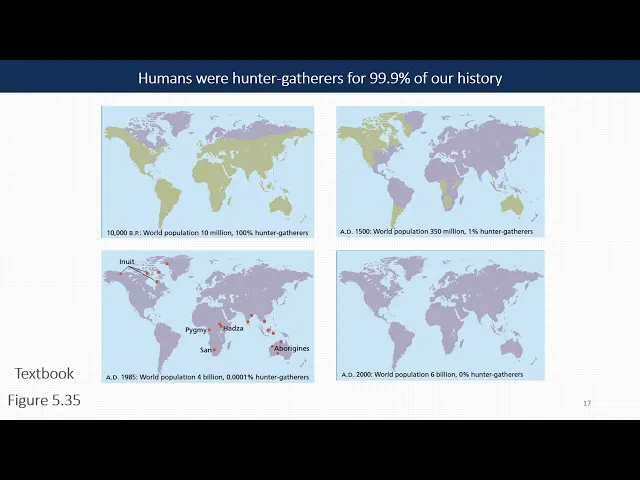
lecture five post glacial foragers in this lecture we'll talk about the world after 8000 BCE the post-glacial environment of Europe bone chemistry and prehistoric subsistence the human skeleton and then we'll talk about two sites the world after 8000 rapid developments were taking place among humans after 8000 BCE as you'll remember from last week at the end of the pleistocene we begin to see some instances of hominin burials both Neanderthal and human here's a picture of a burial from 5000 BCE in Denmark the burial is of an 18 year old woman and her baby not only
were they placed with care they were also placed with various gray goods below the mother's head are many tooth pendants that may have been ornaments on a blanket or item of clothing the baby is buried on top of the wing of a swan with a stone knife at their waist this is an actual photograph from the site as well as an artist's reconstruction of what it may have looked like when she was buried today we're going to talk about the post-glacial period also called the Mesolithic there were many developments that occurred during the Mesolithic including
changes in our diet specialized technology like fishing gear plant processing tools and more complex stone tools we're going to focus on hunter-gatherers today but the post-glacial period also marks a transition from hunter-gatherer lifestyles in some areas of the world with the introduction of plant and animal domestication we'll talk about the introduction of Agriculture more next week but know that as we talk about Hunter and gatherers today there were also some areas where agriculture was being developed around the same time period I thought this was kind of a funny little cartoon so the word of advice
it's the Mesolithic and we're we've domesticated the dog and we're using stone tools and no one's naked anymore there's no excuse to be walking around naked in North America many of the big game animals we discussed last week were extinct by approximately 9 000 years ago this period is often called the Archaic Period while it's called the Mesolithic in Europe during this period humans began to expand their diet and new types of stone tools developed during this period suggesting a higher Reliance on food from plants there is also evidence for long-distance trade in the Americas
high quality items like obsidian copper and shells have been found in areas where they do not occur locally this suggests that humans were treating them over long distances so take a look at this um this chart here this shows what was happening um among the geological epoches which we talked about the other in one of the earlier lectures climatic phases and then in Western Europe and North America they're slightly different types of terms used for the different periods the post post-glacial environment of Europe Europe was much colder during the Ice Age than it is today
it was approximately 20 degrees Fahrenheit colder 18 000 years ago than it was today in this graph you can see how much colder it was then so we have about 18 000 years ago compared with today this difference in temperature allowed the ice sheets to melt which raised the ocean levels eighteen thousand years ago the sea level was as much as 125 meters lower than what it is today imagine what that would have looked like that's as high as a 37 story building think about how much more land is underwater now compared to how much
land would have been exposed then to give you an idea the east coast of North America was approximately a hundred kilometers further out to sea than it is now the coastlines that we have today are only approximately 5 000 years old the changing temperature also led to different types of vegetations that humans had to adapt to and eat as the temperature changed so did the types of plants that were able to grow during this time deciduous forests spread through Western Europe with changes in vegetation came changes in the types of animals as I mentioned before
much of the megafauna that we talked about last week was extinct by this time period those animals were replaced by migratory herds of reindeer horses elk wild cattle and deer here you can see the types of animals that were found at a Mesolithic site called Star Car in England bone chemistry and prehistoric subsistence how do we know what people ate we can figure out what people in the past ate by looking at multiple lines of evidence this evidence includes food remains at sites so animal bones and plant remains it also includes evidence from people like
fecal matter tooth wear and disease and the actual composition of the skeletons themselves new technology called isotope studies can look at the composition of Bones to see what the individual ate in the past based on the organic portions that remain in the skeletons more specifically the carbon atoms in the collagen there are two types of carbon atoms in collagen 12C and 13c using mass spectrometry scientists can measure the ratios of 12C to 13c and determine what types of food the individuals were eating for example 13c is more commonly found in terrestrial plants while 12C is
more commonly found in ocean plants and animals using these ratios we can look for changes in diets as you can see here there's a shift in the diet of humans and Mesolithic and Neolithic Denmark there is much less consumption of Marine Foods after 4000 BC which is the same time that agriculture was introduced in the region the human skeleton since humans bury their Dead skeletons are some of the best preserved evidence we have of ancient ways of life we can tell a lot from skeletons especially if we have a full cemetery of them including things
like how tall the individuals were on average how long they were expected to live and their diets we can also tell if the individuals are male or females males often tend to be larger than females on average but you can't use the size of Bones to determine sex instead we use other markers like the shape of the pelvis the easiest way to determine the age of the skeleton is through the teeth because we have baby teeth and adult teeth it's pretty easy to tell the age of Children and adolescents based on their teeth by the
time an individual reaches 20 years old the teeth have developed and are no longer as useful for determining age as such age estimates after 20 years old are less precise and are based on other types of information like the condition of the individual's bone and degenerative changes we can also learn a lot about the types of diseases and illnesses that they had left by marks on their bones so here's an example of a skeleton and some of the different things that we can learn about the skeleton by looking at the bones um so number one
is looking at the skull and there are lesions on this skull so these Legions might suggest that the individual was sculpt at the time of death number two shows flattened ribs and a fused breast bone and it's possible if you see this archaeologically that maybe that's the result of a corset from the 18th century so wearing corsets would have physically altered those individuals bones and we could see those alterations in the bone long after the individual has died number three is an example of a badly twisted or eroded joints and this could be evidence of
arthritis number four has bone spurs on the knees and these bone spurs might have been caused from riding a horse and being in the saddle for too long uh number five has bone cells or osteons and um you have more of these when you're in your middle age than when you're an adolescent so this type of thing can help us age skeletons number six has shortened and deformed foot bones um and so if you see these archaeologically this might be related to the practice of foot binding in China which happened in previous centuries where they
bind women's feet when they were young so that they couldn't grow and develop into normal sized feet and we'd be able to see this archaeologically number seven shows an example of osteoporosis this is an issue that we deal with today it's lots of bone density and it's more common in older individuals so if you see osteoporosis in a skeleton that might suggest it's from an older individual number eight shows a pelvis and women have or female sorry have wider pelvises so that's one way to be able to tell if the skeleton is a male or
a female number nine is a robust femur and robust femurs are evidence of diets that are higher in meat so depending on how robust the femur is it might suggest that the individual was eating more or less meat and then bumps number 10 bumps and irregularities in the bones if you see that the bone has been broken and healed that means that the individual suffered an injury but lived through that injury because the injury healed and we can see that archaeologically and then finally number 11 indentations and grooves in the teeth are found among fishermen
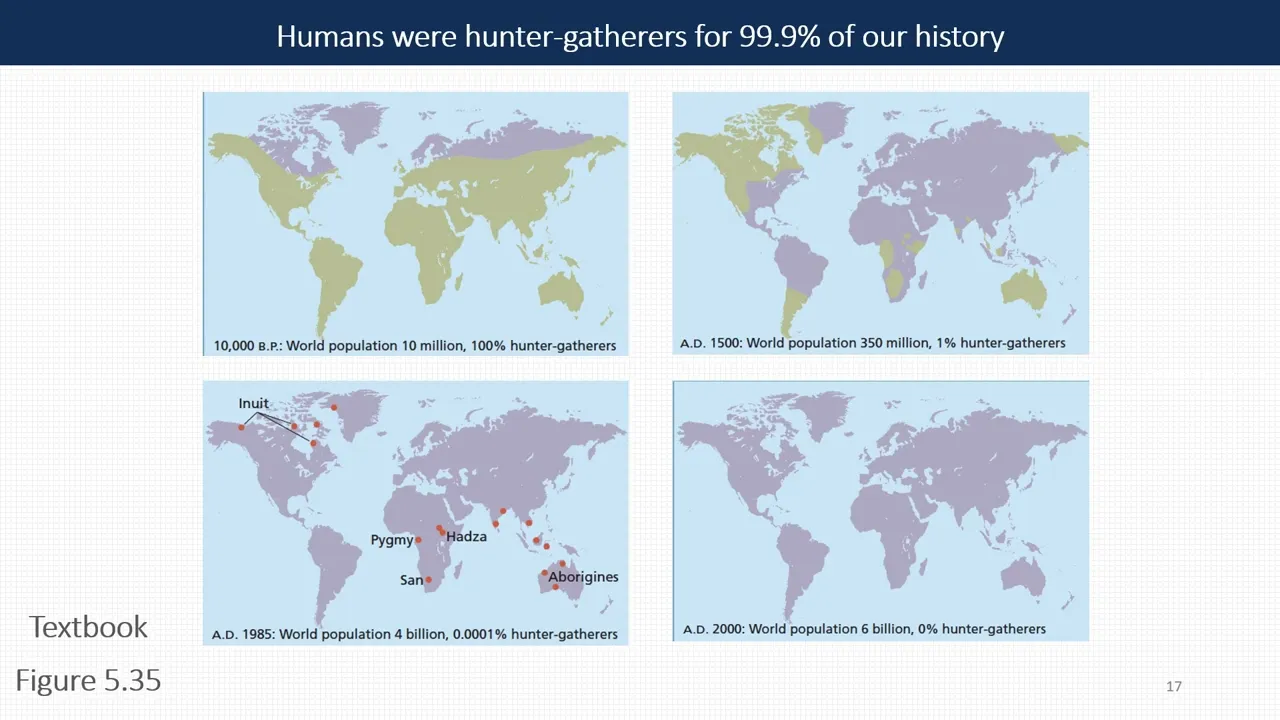
and wool Spinners so if people are using their teeth for different abusing their teeth as tools we can see that archaeologically in the teeth and we can start to reconstruct what types of activities they were doing with their teeth and how they were using their teeth as tools contemporary hunter-gatherers for most of our past almost 99.9 of human past humans were hunter-gatherers hunter-gatherers lived in small simple societies who often followed sources of food and moved seasonally much of what we know about the Society of ancient hunter-gatherers is from studies of contemporary groups of hunter-gatherers for
example leadership was highly dependent on individuals abilities and there were not many differences in status when a society does not have much difference in status among its members it's called a egalitarian society the equality and egalitarian societies seems to be actively maintained within the group and may not be a natural state similarly most food was shared collectively within groups of hunter-gatherers as humans developed agriculture the hunter-gatherers have slowly been eliminated in these maps you can see the last remaining hunter-gatherer groups were living in around 1985. here's a picture of a hunter-gatherer from the Kalahari Desert
of Botswana in South Africa she's harvesting wild mongongo nuts in this picture despite what you may think hunter-gatherers have been described as the original affluent society most hunter-gatherers only work for approximately 30 hours a week and this includes a food collection and meal preparation think about how many hours you spend working each week how are those hours distributed between different tasks your job your studies what about food preparation similarly we can tell from human remains that hunter-gatherers were much healthier than their earlier farming counterparts now we're going to look at a site called Bay back
payback is located in Denmark which is near to Copenhagen this site is well known for a Mesolithic graveyard that was discovered in 1975 during the construction of the school Denmark and Scandinavia have been occupied by humans for less time than the rest of Europe because the areas were covered by ice sheets during the pleistocene as temperatures Rose and the ice sheets malted the area became deciduous forest and was occupied by lots of animals like elk wild pig deer and many types of bird and small mammals there were also lots of fish in the rivers near
the oceans there were marine life like seals mackerel and sharks and Crustaceans and molliffs on the shore these resources Were a Rich supply of food for humans during the later Mesolithic evidence from nearby sites suggests that marine food was probably a core component of the diet at these sites we can see that there were distinct uses of the site for different purposes hard working so you can see on the map where the hard working happened in this area of the site most of the tools that would have been used for Hyde working were located this
includes scrapers that would have been used to scrape the hive so that's the animal skins and then there's a section for Flint working based on the distribution of Flint artifacts you can see where most of the Flint work occurred at the site so this is where they were making stone tools by hitting Flint off of larger pieces of Flint then there are the lithic refused deposits we can also see where the waste materials were taken waste materials include cores that were used to make the flakes and Blades and shattered Flint which is a byproduct of
flinting you can also see there areas where there was primary occupation so this is where people would have done most of their living time and would have slept there's garbage mittens though same as a garbage dump today they would have had garbage bumps back then where they would have thrown all their trash so it looks like this was probably a temporary Camp which was occupied during specific times of the year for specific purposes probably for hunting and butchering animals and processing their hives the graveyard has been dated using radio carbon dates to 4 800 BCE
the grade at this site contains at least 22 individuals the individuals were buried with their bodies fully extended and with a wide array of burial Goods the burial Goods included powdered red ocher which is a reddish substance found naturally that they would have used as a pigment so kind of like a paint and deer antlers there are also some differences in the types of artifacts that were found with males and females males tended to be buried with knives while females were buried with shell and Bone jewelry this is where the grade from the first flight
first slide was found as I mentioned then the infant was buried with a knife by their side because all the adult males in the cemetery were also buried with knives by their side archaeologists have argued that the infant was male note that we can't sex infant skeletons so we can't tell just by looking at the skeleton if it's a male or a female but we can use cultural items if it statistically representative among the entire population to determine whether it was a little boy or a little girl that was buried in that first for real
in addition to the luxurious great bids the site also suggests that there was a lot of conflict in one of the graves that you can see here an adult male and female and an infant were buried together simultaneously the skeletons had lethal injuries suggesting that the man the woman and the child came to Violent deaths at the same time we know that they died from these injuries because the injuries don't have any evidence that they were starting to heal which would have happened if the individuals had survived since they were buried together it looks as
though they were a nuclear family a mother father and their child elon's Bay cave into Higgins the next site we're going to look at is located on the southern tip of Africa researchers at this site are very interested in what types of food people eat in this region there are three types of environmental zones that you can see in this map the green area is called strenfeld this is the Sandy area between the beaches and mountains there are lots of fruits berries and roots with tortoises and daisies here daisies are an animal that's similar to
a hair or a rabbit there are also Antelope and ostrich the blue green area is finboss this area is characterized by shrubs but there are a few trees there are lots of fish in animals in this region and finally the pink area is karoo this is a dry lowland which would have been a pasture for herbivores archaeologists have found that people would have moved between these areas seasonally based on the types of animals that were best during specific times of the year for example finboss is better in the summer while the other two areas are
better during the winter this is because the shellfish and marine species available in the Stan bled and Karu areas would have been supplemented the lack of plant Foods available in the finboss region during the winter similarly these areas were not as good during the summer because the malls can be toxic if eaten during the summer