Okay welcome good morning good afternoon good evening wherever you are in the world welcome to the first lecture of Economics 11 principle of principles of economics um I'm Dr safin amamos I'm going to be teaching you this course online this uh over the next 10 weeks I hope uh you enjoy it I hope it is uh rewarding and fun and productive use of your time and I hope uh this uh project uh continues to grow and continues to Attract more people because I am thoroughly enjoying um moving my teaching and my academic activity from working
at a traditional University to working online directly with people who want to learn what I have to teach and people who want to read what I have to write so um in today's lecture we are going to begin with the basic foundational Concepts and principle of economics and I thought couldn't think of a better place to start than the work Of Carl manger the father of the modern Austrian economics school he wrote a book called the principles of economics which I think is truly the foundational text of Economics because it explains explains the founding and
initial and starting concepts of economics in a coherent way and 150 years after the publication of the book it's becoming clear to a lot of people that this really is the correct foundation on which economics can be built in fact Before this there was very little um there was there was very little uh coherent foundations for economics because it was only after manger and a couple of others but mainly manger after manger came up with the uh stuff that we're going to discuss today on the conception of value and the um and the uh subjective
theory of how value works and whether value is subjective or objective once manger uh established that idea followed by the idea of Marginal analysis that's when economics really took off in fact you could really say modern economics um as a coherent field of knowledge only really started with the marginal Revolution which is what we're going to be discussing today marginal analysis and we're going to end the class by uh illustrating how this helps us understand um the world and how it helps us understand economics better than uh the models that people had before this And
so the um the the work of principles of economics I found to be extremely important and I think using it to begin the course is very useful because it allows us to define the most important terminology in economics and this is the sort of thing think that most other books since then have will likely go over quite quickly and not spend a lot of time explaining it but I think reading the original manger is quite valuable in helping you understand some Of these basic concepts which we're going to discuss today like Goods economic Goods opportunity
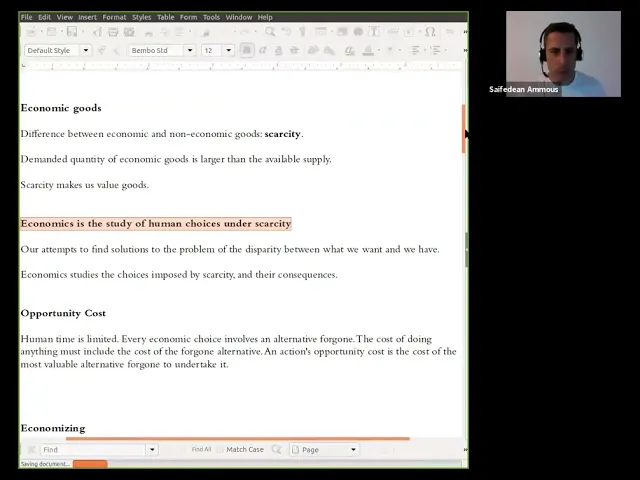
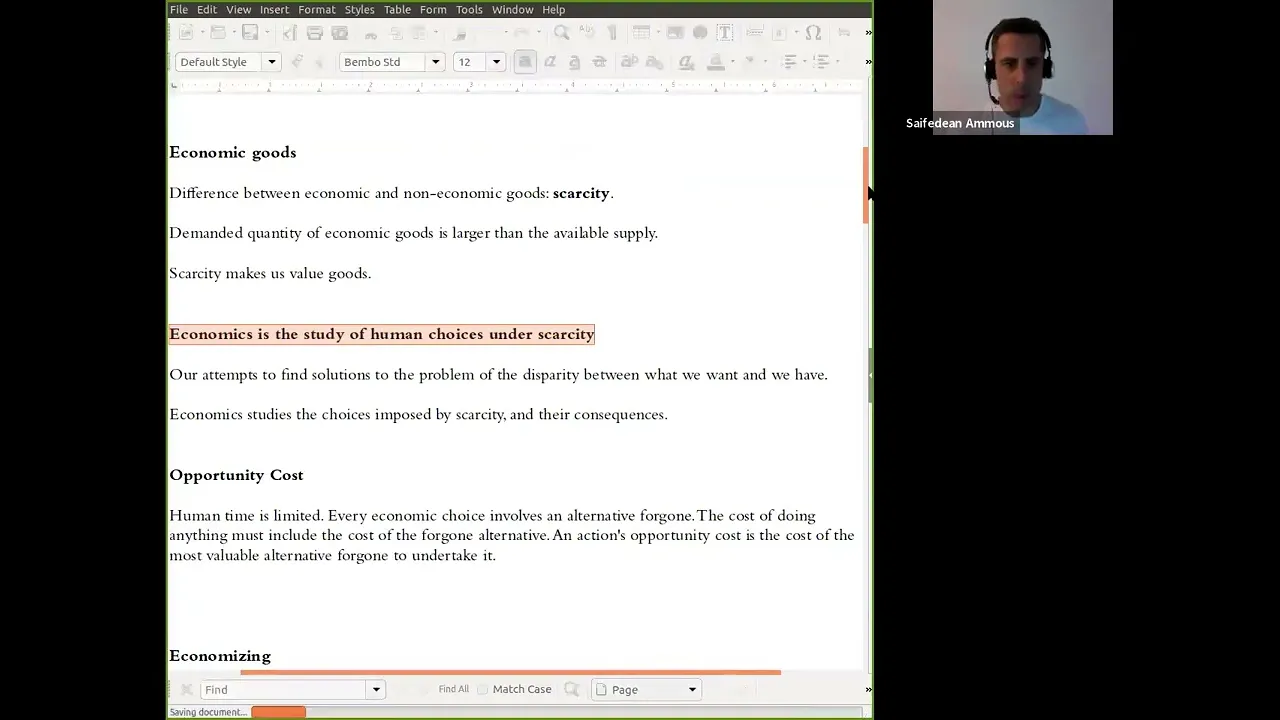
cost what we mean by economizing and what we mean by value and marginal analysis all of these things are worth um getting into in detail so that is going to be the topic of today's lecture I presume you can see my notes clearly right yes okay great all right so to begin with the first thing that I think is useful to discuss the first uh the First concept to begin with is the concept of a good what is an economic good and um manger defines it quite simply l a good is anything that is useful
that can be directed to the satisfaction of our need and so he discusses four different things that make something a good we need to have a human need there have to be some properties that makes this thing capable of satisfying that need and then our mind has to understand this causal Connection between that good and that need and we need to be able to have a command of this good that would allow us to sufficiently direct it to the satisfaction of our need so if you have those four things as manger mentions them then you
have uh something that is a a good and a good can be anything that fulfills those four criteria anything that allows us to satisfy a need uh that that exists amongst us and it's important here to understand that you Know humans don't desire things for their own sake human Desir things for the satisfaction of their own needs humans have needs and humans discover Goods that help one achieve and uh meet those needs that's really it's a very subtle point but it's quite important as we're going to see in this lecture and the next lecture once
we start understanding economic value it's important to understand that what we're after is the human need or the Satisfaction that we want and not the itself we value the good because it helps us satisfy that so this can apply for any good however not all goods are economic Goods there's a difference between economic goods and non-economic goods and that difference is one word the most important word in economics probably scarcity that's why we have economics so uh it is possible for a good to be a good that is non-economic if it is not scarce and
so the best Example for this is air air is a good because we would all die without air we all needed to survive it's very very important for us it's essential yet it's not uh it's not a good because it's not scarce it's everywhere and so it's not sorry it is a good but it's not an economic good because it's not scarce so the difference between an economic and a non-economic good is scarcity it's that the demand for the good is larger than the supply that is available for it once We reach that point of
having something for whom the supply is not as large as the demand then we've got the problem of scarcity and that problem of scarcity means that we need to start valuing Goods we need to start deciding how to use them and we need to start taking care of them and so economics really is the study of how humans make choices under scarcity this is I think the um simplest definition of what economics is if there was no scarcity there would be No entire no field of economics if our demand for things exceeded the supply of
those things sorry if the supply of things exceeded our demand for them then all of those things um you know there would be no economic problem there would be no economic questions there would be no scarcity and there'd be absolutely no reason to learn economics but that's not likely to change anytime soon it's the fundamental property of the world that things are Scarce and ultimately that scarcity is always going to be there because that scarcity is ultimately a function of the scarcity of our time because it is our time that creates all sorts of things
as we'll discuss a little bit later so it is only because of Scar that we move on them and compare the value of one good to the other um effectively of Economics as how we make just attempt to the [Music] problem want and always want more and we'd more if you ask me about any good and figure out how to make more of the Things that they want how can they bridge the gap between what they want and what they have how can they increase what they have so that it comes closer to what they
want or what they need and so effectively economics studies these choices that are imposed by scarcity and they're consequences and that's what we're going to be looking at so we start off from the premise that things are scarce that our demand for things is larger than our uh supply of them and Then based on that we move toward analyzing how people make choices a very important concept here which manger doesn't mention um explicitly and it was arguably developed more fully after manger is the concept of opportunity cost which is truly very very important and The
Logical implication the direct logical implication of the fact that we live in a world of scarcity is that everything has an opportunity cost ultimately your Time on this Earth is limited which means that every economic choice involves foregoing an alternative you only have a limited set amount on Earth and so you can't experience everything all the time also your ability to experience things is limited to one at a time or a few things at a time it's not possible to do all things at the same time you can't both be driving a car and flying
an airplane at the same time so this means that you know the scarcity of Our time at on Earth means that we have to always make choices we have to always make priorities and make choices and prioritize between the choice and um between two choices so every time we make a choice there is a choice that is being not made and under understanding this understanding this reality that you're always choosing and that you're always having to choose is really quite important um and quite it's it's the essence of the Economic way of thinking to always
think of the alternative to always think of what else would be going on what the alternative would be and only by fully um understanding the cost of different Alternatives can you make a proper economic decision or or can your economic decisions um really be um in in my opinion um good economic decisions only by being conscious of the um true opportunity cost so based on this how does manger Define the concept of Economizing he says he he I'm quoting him here he says economizing you know when people because of scarcity because of the fact that
we don't have enough people find ways around this by economizing and so what they do by economizing is they try to maintain at their disposal every unit of a good standing in this relationship in this quantitative relationship that he mentions on satisfying our needs to conserve its useable properties so you Start owning things because of things um being scarce you start keeping possession of them because you realize there's not a lot of this thing to go around and therefore I would like to have this thing tomorrow so it makes sense for me to keep a
property of it and so you see once somebody built say a weapon takes them time to build a weapon for it they realize it's scarce they realize this is essential for their ability to hunt and so they're more Likely to hold on to it so the concept of property emerges out of people's need to economize out of the need of people to um fight against scarcity to find ways of acting that get around the problem of scarcity and secondly people conserve its useful properties that's another form of economizing so you've got this weapon you keep
it and you try and take care of it and not break it and not destroy it three you make a choice between the more important needs which They will satisfy and needs that lead that they must leave unsatisfied so not only do you uh you know you have to also make choices do you go and hunt this animal or do you hunt that animal do you build another weapon or do you hunt another animal uh do you build a better weapon or do you hunt more today you always have choices to make and um then
you start thinking about how to obtain the greatest possible result with a given quantity of the good given that You have this weapon that you can use how can you get the best satisfaction out of it how can you get you start thinking about using it more efficiently and more productively so these are the points of the process of economizing as manger mentions them and a very important point he makes is that economy or the act of economizing the idea of people economizing and all the activity that comes with economizing which you know um includes
trading and making Trade-offs and opportunity cost and so on all of these things have a joint economic origin because their ultimate reason of existence is the fact that we have scarcity in other words economy and property the emergence of property the emergence of people using things as property keeping things and maintaining them and holding on to them and the emergence of economic activity in general are just the natural consequence of scarcity because we live in a world Of scarcity and because we have reason we're able to utilize our reason in order to um get around
this problem of scarcity and that's really what uh oops that's really what the the economic problem really is and it's important to think of this because a lot of people think of property as being something illegitimate but really property is just a very natural outcome of what humans mental capacities allow them to do Under the system of Scar under a world in Which proper scarcity exists and so our definition of property or Mango's definition of property is that it is the entire sum of goods at an economizing individual's command for the satisfaction of his needs
and so this this is what uh is property all of the things that you own to satisfy your needs are what we call property and that is distinguished from wealth which is all of the sum of the entire sum of economic Goods at an Economizing individual's command so there's a subtle distinction between uh property and wealth property refers to all the things that a person owns um but wealth refers to the economic Goods specifically that a person owns and so it's the a very important conclusion from manger and this is something that you're going to
see repeatedly in Austrian economics is that property like human economy is not an arbitrary invention but rather the Only practically possible solution of the problem that is in the nature of things imposed Upon Us by the disparity between requirements for and available quantities of all Goods so property is not an arbitrary invention it's not something that come up with because um you know we're just trying to have fun and we're trying to mess with marxists uh property is just a natural Human Institution and a natural human response that emerges to scarcity it's a way that
We get around the problem of scarcity that's how economizing works and so the difference then between um economic goods and non-economic goods as we said is in terms of their scarcity and that is what gives economic Goods Goods value so non-economic Goods things like breathing air um it has utility obviously but it has no value because it's not scarce so we don't value it that's why if I asked you how much you paid for the air that You breathe you say nothing and you don't value it you don't pay for it and nobody gets paid
for it it's not a scar as good economic Goods on the other hand they do have scarcity and therefore they have utility and uh and value they don't just have uh utility they have utility and value and so this all makes um this all makes uh this is what forces us to begin economizing this is what forces us as individuals to start entering the world of making economic choices and That gives things value that's where value comes from so scarcity is the root of value scarcity is what gives us the incentive to start valuing things
it forces us to economize and we economize by developing subjective valuations of different goods and choosing between them because things are scarce you have to choose and in order to choose you can only choose between different things by choosing between different values that's how it Works so manger defines value as the importance that individual Goods or quantities of goods attain for us because we are conscious of being the dependent on command of them for the satisfaction of our needs once we start understanding the need to have those goods to satisfy our needs then we start
putting value on them and of course the importance as I said earlier is about satisfying our needs we need to satisfy our lives and well-being and the Value of our needs and our lives and our well-being carries over to the goods because they help us satisfy our needs and this is a very important point because the implication of it is that value is nothing inherent in Goods it's not a property of goods it's not an independent thing that exists by itself it's a judgment economizing men make about the importance of the goods at their disposal
for the maintenance of their lives and their Well-being so this might be the most important thing in um um in in in in in mangar's uh uh book just the the idea that value is subjective it is not inherent in things and it sounds like a little bit of a banale statement if you think about it initially but really this is the litus test if you ask me this is the litmus test of an economist economists understand and agree with this non-economists or fake economists don't agree with this and Don't understand it and or or
at least they they they they pretend that it is Trivial and meaningless and they don't understand its implications but really there are only two kinds of economists subjective economists and objective economists or economists who believe that value is subjective and those who believe in some other objective formulation of value the only ones who believe that value is subjective are the austrians and that's why there's such a Big Schism because we get to that point in 1870 where manger says value is subjective if you agree with manger that Val is subjective you're an Australian Economist or
I mean um you know um on the other hand if you disagree then you're one of the many other uh different flavors of Economist like Keynesian or Marxist or whatever um brand of monetary crank is popular these days um and why is this such an important point because it's from the Austrian perspective what matters to us the reason we give value to things is because they satisfy our needs and so if they weren't able to satisfy our needs we wouldn't give them value so we are the ones who give the value the value of the
things doesn't exist from them the value of goods as manger says does not arise from uh is not inherit in Goods themselves it arises from their relationship to our needs with changes in that relationship value arises and Disappears so if value was inherent in Goods then it would be independent of its ability to satisfy uh our needs if on the other hand value is not inherent in the goods themselves if it's dependent on our needs then value would rise and change and disappear and arise as those goods relate to our need and so one of
the most important quotes in the book is value does not exist out inside the consciousness of men without a person Looking at an economic good and making valuation of it that good does not have value value cannot exist without humans valuing it and value only exists in terms of the relation of the good to the satisfaction of an individual's need it is not inherent in the good itself and my favorite example for this is oil oil for instance a couple hundred years ago if you had oil in your land it was it was sludge that
was making your land unusable you couldn't build on your you Couldn't build on your land you couldn't grow food on your land because you had too much oil and it was a problem and if you wanted to use the piece of land you have to actually sometimes pay people to come and extract the oil and take it out of the land and throw it away elsewhere because it was essentially dirt it was scum um they were trying to get rid of it always at all times it was the the you know the it it was
the scum of the earth Basically that was the idea and it was the same oil that today is one of the most important Commodities in the market and one of the most important markets in the world the ability for people to um consume oil is enormously uh significant for their economic well-being everywhere in the world and what changed it wasn't the oil itself that changed it was our mind our consciousness ability to understand how this oil is able to satisfy our needs so if you scroll back Up to the beginning of the lecture when we
say the requisites for being a good oil was not a good even 300 years ago when oil had the same chemical composition that it has today it was worth zero or a negative cost to get it removed because even though we did have a human need for staying warm and for transportation and the properties that allow oil to satisfy those needs did exist there was no human knowledge of that causal connection we didn't Understand this causal connection and therefore we never tried to command oil until recently to satisfy those needs once people understood oh hang
on a second this thing can be burned maybe we can put it in a thing called an engine and then we can turn that energy from the fire into uh doing useful thing well now we have the human knowledge of this connection and now we have a command that allows us to satisfy this need and so suddenly oil becomes valuable and so Oil gains value even though it's the same chemical it's the same substance that it existed before and so basically um if if value is subjective if value is inherent in things then how can
you explain oil changing its value so drastically um I I think you can't and the only way to understand value is that it is subjective it value cannot exist outside human valuation and choices reflecting human's own preferences and Valuations it cannot be an an objective property of objects it's a conscious phenomena in our minds this does not mean that value is not real very important point value is real just because it's not objective does not mean it's fake it is subjective but it is real it is subjective because it exists in your mind and well
a lot of things only exist in our mind and yet they're very real a lot of Human Relationships exist in our mind um and yet they're They only exist in our mind and yet they're very real and um just because something doesn't have an objective physical reality in it you know value is not something like temperature and this is what some schools of Economics have tried to um work with by drawing analogies between economic value and physical properties like temperature and uh trying to study it in the same kind of objective scientific method and of
course these attempts at studying Economics all fail because they fail at answering the questions or they fail at explaining phenomena of how the world works as we're going to see in a bit so uh another way in which we can understand why value is subjective and another implication of why value is subjective is the fact that you can't express value objectively and another important difference between Austrian economists and other economists is the difference between ordinal and Cardinal Valuation this is an extremely important Point ordinal means that you value objects in relation to one another example
a is more valuable than b b is more valuable than C that's ordal valuation or it's a measuring of the ordinal utility or the ordinal value that you get from a good Cardinal valuation on the other hand is the precise numerical valuation in this example you say that the value of a is for instance 14.37 2 the value of B is 4.25 8 and the value is of C is 1. 1273 x with X being some unit of measurement so um this is again an enormous difference between austrians and others all other schools of Economics
as you may have had The Misfortune of noticing in your University education if you've uh suffered through that it's discussed in the first few chapters that oh you know it's it's kind of hard to measure utility and kind of hard to put a number On it but we're going to go ahead and do it anyway and so you carry out all these mathematical equations where you're doing calculations on you utility and it's not clear what the unit with which you're measuring utility even is um so some textbooks call it a util but what is a
util nobody knows it's not a unit of measurement it's not an actual unit nobody has any objective definition of um this unit which means that any objective measurement based on an uh Without an objective unit is completely meaningless and so um if you want to measure anything I think it was Isaac Newton who said this if you want to measure you need to Define your unit and so if you want to measure anything if you wanted to measure utility there must be a fixed objective unit defined and used to measure but human valuations cannot be
measured with an objective unit and so how do you put a valuation on it and if you wanted to really get Into detail about how we can put evaluation on it you know try and think of how much would you value um try and put a value on things that are not um monetary that you can't buy so for instance think about your brother or or your wife or your mother or your daughter and how much would you value them in terms of dollars like how many dollars would it take for you to give up
one of those people and you begin to quite simply see that this is just Ridiculous there are no number of dollars that you could give somebody to give up on um somebody they love and human valuation is not something that is objective it's not something that you can measure because there's no unit that can convert my uh attachment to my daughter into the same unit with which I measure my attachment for my car it's just completely different uh completely different Goods completely different values that we attach to them and so Without a unit it means
that we can't compare and it means that we can't have an objective measurement and it means that we can't add multiply or subtract utilities and that anybody who tries to do those things is just being completely um use your own adjective I'm going it's just off let's put it nicely um in valuation can only be ordinal we can only understand that a is more valuable than b but we can't put the number on it so yes my um child is more Valuable than my car but there's no number that to put on it there's there's
no number that says yeah my child is worth five times what my car is worth it's meaningless we can only see it in terms of ordinal valuation but we can't put uh Cardinal numers on it um so um within other schools of Economics they make all kinds of mistakes about trying to think of how value is so one of the most common mistakes is to think That value is the same thing as a market price but that is not true and that is a very big misconception markets prices are from value and the reason is
simple if I go and I buy a book for $10 I've given up $10 to buy the book what does that tell me about the value of the book The mainstream economic way of looking at it is I paid $10 for this therefore this thing is worth $10 this is wrong because if the thing was worth $10 for me exactly then I would have been Indifferent uh to making this trade and I would wouldn't make it why would I exchange something that is worth $10 for something that is Al also worth $10 the only reason
I got out of bed went to the book shop took the $10 out of my pocket and gave them to the guy and took the book is because I value the book at more than $10 and the only reason that the guy at the book shop accepted the $10 is because he values the $10 more than the book so market prices do not give us Measure of value valuation they only give us measures of the upper or lower bounds of individual valuation when I buy a book for $10 the only thing that we know is
that I value that book at more than $10 and that the seller values that book at less than $10 it might have been possible that if the book was for 20 I may have bought it because I value it at 50 and I may have bought it for 500 you know maybe this book is really really Important for me and I would have been willing to pay 500 if it was um if I had to but it was available for 10 and so I only had to pay 10 so the 10 tells us only one
thing about my valuation of that book subjectively I valued at more than 10 and subjectively the Book seller values it at less than 10 that's it that's all that we can say Obviously the value is not 10 for both of us because otherwise we wouldn't have exchanged obviously I Value the $10 less and he values the $1 more than the book so the only reason the trade exists is because valuation is subjective if value was objective then there is no need for people to be trading with one another because trades would any any trade would
necessarily involve somebody ripping somebody else off and so free exchange and this is a topic we're going to get into in more detail when we discuss trade but free exchange is um it it helps us understand Why uh money uh sorry why value is subjective because it helps us understand it's built on one very important concept which is free trade or free exchange happens because both people want to do it and so when two people together decide that they want to exchange a good um or exchange two goods they're both willingly signing up for this
they're both happy to make that decision where they exchange the book for the $10 and so there can be no Objective value that is stable um that is fixed that is inherent into the book and free trade because if if value is objective people wouldn't have accepted trading it if the value of the book is let's say $12 and that's an objective value then why would the book seller sell it for 10 and they wouldn't accept to sell it for 10 if the objective value for it was 12 I would obviously buy it for 10
because the objective value of it is 12 but Nobody would sell it to me so the only way that they would sell it if they sell it is it says that their valuation is lower than the price that they accept so it follows that anytime two people choose to exchange anytime two people agree to exchange anything they must both benefit from The Exchange because if they didn't then they wouldn't have agreed to The Exchange in the first place if they would if they would not be benefiting from it then they would both Have not undertaken
it and so the fact that they both benefit from it it necessarily follows that each of them received something they value more than what they gave up if you accept the $10 for the book that means you value the $10 more than the book that's it that's all that we need to know because otherwise you wouldn't have accepted if somebody didn't put a gun to your head and you still took the $10 for the book that means you value The $10 more than the book that's it actions speak much louder than words so two people
will have different valuations of the same thing this is why value another reason why we can understand why value cannot be objective if value differs from one person to the other then both those people have different valuations then the value is subjective and that's perfectly fine that's in fact fact you know this this obviously sounds like a scary thought For um mainstream economists who want to quantify and mathematize everything and want to use formulas for everything and you know if you tell modern Economist that all of your formulas on utility are garbage and are in
applicable because utility can't be measured and you can't put a unit on utility you may as well be be measuring you know uh the amount of happiness in a society and trying to figure it out scientifically uh it's ridiculous if if you tell this you know They reject this because most modern economics is built around mathematization is built around physics andv it's built around trying to make math um trying to make economics into mathematical objective science and that can't happen because the subject of Economics as we're seeing here is Human Action human decisions human thought
it is in the mind of men that economic calculation takes place and is in the mind of men that valuation Takes place and that makes it un unwieldy to mathematization unwieldy to objectivize to making it into an objective uh um into making value into an objective thing that can be measured and calculated and so um this um the price is not a um the price is not a measure of value another very common mistake uh and this is very common amongst the uh Marxist economists obviously the Word Economist here is under is between quotation marks
because there's no such thing as a Marxist Economist if you were an economist you can't be a Marxist but some people who are marxists who call themselves economists believe in something called the labor theory of value and according to the labor theory of value things get value because people work on producing them but that of course is absurd as anybody who's worked on a failure of a project will testify Just because you put time and effort and sweat and blood into something doesn't mean it'll be valuable it has to be valuable for people it people
have to Value it in order for it uh to to have value that's that's what value is and no matter how much effort you put into it doesn't guarantee that it's going to have value if you know how to put the effort effort into producing something that um people will have people will value then yes you will Produce something of value but it's not your effort that has produced the value so um and of course you know the the the um famous example I think it was rossard who gives us this one is um the
mudpie you could spend 10 hours making a pie out of mud and you know if you value your hour at five hours five dollar of Labor five5 an hour that's $50 for a pie and yet you'll have a very hard time getting anybody to pay you $50 for your mudpie why Because the kind of people who believe in this nonsense don't usually pay money for it the people who believe in objective value don't put their money where their mouth is they're not going to come uh to you and tell you oh you've put $10 into
it all right here's $50 no um and the people who do spend money they spend it based on their own preferences so um if you're going to make make a pie you know it doesn't matter how much time you put into it how Much effort you put into it that is going to not determine its market value the market value it will be determined based on consumer preferences based on the buyer and how much the buyers are willing to pay and you know it's up to you to be able to build something that they value
but it's completely fallacious to imagine that the effort must correspond to value and um as manger sums it up the determining factor in the value of a good then is neither The quantity of Labor or other goods necessary for its production nor the quantity necessary for its reproduction but rather the magnitude of importance of those satisfactions with respect to which we are conscious of being dependent on the command of the good roundabout German way of saying what determines it is the utility that people get from it the subjective valuation that people get from it and
this is valid and no exceptions can be found for It value or utility are ordinal for a as we mentioned earlier and so in in austan economics value is subjective it depends on the time and place at which the valuation happens value is derived from Human Choice which is necessitated by scarcity value is assigned by individuals to each unit at the time and place in which they make the decision but is not a universal property of the good understanding this property of Value helps us understand how decisions take place this is a really really important
point which drives us to marginalism marginalism as I mentioned at the beginning of the lecture is the starting point of modern economics is the starting point at which really economics became serious and worth engaging with and that's why you know generally most economists who wrote things before 1870 Are um I was going to say you know maybe can be safely ignored you can't I mean not wor I wouldn't say ignored but I mean without the marginal analysis without the marginal basis for understanding and explaining economics it's uh there's a lot of iffy nonsense in them
that's why I generally don't like to read anybody or I don't see much value in Reading uh many of the economists that came before manger so um you know if you're reading Adam Smith For instance I highly recommend you stop and start reading manger and austrians is just a much better way of understanding economics because Adam Smith's inability to understand marginal analysis well you know it was 50 years before 50 years after him um I'm not blaming him for that but but it makes it creates for a lot of confusion and generally the economics that's
worth studying and analyzing is the economics of um what Follows marginal analysis What followed the marginal revolution in particular the mangaran OB uh subjective marginal Revolution so um the important point about marginalism is um and we we'll explain why really marginalism was so important at the end of the lecture but uh the the important thing to it allows us to understand is that humans take economic decisions and May valuation of economic Goods always at The margin meaning they make it with relation to the next unit to the next marginal unit of whatever good and that's
enormously important Point why is this the case well the case comes the the answer comes again from mangar's coherent formulation of understanding economic goods and understanding value remember we said that the value of Goods is derived from their ability to provide us with satisfactions right we value things not because we like things for Their own sake we value things because of their ability to do things for us and of course it follows that different things have different satisfactions uh different satisfactions have different value for us so um if you think about it if I were
to let's say think about a room or uh the size of a house so um or a plot of land if you had a small plot of land that plot of land would offer you the satisfaction of allowing You a place to live and that's enormously important so if I gave you a one plot of land and you had zero plots of land you would use it first for the most important thing you need which is a place to live that's the most important satisfaction now if you get a bigger plot of land then you
might have a better house and then if you get another bigger plot of land then you might have a garden you get a bigger plot of land and you might say build um a a business Where you speculate on maybe I could turn this land into some business that earns me money and so on and so the more land you get the more land that you're going to be deploying but of course if you think about the um importance of the different uh places you know you're not if I give you the first plot of
land you're not going to use the first plot of land as a garden for children to play around that's a less important need on your ladder of needs in in terms of Thinking about all the things that you value in life that uh having a space for your kids to play soccer let's say is maybe the 15th most important thing that you would do with a small plot of land first one obviously is house you want to roof over your head and so if I gave you 15 plots of land yeah the 15th plot of
land you would use to let's say have a soccer field for your kids but the first one you would use for a house the second one you would use for a bigger house the Third one you would use for a workshop Garden whatever the you have many many needs for land but with each unit that you're given you dedicate each unit to meeting the most pressing need immediately we uh you use each marginal unit or each first unit of a good to meet the most important pressing need related to it the second unit will go
to the second most pressing need and as the quantity of the goods that you own increases the needs that you can fulfill Become less important right only if you have 15 units of land can you build a soccer field for your kids but if you have 14 then they're just not going to have their own soccer field they'll go play with their friends somewhere else right so you will always go with the most important unit you will use that you will um you will sorry most important need you will use the good that you have
for the most important need and then with every extra Good you use a less important treade as the quantity of the good increases eventually you get to a point where you have uh no need for having more of the good and you have no valuation to adding an extra point in it there comes a point where you know um say adding an extra apple is worth nothing for you if you have 20 apples today if I gave you 21st Apple it's not worth anything for you you don't value the 21st Apple at anything even though
it's identical to The first Apple but the first Apple went to fulfill the most pressing need that you had which is to satisfy your hunger and then each marginal Apple goes toward fulfilling a less important need this is a highly important Point okay so logically think about it as you proceed from one um uh as you start increasing the quantity of goods that you have you proceed from one need to a less important need and so chronologically we take the supply of goods that we have And use it to meet our most pressing needs if
I give you food you the first food that you need to take is the food that prevents you from starving the next unit makes you healthier stronger and then more and more food gets toward the point of making you you know you start having food for enjoyment and for entertainment and you start uh and then you get to a point where you don't value food anymore you don't value having extra to food anymore okay this is Extremely important now think about the flip side of this image so on the one hand we have we're accumulating
more and more needs and that is allowing us sorry we're accumulating more and more goods and that is allowing us to meet more and more needs and that means that each marginal need that we're meeting is less valuable less pressing than the previous one so what is happening then at each point our valuation of the good if I ask you how much would you pay for the next Plot of land what is happening with each extra plot of land that you have you know the first plot of land was the most valuable for you because
it it it is the difference between having a home and not having a home the second one is more Val is less valuable the third one is less valuable so if you if I went to you and you had only if you had zero plots of land and I asked you how much would you value going from zero to one plots of land you would say yeah a lot let's say I would pay this much for it now if I go and ask you the same question when you have 15 plots of land and I
ask you how much would you value going from 15 to 16 what would your answer be which is more valuable the first or the last um plot of land obviously the first the first one you would have used it for going to for having a home the 15th unit if you're if you have 14 already and I'm asking you about the 15th then your valuation for it is only the valuation To the satisfaction of the need that you have which is building a uh soccer field for your kids let's say so therefore how much do
you value that obviously you value it less than the value of having a home for yourself so you would be willing to pay less for it so what do we see now as the quantity of the good that you have increases the marginal valuation that you attach on each extra unit on each next unit declin lines that's really the key to keep in mind And so value you're always valuing land at the margin when I ask you how much would you be willing to pay for land what you're thinking of is the next use if
you had zero land you're thinking about the first use of land if you had 15 plots of land you're thinking about the 16th uh use of land and so of course which is more pressing your first your first most pressing uh use or your 16th most pressing use obviously the first one is more pressing so what's happening To the value as we move forward value is diminishing and so this is why this is what we call the law of diminishing marginal utility it means basically that the marginal utility of a good decreases as the quantity
we own of that good uh increases and with every extra plot of land that we get the value of the next plot of land declines because we're moving from the most pressing need of a home to the Le less pressing need of a garden of a workshop of a soccer field And so on and so on so the marginal utility of each extra unit is constantly declining and this is an enormously important point because this is how we get to um understand economics and it was really with this that economics stopped being um really a
joke of a field it was only After the marinal Revolution that economists could explain economic value because before that people used to Always mock economists about it who going to see now so so to to to to to recap what I was saying here um go back to this first paragraph if the V the first paragraph in the marginalism section in the notes since the value of goods is derived from their ability to provide us with satisfactions and since different satisfactions have an equal value to us different units of the same good will also have
different will also be unequal So the the value of different units of the same good will also be unequal as it depends on the satisfactions they need so even though it's an identical piece of land or an identical apple or an identical um shoe it will have a different price or sorry different valuation for you based on the need that it means if it was your first shoe it's going to be far more valuable than the fifth shoe that you have so the same good will have a Different value to the same person depending on
what need of his it meets and that's really um H how we can think about it so this is why there is another there's another way of thinking of why there's no such thing as the objective value of a good x what is the objective value of land in my the example that I gave it's there is no objective value for it because even within the same person it depends on where that person is standing with regards to their Current Holdings of land if that person has a lot of land they're going to Value the
marginal unit of the next uh plot of land less than if they had very little land and so the value of a good at any to a person at any point in time depends on which need it satisfies the more a person has of something the less the valuation they will attach to it and that is what is called the law of diminishing marginal utility the marginal utility declines with each Extra unit of a good and that is uh I think maybe the most important breakthrough that economics did as I was mentioning earlier because before
this everybody used to mock economists and for good reason because economists could not explain some very simple things like why is it that diamonds are more valuable than water so all of the theories of value that talk about well values derived from need it's about how much we need things or values Derived from how much work goes into things they fail at explaining why is it that people don't pay as much money for water than they do for diamond and that is going to be the homework for today um think about it over this week
discuss it in the class Forum on uh safe.com forums and we'll discuss this uh next week at the beginning of the lecture why is an ounce of diamond much more expensive than an ounce of water this is a question that was um you know it's how Everybody used to mock economists uh because they couldn't explain it the water Diamond Paradox and then Carl manger came about with marginal analysis and he was able to explain it so your homework now is to think about um how marinal analysis helps us understand why diamond is more expensive than
water and I think um marinal anoun is the only framework that that can make this uh understandable um Simon is saying sometimes people will Pay less for their home and individuals spend more on that soccer field recreational property am I confusing value versus price I think so yes um yeah it's uh you know just because uh well you know you you're not just you're also confusing different Goods um the the the home is different from the soccer field or from the recreational property um it's similar to the water and Diamond Paradox as well and in
the example that I was giving in terms of The land what I was referring to was an identical good it's important to understand this uh it's an identical plain land that can be used equally for um that can be used equally for building a soccer field or building a house and in that case of the identical land you know how much would you pay the price that you would be willing to pay would be higher for your house than for the recreational field now um how much you would pay for recreation doesn't have to Be
less than how much you pay for your house because of marginal analysis as we discuss with the water Diamond um question um AJ is asking how W widespread in the mainstream is understanding that value is subjective um not very widespread and if you'll find some understanding of it it'll be just uh yeah value is subjective but very little understanding of the implications of it and you know the most important implication is that uh all of Utility economics that does math or basically all equations in math are just a waste of time um do non- Austrian
economists also recognize the critical importance of the law of diminishing marginal utility yes uh the yeah the concept of diminishing marginal utility and the concept of diminishing of marginal utility in general is universal in economics pretty much or I would say Universal and economics except for the marxists I I Think they still don't get it um but then again you can't really call them economists um but uh the no the marinal revolution is quite Universal uh within schools of Economics everybody accepts the idea that uh money uh that valuations happens at the margin you look
at the uh microeconomic textbook at that they taught you at University it also discusses um uh it it also talks about the margin and marginal analysis uh but the Subjective value is what they're lacking behind because they do marginal analysis and they do diminishing marginal analysis diminishing marginal utility but uh it's all done with objective values um okay any other questions okay um I am going to Value Daniel is asking I am going to value and be willing to pay more for my first beer after this lecture then I would be willing to pay for
the sixth yes that's what Marginalism means um although with beer it might be a little bit of a bad example because you're a very different person after your fifth beer than you are from the F before your first beer so uh it's not easy to compare them but I think if you were sober and you were asked you know you could have the first beer or I I think the better example is coffee in the morning for people who are addicted at Coffee to Coffee let's say you have a Very important day and you want
to go to your work and you have an important assignment or whatever you need to be focused in your your uh your short on sleep the the first coffee is the difference between getting out of bed and not getting out of bed it's the difference between passing out on your couch and being unable to make it to your office and getting to your office so the first coffee is the most valuable because if you don't drink it you might Not even make it to the office the second coffee is what gets you to uh get
more productive so it's valuable but slightly less valuable than the first one the third one increases your productivity further and you know depending on your tolerance there comes a point might be five six might be 10 might be 20 there will come a point there has to be a point no matter how much you think you like coffee there will come a point at which you think all Right this next cup of coffee is going to kill me I don't want anymore and so you see the valuation that you place on each marginal cup of
coffee declines with each coffee that you've had the most valuable coffee you can have is the first one because it has the most significant effect because it fulfills the most pressing need Peter says is it a problem for Austrian economics that sometimes people mistakenly make trades that aren't in Their own interests no it's not um because their own interest you know it's it's also subjective to Define what is their own interest at the moment in which you defined in which you made the trade you thought it was your own interest you turned out to be
wrong that does not mean that economic decision decision making is invalid economic decision making is still there you're still following decisions and just because you made an error in Calculation um you know it's it's almost like saying that if I make an error in making a mathematical calculation does that invalidate the rules of mathematics it does not and an important point we're going to get to next week when we talk about Mees Human Action is it's important to realize when we say that economic a that Human Action is r we don't mean rational in the
sense of correct we mean rational in the sense of cognitively driven people consciously Think and decide and act based on it that's what we mean by rational and it it doesn't really it's immaterial toward whether it fulfills the needs that a person seeks to achieve what matters is that they're acting with the need they're acting consciously with the gold inside so rational action the opposite of rational action is not stupid action or irrational action the opposite of rational action is instinctive reactions okay that it's it's it's the animalistic Response uh that that animals have to
things without thinking and so it's not so it's Austrian economics doesn't pass judgment on whether your decision was correct or wrong it's just interested in the fact that you take decisions like a human being you think and you act we'll talk about this in detail next week how how many types of economists are there ultimately really if you ask me there are two there are austrialian economists and then there are a bunch of Confused people um J get is saying are there economic Goods money maybe that the law of diminishing marginal utility does not apply
to no but that's a very good question because it's uh the law of marginal diminishing marginal utility still does apply to money but money is the thing with the least diminishing marginal utility because everything else it's marginal utility declines with the you you know one extra plot of land declines but with money it Declines along with the marginal utility of all Goods so with an extra dollar you know you don't just you don't think or so the extra dollar could get me another apple or another orange or another lemon but the utility of the orange
or the lemon or the doll or the Apple will of an extra Apple let's say would by this much but the utility of a dollar will drop less because it doesn't have to be the Apple you will use the dollar to buy anything else as well and so Money is really thought of as the as the thing with the lowest diminishing marginal utility um I think this is pretty much um this is probably enough for today remember the the we we have the full discussion session on Thursday so I'd urge you to go over the
notes go over the lecture go over the reading and prepare your questions post them onto the Forum so that we can discuss them on uh Thursday um and and we'll go over all Of uh these in detail on the Thursday discussion session okay thank you very much guys for joining and I will see you on Thursday and I will see you next week have a good day