Oh [Music] you again we've been joining us during our centenary week as we've been calling it to mark the first meeting held by the Royal Institute of International Affairs known as Chatham House which was on the 5th of July in 1920 and here we are a hundred years later not able to meet in person which is a little sad for us but As I was discussing with our two distinguished guests today we seem to be having more meetings through the wonderful technologies provided to us today through the internet and in this case oom then we
might have done even normally so I'm especially pleased and delighted that we'd have such a great group of people coming to join us today and have this conversation which i think is very appropriate to be able to have at the end of our centenary week the Last in the series on global leadership and international cooperation in the context of kovat and beyond which is a suitably huge title but I think as we are the heirs of an institute founded at a time of great global upheaval in the 1920s where the world tried but failed to
establish structures of International Cooperation and governance through the interwar years try it again in 1945 and Chatham House predecessors of ours were involved with others in helping design What became the Bretton Woods institutions it strikes me that this is an especially good time be having this very large conversation about the future of global leadership and cooperation Lionel Curtis was the name of the individual who conceived the idea of Chatham House he was a delegate to the Versailles peace treaty negotiations taking place in 1919 and he had a great phrase which we have now stenciled into
our wall intense in James's square Saying that the challenge was to move from a world led by the rule of force to the one led by the rule of law and obviously this still remains an ambition in many parts of the world but in others it has become reality and I think that gives us a great framework for this conversation where hopefully we'll get into how the co vid crisis obviously is presenting new challenges to global governance whether it's in health or trade or climate but Also new opportunities hopefully to be able to do things
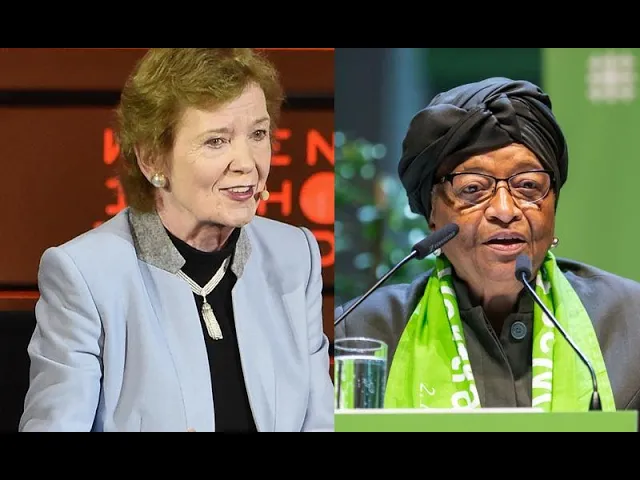
differently to build back better as many people are using that phrase as I said we are delighted to have two speakers closing with us this week Mary Robinson chair of the elders and the elders have been great partners of Chatham House hopefully partners to each other in these last few years on a whole range of issues currently universal health care which i think is a topic very dear to the hearts Of many of the elders and very dear to rob yates in our Center on universal health so delighted to have that partnership with the elders
recognized during our centenary week Mary Robinson obviously known to all of you here president Ireland 1992 97 the first woman president of Ireland UN High Commissioner for Human Rights a UNM void for climate change and somebody who's kept his hand very firmly in now through the vehicle as share of the elders a Position she took over from Kofi Annan so wonderful Mary to have you with us and Ellen johnson-sirleaf delighted to have her with us as well to welcome her back I can't say sadly to Chatham House but to have a with us again also
a member of the elders currently chair of ECOWAS the Economic Community of West African states and she is somebody who as everyone knows I think you've been looking at the news was nominated yesterday by dr. Ted Roscoe graces as Co-chair of the independent panel for pandemic preparedness and response it's got a good acronym thankfully IPPR IP PPR I know how you do the triple never mind I triple PR I'll make up the name right now but with Helen Clarke and somebody who is perfectly a very well place to take this role not only because of
her current role in ECOWAS and a lot of the work she's done on global health but was the first female elected president Of an african state as president of Liberia and has been also for all of the work she's done there and other aspects of leadership in Africa awarded the Nobel Peace Prize in 2011 so two very distinguished guests to join us but also to have this conversation I'll remind you we are on the record perhaps obviously we are live streamed you can tweet if you wish hashtag CH centenary and what I would encourage you
to do if you have questions that you'd Like to raise for this conversation with our two guests please write them into the Q&A box which is available to you there at the bottom I will pick them up and be able to give an opportunity for people to to be able to ask their questions and we can I think we have the option to include e to unmute you if we need to so do please ask your questions in the Q&A box and we'll call on you if we can so look with all of those words
of introduction I Want to turn first to Mary Robinson Mary delighted as I said again to to have you with us to see you again there's sadly not in person but I've given you a huge canvas on which to maybe make some opening remarks of ten minutes or 5-10 minutes I could say to you what's top of your mind on global leadership and International Cooperation and that question would be a complicated one in any circumstances but with kovat 19 into the mix I can only imagine how You're trying to manage all of your different responsibilities
what are your opening thoughts to share with our guests today over to you Mary thank you very much Robin and indeed it is a huge challenge that we're going to be addressing during this conversation but I want to begin by warmly congratulating at Chatham House on your centenary of your founding and I'm glad we're in the actual week of it the week of the fifth of July and I so admire how The Institute has provided exceptional research exceptional convening and expertise over the past hundred years and we will need you over the next century centenary
in the next century as well but let's talk about the tough issues I mean multilateral cooperation today is in a state of profound crisis kovat 19 has swept through every part of the world since the start of 2020 leaving a devastating cost first and foremost in Human lives but also in terms of economic growth in terms of political momentum in terms of social inequality and it is also brought into question many aspects of our interconnected world that have been increasingly well had been taken for granted in recent decades a crisis such as this one would
never be easy to tackle in the best of circumstances unquestionably many national leaders have worked tirelessly and with great determination to bring This pandemic under control and I'd been pleased and I know my dear friend Ellen Johnson Sirleaf would be equally pleased that women leaders have stepped up well during this crisis and have you know led their countries well however this is also a global crisis and it requires a global solution it has therefore been deeply disappointing to see the distinct lack of global leadership in recent months as national leaders have by and large turned
inward and have failed to Prioritize a multilateral approach to the pandemic frankly the complete abdication of leadership and moral responsibility by the President of the United States has certainly not been helpful and stands in stark contrast to the historic leadership role played by the United States and previous comparable cases it has also been I'm afraid sadly unsurprising coming in the wake of the barrage of assaults on the multilateral system orchestrated by the Trump administration since 2017 which basically has sought to undermine some of the crowning achievements of multilateralism and the United States has certainly not
been the only bad actor undermining multilateralism both China and the United States bear responsibility for the counterproductive public infighting the origins of the virus in recent months which has contributed to almost paralyzing the UN Security Council and To undermining the work of the World Health Organization and I know myself that the China of today is not respecting international human rights in the way it was when I served for five years as UN High Commissioner which was 1997 to 2002 I made many visits to China talked about human rights issues could address these issues sadly that
time that that has now that window has closed at least for the moment It would appear it has also been alarming to see some populist leaders use the crisis as a means of subvert amok recei and accountability from the Brazilian government's complicity in the destruction of the Amazon rainforest and lack of attention to covert to actions to undermine democratic safeguards and human rights and countries as diverse as Hungary Israel and the Philippines however the current void of global leadership cannot simply be blamed on The actions of populist and authoritarian leaders deplorable as their actions may
be it has been particularly disappointing that even those were leaders who are most sympathetic to multilateralism have very rarely spoken out forcibly forcefully against the us-led assault on the UN and broader multilateral system you know that absence of any take holding to a counter criticism the crises we are facing through at the moment Covert 19 The Associated prospect of sustained economic slowdown and high unemployment the climate emergency the threat of a new nuclear arms race which is very real entrenched and systemic racism and I'm pleased to see the black lives matter rise against that gender
inequality and oppression are all too complex and multifaceted for any one nation to tackle them on its own well there's needed is an effective system of multilateral cooperation to tackle the Shared problems we face and I think in this anniversary week in particular it's important to recall that Chatham House was founded in the immediate aftermath of great human catastrophe and suffering followed not only the end of the first world war but also the 1918 flu pandemic which ultimately killed many millions more than the war itself chattermouth also shares its centenary year with the creation of
the League of Nations the First serious albeit ill-fated global experiment with multilateral governance in the aftermath of both the first and second world wars national leaders responded with the recognition that a strong global governance system was needed to prevent the recurrence of war and to tackle the key global threats shared by all of humanity the network of international covenants and institutions which was ultimately constructed after 1945 with the United Nations at its core has been far from perfect but it has decisively promoted peace security and the protection of human rights over seven decades and it
led to the 2030 agenda with its 17 sustainable development goals and the Paris climate agreement in 2015 frameworks which are relevant to taking us forward so we currently need the same sense of common purpose to emerge from our current global crisis or we are likely to face Be faced all too soon with further and potentially even more devastating global catastrophes whether caused by climate change by another pandemic or even sadly the prospect of possible nuclear war it's therefore critical that global leaders come together in the aftermath of the pandemic and commit themselves to sustained and
coordinated efforts to tackle the key global threats facing humanity and to help build a better and fairer world based on common principles Of human rights sustainability justice and equality you know these are really big issues and I look forward to the conversation thank you thank you very much married for those opening remarks before before I turn to President Sirleaf just if I could just do one little follow-up question for you because you noted in your remarks there while I'm owning the the tragic loss of multilateral cooperation in the wake of the kovat crisis and the
Trust with previous moments of crisis where the world has at least tried to come together in a different way you noted that some democracies have performed well and I'm just wondering you know there's somebody who's been a political leader obviously yourself what do you think is being about those democracies that have been able to hang it together is it about being democracies or is this simply about competence is there something that You're picking up at the moment before we get to the international questions something about domestic leadership or domestic approaches to government that have stood
out to you as being the best I think it is democracies that have listened to the science listen to their health experts taking it seriously and started with taking tough decisions tough decisions about quite you know really strong lockdown followed by phased careful reopening and varying the Phase depending on the health advice and that was being received and somehow because of a democracy bringing people with you having a trust both in the scientists and in the government that the well-being of the wider population and the protection of those most vulnerable and the protection of health
workers and care workers that's all part of the mix and I am proud as I know Ellen is of the fact that women women LED countries from angular Merkel in in In Germany to the Prime Minister's of Norway Sweden sorry Norway Denmark Finland Iceland Jacinda Iran in New Zealand the president of Taiwan close to China I mean the there has been a real sense of being prepared to take tough decisions but bring your people with you that I think has been the key very important point that I think this trust factor when you trust the
government and we think obviously the US was founded Partly through a lack of trust in government and maybe it's no wonder that you know there's a level of suspicion about when big recommendations come for the middle but I like your comment about tough decisions because tough decisions often are not popular so it's almost the opposite of being populist to be able to take tough decisions at moments of crisis like this thank you very much I'm going to and to President Sirleaf now you're able To unmute yourself that would be wonderful or something could unmute President
Sirleaf so we can hear her remarks would be great but President Sirleaf obviously you've taken on or you're about to take on an additional responsibility in addition to all of your others so we're going to look forward very much to your remarks and thank you so much for joining us we could see you're on YouTube please go ahead and welcome to our centenary week Over to you presents early thank you I'm very pleased to speak at this event to mark the centenary of the founding of Chatham House this institution has a well-deserved reputation for providing
exceptional analysis and expertise on key global issues I wish I was celebrating this important milestone at a better time for our world unfortunately covering 19 of virus which we have yet to fully understand has Slipped the Securities of countries borders to infect big and smaller countries alike quick 19 is indiscriminate in his painful effects on precious lives and likelihoods the region of the pole the young and the old the haves and have-nots fights worlds and third world's men women and children Christians and Muslims worship ups of all religions combatants on opposing sides of conflict all
of us are experiencing the agonizing effects of Kovach 19 from climate change to nuclear proliferation from social injustice and exclusions to gender inequalities and in equities from any poverty to ending their many senseless Wars the truth is that the presenting unfortunate global reality of this pandemic is a clarion call in its transmission of this deadly virus and a stinging effect on all of us are differences in race gender religion sexual orientation where we worship none of it has come to a choice none of it Has come to Muniz from this effect the simple truth is
there we face a global problem and unless we own the solution globally none of us can pretend to be truly spared this therefore is not the time to retreat from the world where might we hope to hide by this retreat certainly it is not the time to imagine that any one country can go it alone we need each other if there is a lesson to be learned is that we have always Needed each other indeed covert 19 has exposed our mutual vulnerability and has a so betta daddy inequalities that continue to exist both within and
between countries Africa and the global south mood generally these particular risks given a widespread presence of weak health care systems and the impracticality in many situation of maintaining social distancing an appropriate hygienic standards particularly in urban slum communities Many governments in this global South have limited fiscal space to take the necessary health and economic measures needed to limit the impact of the pandemic living populations particularly exposed in crushing economic and social costs the only way they effectively continue Kovach 19 is therefore through global multilateral coordination indeed there's no issue on which the case for multilateral
cooperation is clearer a More essential and the tackling of this pandemic which is the pre-eminent example of a global public good in continuing this presenting threat to global public health economic stress and social disorder we are only as strong as the weakest link in our human chain the virus will not be overcome unless all states were together pooling resources and expertise to strengthen health systems develop and distribute an Effective vaccine protect health care workers provide the necessary care to all who are needed in the society this was particularly include vulnerable groups such as refugees migrants
the elderly and the infirm special attention must also be given to the needs of the global self once an effective vaccine is developed it is critical that it is made accessible and affordable for all countries admittedly the depth of cooperation that is required to tackle This pandemic would be challenging to achieve even in the best of times it is therefore particularly concerning that the virus has dropped at a moment when the multilateral system has been under sistine attack ironically thereby the very country that plays a leading role in the creation of existing global covenant systems
however as Kovach 19 is taking away our lives and livelihoods what we must not let ourselves lose to the virus Is our common sense which is at the heart of all humanity it is common sense that none of us is safe until all of us are safe we came to understand and appreciate this in Liberia as we struggled with Ebola it was predicted there are at least 20,000 of Liberians who die every month to the epidemic as the leader I rejected the protection I knew a firmer prediction would not be enough because solutions are never
found in what we wish them to be it is found When we are willing to work for a solution to the problem I therefore appeal to the world for support and the world was kind to respond I mobilised Liberians across the differences of our cultures religions gender and ages to all the epidemic and its solution as Liberians began to respond we truly began to fight back to the fight a virus like Kobe 19 which we did not know unlike today was taking away the lives of our loved ones and depriving us of Our livelihoods this
too is how we must globally respond to this pandemic it is how we save ourselves and save the lives of us that we love we do so by fighting back together while no one solution will work for all countries all countries must work together sharing experiences and knowledge in contribution to a global solution we do we must act eased financial trade and other restrictions so that smaller economies do not crumble and collapsed Thereby leading to further threats to global peace and security rather than restricting democratic practices and offset the growing need to make government more
responsive transparent and accountable we must be strong and decided in our rejection of the temptation to return to authoritarianism in Liberia this is how we overcame Ebola this is how we will overcome Corbett 19 by fighting back alone or against each other we will win we will survive this Pandemic by fighting together knowing that we are connected to each other and as such we are each responsible for the lives and well-being of each other 2020 was always going to be a significant year but those of us who are committed to the principle of multilateral cooperation
as we mark the 75th anniversary of the United Nations and the end of the Second World War it is crucial that this anniversary is used as a moment for leaders to come together And recommit to the principles of multilateral cooperation which continues to be essential in successfully tackling the global challenges that we face currently and will confront in the years ahead once again I congratulate Chatham House on the centenary celebration and wish you success in the coming years thank you thank you very much present study thank you for those warm words for Chatham House and
those very important Words about the importance of international cooperation you said we're only as strong as the weakest link of the human chain it's ER it's one of those fundamental elements that's being bought particularly to home to everyone by the Kerr vid crisis and I appreciate you you making that point and as you said using this anniversary moment to try to look for opportunities if I could do one follow-up question to you and then I'll maybe bring a couple of our I've got one other question I'll ask to go through you but one specifically for
you presents early before we start to go to the members and our guests with us today as you will imagine and I thought maybe best to get this out of the way at the beginning there's lots of questions coming in about your recent appointment to the new WH o panel for pandemic preparedness and response and there's a question in particular from Antonello Republican newspaper in Italy and let me paraphrase the question for you because that way you can say what you feel you can say at the moment I know he's only announced yesterday and there's
a huge amount to be developed but the phrase is and penelo says in there is about an honest assessment and that's an interesting phrase and I'm just wondering what feud you do you feel that you and Helen Clark and this panel will be able to achieve with this honest Assessment how much of it is looking back and how much of it obviously is looking forward because it is about learning lessons I think for the future and and obviously how central is it to have the u.s. in and can the w-h-o get the u.s. back to
be able to do that would you be feel comfortable sharing a couple of opening thoughts about that clearly you know as you write as you said the appointment was just made a day ago in the modern modalities for the Working work for the committee have yet to be established I'm honored to work with the Prime Minister Helen Clark as as together with the rest of a panel that has yet to be organized we will do what we can I think it's a matter of looking at the institution found it after World War two along with
other multilateral institution where it stands today in meeting the requirements And the complexities of the day's world it also in keeping with the Mandate look at how the code 19 has been responded to by the institution what are the challenges are here and how do we ensure that partnership in keeping with all the things I said that we've got to be together in the world if we're going to solve the world complexities and so I hope that our study our report will be able to make some recommendations for ensuring that the world stays together Prepared
for any other condemning let me come thank you I'm you can see that dr. Ted Rosa's has picked a diplomat as well as an expert in being able to answer these questions so that's a good and probably a good sign as well on his part and I would simply note that colleagues in our central new versal health which had a mouse actually did a study on whe o reform I want to say at least four five years ago so I'll be encouraging them to dust it off and and and check Some of the most relevant
recommendations and share them with you and others when it comes to it I'm sure you'll have a lot of information though I notice it's a quick agenda I think you're meant to have an interim report out by November so we wish you the best of luck with what will be I'm sure a very busy process coming along here let me just follow up on that point I think you made a very important element I'm gonna come to Mary Robinson in a second Now you said presents early if that you know this was an institution after
all founded it is a UN institution the World Health Organization founded off the back of World War two all sorts of structures that maybe was suited to that time and Mary if I may come to you you know we are all very quick to bemoan and criticise the failure of multilateral institutions we did have the US Trade Representative Bob light Heiser speaking As a centenary event yesterday and he made I think the not unfair comment that the WTO a successor to the general agreement on tariffs and trade you know has really not served all countries
well it was designed with an assumption that markets would open that if everyone was brought in it had no conception of what state-led markets might be and so you have a WTO World Trade Organization that assumes all countries are on the same track but actually you have some that Want to hold on to state-led economies some the world lent market led economies how can you have the same rules but I'm wondering too the comments the present survey said maybe it is the fact that we shouldn't be criticizing quite as much the critics of multilateralism maybe
we need to listen to them things need fixing and I'm wondering you know yeah how would you respond to that element those who say these institutions are past their sell-by date some of them They need reinventing is that a fair critique I'm very much in favor of critical examination when I served in the UN system as High Commissioner for Human Rights I remember frequently repeating that famous saying of Winston Churchill about democracy that it's the worst system except for all the others and that's what I would say about the UN it's the worst system but
actually we should be very grateful that it's there and of Course it needs reform always and it needs it needs accountability needs scrutinizing and it eats this tension of precisely being you know looked to to do better and I think you know with covert on top of the climate crisis we have another reason to think you mentioned the WTO a good deal of the basis of the WTO was that the global trade could go up and up and up with no accounting for nature no accounting for the fact that it was Beginning to destroy the
ecosystems that sustain us and that the fossil fuel fueled economy etc and so I believe we have a moment where partly because we're at home with kovat we have more time to reflect and we have to reflect the business-as-usual was not getting us to a safe world for a start we were not on course to meet the advice of the climate scientists in October 2018 that we had to stay at 1.5 degrees and not go above it if we wanted a safe world for our Children and grandchildren we were nowhere close to that and we
also had a world of great inequalities that kovat has just exacerbated and made it's like a mirror it's shown us this so I think let's reflect in our homes on article 1 of the Universal Declaration of Human Rights article 1 says all human beings are born free and equal in dignity and rights how far from that we we have become how far we and the dignity comes before the rights and the dignity is That sense of self and if you are lying in a doorway you're homeless you're you know suffering from hunger and people walk
past you and ignore you you have no dignity you have no sense in that sense so you know I just want I wonder if we can somehow just for a little while go back to the basis of human rights gender equality tackling racism and actually come out of this in a better place and you you very see use the word dignity because I don't mean to keep harking Back to it but I think it was relevant that bobwhite eyes are yesterday specifically said what is one of the key roles of trade policy it should be
to enable human beings to have dignity in a country and his view was the global trading system dignity from many of the working-class without the kind of education or other qualifications to succeed in a in a rapacious global economy and I'm wondering when we talk about dignity in That sense is it the case that member states that nation-states are going to have to be more responsible for protecting the dignity of their citizens rather than multilateral organizations because that seems to be the trend at the moment is that people are saying we can't trust these big
organizations to look after the dignity of our populations we need to take care of it you sense attention there Mary and then I know ask the same question to President Sirleaf I think I'd put it slightly differently and member states have always had that primary responsibility that's what all the work that I did as High Commissioner with my office and my successors have done M is to hold to account to try and and and we need more support from countries in doing that but actually since the UN guiding principles on business and human rights we
realized that also the private sector has a huge responsibility and That was that the UN guiding principles make it clear governments have a responsibility to protect their people but corporations have responsibility to respect all human rights they should have a due diligence way of assessing how the corporation and its supply chain is or is not performing in respecting human rights and dignity so it's not just its its its the wider corporate world as well and I think I'm seeing in the corporate world and you thinking About getting away from shareholder to stakeholder thinking about workers
employees and communities and thinking in terms of some values that weren't on the table before and I welcome that that's to see that shift happening is is very pleasing present Sirleaf could I ask you that same sort of question do you see some sort of structural problem with the way international organizations were built up after World War two obviously sir principles of reform that You think are missing at the moment Mary Robinson was mentioning the importance of getting the private sector more active involved and obviously the Global Compact that Kofi Annan pushed through had that
partly in its mind and I can imagine the w-h-o will be a lot more role for private companies on vaccine development is there something about international institutions that you think of being a failing that's common To them that you'd like to see change anything you'd like to share maybe even from your regional experience in ECOWAS let me put it this way all stakeholders in nation states have the prime responsibility to protect everyone and provide equal opportunities for everyone in the state institution must also ensure that their own priorities their own policies must be aligned to
the policies of nation states that must produce the conducive environment not Only for carrying out official functions but ensuring that a private sector is an equal participant equal contributor to the processes of development and yes they have to ensure the dignity of the people in the state and and the the government takes the primary responsibility in full cooperation with a private sector and other stakeholders of the society thank you very very clearly Portman good thing is we are recording this so We'll be able to to bottle some of your both of your comments Mary you
wanted to come back in again very briefly a lesson from Kovich an important lesson is that government matters and international cooperation matters we will see the governments that didn't take steps early didn't take those tough decisions have let their people suffer a prolonged far too great illness and death we will see that royally it's already visible and we will see That governments that were responsible if we had International Cooperation we would deal with this much better we would get the vaccine in a way that would be accessible to everyone we must have it as a
common good etc we need this language we need a recovery package that addresses what Ellen pointed out the developing countries and it's that's that's why kovat is a lesson to us of what we need and i hope we take that lesson thank you I'm going to bring in One of our guests members who's got a question Suzanne Schuler hopefully Suzanne you can be unmuted and we could take your question now Suzanna user yes thank you for giving me the opportunity and thank you President Sirleaf and president Robinson for your crucial points and also pointing out
female leaders which I think leads me to my question of leadership because for me I'm from the Center for effective dispute resolution and we're dealing With many young leaders in a lot of organizations those organizations you just mentioned we help them to resolve conflicts within the organization's better and a lot of donor money actually goes to internal conflict resolution and they can't really take care of the conflicts they are supposed to resolve and for me because there's often a question I get asked so what are the skills and competencies the new generation of leaders need
to have and To develop to bring about the change we so urgently need and I follow up with a more philosophical question as well to both of you so what gives you hope in these dark times and with all the experience you've been through and what you've achieved how long you go first as we're talking about women leaders let me start off by saying women leaders are not selected because of entitlement they are selected because they are equally endowed with competence and knowledge But there are certain characteristics of leaders all the leaders that should stand
out first I think self-confidence 1 being able to be assured of what they do the action that they take the policies they promote the courage to take hard decisions when it's necessary to do so the ability to communicate with the public in an honest and thoughtful way to be able to gain their confidence to be able to ensure compliance with some of the policies that have to be Taken a certain amount of empathy compassion unnecessary if one will get the support working for the welfare of all down death that one depends a lot upon an
endowment resources capacity and all of that but a leader must be able we'll all of that to continue to promote those and to prune and to be able to uplift us through the promises that they make and the decisions that they make so [Music] all leaders I think must bring to the Task a certain amount of commitment to promote a welfare to address the vulnerabilities in the society through their policies through the examples self examples that they are going to give to the public to be able to bring the confidence and the cooperation to ensure
that their vision and their goals are achieved I very much agree with what Ellen has just been sitting and I just want to kind of build on it a little bit with the focus on young people because That was part of the question for young girls young women very often they don't feel the same sense of confidence that young men do young men are somehow encouraged to feel I'm more than capable of anything that comes along girls are somehow induced to have doubts about it and I think that that can be seemed to be a
sort of problem at that age but actually I want to make the point that women leaders have a great advantage of self-doubt It's actually an advantage because it means that you listen to the science that you listen to experts that you try to improve that you listen to those who will guide you to good solutions rather than thinking I know it all I have the solutions so it's actually interesting so that's just one point I wanted to make that very often with women leaders and Ella will know this as well we actually discuss how we
might have done better I never hear male leaders discuss How they might have done better I mean in a group anyway the second thing to encourage young people is a saying that Kofi Annan used all the time I heard him frequently you're never too young to lead and you're never too old to learn it's a lovely seconds now yeah Ellen you remember - now I think we have a world where there's a disconnect because sadly we have a very young world in most of the worlds the major part of the world Very young in Africa
for example but actually quite old leaders as Ellen would also recognize I think that has to change and I think it can be changed by making space for young people and you know those of us who are at a certain stage of having held office are asked to go on high-level panels I now always ask is there going to be are there going to be young people and I didn't ask it this time because I knew you had a particular focus but I want to make the point I Would prefer if it had been Ellen
and myself and a young person three of us talking you know or maybe two young people and you know let's make space for young people let's hear their voices hear their imagination their commitment and look at what the children are doing but their Friday is the future and look how how much there questioning effectively truth to power and we need young people to feel they can be part of the solution oh yeah you Could not have tipped me off better Mary but thank you for making that point about needing this publicly on fora like this
as well but I'm proud to say the one things we kicked off ahead of our centenary year was to think all the common futures conversations which it's coming together young people from across Europe and Africa where we're getting them to tell us what is most important to them about their futures rather than us being you know the providers of Analysis to them and actually the next question on the list no no so I was gonna say so you'll have a chance to be intergenerational because solonian koozie who's a member of our common futures conversation is
on the line and is going to ask you her question because is a member of this group and that has the most polite question so I thought I'd better get it in now and I think it flows nicely Mary from your points and also Ellen's so Please go ahead son if young on hopefully you're unmuted my name is Solomon zukie I am a founding member of the common features conversation community and I am a youth leader at Labour Party of Kenya and in 2017 general elections I ran for political office but I lost our thank
you to president Robinson and Sally for your awesome presentation my question goes to President Sirleaf our what was the key ingredient to your Success as president of an African nation where Patrick Pichette key largely undermines women leadership thank you I hope you got that Priscilla Thea where patriarchy generally undermines women's leadership over to you women I listened to women women at all levels in society professionals activist farmers market ears I listened to them and said if I were elected I would make them lifespan I will try to break the chains that Bound them all of
the stereotypes and the obstacles that they faced to be able to achieve their goals and to be leaders and so that was the key ingredient working with women making sure that women support women support it and frankly I can say that because of that I was selected because of the women vote and the women came out just massively in so I owe that I owe my presidency I owe my victory to them and so I also want to say to salomi because when I heard her Say she she ran and lost to not be afraid
of losing losing is a part of the leadership joining because you won't win all the time the biggest thing is with your self-confidence you can rise above the obstacle that prevented you from winning so losing and losing the lessons of the experience from losing can make you stronger can provide you that added impetus and determination to succeed so run again very clearly put thank you so much for Those inspiring words presence early if I did you want to come in Mary I saw you unmuted but no okay look where we could keep going on this
side but I thought as global cooperation also has some rather hard edges to it let me bring in Rob Mayo I think has an appropriate question to remind us of some of the hard edges of the world we're dealing with at the beginning of our second century Rob over to you thank you very much and thank you president Robinson and President Sirleaf for your points this afternoon Mary Robinson alluded to the tension between an unstoppable rising China and an immovable and America which could propel the world towards nuclear conflict I think that koban 19 has
been a Jupiter sling for the vulnerabilities suspicions and inequalities which tend to exist in me the underlying nature of international relations which has come to a head very prominently very publicly In the clash between the US and China and so my question is this how can leaders and diplomats on all sides come together to call those states back from the brink of catastrophe in order to free up energy and agency for international cooperation that's a very interesting question and a difficult one to answer with with great confidence because one of the points that I was
making was that there isn't a kind of overt defense of Multilateralism actually there was one forum that I attended recently where I was surprisingly pleased at the strong affirmation by that forum and that was a forum of small states which Singapore was the chair of em had a virtual meeting under the UN and I presented the elders report on multilateralism it was actually a pre-launch we launched it on the 26th of June this was about the 11th of June if I remember and these were small states a hundred of them who were Participating there were
a significant number of ministers who chose to come in virtually some deputy Prime Minister's a president or two small islands and a number of senior ministers of Foreign Affairs etc and all of them asserted so strongly their belief in multilateralism now what the elders have made clear in our report is multilateralism is good for both large and small countries but it is a system that you know is is geared towards more fairness for all Countries because all countries I would have a voice would have a say in decision-making and I do regret that we're getting
into a stage of almost a bipolar in a bad sense world a stronger China assertive not so good on human rights a weaker United States I have to say I'm the trump administration weaker because it's not coping well with the covert 19 and it has pulled out of you know the Paris climate agreements most recently as the World Health Organization etc it's it's it's actually moving in the other direction now this is not good to have this kind of world at a time when we desperately need to have nuclear disarmament we need a new start
treaty the Americans are trying to bring the Chinese in which I don't think is appropriate to the New START renewal and you know this is a very serious time the the elders have also been very concerned and we have our policy on nuclear non-proliferation and Nuclear disarmament and so I I don't I I would like to see more voice in favor of the importance of multilateralism even just in the context of kovat if we had a global response to covert the world would be in a much better place because the g20 did do something about
the vaccine the eight billion but it needs to do far more for debt relief for developing countries who are facing a huge problem as Ellen knows better than I do Of you know lack of remittances to the same extent - accumulating at a time when kovat is also hitting hard and it's the global response that is essential and that requires a system of multilateralism that is defended by countries and believed in and we are in a bumpy time so the elders are very keen to see countries stepping up just wondering we may have lost the
connection briefly to Ellen Johnson Sirleaf so I'm just going to keep moving on for a second it's the camera could have gone dark so I'll just wait and we'll bring her in a minute Mary you're you're gonna have to carry the carry the load for the moment which I know is not going to be difficult for you and obviously you're chairing the elder services this is par for the course for you I wanted to ask you a quick question also because it was a little more on the alright we've got we've got President Sirleaf again
which is good your your muted now sorry your muted we need to unmute you oh now that's it you're unmuted it's good you're unmuted nope there we go that's it perfect do you mind we thought we could see you as Truman well I could see a bit of you in the dark it was very strange no wonder luckily you're wearing a very elegant head covering which I knew I knew you were still there I do want to follow up the question if you don't mind Mary if I Could hold for a second because this question
about the US and China you know there may be a very different perspective from African nations about the role of China and this us-china cooperation and I didn't want to miss the chance presents early for you to share your view of how you see this competition how you view China's support for Africa's development and and and how you avoid getting caught in this vice of competition you know Liberia has develop A partnership cycle that includes not only the United States which is a main supporter of Liberia's effort but China the European Union other countries in
there are saying so we have always felt that Liberia needs to not only work with benefit contribute to all those institutions in which all the nations of the world participate that's why we have the United Nations that's why we have the African Union and all the other bodies the multilateral bodies in which We are part of even though we're not the main leader so and I think the message from us is as a means of getting people to see what's happening in the world today as a result of covet 19 that has been the stolen
to be able to bring a realization to where we are and where we could be if we hadn't this united world with nationalism being the order of the day poorer countries more migrants more refugees more tear more terrorism taking Over certain parts of the world which were leading in to more protests what would the world be if we were to descend into that state of chaos and I just hope that all the leaders of the world looking at what's happening as a result of Kobe 19 will stop will think of it we reflect upon where
we are and where we could be unless we all came together to be able to address what really about issues that require global cooperation charming they're all part of it and I Think they too have to be the main players to help this promote this unity that we need that very well-put look we are coming close to the close we may just drift over by by five minutes from the official closing time if that's all right with both of you president Robinson and Sirleaf what I'd like to do is ask you both the question myself
one maybe a different question to each of you rather than having you both answer the same question if you see what I'm saying and then I'm gonna bring in hopefully Pauline Otte for a last outside question and then that should be it so if I could ask you a question each individually first to you Mary Robinson the Human Rights Council you referenced earlier on the UN Declaration of universal human rights it strikes me the one of the most fundamental divisions in the world right now is between governments that believe They represent their own citizens rights
and they will take the dominant view of that and represent the majority and other governments for whom they feel they're there to represent their citizens and their collective rights including of minorities are the priority and I don't need to say more than that you can imagine which governments I'm referring to on each side of that equation and it is one of the dividing lines that seems strongest and it's Manifested now in the Human Rights Council and I'm just wondering where there's a form of your Commissioner for Human Rights how optimistic or worried do you argue
about this idea of human rights being at the core of multilateral institutions for the future what can be done about it I do believe that the actual job of being UN High Commissioner for Human Rights is more difficult in this current very divided and angry kind of world I know this because there are Actually fewer countries that defend the way the High Commissioner is seeking to do the job on behalf of the international community when I served as High Commissioner for Human Rights I could look to quite a number of countries to really support politically
you know what needed to be done that's harder now and that and that's a great pity it's it's all part of what I'm saying the need to step up and value but at the same time all around the world People are coming out in numbers for their rights that's the extraordinary thing there is a global movement for Human Rights it's a movement for human rights defenders of land and and water rights in in different parts of the world particularly Latin America it's a movement for climate justice of the young people it's a movement for black
lives matter of the you know these are all not connected enough but could be connected because they're all Basically for the values of human beings I mean the United Nations Charter starts with the three words that I said I served as UN High Commissioner we the people's and then gives far too much power to states that's one of the weaknesses in the human system as we know but but actually there is a culture of human rights even in China even in China and strongly in Hong Kong where we see these demonstrations with what China is
doing in Hong Kong and we see it in Lebanon we see it you know we see it in so many different parts of the world when people are deprived of their rights and what that means and I think that's what we have to understand that we're going through a bumpy time of populism and nationalism we've been through this before it's more a case of holding on to our values and recognizing as I said in 2015 not so long ago we got to global frameworks that are hugely relevant the 2030 agenda with its 17 sustainable Goals
the Paris agreement as interpreted now by the IPCC about 1.5 degrees they are the way forward in our recovery in you know in in every country they're relevant to every country thank you for that and until Sarah Lee if I went to ask you a different question especially given the context of large levels of debt that are likely to affect countries around the world including in Africa this is a question from Dina Mufti and I think it was maybe something else as Well how worried are you about debt burdens you know about servicing them about
their impacts on Social Development and even social unrest the financial dimension of this how much of this is a concern for you right now what could be done about it very concerning African nations in the last decades did very well to be able true relief measures to settle debts and to become current in meeting debt service obligations Many have had over the years to be able with this fiscal space that open to once again resort to credit means for being able to expand economic activity they now have to pay back and at this particular time
would covet 90 and having hit it means that there will be called to pay back there at a time when they economies have shrunk because of this did Russians in supply change disruption in productive systems joblessness it means to respond to this Kovach 19 and all that it means so economic growth rates are falling at a time when debt service is rising our nations are going to be in a bad bad situation and so we have to be concerned and this is why president rama pusseh in his position as current chair of the African Union
authority as appointed three of our eminent professionals to be able to start that process of making the case for debt relief and in some cases we're calling for a moratorium for Certain years if they don't get that debt moratorium many of our countries that have been doing so well the economy is doing well with us you know looking forward to the African free trade agreement providing the impetus for more regional cooperation and integration all of those efforts would be dampened if we don't resolve the debt problem to enable them to continue to meet the requirements
of growth so I hope that our message is calling for the relief Calling for moratorium is taken seriously by the world leaders by the partners by the multilateral institutions and it will bring some relief thank you very much my good if you've got time a last question from outside and then we will close up this meeting we've not been able to take all the questions apologize for that but I think we've got to a good number of the good number than pulling RT if you're there we'd like to Call on you to ask your question
about a very important topic information and misinformation Pauline if you're that yes am please go ahead um excellences sorry I've got voice challenger this time actually with the overwhelming wealth of experience would advice will you give and how to reconcile the post-show and misinformation to the public and international community on Kovac situation by political leaders to gain Political leverage against science-based advice by public health experts more so in the context of mixed mistress at both national and international arena for meaningful multilateral cooperation thank you I hope you had my voices it's cooking up sorry you
did very well Pauline I think we got that inflicted Thank You Pauline impact of misinformation or to the public on Cove in nineteen leveraging you know suspicion of science leveraging public Mistrust maybe Ellen Johnson Sirleaf let me go to you first and then give a last word to Mary and let's do it that way around and then I'll close up first and then Johnson Sirleaf and have the responsibility through the agencies of government that have the mandate to be better respond to occur in nineteen to provide regular honest timely information to the public on the
effects of this disease of the virus on the responses on the requirements that Are needed on the part of citizens in terms of compliance and cooperation that is like to mute a certain way the kinds of speculations from misunderstandings the accusations that sometimes are levied against officials who are responsible there will always be in any society those who that the skeptics who will always find a reason why the responses are not effective that government policies are not I'm not addressing the Issues properly that they're too slow but I think that can be minimized with what
I say honest regular timely information to the public and I think when they're when their criticisms and disinformation I think one has to just again go back and said you know anyone who takes the responsibility must do so with a certain amount of understanding and if not and they are irresponsible then I think the government will have to in a very peaceful and legal way try to Address that misinformation from wherever it comes thank you very much for those so over to you Mary this you answer that question and any closing point you wanted to
make okay well again building on what Ellen said there is a lot of misinformation in so many different ways undermining trust in information but actually I believe Koval is possibly helping us there because it doesn't listen to misinformation it's a pandemic it just hits and those Countries and those governments that are not listening to the science and taking the tough decisions are exposed now they're exposed in the United States at different states and they're you know the states that are coping better are very angry with the states that aren't and you know there's almost a
an argument very only going on in the United States look at Brazil over again I think so I I'm rather hopeful that at least that part Of misinformation may be exposed and people will begin as I said to trust two things trust the science and trust that government has to play a role in our countries and have the responsibility for the basics of life and take that responsibility I think these the two strong lessons that we can that we can draw and the elders always have to bring hope and I think maybe I should quote
the wonderful expression that Archbishop Tutu ended up With when he was accused of being an optimist and he said oh no he said I'm not an optimist I'm a prisoner of hope and that's how I approach the complex issues that we're dealing with at the moment it is not easy and indeed Kovich has really given us huge problems Ellen mentioned the debt problem in Africa and kovat is not a great leveler it has exacerbated the inequalities but it has shown us very clearly that business as usual as we Remember it was not equal and was
not bringing us to a safe future so we have to in the words of the UN build back better and that means taking account of the need for a global recovery response that helps developing countries the need for all action to be focused on clean green jobs and nature based solutions so that we live with mother nature in a sustainable way and stay at that level of 1.5 degrees this is a time when young people have to lead because we've made So many mistakes with our business as usual I have great hope but young people
will do far better if we just give them the chance thank you for those strong words at the end and returning to the climate theme which is so important and as I look back at my little notes from this conversation I realize that in in your remarks you've touched on pretty much all of the core themes that we've set ourselves for our second century which starts in essence next year green Recovery which you just most mentioned there Mary how to avoid the kind of geopolitical standoff that either or the President Sirleaf was mentioning I think
you talked about your partnership cycle I thought was a very interesting phrase obviously the references to health and tell them how I put universal health at the core of its working on global health the whole dimension of International Economic Cooperation and making sure That the poorer countries of the world are very much included in those models which again President Sirleaf mentioned in which my colleagues are working on a Chatham House and the whole nature of democracy how we can strengthen it what drives trust how you take tough decisions and the concept of inclusive governance which
i think is one that we have an initiative on right now which again touches on many of your remarks that this we can't just leave it all to Governments all of us have to play a role in the response and I want to do a shout out for my colleague Patricia Lewis who runs our entire security program has been sitting quietly in the background in case I lost my Wi-Fi she's reading our work on resilience and how we make sure we build up in a truly resilient way in the future which is incredibly important as
well so I think with your remarks you've made us as well prisoners of hope Thank you very much Ellen Johnson Sirleaf thank you Mary Robinson for giving us the benefit of your wisdom and your experience right at the end of our centenary week and laying out some challenges for us to pick up as we go forward and thank you to all of our members and guests who joined us for this call for the very good questions sorry I didn't get to them all as always but hopefully you had a chance to read them even if
they weren't asked thank You very much we looked forward to seeing you in person soon good luck with all your good work goodbye goodbye thank you