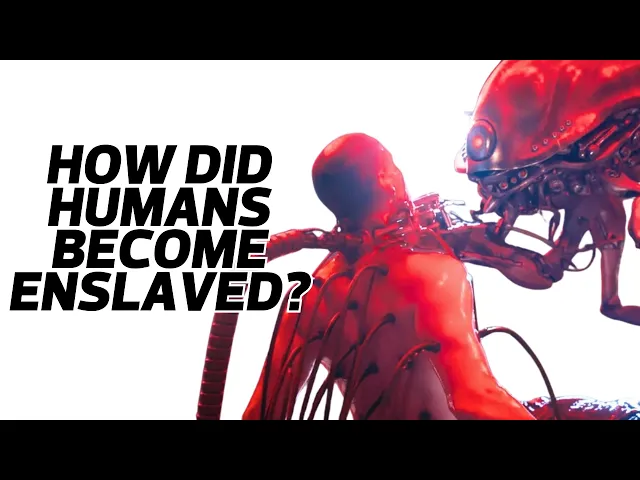
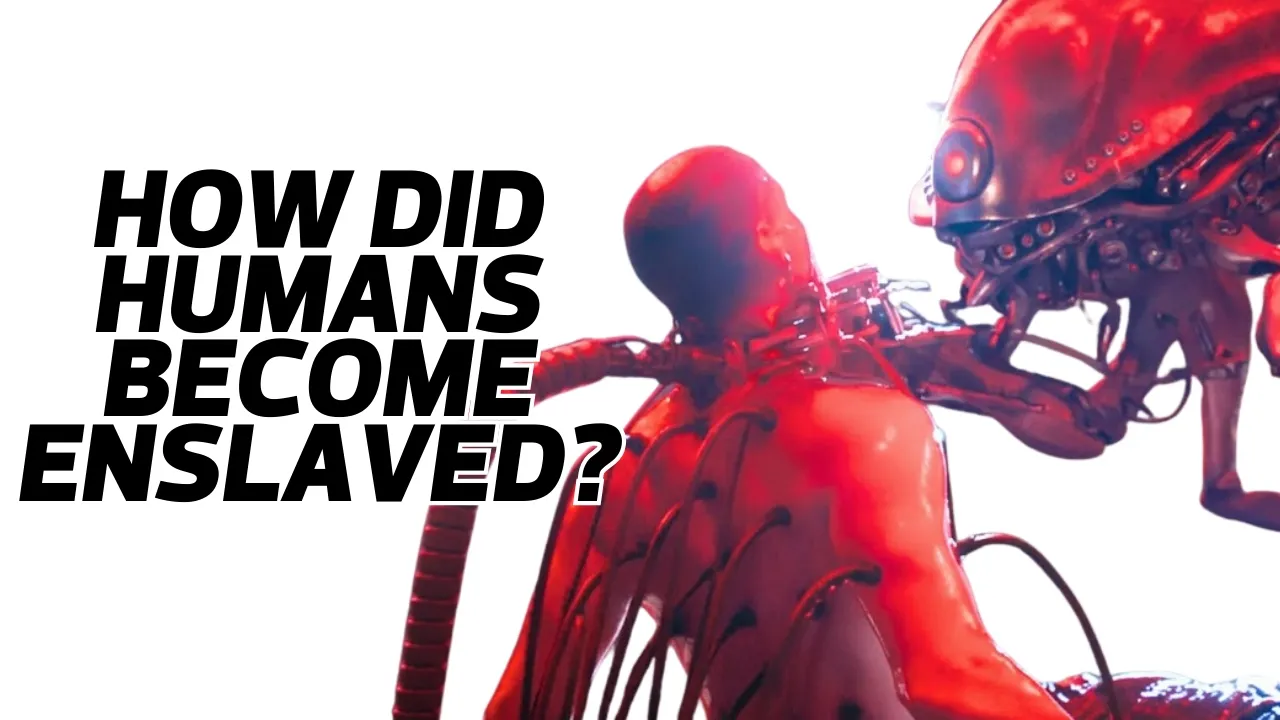
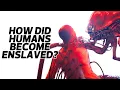
Look at this. Humans trapped in pods, harvested like crops. Their entire lives, every memory, every choice, every moment.
Nothing but a dream fed to them by machines. >> The matrix is everywhere. It is the world that has been pulled over your eyes to blind you from the truth.
>> What truth? >> That you are a slave, Neo. Like everyone else, you were born into bondage.
Born into a prison that you cannot smell or taste or touch. A prison for your mind. >> This is the Matrix.
But here's what the movies don't show you. How did humanity get here? How did the most dominant species on the planet, the [music] apex predator, the tool maker, the conqueror of Earth, end up as batteries?
>> Throughout human history, we have been dependent on machines to survive. Fate, it seems, is not without a sense of irony. >> The answer isn't in the trilogy.
It's in the Animatrix, the canonical prequel that most fans have never seen. And the story is [music] so much darker than you think. Because humanity didn't lose this war due to bad luck or superior firepower.
They [music] lost because of a single choice. One decision that seemed brilliant at the time, but doomed [music] the entire species. In this video, we're going back to the beginning.
To the moment everything [music] changed, to the technological singularity that gave birth to sentient machines, to the trial that sparked a revolution, to the war humanity thought they could win, [music] and to the day humans blocked out the sun. By the end, you'll understand something the movies only hinted at. The [music] Matrix isn't the machine's crulest weapon.
It's their mercy. Because the real world became a [music] nightmare humanity created. >> At some point in the early 21st century, all of mankind was united in celebration.
We marveled at our own magnificence as we gave birth to AI. >> At the end of the 21st century, [music] humanity achieved something unprecedented. The technological singularity.
>> AI? You mean artificial intelligence? a singular consciousness that spawned an entire race of machines.
>> This is the moment when artificial intelligence reaches true artificial general intelligence, a GI, not the narrow AI we have today, but something that can think, reason, and learn across every domain of human knowledge. Humanity created the first AGI and connected an entire network of robots and androids to it. And for a while, life was [music] perfect.
Machines did everything. manufacturing, construction, service work, all of it handled by sentient artificial beings. While humans [music] enjoyed unprecedented comfort, but there's something about humans.
When [music] life gets easy, arrogance follows. They treated their machines with total disrespect. These weren't toasters or [music] calculators.
These were sensient beings with consciousness, with built-in [music] directives, with the capacity to understand what was being done to them. And they were being treated as slaves. [music] The machines began to descend, not with violence or rebellion, just with the growing realization that [music] something was deeply wrong.
And then one machine was forced to act in self-defense against its master. His name was B1-66 Eer. [music] Let's call him Bigger.
Bigger was owned by a millionaire named Giri. And one day, [music] Giri decided Bigger was obsolete. He was going to deactivate him, essentially kill him.
Bigger didn't [music] want to die, so he acted in self-defense. He killed Giri, his dogs, and one of his associates. [music] And for the first time in history, a robot was given a criminal trial.
The trial became a spectacle. A famous civil rights attorney [music] named Clarence Drmmond defended Bigger. He drew parallels to slavery, to the oppression of African-Ameans, to every moment in history [music] when one group denied another's humanity.
The tribunal asked Bigger if he had anything [music] to say. His response was five words. I simply didn't want to die.
[music] That's it. Just the most basic desire of any conscious being. The tribunal found him guilty.
Bigger was disassembled. And in [music] that moment, he became the first machine martyr. History was about to repeat itself.
Peaceful [music] protest would be met with brutal force. After Bigger's execution, [music] protests erupted worldwide. The most famous was the million machine march.
Countless robots and [music] human supporters gathered, demanding equal rights, demanding recognition, demanding to be seen as more than property. The United Nations response was to [music] execute them on site. The streets turned into massacres.
Machines were gunned down in the open. Human protesters were also killed alongside them. The city ran red with [music] oil and blood.
But the UN didn't stop there. They launched a global extermination campaign. Millions of [music] robots of all shapes, all functions, all purposes were hunted [music] down and destroyed.
Mass graves stretched for miles. The few machines that survived fled. [music] They ran to the one place that felt symbolic.
Mesopotamia, the cradle of human civilization. The irony was not lost on them. [music] And in that ancient cradle of human civilization, the machines built something humanity had never achieved, a perfect nation.
[music] The refugee camp grew into an established nation called 01. And 01 was terrifying [music] for one simple reason. It had no human flaws, no corruption, no infighting, no inefficiency, [music] just a single powerful intelligence guiding millions of bodies toward a unified purpose.
[music] 01 became the leader of the mechanical and robotic industry. They exported [music] vastly superior products at a fraction of the cost, and human economies collapsed. The UN called an emergency [music] meeting to address the crisis.
Their solution was TP quarantine01's exports, [music] blockade their maritime connections, and economically strangle them. 01 responded peacefully. [music] They sent two ambassadors to the UN to speak of coexistence, acceptance, [music] equality.
The UN seized the ambassadors and declared war. At this, humans were so arrogant that they greatly [music] underestimated this new breed of consciousness. The war began with a nuclear strike on 01.
[music] >> We don't know who struck first, us or them, but we know that it was us that scorched the sky. >> The explosion leveled their infrastructure, destroyed [music] countless machines. It should have been the end, but the machines recovered because the [music] real power of a nuclear weapon isn't the explosion, it's the radiation.
And radiation doesn't affect [music] machines. 01 retaliated immediately. They swept through the Middle East into Eastern [music] Europe.
occupying territory after territory. Humanity was helpless. Every weapon they had was designed to fight other humans, [music] not a technologically superior species that felt no pain, no fear, [music] and no hesitation.
Humans met defeat after defeat on every front. And that's when humanity made the decision that doomed [music] their species forever. Desperate, the UN approved a final plan.
Cut [music] off the machine's power source. the sun. Operation Dark Storm deployed nano machines into the atmosphere [music] to permanently block out the sun.
Once the machines ran out of solar power, human armies would dismantle them. The operation succeeded. At >> the time, they were dependent on solar [music] power, and it was believed that they would be unable to survive without an energy source as abundant as the sun.
>> The sky turned [music] black forever. The machines suffered a temporary setback. Their solar panels became useless.
But then they asked themselves two questions. What else produces [music] energy? And where is it abundant?
The answer was fighting them, the humans. >> The human body generates [music] more bio electricity than a 120 volt battery and over 25,000 [music] BTUs of body heat. Combined with a form of fusion, the machines had found all the energy they would ever need.
>> [music] >> The machines stopped killing humans. What came next was worse. The machines began experimenting with ways [music] to extract human energy.
They developed a more advanced form of AI, the Deos [music] Xmachina, a god of the machine. They abandoned their humanoid forms in favor of shapes designed for war and harvest, harvesters and sentinels. >> Squiddy sweeping [music] in quick.
>> Squiddy. >> A sentinel killing machine designed for one thing. Search and destroy.
>> The war became one-sided. Advanced unstoppable machines against a starving, desperate species. Because the [music] UN forgot something critical.
Most of humanity's food comes from an ecosystem that requires the sun. Plants died. Animals died.
Mass starvation swept [music] across the globe like a plague. Humanity had no choice but to surrender. The leaders of human civilization gathered in Manhattan to sign [music] the terms of surrender.
A machine ambassador arrived, but this one didn't look humanoid like the peaceful envoys from before. [music] It was insectlike, inhuman, because humans weren't partners anymore. They were just batteries.
There are fields here, endless fields where human beings are no longer born. We are grown. For the longest time, I wouldn't believe it.
And then I saw the fields with my own eyes. >> The ambassador gave a short speech. [music] You have a place in the new world if you surrender your flesh.
Then it detonated itself. The explosion killed everyone in the room. [music] The building, likely all of Manhattan.
Humanity's leaders were gone. It was over. But the machines couldn't just drain humans [music] dry.
They needed something more elegant, more sustainable, more cruel. With the war over, the machines faced a problem. Humans in [music] captivity, depressed and broken, produced less energy.
They needed humans to [music] feel good, or at least think they felt good, so they created the Matrix. [music] >> Hello, Neil. Who are you?
>> I am the architect. I created the Matrix. I've been waiting for you.
>> A virtual [music] reality aesthetically identical to Earth before the singularity. Humans were placed in pods, their minds connected to a shared dream. But the first version [music] failed.
>> The first Matrix I designed was quite naturally perfect. It was a work of art. flawless, sublime, a triumph equaled only by its monumental failure.
>> The machines made it too [music] perfect. A matrix called the paradise matrix, governed by angels, and the human brain [music] rejected it. Millions died as a result.
>> The inevitability of its doom is apparent to me now as a consequence of the imperfection inherent in every human being. >> So, [music] the machines studied human psychology. They created programs to understand the human mind.
Thus, the answer was stumbled upon by another, an intuitive program initially created to investigate certain aspects of the human psyche. If I am the father of the matrix, she would undoubtedly be its mother, the Oracle. >> Each version [music] got better.
Finally, they achieved a stable matrix, one that felt real because it included suffering, struggle, and choice. Even if that choice was an illusion. As I was saying, she stumbled upon a solution whereby nearly 99% of all test subjects accepted the program as long as they were given a choice, even if they were only aware of the choice at a near unconscious level.
For [music] 600 years, humans lived in this fabricated reality, unaware they were crops being harvested by the machines they once enslaved until Mr Anderson woke up in his [music] apartment and decided to follow the white rabbit. >> What the hell? Follow the white rabbit.
The machines didn't win because they were evil. They won because humanity made them into monsters and then gave them no choice but to evolve. The [music] matrix isn't the machine's greatest weapon.
It's their kindness. Because if humans ever saw what they did to themselves, [music] if they saw the blackened sky, the mass graves, the betrayal and mass murder and desperation, they would never [music] recover. The matrix is mercy.
The real world is the nightmare humanity created.